
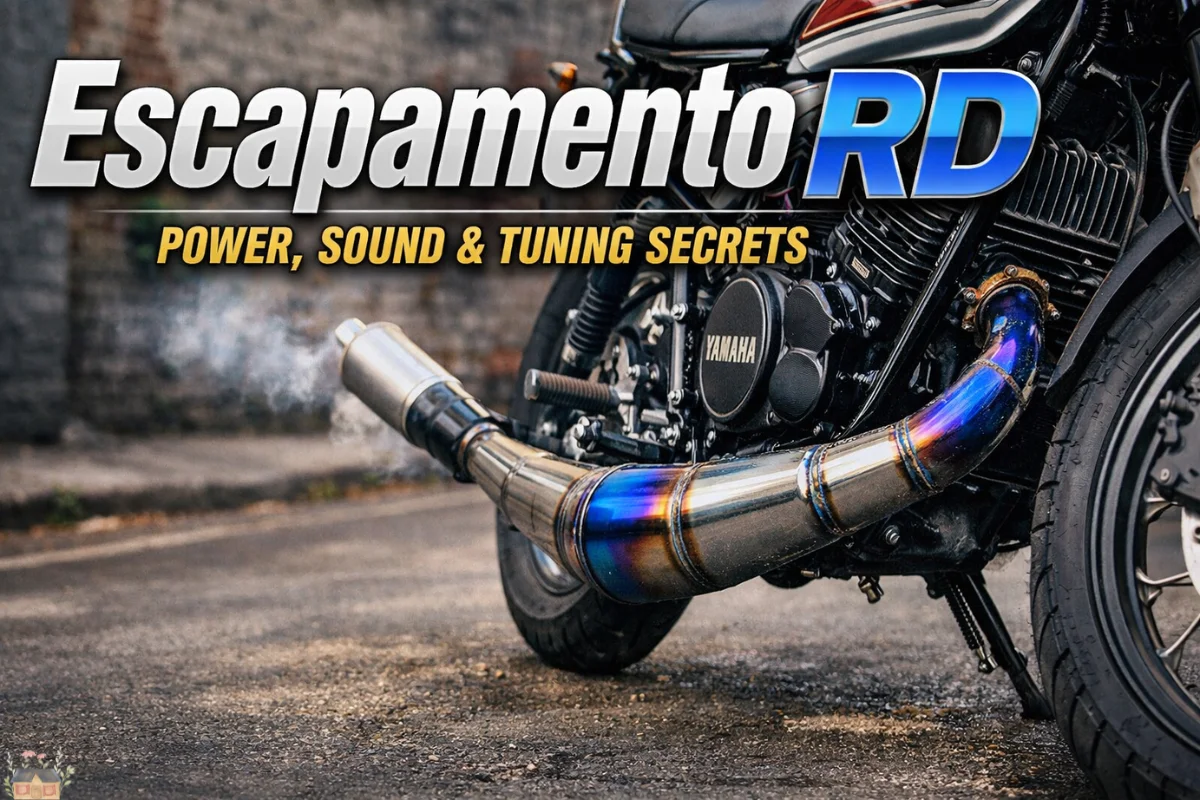
The moment that the expansion chamber begins to resonate, the air changes. Strangers pause and look toward the sound. Other riders twist their throttles in acknowledgment. Children point. Dogs bark. There is no mistaking it—the sound of an escapamento RD cutting through traffic or bouncing off city walls is unmistakable, unforgettable, and increasingly rare. For those who grew up in the era when Yamaha’s race-developed two-strokes ruled both showrooms and stoplight drags, it brings back the pulse of youthful freedom. For a new generation discovering these machines through restoration projects or weekend tinkering, it represents authenticity in an age of increasingly sanitized motorcycling. The escapamento RD is not merely a component; it is the beating heart of a machine that refuses to fade into nostalgia.
Beyond the Expansion Chamber: What Escapamento RD Actually Does to Your Engine
Most riders understand that an escapamento RD makes power and noise. Fewer understand how. The difference between knowing and understanding is what separates a rider who buys parts from one who builds machines.
Two-stroke engines operate on a principle that is both elegant and unforgiving: every downward piston stroke is a power stroke. But this efficiency comes at a cost—the exhaust port opens while the combustion event is still finishing, allowing unburnt fuel to escape and fresh charge to follow it out. This is where the escapamento RD transforms from simple tubing into precision engineering.
The expansion chamber creates a sophisticated pressure wave management system. When the exhaust port opens, a positive pressure wave travels down the header pipe, reflects off the divergent cone, and returns as a negative wave that literally sucks the remaining fresh charge back into the cylinder before the port closes. This is not marketing language; it is applied thermodynamics. A correctly designed escapamento RD can recover between 15% and 25% of the fuel that would otherwise exit the exhaust valve unused.
This explains why the same RD350 engine that produces perhaps 32 horsepower with stock pipes can approach 50 horsepower with properly tuned expansion chambers. You are not merely reducing restriction—you are engineering the exhaust flow to perform mechanical work.
The Physics of Sound: Why Escapamento RD Screams While Others Rumble
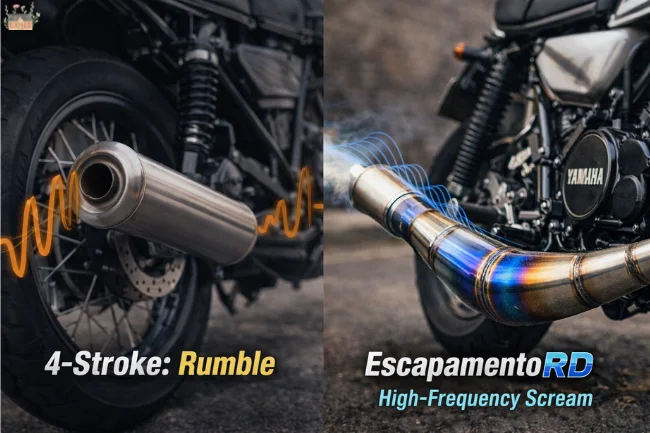
Four-stroke exhaust notes are largely about cylinder firing order and muffler design. The escapamento RD sound profile is fundamentally different because the combustion frequency is higher and the exhaust event duration is longer relative to crankshaft rotation.
Consider the math: A four-stroke engine fires each cylinder once every two revolutions. In a two-stroke engine, combustion occurs with every crankshaft rotation. At 8,000 RPM, a four-stroke produces 4,000 combustion events per minute per cylinder; a two-stroke produces 8,000. This doubling of frequency places the exhaust note into a higher perceptual register regardless of silencing.
But the escapamento RD adds another layer. The expansion chamber itself acts as an acoustic filter. The divergent and convergent cones create standing waves that reinforce specific frequencies while canceling others. This is why a well-tuned RD does not simply sound loud—it sounds tuned, almost musical. The characteristic “ring-ding-ding” is the audible manifestation of pressure waves reflecting within precisely calculated geometric boundaries.
Experienced builders know that changing the header pipe length by even 15 millimeters audibly shifts the powerband. It changes the exhaust tone as well. The escapamento RD is an exhaust system, yes. It is also a musical instrument calibrated in hertz rather than horsepower.
Material Science and Thermal Dynamics: Choosing Your Escapamento RD by the Numbers
Riders typically select an escapamento RD based on price, brand reputation, or aesthetic preference. These are valid considerations, but they ignore the single most important variable: thermal expansion behavior.
| Material | Weight (Relative) | Heat Retention | Expansion Rate | Acoustic Signature | Typical Lifespan |
|---|---|---|---|---|---|
| Mild Steel | 1.0x (Baseline) | High | Moderate | Warm, rounded | 3-7 years |
| Stainless Steel | 1.1x | Moderate | Moderate | Crisp, bright | 10-15+ years |
| Titanium | 0.6x | Low | High | Sharp, metallic | 15-20+ years |
| Carbon Fiber | 0.4x | Very Low | Minimal | Damped, controlled | 5-8 years |
Mild steel remains popular among Brazilian escapamento RD builders not because it is cheap—though it is—but because its thermal expansion coefficient closely matches that of the cast iron cylinder and steel studs used in original RD engines. This creates a harmonious thermal cycle where everything expands and contracts together. Stainless steel expands differently, which is why high-quality stainless systems incorporate expansion joints or carefully calculated mounting tolerances.
Titanium offers weight savings that genuinely matter on an RD350, where every kilogram affects the power-to-weight ratio. But titanium escapamento RD systems require careful attention to mounting because the material transfers vibration differently than steel. Carbon fiber silencers reduce unsprung mass and never rust, but carbon surrounding a two-stroke exhaust gas stream eventually degrades—it remains a consumable component for weight-obsessed riders.
The Carburetor Marriage: Why Rejetting Is Not Optional
This section exists because the competing article mentions rejetting in passing, and that is insufficient. Installing an escapamento RD without carburetor recalibration is not merely suboptimal—it is mechanically irresponsible.
When you improve exhaust scavenging, you increase the volume of air drawn through the carburetor during each intake event. An increase in airflow demands a corresponding increase in fuel to preserve the proper mixture. The stock main jet on a Brazilian-market RD350 is typically around 180. With a free-flowing escapamento RD and a performance air filter, the main jet frequently needs to increase to 210, 220, or even 240, depending on your specific pipe geometry and atmospheric conditions.
But rejecting is not simply “install larger jets.” The interaction between these variables is non-proportional. Riders chasing optimal performance must understand:
The Needle Position Hierarchy
The needle jet and jet needle control fuel delivery from approximately one-quarter to three-quarters throttle. Installing an escapamento RD often requires raising the needle clip (lowering the needle) by one or two positions to enrich this critical transition range. Without this adjustment, the engine will hesitate or “stutter” when accelerating from cruising speed.
Pilot Circuit Compensation
The pilot jet and air screw control idle to one-quarter throttle. Many escapamento RD systems actually improve low-RPM scavenging to the point where the engine draws more air at idle, requiring a larger pilot jet—counterintuitive but frequently necessary.
The Plug Chop Protocol
Experienced RD tuners verify their jetting through controlled plug chops: running the engine at a specific throttle position under load, immediately cutting the ignition, and examining the insulator color at the spark plug base. Tan or light brown indicates a correct mixture. White indicates a lean, dangerous operation. Black, sooty deposits indicate excessive richness.
An improperly jetted RD with an escapamento RD will not merely perform poorly. It will develop hot spots on the piston crown, scuff the exhaust side of the cylinder bore, and eventually seize. The exhaust system did this, but the rider failed to compensate.
Regional Variation: How Brazilian Escapamento RD Differs from European and Japanese Systems
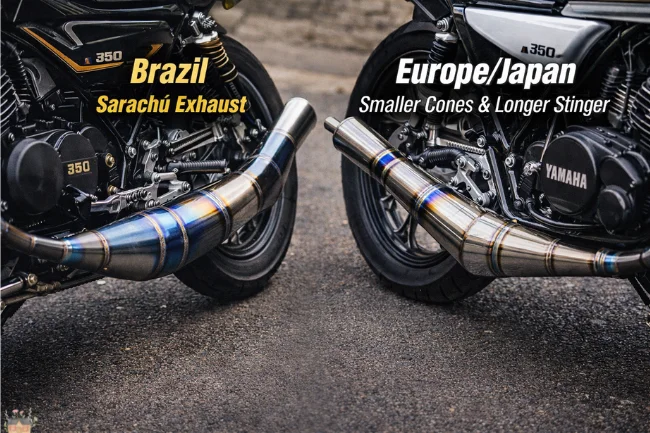
The global RD community shares DNA but developed distinct regional characteristics. Brazilian escapamento RD culture diverged significantly from Japanese and European practice due to three factors: fuel quality, enforcement patterns, and local manufacturing capability.
Brazilian fuel throughout the 1980s and 1990s contained lower aromatic hydrocarbons than European gasoline. This affected two-stroke combustion characteristics, leading local builders to develop escapamento RD chambers with slightly larger blowdown cones and different stinger diameters than equivalent Japanese or Italian systems. A Brazilian-market Sarachú pipe is not a copy of a European chamber—it is a distinct evolutionary branch optimized for local conditions.
Enforcement patterns also mattered. European noise regulations became progressively stricter; Brazilian enforcement remained inconsistent and often negotiable. This allowed Brazilian escapamento RD builders to prioritize performance over compliance in ways their European counterparts could not. The result was an indigenous exhaust design language that prioritized mid-range torque for street racing rather than peak horsepower for track use.
Modern Brazilian riders restoring RD350s face a choice: source period-correct Brazilian chambers that represent authentic local history, or import modern European systems that offer superior materials and more consistent manufacturing. Both are valid. They simply honor different legacies.
The Restoration Dilemma: Period Correctness Versus Modern Performance
The vintage motorcycle restoration community debates whether escapamento RD systems should replicate original specifications or embrace modern improvements. This is not a trivial aesthetic disagreement—it reflects fundamentally different philosophies about what these motorcycles should be.
The Preservationist View
Original-spec escapamento RD systems, including factory Yamaha chambers or authorized period accessories, maintain historical accuracy. The slightly restricted powerband, the specific tone, even the slower throttle response—these are not flaws to be corrected. They are characteristics of how the motorcycle was originally experienced. Installing modern expansion chambers on a concours-level restoration is analogous to replacing a Stradivarius violin’s sound post with carbon fiber. It may perform differently, but it is no longer the same instrument.
The Perpetual Evolution View
RD motorcycles were always platforms for modification. Yamaha designed them with aftermarket tuning in mind. The engineers who created the RD350 expected riders to change exhaust systems, modify port timing, and experiment with carburetion. Installing a modern escapamento RD with CNC-machined flanges and consistent weld penetration continues this tradition rather than betraying it.
The Practical Compromise
Many restorers now choose systems that appear visually authentic—correct cone profiles, appropriate silencer shapes, period-style mounting brackets—but utilize modern materials and manufacturing techniques. Jim Lomas and TYGA Performance both offer escapamento RD systems that replicate original geometry while employing superior stainless steel and precision hydroforming. To casual viewers, they pass as factory-spec. To the engine, they perform substantially better.
Racing Application: Beyond the Street
Street riders discuss escapamento RD in terms of sound and acceleration. Racers discuss it in terms of powerband width and lap time consistency. The priorities shift depending on the context.
Road racing demands an escapamento RD that delivers broad, predictable power across a wide RPM range because corners follow straights and gear selection is finite. Drag racing demands peak horsepower at a specific RPM because the engine operates near redline for the entire run. Dirt track and speedway applications demand torque delivery that does not upset chassis traction.
These divergent requirements have produced specialized escapamento RD geometries:
- Road Race Geometry: Longer header pipes, shallower divergent cone angles, and longer stingers. The objective is power from 7,000 to 10,000 RPM with minimal peakiness.
- Drag Race Geometry: Shorter headers, steeper cone angles, and carefully tuned stinger lengths that create maximum pressure wave amplitude at peak power RPM. Rideability below 6,000 RPM is irrelevant.
- Street/Endurance Compromise: Medium header lengths with progressive cone angles that sacrifice ultimate peak power for usable torque from 4,500 RPM upward.
Brazilian street racers historically favored the drag race approach because their competitions occurred over short distances where launching and initial acceleration determined outcomes. This cultural preference influenced Brazilian escapamento RD design toward aggressive, peaky power bands that European riders sometimes found difficult to manage.
Installation Errors That Kill Performance
Even a correctly designed escapamento RD will perform poorly if installed incorrectly. The most common installation errors observed in workshops servicing vintage Yamaha RDs include:
Inadequate Support Bracketry
Expansion chambers are heavy. The stock mounting points on RD frames were designed for the lighter, more compact stock exhaust system. Aftermarket escapamento RD systems place different stresses on different locations. Cracks develop at cylinder head flanges, silencer mounting tabs fracture, and header pipes develop stress risers at bends—all because additional support brackets were omitted during installation.
Incorrect Stinger Insertion Depth
The stinger tube must insert into the final convergent cone to a specific depth, typically between 15mm and 25mm, depending on chamber design. Insertion depth affects both the reflected wave timing and the exhaust gas cooling rate. Riders who simply slide the silencer on until it stops have no idea whether their stinger insertion depth matches the designer’s intention.
Flange Sealing Failure
Two-stroke exhaust flanges must seal completely. Any air leak at the cylinder-to-pipe junction leans the mixture specifically for that cylinder and creates audible “chuffing” under load. Copper exhaust gaskets can be annealed and reused; crushed OEM gaskets cannot. High-temperature silicone designed specifically for two-stroke exhaust applications is acceptable for temporary installation only.
Spring Tension Variation
Escapamento RD systems rely on spring tension to maintain flange contact while allowing thermal movement. Springs lose tension over time. Unequal spring tension warps the flange and creates leakage paths. Replacing all mounting springs simultaneously as a set is inexpensive insurance against exhaust leaks.
The Future: Escapamento RD in the Electric Era

It is paradoxical that escapamento RD culture intensifies as two-stroke motorcycles become rarer. The bikes themselves are disappearing—crashing, rusting, being parted out. But the exhaust systems remain, traded among enthusiasts, replicated by small builders, and installed on the diminishing number of rideable RD chassis.
Younger riders approaching these motorcycles bring different expectations. They have never experienced a time when two-stroke engines were ordinary transportation. For them, the escapamento RD represents a deliberate choice rather than a necessary upgrade. They select expansion chambers the way previous generations selected leather jackets—as an identity declaration.
This shift from necessity to choice may ultimately preserve escapamento RD knowledge better than any workshop manual could. When riders choose an exhaust system not because it is available but because it expresses something about how they wish to experience motorcycling, they ask better questions. They want to understand why one chamber produces power at 7,500 RPM and another at 9,000. They learn to read torque curves and pressure wave diagrams. They become, intentionally or not, the next generation of two-stroke tuners.
FAQs
Will an escapamento RD damage my engine if installed without other modifications?
Not inherently, but operation without carburetor recalibration will. The increased scavenging efficiency leans the air-fuel mixture, potentially causing piston overheating. Rejection is mandatory, not optional.
How do I identify a genuine Brazilian Sarachú exhaust versus a replica?
Original Sarachú chambers feature distinctive weld bead patterns at the divergent cone junctions and specific mounting bracket dimensions. Documentation exists in Brazilian RD enthusiast forums with detailed photographic comparisons.
Can I install an escapamento RD designed for an RD350 on an RD125?
It may fit physically, but it won’t function correctly. The expansion chamber volume and cone angles are tuned for specific displacement and exhaust port timing. An RD350 pipe on an RD125 will kill low-end power and provide no top-end benefit.
Why does my escapamento RD produce blue tinting on stainless steel?
This is normal. Stainless steel discolors between 400°C and 600°C, producing straw, gold, purple, and blue hues depending on the exact temperature. It indicates proper thermal cycling, not damage.
How often should repacking occur for road use?
Fiberglass packing in silencers compresses and deteriorates with exposure to exhaust pulses and moisture. Road riders should repack every 5,000 kilometers. Racers should repack after every race weekend.
Conclusion: More Than Pipe
The escapamento RD survives because it was never merely functional. Motorcycles have always carried meaning beyond transportation, and few components carry meaning as visibly, audibly, and immediately as an expansion chamber on a tuned two-stroke. It signals to everyone within earshot that this machine is not transportation—it is intention, made manifest in steel and sound waves.
Riders who install escapamento RD systems today participate in a tradition spanning five decades and multiple continents. The equipment has evolved. The materials are more advanced. The understanding runs deeper than ever. But the essential act remains unchanged: a rider, their motorcycle, and the determination that how it sounds matters as much as how it performs.
That is not nostalgia. That is continuity. And as long as Yamaha RD motorcycles continue to turn wheels under power, the escapamento RD will remain their voice.
For broader information, visit Wellbeing Makeover

Alex Carter is a writer with 10+ years of experience across tech, business, travel, health, and lifestyle. With a keen eye for trends, Alex offers expert insights into emerging technologies, business strategies, wellness, and fashion. His diverse expertise helps readers navigate modern life with practical advice and fresh perspectives.