
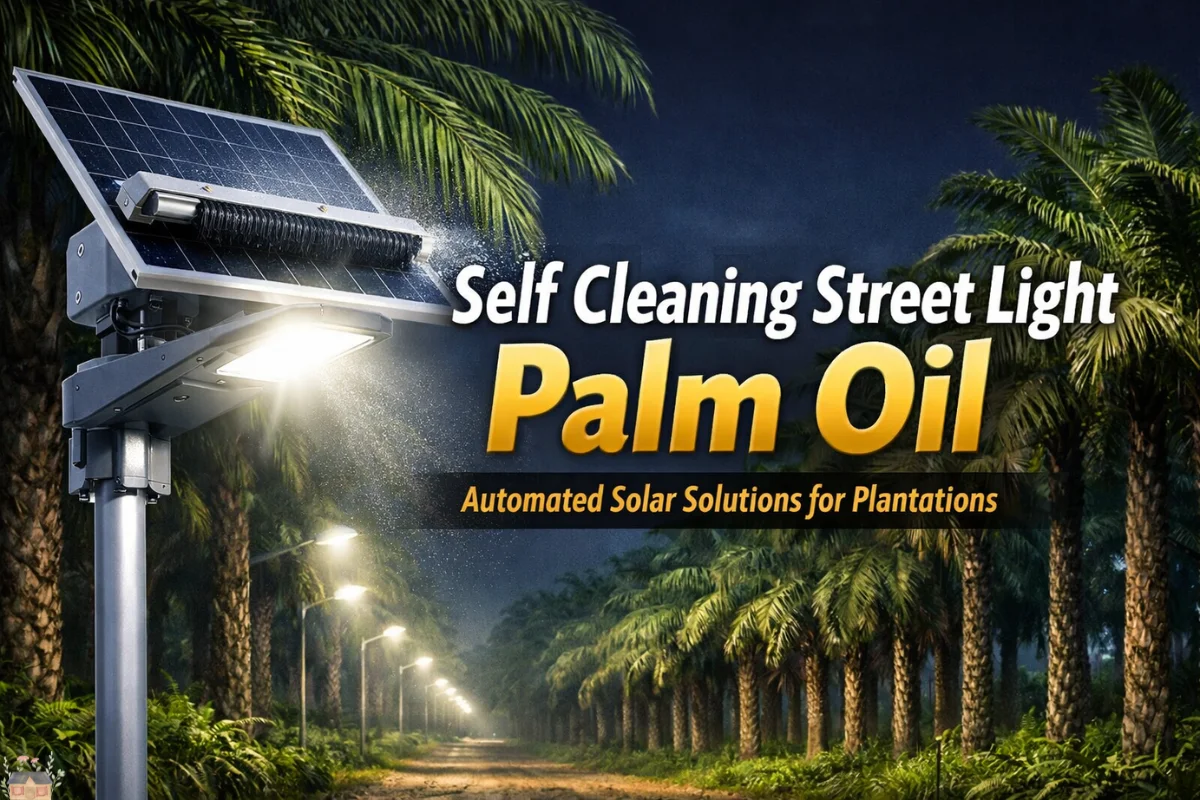
A self cleaning street light palm oil solution is an integrated solar lighting system equipped with automated brushes or specialized coatings designed to remove dust, tropical debris, and airborne oil mist. These systems maintain peak photovoltaic efficiency in plantation environments, ensuring reliable nighttime illumination for worker safety and logistics without the high costs of manual maintenance.
The Illumination Gap in Modern Palm Oil Production
Palm oil plantations are the powerhouses of global agriculture, often spanning thousands of hectares of remote, rugged terrain. As these operations modernize, the need for 24/7 infrastructure—specifically, reliable lighting—has shifted from a luxury to a logistical necessity. However, the very environment that sustains oil palms is a silent killer for traditional solar technology.
In a typical plantation, the air is thick with more than just humidity. It carries a cocktail of silica-rich dust from unpaved haulage roads, organic pollen, and a persistent fine oil mist generated by nearby milling and processing facilities. When these elements settle on a standard solar panel, they don’t just block light; they create a sticky, calcified “shading” layer that can reduce energy harvest by 30% to 50% in just a few weeks.
The “Self Cleaning Street Light Palm Oil” approach addresses this by treating the solar panel not as a static component, but as a dynamic, self-maintaining engine.
How Self-Cleaning Technology Masters the “Sticky” Plantation Climate
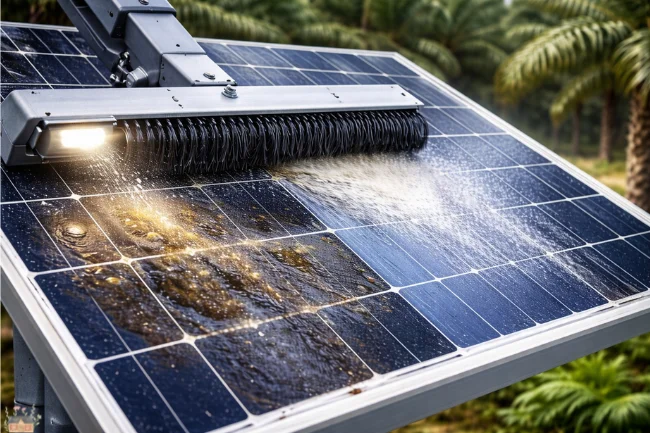
The primary challenge in a palm oil setting is the viscosity of the grime. Unlike desert dust, which is bone-dry and can sometimes be blown off by high winds, plantation residue is often greasy.
1. The Mechanical Advantage: Integrated Brush Systems
Most high-end self-cleaning units utilize a heavy-duty, UV-resistant brush or silicone wiper. These are programmed to traverse the panel at strategic intervals—typically at dawn and dusk.
-
The Logic: By cleaning at dawn, the system ensures the panel is pristine for the peak sun hours.
-
The Result: Physical agitation breaks the surface tension of oil-mist buildup that passive coatings alone might struggle to shed.
2. Specialized Hydrophobic & Oleophobic Nano-Coatings
Advanced units often treat the tempered glass with a dual-layered coating.
-
Hydrophobic: Repels water, causing tropical downpours to “bead” and carry away loose debris.
-
Oleophobic: Specifically designed to repel oils. In the context of a palm oil mill, this prevents the fatty acid mists from bonding chemically to the glass.
3. Smart Logic Controllers (MPPT)
A “smart” light doesn’t just clean on a timer; it cleans on demand. Modern systems monitor the charging current. If the internal MPPT (Maximum Power Point Tracking) controller detects a drop in efficiency that doesn’t align with the time of day or cloud cover, it triggers an emergency cleaning cycle to clear potential obstructions like a fallen palm frond or bird droppings.
Read Also: Solar Brackets for 365 W Solar Panel: Complete Mounting Guide
Strategic Benefits for Plantation Management
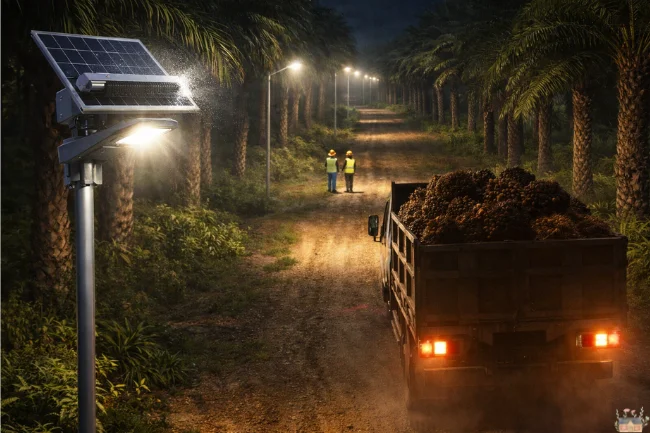
Investing in self-cleaning infrastructure is a move toward Operational Excellence (OpEx). Here is how it translates to the bottom line:
Enhanced Worker Safety and Security
Harvesting and transport often happen in the pre-dawn hours. Well-lit collection points and intersections reduce the risk of vehicle accidents and wildlife encounters (such as snakes or elephants). Self-cleaning lights ensure that these safety zones don’t go dark due to a dirty panel.
Elimination of the “Maintenance Loop”
In a standard setup, a plantation would need a dedicated truck and a two-man crew to manually wash panels every month.
-
Labor Risks: Climbing ladders in remote areas leads to workplace injuries.
-
Logistics: The fuel and time spent reaching the furthest corners of a 5,000-hectare estate are better spent on crop health and harvesting.
Battery Longevity
When a panel is dirty, the battery rarely reaches a full state of charge (SoC). Constant “shallow charging” and deep discharging lead to lead-acid or even lithium-ion fatigue. By keeping the panel clean, the battery stays within its optimal voltage range, potentially doubling its service life.
Technical Comparison: Standard vs. Self-Cleaning Systems
Planning Your Deployment: Site-Specific Considerations
Not every area of a plantation requires the same level of technology. A tiered approach to self cleaning street light palm oil cost management is often the most effective strategy.
Tier 1: The Processing Mill and Refinery
These are high-contamination zones. The concentration of airborne particulates and oil vapors is at its peak.
-
Recommendation: Heavy-duty mechanical brush systems with oleophobic coatings. Use higher lumen output (180lm/W+) to ensure visibility through potential steam or haze.
Tier 2: Main Haulage Roads and Weighing Stations
Dust is the primary enemy here.
-
Recommendation: Standard mechanical wipers. Focus on pole height (6–8 meters) to ensure the light spread covers wide truck paths.
Tier 3: Worker Housing and Perimeter Fencing
Lower contamination, but high social impact.
-
Recommendation: Hybrid systems or even high-quality nano-coated units if the budget is constrained.
Financial Analysis: The ROI of “Set and Forget”
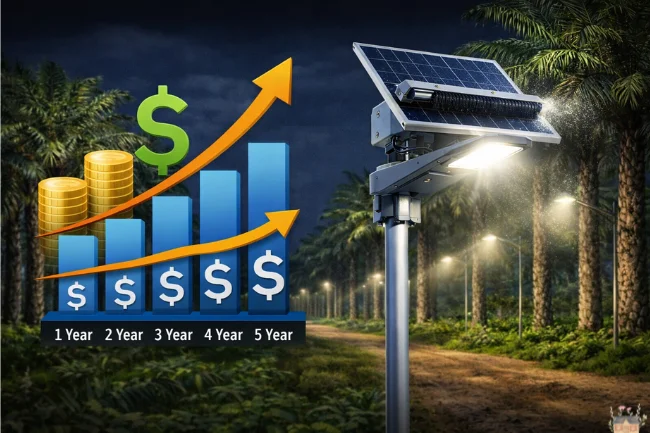
When discussing the self cleaning street light palm oil cost, it is vital to look at the Total Cost of Ownership (TCO) over a 5-year period.
-
Initial CapEx: A self-cleaning unit may cost 20–30% more than a premium standard solar light.
-
Labor Savings: Calculate the cost of a maintenance crew (2 people), a specialized vehicle, and water transport. In large estates, this often exceeds $50–$100 per light, per year.
-
Replacement Costs: Standard panels obscured by grime often suffer from “hot spots,” where covered cells overheat and burn out, requiring a full fixture replacement.
The Verdict: Most plantation operators find that the “efficiency gap” pays for the price premium of self-cleaning tech within 14 to 24 months.
Read Also: The Pros and Cons of Bifacial Solar Panels for RVs: Complete Buyer’s Guide
Engineering Best Practices for Palm Oil Environments
To ensure the longevity of your investment, look for these specific engineering markers:
1. Corrosion Resistance (C5-M Standard)
The humidity in Southeast Asia and West Africa is brutal. Ensure the light housing is made of die-cast aluminum or hot-dip galvanized steel with a powder coating that meets marine-grade corrosion standards.
2. LiFePO4 Battery Chemistry
Avoid lead-acid or standard Lithium-ion (NCM). Lithium Iron Phosphate (LiFePO4) is the gold standard for plantations because it can withstand high ambient temperatures ($45^\circ\text{C}+$) without thermal runaway and offers over 3,000 charge cycles.
3. Bird Deterrents
Bird droppings are acidic and can “etch” the glass of a solar panel. Quality self-cleaning lights include “bird spikes” on the top of the fixture to prevent nesting and perching.
Overcoming Potential Implementation Challenges
Expert Insight: “The biggest failure point in self-cleaning lights isn’t the motor—it’s the ‘cleaning frequency’ settings. In the peak of the dry season, you may need a cycle every 12 hours. During the monsoon, once every three days is plenty.”
Challenge: Mechanical Wear and Tear
Moving parts will eventually need service.
-
Solution: Choose modular designs where the brush assembly can be “hot-swapped” in under 10 minutes without taking down the entire pole.
Challenge: Energy Consumption of the Motor
Does the cleaning mechanism drain the battery?
-
Solution: Modern motors are highly efficient, using less than 1% of the total daily energy harvest for a standard cleaning cycle. The energy gained by having a clean panel far outweighs the energy spent cleaning it.
The Future: IoT and Remote Plantation Management
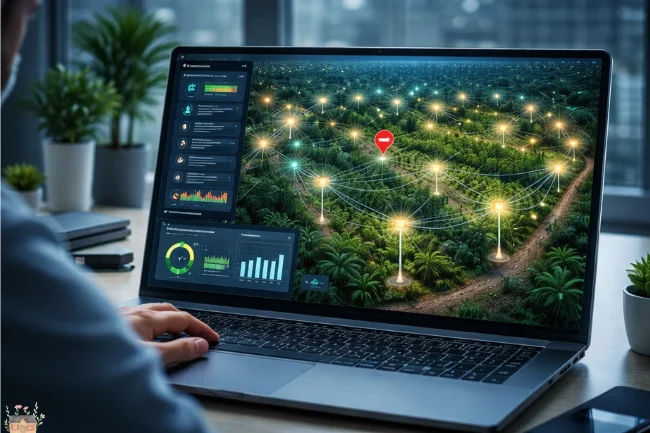
The next frontier for the palm oil industry is the Internet of Things (IoT). Advanced self-cleaning street lights are now being equipped with Zigbee or LoRaWAN Mesh networking.
-
Centralized Dashboard: A plantation manager can sit in the head office and see a map of every light on the estate.
-
Predictive Maintenance: The system sends an alert if a motor is struggling or if a battery is underperforming.
-
Group Controls: Dim the lights during the “off-season” or brighten them during the peak harvest month to support increased traffic.
FREQUENTLY ASKED QUESTIONS
1. How often do the brushes need to be replaced?
In typical plantation conditions, high-quality nylon or silicone brushes last between 3 to 5 years. Replacement is a simple manual task that can be synchronized with a general site inspection.
2. Can these lights withstand tropical storms and monsoons?
Yes. Most industrial-grade self-cleaning lights are rated IP65 or IP66 (waterproof) and withstand wind speeds of up to 160 km/h. The cycle often pauses during high winds to protect the mechanism.
3. Is the “self cleaning street light palm oil cost” justifiable for smallholders?
For smallholders with fewer than 50 lights, the cost may be high. However, for cooperatives or large-scale estates where economies of scale apply, the ROI is undeniable.
4. Do these lights work if there is no rain for months?
That is actually when they are most valuable. Without rain for “passive” cleaning, dust buildup accelerates; the mechanical brush ensures 100% capacity during long dry seasons.
5. Does the oil mist from the mill damage the brush?
Brushes are made from oil-resistant materials. The act of wiping prevents oil from “baking” onto the glass, which is what causes permanent damage to standard panels.
6. Do self-cleaning solar panels work?
Yes, they effectively use automated brushes or hydrophobic coatings to remove dust, maintaining up to 95–98% energy efficiency compared to uncleaned panels.
7. How to manage an oil palm?
Successful management requires precise nutrient application (NPK), triangular planting spacing (9m x 9m x 9m), and integrated pest control to maximize yield.
8. What are the disadvantages of solar street lights?
The primary drawbacks include a higher upfront investment cost and a dependency on weather conditions during extended rainy seasons.
9. Can a street light be charged by solar energy?
Absolutely; modern solar street lights are fully autonomous, capturing sunlight by day and using lithium batteries to power the LED at night.
Conclusion: Lighting the Path to Sustainability
The transition to self cleaning street light palm oil infrastructure is more than a technical upgrade; it’s a commitment to a more resilient and autonomous plantation model. By removing the “human element” from the dangerous and repetitive task of panel cleaning, operators can focus their resources on what matters most: sustainable yield and worker welfare.
In an industry where the environment is the greatest asset and the greatest challenge, self-cleaning technology provides the bridge to consistent, carbon-neutral, and reliable operations.
Learn about Solar Panels Serial or Parallel
For broader information, visit Wellbeing Makeover

I’m Salman Khayam, the founder and editor of this blog, with 10 years of professional experience in Architecture, Interior Design, Home Improvement, and Real Estate. I provide expert advice and practical tips on a wide range of topics, including Solar Panel installation, Garage Solutions, Moving tips, as well as Cleaning and Pest Control, helping you create functional, stylish, and sustainable spaces that enhance your daily life.