
Moving to Ireland from the US is more achievable than most Americans realize — but it requires navigating visa pathways, understanding the real cost of living, and knowing what daily life actually looks like once you arrive. This guide covers everything from legal immigration routes and housing costs to working rights and the best cities to settle in, so you can make an informed decision before you pack a single box.
Is Moving to Ireland from the US Really the Right Choice?
Ireland has seen a remarkable surge in American arrivals — CSO data shows 9,600 US arrivals in the 12 months to April 2025, nearly double the previous year. It’s easy to see why. English is the primary language, the pub culture is warm and social, and multinational tech giants like Google, Apple, and Meta have built major European headquarters there.
But Ireland isn’t a frictionless version of the US with a Celtic twist. The weather is genuinely wet and grey for much of the year. Housing — especially in Dublin — is tight and expensive. Public transportation outside the capital can feel sparse if you’re used to having a car. And the healthcare system, while solid, works differently from what most Americans are familiar with.
That said, for the right person — a tech professional, a remote worker, someone with Irish ancestry, or a family looking for work-life balance — Ireland can be genuinely transformative. Going in with clear expectations is what separates expats who thrive from those who book a return flight within a year.
Legal Pathways: How Americans Can Move to Ireland
Moving to Ireland from the US legally means choosing the right immigration route for your situation. Unlike EU citizens, Americans cannot simply show up and settle. You’ll need a legal basis to stay longer than 90 days. Here are the primary routes, each with different requirements.
1. Employment-Based Permits
The most common route. If you have a job offer from an Irish employer, you may qualify for:
- Critical Skills Employment Permit — for highly skilled roles (tech, engineering, healthcare). The minimum salary threshold rises to €40,904 from March 2026, with some role-based variations.
- General Employment Permit — broader eligibility, minimum salary rising to €36,605 from March 2026.
Applications are processed through Ireland’s Department of Enterprise, Trade and Employment (DETE) via the Employment Permits Online system. Your employer must be an approved sponsor, so confirming this early in the job offer process is essential.
2. Family and Relationship-Based Routes
If you’re in a committed, long-term relationship with an Irish citizen or legal resident, you may be eligible to relocate on the basis of that relationship. You’ll typically need:
- Proof of cohabitation for 2+ years (leases, joint utility bills, shared bank statements)
- Evidence that your Irish partner meets income thresholds (where applicable)
Spouses and dependents of existing employment permit holders can also apply to join their partner in Ireland — and in many cases, can apply for their own work authorization once resident.
3. Student Visa
Ireland is home to world-ranked universities like Trinity College Dublin and University College Dublin. A student visa (Study Visa) allows you to stay for the duration of your program. Students on a Stamp 2 permission can work up to 20 hours per week during term and up to 40 hours per week during official holiday periods (June–September and December 15–January 15).
4. Irish Ancestry and Citizenship by Descent
This is perhaps the most underused pathway. If one of your grandparents was born on the island of Ireland, you likely qualify for Irish citizenship through the Foreign Births Register — no visa required, and you’d have full EU freedom of movement. Applications go through Ireland’s Department of Foreign Affairs.
- Important nuance: Great-grandparent claims only work if your parent first registered their own Irish citizenship before you were born. If you’re unsure, check your family records before assuming eligibility.
5. Start-Up Entrepreneur Program
If you have an innovative business concept and at least €50,000 in funding, Ireland’s Start-Up Entrepreneur Program offers a pathway to residency. Applications are reviewed quarterly, and there’s a non-refundable €350 application fee.
For a detailed breakdown of documentation requirements for each route, the US State Department’s Ireland travel page provides current entry and visa guidance.
First Steps After Moving to Ireland from the US
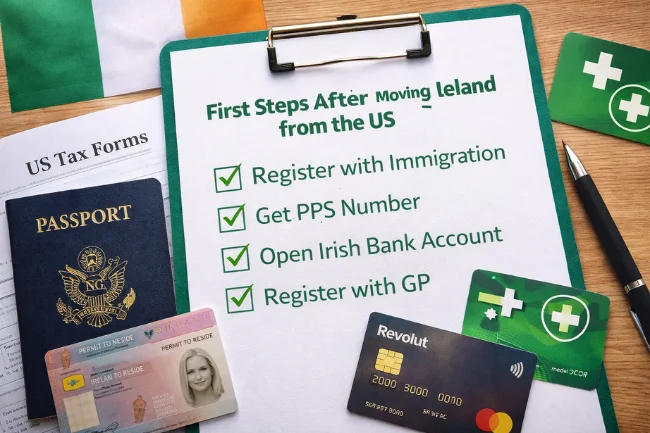
One area that relocation guides often skip is the administrative groundwork you need to lay in your first weeks. Here’s what actually needs to happen on the ground:
- Register with the Irish Immigration Service (ISD) — If your stay extends beyond 90 days, you must register and receive an Irish Residence Permit (IRP) card.
- Apply for a PPS Number — Ireland’s equivalent of a Social Security number. You’ll need this for banking, employment, and healthcare access.
- Open an Irish bank account — This is harder than it sounds. Many banks require proof of address, which you can’t get without a bank account. Start with a digital bank (Revolut or N26 are popular with new arrivals) to bridge the gap.
- Register with a GP (general practitioner) — Essential for accessing the public healthcare system. If you’re not immediately eligible for public healthcare, private insurance is a sensible interim step.
- Sort your US tax obligations — As a US citizen, you remain obligated to file US federal taxes no matter where you live. Ireland has a tax treaty with the US to prevent double taxation, but the filing requirement doesn’t disappear.
If you’re relocating from within the US first — say, consolidating from a different state before your flight — knowing how to handle large appliance moving logistics and household goods ahead of an international move can save significant headaches.
Cost of Living in Ireland for Americans: What to Budget
One of the biggest questions people have when moving to Ireland from the US is how far their paycheck will stretch. The cost of living is where many Americans get an unpleasant surprise. Ireland — particularly Dublin — is one of the more expensive cities in the EU. Here’s a realistic breakdown:
Monthly Living Costs by City (2025)
| Expense | ?️ Dublin | ? Cork | ? Galway | ?️ Limerick |
|---|---|---|---|---|
| Rent (1BR, city center) | €1,909 | €1,504 | €1,355 | €1,586 |
| Utilities (electric, gas, water) | €227 | €213 | €238 | €161 |
| Internet + mobile | €66 | €63 | €68 | €61 |
| Groceries (1 person/mo) | €250–€380 | €220–€330 | €230–€340 | €210–€320 |
| Public transport pass | €96 | €68 | €60 | €54 |
| Casual dining (per meal) | €20.50 | €18 | €18 | €17 |
| Pint of beer | €7 | €6 | €6.50 | €6 |
| Private health insurance | €100–€250 | €100–€250 | €100–€250 | €100–€250 |
| Basic monthly total | €2,479–€3,064 | €2,037–€2,297 | €2,396–€2,656 | €2,019–€2,279 |
Recommended gross salary benchmarks (2025):
- Dublin: ~€51,000–€54,000/year
- Cork: ~€43,000–€45,000/year
- Galway: ~€41,000–€43,000/year
- Limerick: ~€42,000–€45,000/year
One practical note on transportation: Dublin’s TFI Leap Card uses fare capping — adult Zone 1 trips are capped at €6/day and €24/week. Outside Dublin, most people need a car, and fuel runs roughly €1.50–€1.80 per litre currently.
Working in Ireland as an American
For anyone moving to Ireland from the US for career reasons, the job market is a genuine draw — particularly in technology, pharmaceuticals, finance, and professional services. The presence of so many US company headquarters (Google, Meta, Pfizer, Stripe, and dozens more) means that American professionals often find familiar working cultures and even colleagues they know.
A few things to know about the Irish workplace:
- Work-life balance is real. Evenings and weekends are generally protected. Don’t expect a culture of replying to 10 PM Slack messages.
- Annual leave is statutory. Workers are legally entitled to at least 4 weeks of paid leave per year.
- Pay is generally competitive in skilled sectors, but the effective take-home is reduced by income tax (20–40%), PRSI, and USC (Universal Social Charge).
Remote workers employed by US companies can also live in Ireland, but this creates complex tax residency questions. You may owe Irish income tax on your earnings even if your employer is US-based. This is one area where consulting an international tax professional before you relocate — not after — pays for itself.
Best Places to Live in Ireland for US Expats
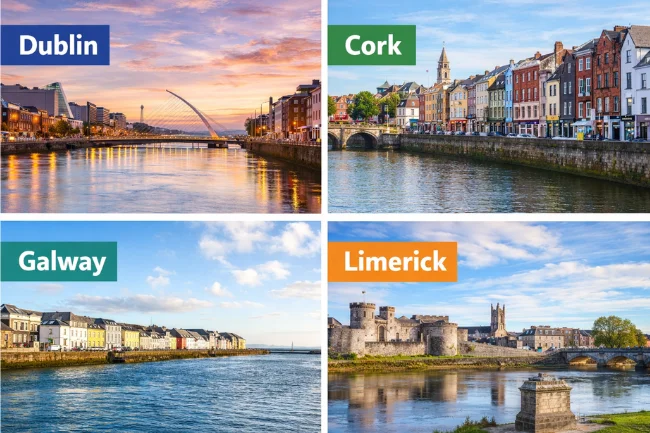
Where you settle is one of the most personal decisions involved in moving to Ireland from the US. The “best place to live” question comes down to what kind of life you want.
Dublin
The default choice for career-focused expats. If you’re in tech, finance, or international business, the job density here is unmatched. It’s also where you’ll find the largest American expat networks, international schools, and the widest range of cultural amenities. The trade-off is cost and pace — Dublin feels genuinely urban.
Cork
The city that locals insist is underrated (and they’re right). Cork has a growing pharma and medtech cluster, a beautiful city center, and a notably warmer social vibe than Dublin. It’s roughly 25% cheaper to live in, with a strong employer base and improving infrastructure. Families especially tend to love it.
Galway
The cultural heart of Ireland. Galway punches above its size in terms of festivals, music, food, and community feel. It’s particularly attractive for remote workers and creatives who want access to nature (Connemara is stunning) without giving up a city altogether. Job opportunities are more limited in traditional industries, but the remote work shift has made it genuinely viable.
Limerick
The value play. Limerick’s cost of living is the lowest of the major cities, and it has a quietly growing tech and engineering sector. It’s close to Shannon Airport, which helps with transatlantic connections. It lacks Galway’s cultural pull, but for anyone prioritizing affordability with a real job market, it deserves serious consideration.
Rural and Countryside
Counties like Kerry, Clare, Sligo, and Donegal offer dramatically lower costs and access to some of Europe’s most beautiful scenery. The trade-offs are limited public transport, fewer job options (making remote work essential), and longer drives to airports. If this is what you’re weighing, it’s worth reading about interstate relocation decisions and how lifestyle preferences factor into major moves — many of the same frameworks apply internationally.
Healthcare in Ireland: What Americans Moving from the US Need to Know
One aspect of moving to Ireland from the US that surprises many expats is how differently healthcare is structured. Ireland operates a two-tier system — public and private. Public healthcare (via the HSE) is available to people who are “ordinarily resident” in Ireland, generally meaning you live there or intend to for at least a year. Access is based on residency and income, not employment status.
For most newly arrived Americans, private health insurance is the practical short-term solution. It costs roughly €100–€250/month depending on your age and plan, and it gives faster access to specialists and private hospitals. As you establish residency and obtain your PPS number, you may become eligible for public healthcare over time.
Frequently Asked Questions
Moving to Ireland from the US
1
How long can Americans stay in Ireland without a visa?
US citizens can visit Ireland for up to 90 days without a visa under the Visa Waiver Program. Staying longer requires a legal basis — a work permit, student visa, family permission, or citizenship.
2
Can I work remotely for my US employer while living in Ireland?
Yes, but it’s legally and tax-wise more complex than it sounds. You will likely become an Irish tax resident, meaning you owe Irish income tax on your worldwide income. The US-Ireland tax treaty helps prevent double taxation, but you’ll still need to file in both countries. Get professional advice before you start.
3
How long does it take to get an Irish work permit?
Processing times vary, but Critical Skills Employment Permits typically take 4–6 weeks. General Employment Permits can take longer. Factor this into your timeline before resigning from your US job.
4
Can I bring my car from the US to Ireland?
Technically, yes, but it’s rarely practical. Ireland drives on the left, and US cars are right-hand drive, which is a significant safety and legal issue. Most expats sell their US vehicle and buy locally.
5
Do I need to give up my US citizenship to become an Irish citizen?
No. The US allows dual citizenship, and Ireland does as well. Many Americans who qualify for Irish citizenship by descent hold both passports — giving them visa-free access across the EU.
6
What’s the biggest mistake Americans make when moving to Ireland from the US?
Underestimating the housing market. Rental availability in Dublin is genuinely constrained. Many expats arrive with a job lined up but struggle to find suitable housing quickly. Starting your search at least 2–3 months before your move date — and being prepared to act fast on viewings — is essential.
7
Is Ireland safe for Americans?
Ireland consistently ranks among the safest countries in the world. The Global Peace Index regularly places it in the top ten. Violent crime is low, and Americans generally adapt comfortably to Irish social norms.
Moving to Ireland from the US is a major life decision, but for many Americans, it has proven to be one of the best they’ve ever made. The key is going in prepared — with the right visa pathway identified, a realistic budget, and an understanding of where you want to put down roots. Do that groundwork, and Ireland has a way of feeling like home faster than you’d expect.
For broader information, visit Wellbeing Makeover

I’m Salman Khayam, the founder and editor of this blog, with 10 years of professional experience in Architecture, Interior Design, Home Improvement, and Real Estate. I provide expert advice and practical tips on a wide range of topics, including Solar Panel installation, Garage Solutions, Moving tips, as well as Cleaning and Pest Control, helping you create functional, stylish, and sustainable spaces that enhance your daily life.