
Moving to England from the US is one of the more manageable international relocations Americans make — but manageable doesn’t mean simple. Between visa requirements, banking setup, healthcare registration, and the cultural adjustment of driving on the left, there’s a lot to plan for. This guide breaks down the key steps, costs, and considerations to help you relocate with confidence.
Visa Options for Americans Moving to England
Before anything else, your legal right to live and work in England determines the entire timeline of your move. Since the UK left the European Union, immigration rules have been consolidated under the UK Points-Based Immigration System.
The most common visa routes for Americans include:
- Skilled Worker Visa – Requires a confirmed job offer from a UK employer with a valid sponsorship license. Points are awarded for salary, skill level, and English language ability.
- Global Talent Visa – For leaders or potential leaders in academia, research, arts, or digital technology. No job offer required, but endorsement from a recognized body is.
- Student Visa – For those accepted into a UK institution for a course longer than six months.
- Family Visa – For those joining a UK-settled spouse, partner, or family member.
- Ancestry Visa – Available to Commonwealth citizens with a UK-born grandparent. While Americans don’t qualify directly, those with dual Commonwealth citizenship may.
- High Potential Individual Visa – Open to graduates of select global universities within five years of graduation.
For the most current and complete guidance, the UK government’s official Coming to the UK page for US citizens is the authoritative resource.
The Skilled Worker route is the most common path for Americans relocating for employment. Tourist visas do not permit working, and overstaying has serious immigration consequences.
The Cost of Moving from the US to England
Budgeting accurately is one of the most overlooked parts of an international move. Costs vary significantly depending on how much you’re shipping, whether you’re renting initially, and which part of England you’re settling in.
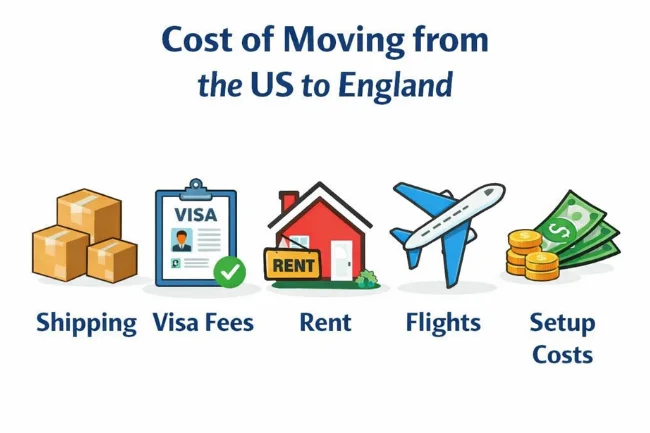
The Immigration Health Surcharge (IHS) gives visa holders access to the National Health Service (NHS) and must be paid upfront for the full visa duration before arrival.
Taxes: What Americans Moving to England Must Understand
One of the more complex aspects of moving abroad as an American is that the US taxes its citizens on worldwide income, regardless of where they live. Even after moving to England, most Americans are still required to file a US federal tax return each year.
The UK also has its own tax system, and you’ll become a UK tax resident after spending 183 days or more in the country in a tax year. This creates potential double-taxation, though the US-UK Tax Treaty helps mitigate much of this.
Key tax considerations include:
- Foreign Earned Income Exclusion (FEIE) – Allows qualifying Americans abroad to exclude a portion of foreign earned income from US taxes.
- Foreign Tax Credit – Offsets US tax liability with taxes already paid to the UK.
- FBAR and FATCA reporting – Americans with foreign bank accounts above certain thresholds must report them to the IRS.
Given the complexity, working with a specialist in US expatriate taxation is strongly recommended. Resources like Greenback Tax Services provide detailed guidance specifically for Americans moving to the UK.
Finding Housing When Moving to England from the US

England’s rental market varies enormously by region. London remains one of the most expensive cities in the world for renters, while cities like Manchester, Leeds, Birmingham, and Bristol offer lower costs alongside strong job markets and quality of life.
Renting before buying is almost universally the right move for new arrivals. Most mortgage lenders require at least six months to a year of UK credit history, and understanding local neighborhoods takes time.
Useful platforms for searching rentals include Rightmove, Zoopla, and SpareRoom. Rentals in England typically require:
- Proof of identity (passport)
- Proof of address (which can be challenging initially — a letter from your employer often helps)
- A credit check (your US credit score does not transfer)
- A deposit equivalent to five weeks’ rent (capped by law since 2019)
Opening a UK Bank Account as an American
Without a UK bank account, paying rent, setting up utilities, and receiving a salary become significantly harder. The problem is that most traditional banks require a UK address before opening an account — and landlords often want bank details before handing over keys.
The practical workaround most expats use is opening an account with a digital bank such as Monzo, Starling, or Wise before or immediately upon arrival. These accounts can be opened with just a passport and are fully functional for everyday use. Once you have an address and payslips, opening a traditional high street bank account becomes straightforward.
Healthcare in England for Americans: How the NHS Works
One of the biggest lifestyle differences Americans notice when moving to England from the US is the National Health Service. The NHS provides most healthcare services at little to no point-of-service cost to those who have paid the Immigration Health Surcharge.
After arriving, you register with a local GP (general practitioner) — the equivalent of a primary care physician — by contacting a nearby surgery. GP registration is free and does not require health insurance. From there, referrals to specialists, hospital care, and most prescriptions are covered.
Prescription charges in England are a flat fee (currently £9.90 per item as of recent rates), and there are exemptions for low-income, pregnant, certain conditions, and those over 60. Private health insurance is available and commonly offered by employers for faster access to specialists.
Practical Life Adjustments After Moving to England from the US
Driving in England as an American
You can use a valid US driver’s license in England for up to 12 months. After that, you’ll need to obtain a UK license, which involves passing both a theory test and a practical driving test. The practical adjustment — driving on the left, with the driver’s seat on the right — takes most Americans a few weeks of nervous practice.
Mobile Plans
Unlocked US phones work on UK networks. Major providers include EE, Vodafone, O2, and Three. SIM-only plans are affordable, and 30-day rolling contracts are easy to set up without a long-term commitment.
Cultural Adjustment for Americans Relocating to England
England shares a language with the US, but the cultural differences are real and worth acknowledging. Work culture tends to be more formal in some industries, humor is often drier, and queuing (standing in line) is taken seriously. The pace of life outside London is considerably slower than in major American cities.
Considering Other Destinations?
England isn’t the only English-speaking country worth considering for Americans thinking about an international move. If you’re still weighing options, it’s worth comparing other expat-friendly destinations. Moving to Australia from the USA covers what that transition looks like, while moving to Ireland from the US outlines a European option where many Americans qualify for citizenship by descent. For those not yet ready to leave the country, a domestic relocation might be the right first step — moving from New York to California is one of the most common big moves Americans make.
Frequently Asked Questions
How long does it take to get a UK visa from the US?
Processing times vary by visa type. Standard Skilled Worker visa applications typically take three to eight weeks. Priority processing is available for an additional fee and can reduce this to five business days. Applying well in advance — at least three months before your intended move date — provides a buffer for delays.
Do I need to give up my US citizenship when moving to England?
No. The US allows dual citizenship, and the UK generally permits it as well. Moving to England and eventually gaining British citizenship through naturalization does not require renouncing your American citizenship. You will, however, continue to have US tax filing obligations regardless of where you live.
Can I access the NHS as an American living in England?
Yes, provided you have a valid UK visa and have paid the Immigration Health Surcharge. After registering with a local GP surgery, you’re entitled to NHS services on the same basis as UK citizens. Private health coverage remains optional but can speed up access to non-urgent specialist care.
How does the cost of living in England compare to the US?
It depends heavily on location. London is among the world’s most expensive cities and broadly comparable to New York. Outside the capital, England’s cost of living tends to be lower than that of major US metropolitan areas, particularly for healthcare and transport. Groceries and utilities are roughly similar, though energy costs have risen sharply across the UK in recent years.
What should I do first when I arrive in England?
The immediate priorities are registering with a GP, setting up a UK bank account (start with a digital bank if needed), and notifying HMRC (the UK tax authority) of your arrival if you’re starting employment. Applying for a National Insurance Number — the UK equivalent of a Social Security Number — is also essential before you begin working, as it’s required for payroll.
Final Thoughts on Moving to England from the US
Moving to England from the US involves more planning than most people initially expect, but it’s a well-trodden path with clear processes once you understand them. Sorting your visa first, understanding your ongoing US tax obligations, and approaching practical steps like banking and healthcare in the right order will make the transition considerably smoother.
If you’re in the early stages of planning, Wellbeing Makeover offers resources on international relocation and lifestyle transitions that can help you think through the bigger picture alongside the logistics.

I’m Salman Khayam, the founder and editor of this blog, with 10 years of professional experience in Architecture, Interior Design, Home Improvement, and Real Estate. I provide expert advice and practical tips on a wide range of topics, including Solar Panel installation, Garage Solutions, Moving tips, as well as Cleaning and Pest Control, helping you create functional, stylish, and sustainable spaces that enhance your daily life.