
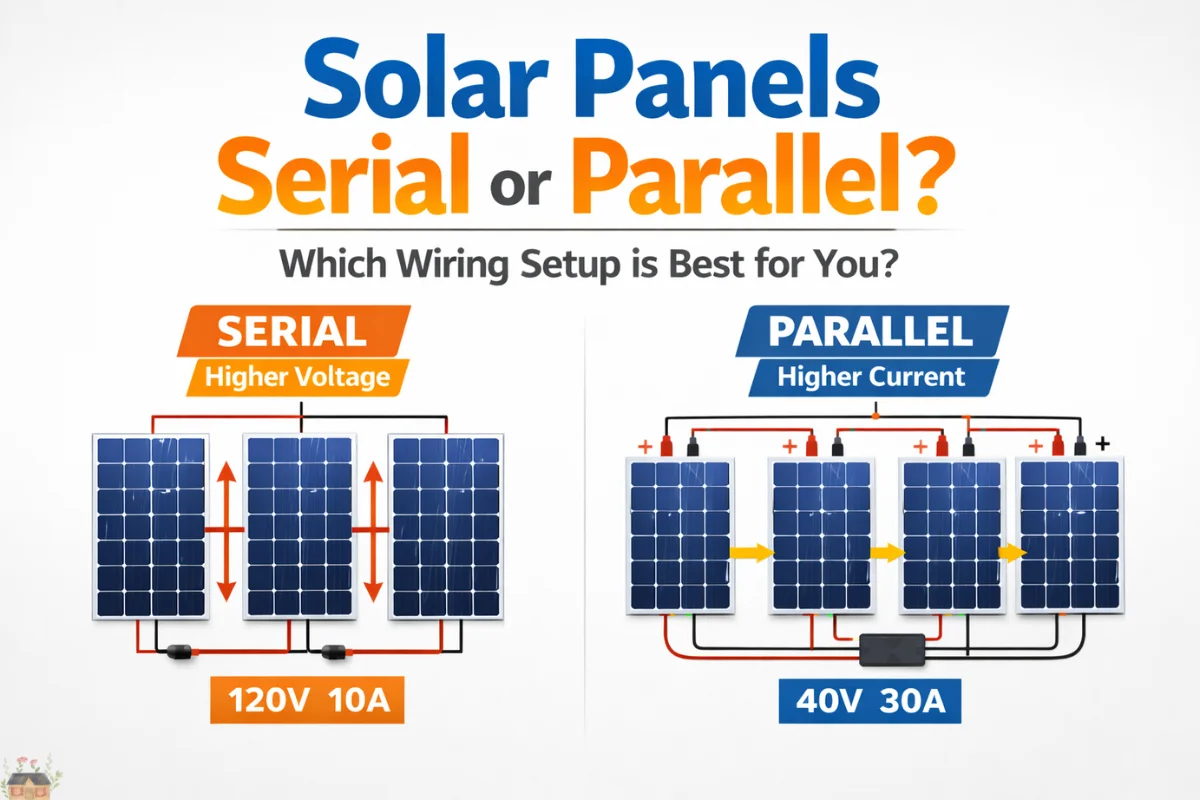
The transition to renewable energy often begins with a fundamental technical decision that dictates the efficiency, cost, and longevity of the entire system. When designing a photovoltaic (PV) array, one of the most critical questions homeowners and installers face is whether to wire solar panels serial or parallel. While both methods serve the primary goal of delivering power from the roof to the battery or grid, they do so by manipulating electrical physics in entirely different ways.
Choosing the wrong configuration can lead to underperforming systems, incompatible components, or even safety hazards. This guide provides a comprehensive technical breakdown of both wiring methods, the impact of environmental factors like shading, and how to determine which setup aligns with your specific energy goals.
The Fundamentals of Solar Electricity
To grasp the difference between serial and parallel wiring, it is necessary to understand two primary electrical measurements: Voltage ($V$) and Amperage ($I$).
-
Voltage is the electrical pressure or force.
-
Amperage is the flow of the electrical current.
-
Wattage ($P$) is the total power produced, calculated by the formula $P = V \times I$.
When we connect multiple solar panels, we are creating a “string.” How we connect those panels determines whether we are increasing the total pressure (voltage) or the total flow (amperage).
What is Serial Wiring?
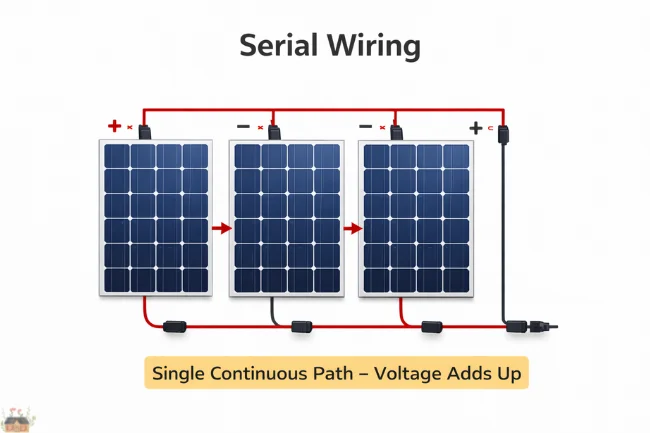
Serial wiring, or connecting panels “in series,” involves connecting the positive terminal of one solar panel to the negative terminal of the next. This creates a single continuous path for the electricity to flow.
How Voltage and Amperage Behave in Series
In a series circuit, the voltages of each individual panel are added together, while the amperage remains the same as that of a single panel. For example, if you have three panels, each rated at 40 volts and 10 amps:
-
Total Voltage: $40V + 40V + 40V = 120V$
-
Total Amperage: $10A$
Advantages of Serial Wiring
-
High-Voltage Efficiency: Higher voltage allows the system to overcome resistance in the wires more effectively. This is particularly beneficial if the distance between the solar array and the inverter is long.
-
Smaller Wire Gauges: Because the amperage remains low, you can use thinner, less expensive wiring without risking overheating or significant power loss.
-
Controller Compatibility: Most modern Maximum Power Point Tracking (MPPT) charge controllers require a higher input voltage than the battery bank voltage to function optimally.
The “Christmas Light” Drawback
The primary disadvantage of serial wiring is its vulnerability to “obstruction.” Much like old-fashioned holiday lights, if one panel in a series is shaded, dirty, or malfunctioning, the performance of the entire string drops to the level of the weakest panel. If a single panel’s output is cut by 50% due to a stray shadow, every panel in that series will also operate at 50% capacity.
Read Also: The Pros and Cons of Bifacial Solar Panels for RVs: Complete Buyer’s Guide
What is Parallel Wiring?
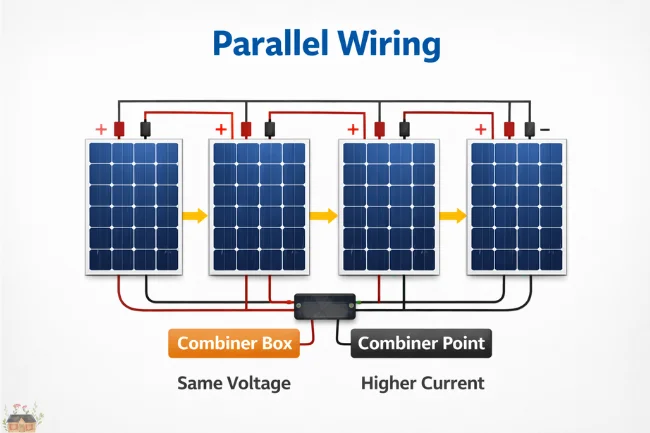
In a parallel configuration, the positive terminals of all panels are connected to a single central “combiner,” and all negative terminals are connected to another. Instead of one long loop, each panel has its own independent connection to the system.
How Voltage and Amperage Behave in Parallel
In a parallel circuit, the amperage of each panel is added together, while the voltage remains the same as that of a single panel. Using the same three 40-volt, 10-amp panels:
-
Total Voltage: $40V$
-
Total Amperage: $10A + 10A + 10A = 30A$
Advantages of Parallel Wiring
-
Shade Resilience: Because each panel operates independently, a shadow falling on one panel will not affect the output of the others. This makes parallel wiring the superior choice for locations with trees, chimneys, or frequent bird activity.
-
Low Voltage Safety: Low-voltage systems are often preferred for small-scale applications like RVs or boats, where maintaining a system under 50V can reduce the risk of high-voltage arcing.
The Downside of High Amperage
The main challenge with parallel wiring is the high current. High amperage requires much thicker (and more expensive) wiring to prevent energy loss through heat. Additionally, you will likely need a combiner box and heavy-duty fuses for each panel to ensure the system remains safe.
Comparing Solar Panels Serial or Parallel
To choose the right configuration, it is helpful to see the direct trade-offs side-by-side.
| Feature | Serial Wiring | Parallel Wiring |
|---|---|---|
| Total Voltage | Sum of all panels | Voltage of one panel |
| Total Amperage | Amperage of one panel | Sum of all panels |
| Wiring Requirements | Thinner, cheaper wires | Thicker, more expensive wires |
| Shade Impact | High (one panel affects all) | Low (panels act independently) |
| Distance to Inverter | Good for long distances | Best for short distances |
| Complexity | Simple “plug and play” | Requires combiner boxes/fuses |
The Role of the Charge Controller
The decision of whether to wire solar panels serial or parallel is often dictated by the Charge Controller. This device sits between the panels and the battery, regulating the energy to ensure the battery isn’t overcharged.
MPPT Controllers (Best for Series)
Maximum Power Point Tracking (MPPT) controllers are sophisticated. They can take high-voltage, low-amp power from a series string and “convert” it into the lower-voltage, high-amp power needed to charge a battery. This allows you to reap the benefits of high-voltage transmission without damaging your battery bank.
PWM Controllers (Best for Parallel)
Pulse Width Modulation (PWM) controllers are simpler and less expensive. However, they cannot “transform” voltage. They essentially act as a switch. If you have a 12V battery and a series string producing 80V, a PWM controller will waste the majority of that energy. Therefore, systems using PWM controllers almost always require parallel wiring to keep the array voltage close to the battery voltage.
Read Also: HMS Photovoltaik: Achieve Amazing Energy Freedom
Series-Parallel Hybrid Arrays
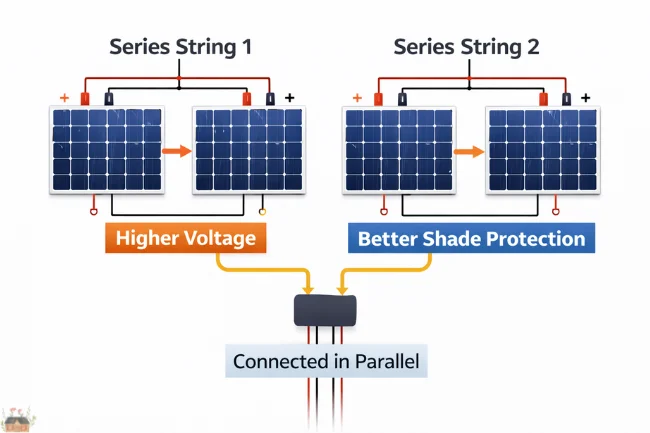
In large residential installations, you aren’t strictly limited to one or the other. Many professionals use a series-parallel configuration. This involves creating several small strings (panels in series) and then connecting those strings to each other in parallel.
This hybrid approach offers a “best of both worlds” scenario:
-
It increases the voltage enough to satisfy an MPPT controller and use efficient wiring.
-
It provides redundancy; if one string is shaded, the other strings continue to produce power at full capacity.
Critical Factors for Decision Making
When determining how to wire your array, consider these four variables:
1. Environmental Shading
Does your roof have consistent sun, or do nearby structures cast shadows at certain times of the day? If your roof is prone to partial shading, parallel wiring or the use of Microinverters (which essentially make every panel its own system) is highly recommended.
2. Distance and Voltage Drop
Electricity loses energy as it travels through a wire, a phenomenon known as voltage drop. This loss is more pronounced at low voltages and high amperages. If your solar panels are located 50 feet or more from your batteries or inverter, wiring in series is almost always the better choice to minimize energy waste.
3. Equipment Specifications
Every inverter and charge controller has a “Maximum Input Voltage” and a “Maximum Input Current.”
-
If you exceed the voltage limit (common in series), you can fry the electronics instantly.
-
If you exceed the current limit (common in parallel), the controller will simply “clip” the excess power, leading to wasted energy.
4. Expansion Plans
If you plan to add more panels in the future, parallel wiring is generally more forgiving. You can add more panels to a combiner box easily, provided your controller can handle the extra current. Adding to a series string often requires ensuring the new panels have identical specs to the old ones to avoid bottlenecking the system.
Technical Safety and Hardware
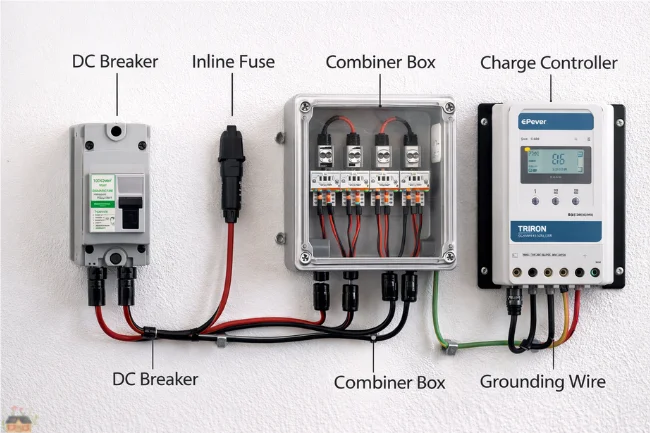
Regardless of the wiring method, safety components are non-negotiable.
Bypass Diodes
Most modern panels come with internal bypass diodes. These are designed to mitigate the “Christmas light” effect in series wiring by allowing current to flow around a shaded cell. While helpful, they are not a perfect fix and do not replace the inherent shade-resilience of parallel wiring.
Overcurrent Protection
In parallel systems, if one panel shorts out, the other panels could send their combined current into the shorted panel, causing a fire. This is why parallel strings require inline fuses. In a simple series string, this is usually not a concern because the current cannot exceed the rating of a single panel.
Practical Application: Real-World Scenarios
Scenario A: The Off-Grid Cabin
An off-grid cabin uses two 200W panels and a 12V battery system with a PWM controller.
-
Recommendation: Parallel. The PWM controller needs the voltage to stay near 12V-18V. Series wiring would push the voltage to 40V+, which the PWM controller cannot utilize efficiently.
Scenario B: The Suburban Home
A home has twelve 400W panels on a clear, south-facing roof with an MPPT inverter located in the garage.
-
Recommendation: Series or Series-Parallel. The high voltage will allow for thin wiring runs through the attic and high efficiency at the inverter. Since there is no shade, the risks of series wiring are minimal.
Summary of Key Takeaways
The choice between wiring solar panels serial or parallel depends on balancing the limitations of your hardware with the realities of your environment.
-
Series is the king of efficiency and simplicity for clear, unshaded areas and long wire runs.
-
Parallel is the reliable workhorse for complex environments where shade is unavoidable or where low-voltage safety is a priority.
-
Hybrid configurations provide the necessary flexibility for large-scale systems to maximize output while maintaining safety.
Before finalizing your installation, always consult the data sheets for your panels and your charge controller. Calculating the “Cold Weather Voltage” is particularly important for series strings, as solar panels produce higher voltage in freezing temperatures, which can inadvertently exceed your controller’s limits.
If you are looking for specific hardware recommendations or need help calculating the voltage drop for your specific wire length, your next step should be to use a string sizing calculator or consult with a certified solar technician to ensure your design is both safe and optimized for your local climate.
Frequently Asked Questions
Can I mix different brands of solar panels in series or parallel?
It is generally discouraged. In a series, the entire string is limited by the panel with the lowest amperage. In parallel, the system is limited by the panel with the lowest voltage. If you must mix panels, ensure their electrical ratings ($V_{mp}$ and $I_{mp}$) are as close as possible to avoid significant power loss.
Does serial or parallel wiring charge batteries faster?
Neither is inherently faster; speed depends on total wattage. However, an MPPT controller in a series setup often harvests more energy in low-light conditions (dawn/dusk) because the higher voltage “wakes up” the controller earlier than a low-voltage parallel setup would.
Is parallel wiring safer than series wiring?
Parallel wiring uses lower voltage, which reduces the risk of electrical shock. However, it uses much higher current, which increases the risk of heat buildup and fire if the wiring is undersized. Both are safe if designed according to electrical codes and properly fused.
What happens if I connect panels of different wattages in series?
If you connect a 100W panel (5A) with a 300W panel (10A) in series, the 300W panel will be forced to operate at 5A. You will effectively turn your 300W panel into a 150W panel, wasting half of its potential.
Do I need a combiner box for series wiring?
Usually, no. Series panels are typically connected directly to each other using their built-in MC4 connectors. A combiner box is generally only required for parallel configurations or when joining multiple series strings together.
Learn about Solar Brackets for 365 W Solar Panel
For broader information, visit Wellbeing Makeover

I’m Salman Khayam, the founder and editor of this blog, with 10 years of professional experience in Architecture, Interior Design, Home Improvement, and Real Estate. I provide expert advice and practical tips on a wide range of topics, including Solar Panel installation, Garage Solutions, Moving tips, as well as Cleaning and Pest Control, helping you create functional, stylish, and sustainable spaces that enhance your daily life.