
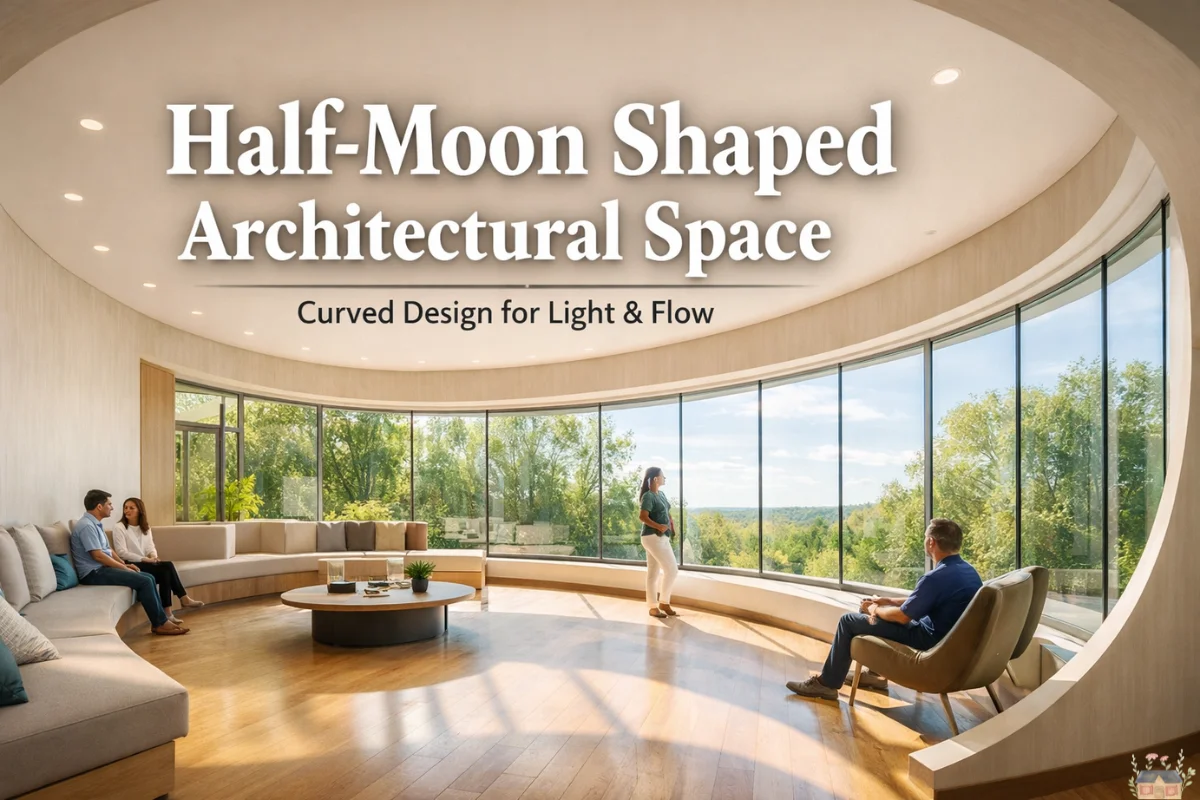
A half-moon shaped architectural space, often referred to as a semicircular or segmental design, is a structural layout defined by a 180-degree arc. Historically rooted in classical amphitheaters and lunettes, this geometry is utilized today to improve acoustic performance, maximize natural light, and create fluid, organic transitions within modern residential and commercial buildings.
The Geometry of Curvilinear Design
Architecture has long been dominated by the efficiency of the right angle. However, the introduction of the half-moon shaped architectural space challenges the rigid constraints of linear design, offering a softer, more intuitive approach to spatial organization. From a mathematical perspective, the semicircle provides a unique balance between the enclosure of a circle and the accessibility of a flat plane.
When a designer opts for a curved boundary, they are often looking to solve specific environmental or psychological challenges. Unlike a full circle, which can feel isolating or directionless, a half-moon shape provides a clear “back” (the diameter) and an “expansive front” (the arc). This orientation makes it particularly effective for gathering spaces, as it naturally directs attention toward a focal point while maintaining a sense of embrace for those within the curve.
Historical Significance: From Ancient Rome to Neoclassicism
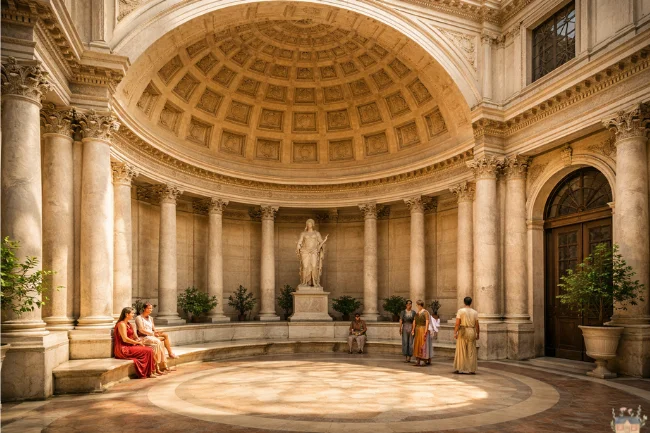
The half-moon shape is not a modern invention; it is a fundamental element of classical architectural vocabulary. To understand its current application, one must look at its origins in monumental construction.
The Roman Influence
The Romans were masters of the arch and the vault. The semicircular “exedra”—a room or alcove with a curved back—was a staple of Roman villas and public baths. These spaces were designed for conversation and reflection. The shape allowed multiple people to sit facing one another without the awkwardness of a long, straight bench, facilitating a democratic flow of dialogue.
The Rise of the Lunette
In Renaissance and Neoclassical architecture, the “lunette” became a primary decorative and functional element. A lunette is a half-moon shaped space located above a door or window. While often filled with frescoes or stained glass, its structural purpose was to distribute weight away from the opening while allowing light to penetrate deeper into vaulted ceilings.
Read Also: Is a Barn an Architectural Feature? Key Insights
Functional Advantages of a Half-Moon Shaped Architectural Space
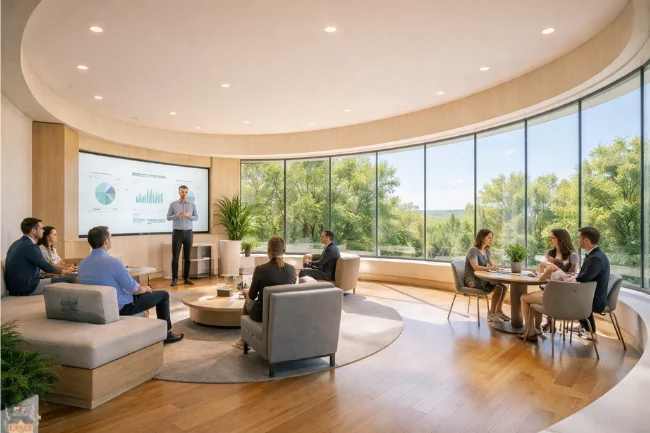
While aesthetic beauty is a significant driver, the decision to implement a half-moon shaped architectural space is frequently rooted in high-performance functional requirements.
1. Superior Acoustic Distribution
Sound waves behave differently when they encounter a curved surface compared to a flat one. In a rectangular room, sound often reflects off parallel walls, creating echoes or “standing waves.” A half-moon shape scatters sound more evenly. This is why many of the world’s most prestigious concert halls and legislative chambers utilize a semicircular layout. It ensures that a speaker at the center of the diameter can be heard clearly by everyone along the arc without the need for heavy electronic amplification.
2. Optimization of Natural Light
A curved glass wall or a series of windows arranged in a half-moon shape captures sunlight from multiple angles as the sun moves across the sky. Unlike a flat window that may only receive direct light for a few hours, a semicircular window array tracks the solar path more effectively. This reduces the need for artificial lighting and can contribute to the thermal heating of a space in colder climates.
3. Enhanced Circulation and Flow
In high-traffic commercial buildings, corners are often “dead zones” where movement slows down. A half-moon shaped architectural space eliminates these sharp turns, encouraging a more fluid “centrifugal” movement. People naturally move in paths that require the least resistance, and the gentle curve of a semicircle mimics the organic way humans navigate their environment.
Comparison: Rectangular vs. Half-Moon Spatial Dynamics
| Feature | Rectangular Space | Half-Moon Shaped Space |
|---|---|---|
| Acoustics | High risk of echo; requires dampening. | Natural sound diffusion; ideal for clarity. |
| Lighting | Static; limited to the window’s orientation. | Dynamic; captures light from various solar angles. |
| Social Interaction | Hierarchical; focus is often at one end. | Egalitarian; encourages face-to-face contact. |
| Space Efficiency | High; easy to furnish with standard items. | Moderate; requires custom or curved furniture. |
| Structural Complexity | Low; standard framing and materials. | High; requires specialized masonry or glasswork. |
Modern Applications in Contemporary Architecture
Today, architects use the half-moon shape to break the monotony of urban landscapes. We see this geometry appearing in three primary areas:
Residential Sunrooms and Bump-outs
In residential design, a “bow window” or a semicircular conservatory creates a transition zone between the indoors and the outdoors. By extending a half-moon shaped architectural space into a garden, homeowners gain a panoramic view that a standard flat window cannot provide. It creates a “nook” feeling—a sense of being protected while simultaneously being exposed to nature.
Public Plazas and Amphitheaters
Urban planners use the half-moon shape to define public gathering spots. A semicircular stone bench or a raised half-moon stage creates a natural “urban living room.” It signals to pedestrians that this is a place to stop, sit, and observe, rather than just a thoroughfare.
Corporate Atriums
Modern office buildings often feature a half-moon shaped atrium to serve as the heart of the structure. By using this shape for a central lobby, a company can create a grand sense of arrival. The curve draws the eye upward and around, making the interior feel more expansive than its actual square footage might suggest.
Read Also: How Is the Agha Bozorg Mosque Architecture Categorized?
Challenges in Designing Semicircular Spaces
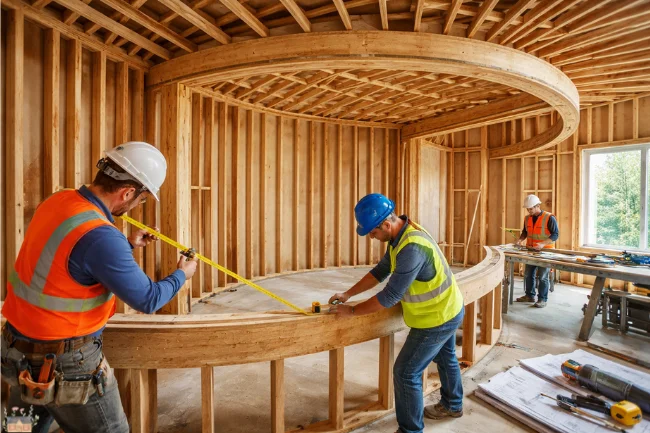
Despite the many benefits, integrating a half-moon shaped architectural space requires meticulous planning and a higher budget than traditional builds.
-
Material Waste: Most building materials—drywall, plywood, and glass—are manufactured in rectangular sheets. Creating a curve involves cutting these materials down, leading to higher waste percentages or the need for expensive, pre-bent components.
-
Furnishing Difficulties: Standard furniture is designed for 90-degree corners. Placing a rectangular sofa against a curved wall creates awkward gaps. To fully utilize a half-moon space, interior designers often have to commission custom-curved seating or built-in cabinetry, which adds to the overall project cost.
-
Engineering Precision: Calculating the load-bearing capacity of a curved beam or “header” requires more complex structural engineering than a straight lintel. Any slight deviation in the radius can lead to issues during the installation of windows or roofing.
The Psychological Impact of the Curve
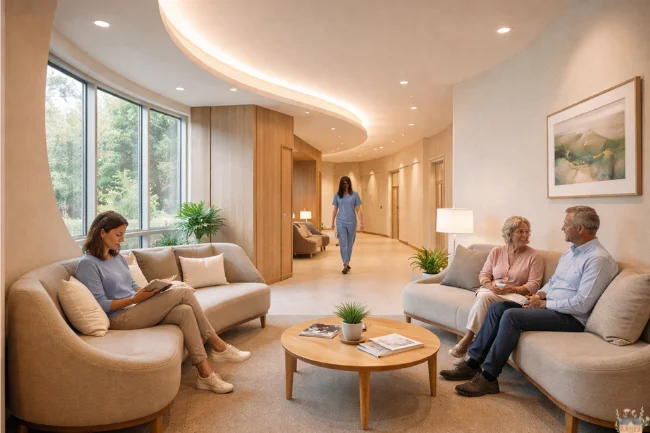
There is a growing body of research in the field of neuro-architecture suggesting that humans have a biological preference for curved lines. Sharp angles and jagged edges often trigger a subtle “threat” response in the amygdala, associated with the danger of sharp objects in nature.
Conversely, the half-moon shaped architectural space is perceived as “soft” and “safe.” In healthcare settings, particularly in mental health facilities and pediatric wards, architects are increasingly using curved walls to reduce patient anxiety. The lack of sharp corners creates a calming environment that feels less institutional and more protective.
Environmental Sustainability and the Semicircle
From a sustainability perspective, the half-moon shape can be highly efficient regarding the “surface-area-to-volume” ratio. While a circle is the most efficient, the half-moon offers a compromise that allows for better integration with existing rectangular grids while still reducing the exterior wall area through which heat can escape.
When oriented correctly (for example, facing south in the northern hemisphere), a half-moon shaped architectural space acts as a solar collector. The curve can be designed to allow deep winter sun to penetrate the building for passive heating while using an overhanging “eyebrow” roof to block the high, intense summer sun.
FAQ: Common Questions About Half-Moon Architectural Designs
1- What is the difference between a crescent and a half-moon shaped architectural space?
In architectural terms, a half-moon space is a perfect semicircle (180 degrees) with a flat diameter. A crescent shape is a “lune,” where two different circular arcs intersect, creating two pointed ends. While both are curvilinear, the half-moon is typically more functional for interior floor plans due to the stable, straight back wall.
2- Are half-moon shaped spaces more expensive to build?
Generally, yes. The costs are higher due to the need for specialized labor, such as skilled masons or carpenters who can work with radii. Additionally, materials like curved glass or radius-cut stone carry a premium price tag compared to standard off-the-shelf rectangular components.
3- How do you furnish a room with a curved wall?
The most effective way to furnish a half-moon shaped architectural space is through built-in furniture that follows the arc. If custom work isn’t an option, using circular area rugs, round coffee tables, or “floating” the furniture away from the walls can help the room feel cohesive rather than cluttered by “corner gaps.”
4- Is a half-moon shape good for small rooms?
It can be, but it must be handled carefully. In a small space, a curve can actually make the room feel larger by removing the visual boundaries of corners. However, it can also create “dead space” that is hard to use for storage. Using the curve for a window or a seating nook is usually the best application in small footprints.
5- What architectural style uses the half-moon shape most often?
While it is found in many styles, it is most prominent in Art Deco, Neoclassical, and Modern Organic architecture. Art Deco often uses the “streamline” curve for balconies and entryways, while Neoclassical architecture uses the shape for formal porticos and grand windows.
Final Considerations on Semicircular Integration
The half-moon shaped architectural space remains one of the most versatile and visually striking tools in a designer’s arsenal. It bridges the gap between the rigid efficiency of modernism and the organic beauty of the natural world. Whether used to capture the morning sun in a breakfast nook or to carry the hushed tones of a lecture hall, this geometry serves as a reminder that the shortest distance between two points is not always the most beautiful or functional path.
When planning a project that incorporates these curves, the key is to balance the aesthetic “wow factor” with the practical realities of construction and interior utility. When executed with precision, these spaces do more than just house activities; they shape the way we feel and interact within the built environment.
Learn about Why Interior Design is Interesting Mintpaldecor
For broader information, visit Wellbeing Makeover

I’m Salman Khayam, the founder and editor of this blog, with 10 years of professional experience in Architecture, Interior Design, Home Improvement, and Real Estate. I provide expert advice and practical tips on a wide range of topics, including Solar Panel installation, Garage Solutions, Moving tips, as well as Cleaning and Pest Control, helping you create functional, stylish, and sustainable spaces that enhance your daily life.