
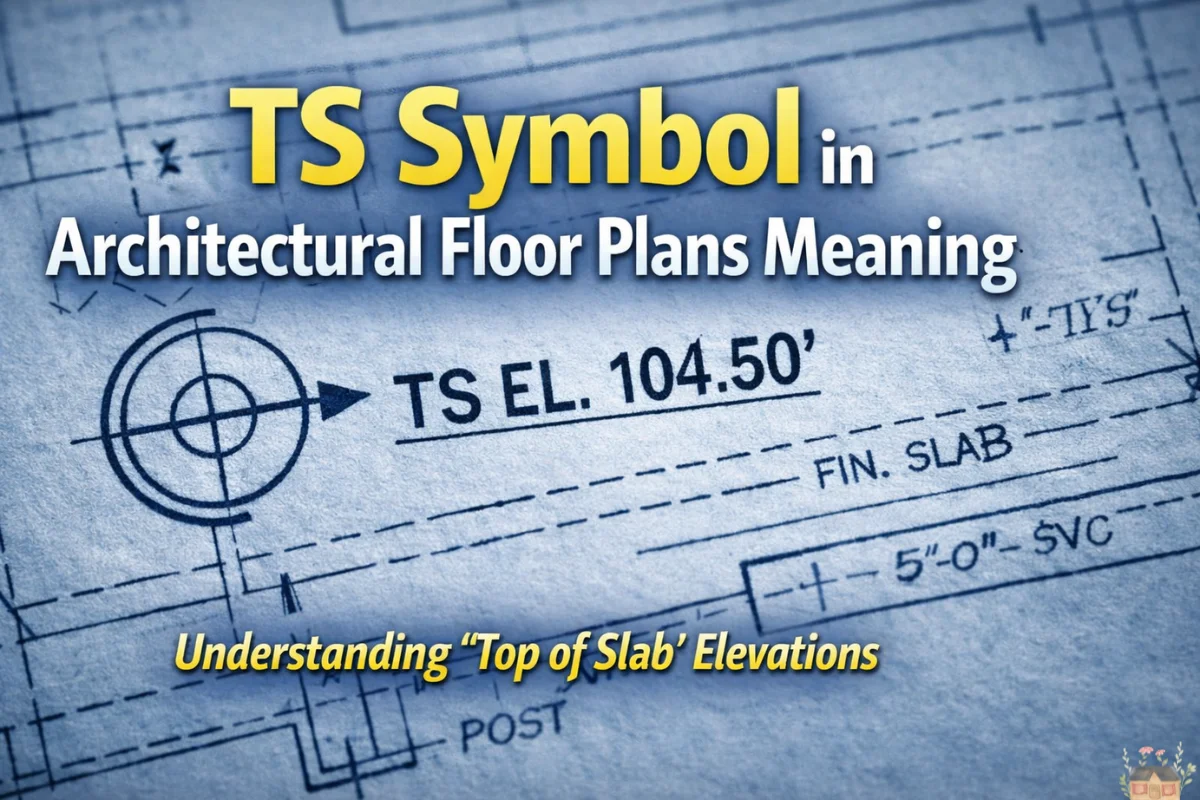
The TS symbol in architectural floor plans meaning typically refers to a “Top of Slab” elevation marker. It indicates the precise vertical height of a concrete slab’s finished surface relative to a project benchmark or sea level, ensuring structural accuracy during every phase of construction.
The Role of Symbols in Architectural Communication
Architectural blueprints serve as the technical manual for the construction industry. These documents translate a designer’s vision into data that engineers, contractors, and inspectors use to build safe structures. Within these complex drawings, abbreviations and symbols act as a shorthand to keep the pages clean while conveying critical site data.
Among the various notations found on a foundation or floor plan, elevation markers are perhaps the most vital for the structural integrity of the build. When a professional encounters “TS” on a drawing, they are looking at a directive regarding the vertical positioning of the building’s base. Understanding the TS symbol in architectural floor plans meaning is essential for anyone involved in site preparation, pouring, or framing.
Deciphering the TS Symbol in Architectural Floor Plans Meaning
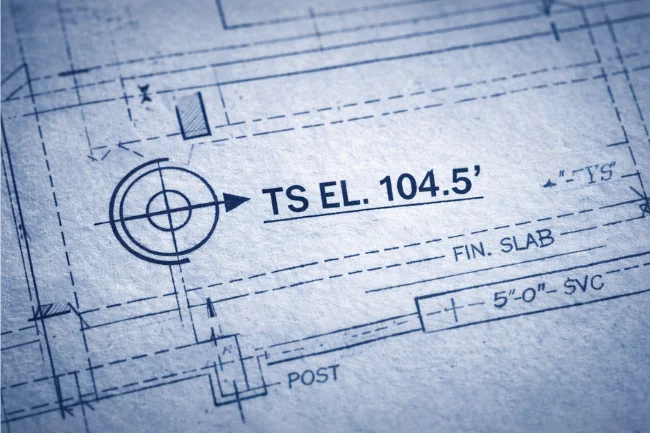
The “TS” abbreviation stands for Top of Slab. In the context of a floor plan or a foundation detail, it identifies the exact finished height of the concrete slab. This is a “spot elevation,” meaning it applies to the specific point or area where the symbol is placed on the blueprint.
In most cases, the TS symbol is accompanied by a numerical value. For example, you might see “TS EL. 104.5’”. This tells the concrete contractor that the top surface of the poured concrete must reach an elevation of 104.5 feet based on the project’s established datum.
Why Top of Slab Matters
The Top of Slab is the “zero point” for many other architectural elements. If the slab is poured at an incorrect height, several cascading issues can occur:
-
Door Thresholds: If the slab elevation is incorrect, exterior doors may not meet the ground properly, leading to water infiltration or tripping hazards.
-
Stair Geometry: Building codes are very strict regarding riser heights. A minor variance in the slab height can make the first step of a staircase illegal or unsafe.
-
Plumbing Rough-ins: Drain pipes are set before the slab is poured. If the TS elevation doesn’t match the design, the pipes might end up buried too deep or protruding too high for the fixtures.
-
Clearance Heights: In commercial buildings, the distance between the TS and the bottom of the ceiling joists must meet specific fire codes and utility requirements.
Read Also: Why Interior Design is Interesting Mintpaldecor: Top Insights
Distinguishing the TS Symbol in Architectural Floor Plans Meaning from FFE
To fully grasp the TS symbol in architectural floor plans meaning, it is helpful to compare it to other common elevation markers. Architects use different codes to specify different “layers” of the floor assembly.
TS vs. FFE: The Critical Difference
One of the most common points of confusion for homeowners and junior designers is the difference between TS (Top of Slab) and FFE (Finished Floor Elevation).
The TS represents the structural concrete. However, if the design calls for a thick hardwood floor or a radiant heating system topped with tile, the final surface the occupant walks on will be higher than the slab. If a floor plan shows TS 100.0′ and the flooring material is 2 inches thick, the FFE will be 100.16′. Failing to account for this “build-up” can lead to errors in cabinetry installation and appliance fitting.
How the TS Symbol in Architectural Floor Plans Meaning Varies by Drawing Type
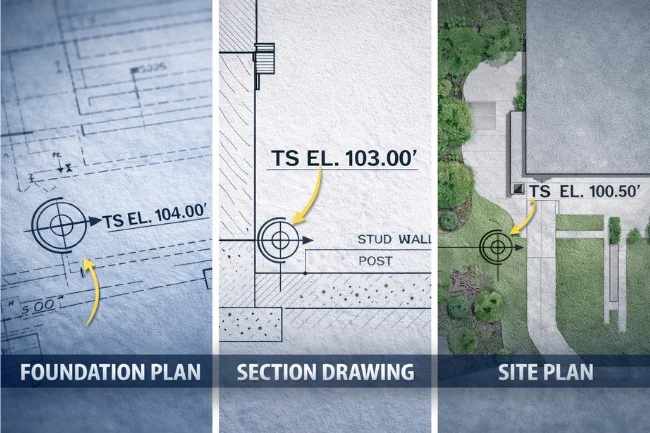
The TS symbol does not exist in a vacuum; its application shifts slightly depending on which page of the blueprint set you are viewing.
Foundation Plans
On a foundation plan, the TS symbol is the primary guide for the site crew. It dictates the “pour height.” In areas with varying topography, a single building might have multiple TS notations. For instance, a “stepped foundation” on a hillside might have a TS of 98.0′ at the front and a TS of 94.0′ at the rear.
Section Drawings
Architectural sections provide a “cut-through” view of the building. In these drawings, the TS symbol is often represented by a target-like icon (a circle divided into quadrants) with a line pointing to the top edge of the concrete. This helps the framer understand exactly where the sill plate or wall studs begin in relation to the ground.
Site Plans and Grading
On a site plan, the TS is used to ensure the building sits correctly within the landscape. Engineers use the TS elevation to design the “grading” (the slope of the dirt) around the house. The ground must always slope away from the TS to prevent basement flooding and foundation erosion.
Read Also: Is a Barn an Architectural Feature? Key Insights
Technical Variations of the TS Symbol in Architectural Floor Plans Meaning
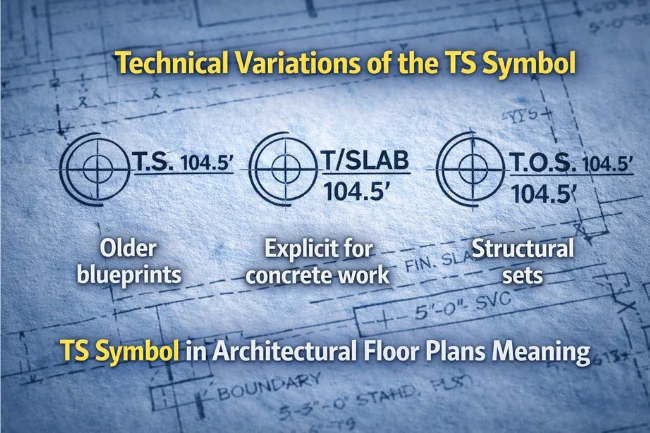
While “TS” is the industry standard, architectural firms may use variations based on regional preferences or software defaults (like Revit or AutoCAD). You may occasionally see:
-
T.S.: Using periods is more common in older, hand-drawn blueprints.
-
T/SLAB: A more explicit version used when clarity is paramount for the concrete sub-contractor.
-
T.O.S.: Common in structural engineering sets to avoid confusion with “Thermal Steel” or other trade-specific terms.
Regardless of the specific lettering, if the symbol is located on a horizontal surface in a section or floor plan, it almost certainly refers to the slab elevation.
The Importance of Benchmarks and Datums in Elevation Mapping
To understand what a TS value like “102.5” actually means, you must identify the Datum. A datum is the starting point for all vertical measurements on a job site.
-
Mean Sea Level (MSL): Large commercial projects and those in flood-prone areas often use the actual elevation above sea level. In this case, a TS of 15.0′ means the slab is 15 feet above sea level.
-
Relative Datum (Project Zero): On smaller residential jobs, an architect might pick a fixed, immovable object—like a fire hydrant or a manhole cover—and designate it as 100.0′. Every TS symbol in the plans is then calculated relative to that 100-foot mark.
If the surveyor misidentifies the benchmark, every TS symbol on the architectural floor plan becomes inaccurate, which can lead to catastrophic legal and structural consequences, especially regarding local height restrictions and flood zone compliance.
Practical Insights for Reading TS Markers Correctly
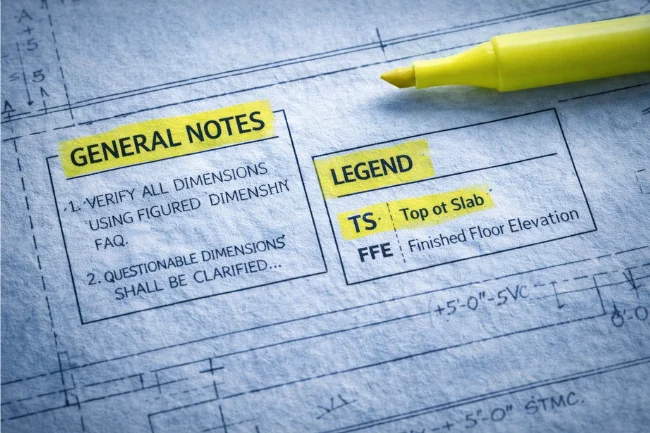
When reviewing plans, always look for the “General Notes” section, usually found on the first or second page (often Sheet A1.1 or G0.1). This section will explicitly define the abbreviations used throughout the set. If the TS symbol in architectural floor plans meaning is not listed there, check the legend on the foundation sheet.
Checking for Slope
It is a common mistake to assume a slab is perfectly flat. In garages, laundry rooms, or commercial kitchens, the slab is often sloped toward a floor drain. In these cases, you may see two TS symbols: one for the “high point” and one for the “low point.” These are critical for ensuring water flows in the intended direction rather than pooling against walls.
Common Errors Related to Slab Elevations
Even with a clear understanding of the symbol, errors can occur during the transition from paper to the physical site.
-
Confusing “Top of Footing” with “Top of Slab”: The footing is the wider concrete base that sits beneath the slab. Confusing “TF” (Top of Footing) with “TS” can result in the entire building being set several feet too low in the ground.
-
Ignoring Sub-Slab Components: The TS elevation accounts for the concrete, but beneath that concrete is usually a layer of crushed stone and a vapor barrier. Excavation must go deeper than the TS elevation to accommodate these layers.
-
Metric vs. Imperial Units: In international projects, verify if the TS is in meters or feet/inches. A TS of 3.0 in a metric plan is vastly different from a TS of 3.0 in an imperial plan.
Frequently Asked Questions
1- What does TS mean on a foundation plan?
On a foundation plan, TS stands for “Top of Slab.” It indicates the required vertical elevation for the finished surface of the concrete floor. This measurement is crucial for contractors to ensure the building is level and sits at the correct height relative to the surrounding terrain and utility connections.
2- Is TS the same as FFE?
No, TS (Top of Slab) and FFE (Finished Floor Elevation) are different. TS refers specifically to the structural concrete surface. FFE refers to the final height of the floor after finishes like tile, carpet, or hardwood are installed. FFE is always equal to or higher than the TS elevation because it includes the thickness of the flooring material.
3- How do I find the TS value if it’s not labeled on every room?
If a specific area isn’t labeled with a TS symbol, look for a nearby elevation marker or check the “Building Sections”. Often, the TS is established on a main section drawing (like 1/A3.1) and applies to the entire floor unless a “Step” or “Depression” is noted elsewhere on the floor plan.
4- Why do some plans use TOS instead of TS?
“TOS” is an alternative abbreviation for “Top of Slab” or “Top of Steel.” While “TS” is more common in residential architectural floor plans, structural engineers often prefer “TOS” or “T.O.S.” to be more explicit. Both symbols generally convey the same elevation data regarding the top surface of the horizontal structural element.
5- What happens if the TS is poured at the wrong elevation?
An incorrect TS elevation can cause major structural and functional issues. It may lead to stairs that don’t meet building codes, exterior doors that won’t open properly, or improper drainage. Correcting a slab that was poured too high often requires expensive concrete grinding or structural modifications to the rest of the building’s framing.
Summary of Architectural Elevation Standards
The TS symbol in architectural floor plans meaning is a fundamental piece of data that bridges the gap between architectural design and physical construction. By denoting the “Top of Slab” elevation, this symbol ensures that every subsequent component of the building—from walls and stairs to plumbing and finishes—is positioned correctly in vertical space.
When reading blueprints, always verify the project datum, distinguish between the slab height and the finished floor height, and consult the legend to ensure consistency across all trade drawings. Understanding these technical nuances prevents costly field errors and ensures the long-term viability of the structure.
If you are currently reviewing blueprints for a renovation or new build and encounter unfamiliar symbols beyond the TS marker, your next step should be to cross-reference your floor plans with the structural engineering set to ensure all elevations align across both disciplines.
Learn about Half-Moon Shaped Architectural Space
For broader information, visit Wellbeing Makeover

I’m Salman Khayam, the founder and editor of this blog, with 10 years of professional experience in Architecture, Interior Design, Home Improvement, and Real Estate. I provide expert advice and practical tips on a wide range of topics, including Solar Panel installation, Garage Solutions, Moving tips, as well as Cleaning and Pest Control, helping you create functional, stylish, and sustainable spaces that enhance your daily life.