
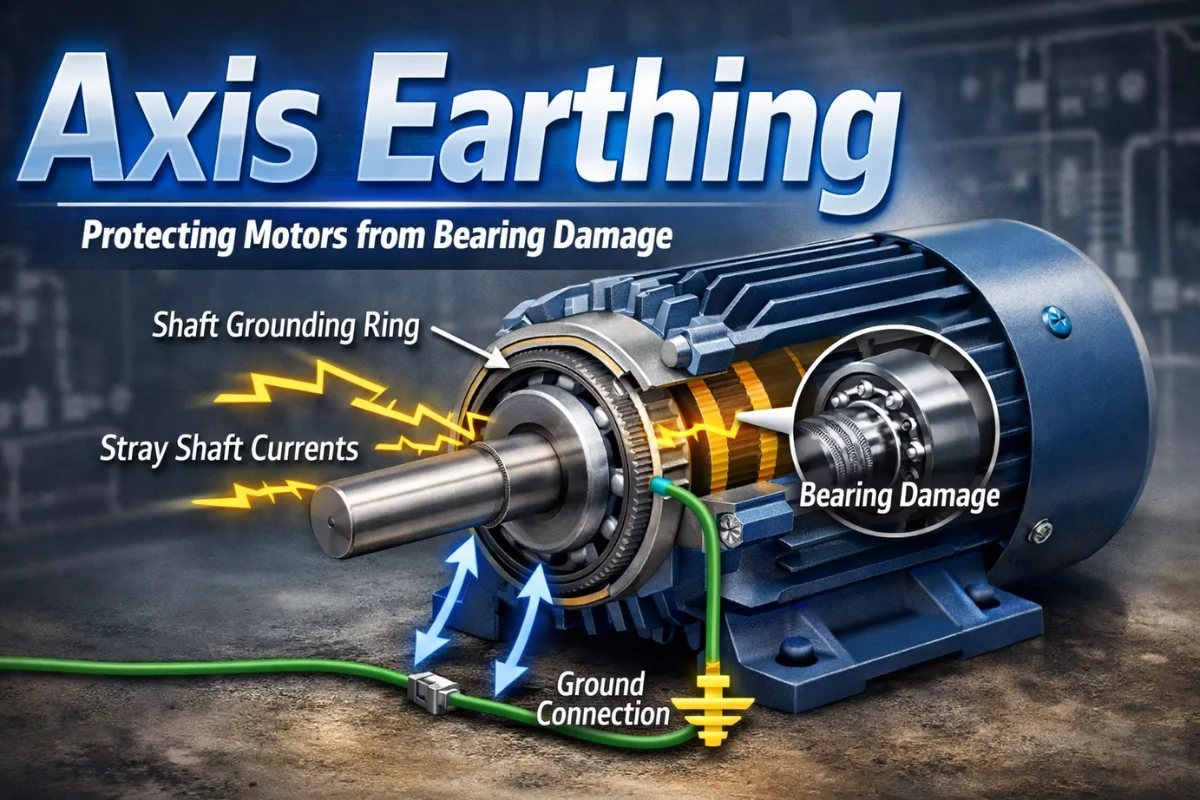
Axis earthing is a grounding technique used to safely dissipate stray electrical currents that accumulate on the rotating shafts of electric motors, generators, and similar equipment. Without this protection, those currents discharge through the bearings, causing premature mechanical failure. Axis earthing provides a controlled path to ground, extending equipment life and reducing unplanned downtime.
Understanding the Problem: Stray Shaft Currents
Electric motors and generators are everywhere in modern infrastructure — from industrial manufacturing floors to HVAC systems in commercial buildings and the inverters behind solar panel installations. While these machines are engineered to exacting standards, one persistent issue continues to shorten their operational lifespan: stray electrical currents on rotating shafts.
When a motor operates, it generates magnetic flux. In a perfectly balanced machine, that flux cancels out, and no net voltage appears on the shaft. In practice, however, slight asymmetries in the laminated stator core, air gap irregularities, and the widespread use of variable frequency drives (VFDs) all create conditions where voltage builds up on the shaft — a phenomenon known as shaft voltage.
If that voltage has nowhere controlled to go, it will discharge through the path of least resistance. More often than not, that path runs straight through the motor’s own bearings. The resulting micro-discharges — called electrical discharge machining, or EDM — pit and erode the bearing raceways, causing a characteristic washboard pattern known as fluting. The bearing then runs rough, generates excess heat, and eventually fails.
Axis earthing addresses this at the source by giving shaft current a low-resistance path directly to ground before it can reach the bearings.
How Axis Earthing Works
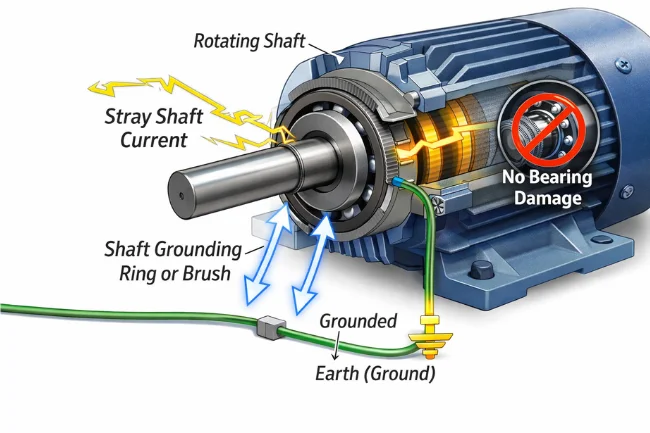
The core principle is straightforward: establish continuous electrical contact between the rotating shaft and the grounded motor frame or earth terminal. This creates a bypass circuit. Shaft voltage that would otherwise build up and discharge destructively through the bearings is continuously bled away at a safe, controlled level.
Effective axis earthing systems must maintain reliable contact with a spinning shaft — sometimes rotating at thousands of revolutions per minute — without introducing friction that damages the shaft surface or creates its own wear problem. This requirement has led to several different engineering approaches, each with its own strengths and appropriate use cases.
Technical documentation from organizations such as AXIS India’s earthing and lightning protection guidelines illustrates how grounding best practices apply across both rotating machinery and broader electrical protection systems, reinforcing the importance of a holistic approach to earthing in any facility.
Common Axis Earthing Methods
Shaft Grounding Rings
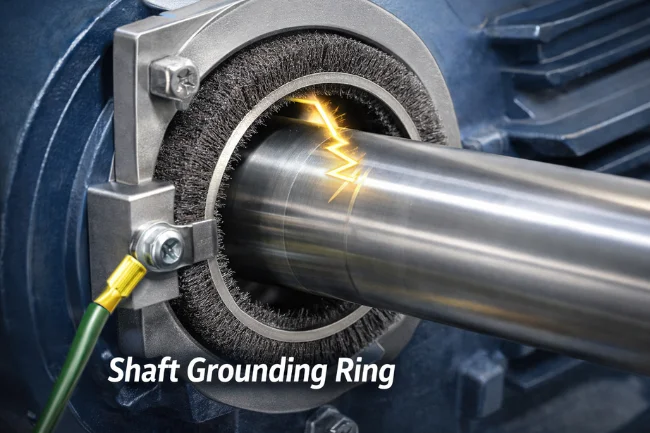
Shaft grounding rings — sometimes called conductive microfiber rings — are among the most widely adopted solutions for VFD-driven motors. These devices mount to the motor frame and place thousands of conductive carbon microfibers in continuous 360-degree contact with the shaft surface. The microfibers are fine enough that they exert virtually no drag, yet they maintain reliable electrical contact even at high rotational speeds.
The advantage of this design is its consistency. Because the fibers contact the shaft continuously rather than intermittently, shaft voltage bleeds away steadily rather than accumulating between contact events. Manufacturers report bearing life extensions of several times the unprotected baseline in properly fitted installations.
Carbon and Metal Grounding Brushes
Traditional grounding brushes consist of a block of conductive material — typically carbon, graphite, or a carbon-metal composite — mounted in a holder that presses it against the shaft or a dedicated slip ring. These are particularly common in larger industrial motors and generators where the shaft diameter and power levels are too large for microfiber ring designs.
Brushes require periodic inspection and replacement as the contact material wears down. In high-load applications, brush wear rate becomes an important maintenance planning factor. Brush holders also need to maintain the correct contact pressure: too light and the contact becomes intermittent; too heavy and wear accelerates.
Insulated Bearings
Rather than grounding the shaft, insulated bearings interrupt the current path at the bearing itself. A ceramic coating or sleeve isolates the bearing’s inner or outer race, preventing current from flowing through it even if shaft voltage builds up. This approach is typically used on the non-drive end of a motor as a complementary measure alongside shaft grounding on the drive end, ensuring that current cannot find an alternate return path.
Conductive Shaft Coatings and Grease
For lightly loaded or lower-speed applications, conductive grease or metallic coatings applied to the shaft can provide a degree of electrical continuity. These are generally considered supplemental measures rather than primary grounding solutions, since their electrical performance degrades over time and with temperature cycling.
Axis Earthing Methods at a Glance
The table below summarizes the key differences between the most commonly used axis earthing approaches:
Where Axis Earthing Is Most Critical
Axis earthing is not equally necessary across all motor-driven equipment. Its importance scales with the severity of the shaft voltage problem, which in turn depends on several factors.
- Variable frequency drives (VFDs): VFDs are the single biggest driver of bearing current damage in modern installations. The high-frequency switching of a VFD creates common-mode voltage that couples capacitively to the shaft. Motors controlled by VFDs should almost always be assessed for shaft grounding.
- Motor power and frame size: Larger motors generate stronger electromagnetic fields and have more mass to accumulate charge. Above roughly 100 horsepower, the case for axis earthing becomes particularly strong.
- Long cable runs between VFD and motor: Long cables increase parasitic capacitance, worsening common-mode current. Where cable runs exceed 50 feet, shaft grounding measures warrant serious consideration.
- High-duty-cycle applications: Equipment that runs continuously — such as pumps, fans, and compressors — accumulates far more bearing EDM damage over time than intermittently operated machinery. This is equally relevant in residential and commercial settings where equipment like pool pumps or solar charge controllers with integrated motors operate for extended periods.
Axis Earthing in Building and Facilities Contexts
While axis earthing is most commonly discussed in heavy industrial settings, its principles apply to any building or facility that houses motor-driven equipment. HVAC chillers, elevator drives, commercial exhaust systems, and data center cooling units all involve motors large enough to benefit from a shaft grounding assessment. Facilities managers and electrical contractors responsible for these systems increasingly treat axis earthing as part of standard motor maintenance planning rather than an afterthought.
Even in residential contexts, the concept matters more than many homeowners realize. Consider that modern energy-efficient lighting systems and HVAC equipment increasingly rely on electronically commutated motors and variable-speed drives — exactly the types of systems where shaft current is a known concern. Proper grounding of the electrical system as a whole, including motor-driven components, contributes to the reliability and safety of the entire installation.
Electrical grounding quality also intersects with broader building health. Poor or incomplete grounding in electrical systems can create conditions that affect indoor air quality indirectly — for instance, by causing motor overheating that degrades insulation materials. Facilities that struggle with unexplained moisture or air quality issues may want to assess their electrical grounding comprehensively, as issues like bathroom mold growth can sometimes trace back to failing HVAC equipment whose root cause is electrical.
Installation and Maintenance Considerations
Correct installation is as important as selecting the right axis earthing method. A grounding ring installed without proper shaft surface preparation, or a brush holder mounted at the wrong angle, will underperform regardless of product quality. Key installation considerations include:
- Shaft surface condition: The shaft contact area should be free of paint, corrosion, and grease before mounting a grounding device. Rough shaft surfaces accelerate microfiber or brush wear.
- Grounding path integrity: The grounding device is only as effective as the path it connects to. The ground conductor must connect reliably to the motor frame and from there to a solid earth ground.
- Clearance and alignment: Grounding rings must be concentric with the shaft. Misalignment causes uneven fiber contact and accelerates wear on one side of the ring.
- Periodic inspection: Shaft grounding devices are not entirely maintenance-free. Periodic inspection of brush condition, fiber wear, and connection integrity is recommended at standard motor maintenance intervals.
Key Takeaways and Next Steps
Axis earthing is a well-established technique that addresses a real and costly problem in rotating electrical machinery. Shaft currents — whether induced by magnetic asymmetry, capacitive coupling from VFDs, or other sources — cause bearing damage that appears gradually but ultimately results in early equipment failure. Shaft grounding rings, brushes, and insulated bearings each offer effective solutions suited to different applications.
For anyone responsible for motor-driven equipment — whether in an industrial plant, a commercial building, or a residential property with significant HVAC or solar power infrastructure — understanding axis earthing is a practical asset. Consulting with a qualified electrical engineer or motor specialist is the appropriate starting point for any new installation or when assessing aging equipment for grounding upgrades.
Frequently Asked Questions
Q1
What is axis earthing used for?
Axis earthing is used to safely divert stray electrical currents from the rotating shaft of a motor or generator to ground. Without it, those currents discharge through the motor bearings, causing erosion damage and early failure. It is especially important for motors controlled by variable frequency drives (VFDs), which are a primary source of harmful shaft voltage.
Q2
How does shaft current damage bearings?
Shaft current arcs across the thin oil film between the bearing balls or rollers and the raceway. Each discharge event removes a tiny amount of metal through a process similar to electrical discharge machining (EDM). Over time, these micro-craters produce a corrugated or fluted surface on the bearing raceway, increasing vibration, noise, and heat until the bearing fails.
Q3
Is axis earthing required by the electrical code?
There is no single universal electrical code provision that mandates axis earthing in all applications. However, motor manufacturers increasingly recommend or require shaft grounding as a condition of warranty compliance for motors used with VFDs. Some industry standards and application guides, including those from IEEE and motor manufacturers, provide detailed guidance on when shaft grounding should be implemented.
Q4
Can axis earthing be added to an existing motor?
Yes. Retrofit shaft grounding kits are available for most standard motor frame sizes. Installation typically involves cleaning the shaft surface at the intended contact zone and mounting the grounding ring or brush holder to the motor end shield. In most cases, a motor does not need to be disassembled or rewound to receive a shaft grounding upgrade.
Q5
What is the difference between axis earthing and general electrical grounding?
General electrical grounding connects the non-current-carrying metal parts of an electrical system to earth to protect against fault currents and electric shock. Axis earthing is more specific: it addresses the current that appears on the rotating shaft of a motor due to electromagnetic induction or capacitive coupling. Both serve safety and equipment protection purposes, but they address different electrical phenomena through different hardware solutions.

I’m Salman Khayam, the founder and editor of this blog, with 10 years of professional experience in Architecture, Interior Design, Home Improvement, and Real Estate. I provide expert advice and practical tips on a wide range of topics, including Solar Panel installation, Garage Solutions, Moving tips, as well as Cleaning and Pest Control, helping you create functional, stylish, and sustainable spaces that enhance your daily life.