
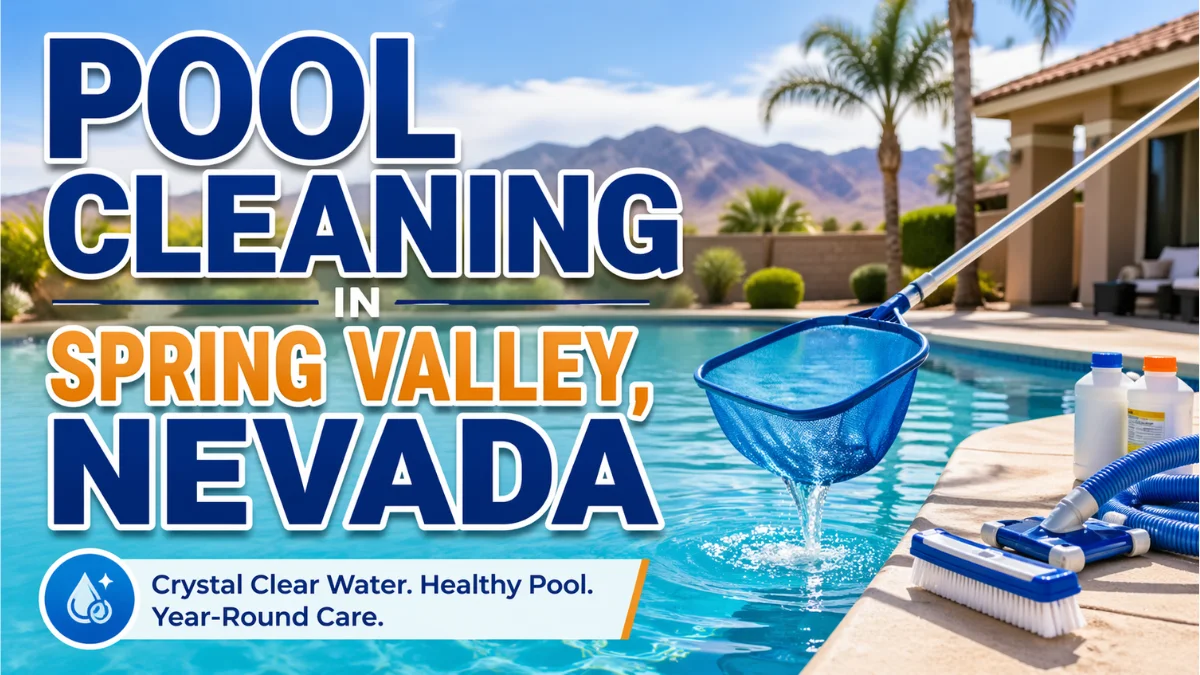
If you own a pool in Spring Valley, Nevada, you already know that the desert climate plays by its own rules. Pool cleaning in Spring Valley, Nevada, isn’t just about skimming leaves off the surface once a week — it’s a year-round commitment that, when done right, keeps your water safe, your equipment running, and your utility bills from spiraling. I’ve spent years working with and researching pool maintenance in this part of the Las Vegas Valley, and what I’ve found is that most homeowners run into the same preventable problems simply because nobody told them what the heat, wind, and hard water here actually do to a pool.
This post covers everything from routine cleaning tasks and chemical balance to seasonal considerations, professional service comparisons, and the real cost of neglect. Whether you’re a new pool owner or you’ve had your backyard oasis for a decade, there’s something here for you.
Why Pool Cleaning in Spring Valley, Nevada, Is Different From Other Places
Spring Valley sits in Clark County, just west of Las Vegas proper, at an elevation of roughly 2,000 feet. The summers are brutal — temperatures regularly climb above 110°F — and that extreme heat accelerates every chemical reaction happening in your pool water. UV radiation alone can destroy chlorine in a matter of hours if you’re not using stabilized tablets or a proper cyanuric acid level.
Beyond heat, the Las Vegas Valley is notorious for its hard water. According to the Southern Nevada Water Authority (SNWA), local tap water carries high concentrations of calcium and magnesium. Over time, that calcium deposits on your pool walls, clogs your filter media, and causes cloudy water that no amount of shock treatment will fully fix until the underlying mineral issue is addressed. This is why a standard pool maintenance checklist that works in, say, Florida or Georgia simply doesn’t translate one-to-one here.
The other factor is wind. Spring Valley gets consistent gusts, especially in spring and early fall, that carry fine Mojave Desert dust into your pool. That dust is not just cosmetic — it introduces phosphates and fine particulates that feed algae and clog your filtration system faster than in calmer climates.
The Core Components of a Complete Pool Cleaning Routine
Skimming and Brushing
Every pool needs regular skimming to remove surface debris before it sinks and becomes a filtration burden. In Spring Valley, I’d recommend skimming daily during the windy spring months and at least every other day during summer when bathers and insects are at their peak.
Brushing your pool walls and floor is equally important. Algae don’t need much of an invitation — a little shade behind a step or in a corner, and you’ve got a bloom starting. Brushing breaks up the biofilm before it can take hold. Use a nylon brush for plaster pools and a soft brush for vinyl liners.
Vacuuming
Automatic pool vacuums — both suction-side and robotic varieties — have made this step much less painful than it used to be. That said, a robotic vacuum is the smarter investment in a dusty desert environment because it doesn’t rely on your pump’s suction, meaning your filter isn’t getting additionally taxed while the vacuum runs. Robotic cleaners like the Dolphin Nautilus or Polaris 9550 Sport capture fine particles in their own internal bags, which helps with the silt common to Spring Valley yards.
Filter Cleaning and Backwashing
Your filter is doing the heaviest lifting in your pool’s cleaning system. Anyone serious about pool cleaning in Spring Valley, Nevada, quickly learns that filter type makes a big difference in how often and how intensively you have to work. The three options most local pool owners work with are: sand, diatomaceous earth (DE), and cartridge.
Sand filters need to be backwashed when the pressure gauge rises 8–10 PSI above the clean baseline. DE filters produce the cleanest water but require more hands-on maintenance — you disassemble and hose down the grids periodically, then recharge with fresh DE powder. Cartridge filters are the lowest-maintenance option for most residential pools, but the cartridges need rinsing every two to four weeks and full replacement every one to three years, depending on your bather load and local debris.
Given the calcium-heavy water in this area, cartridge filters tend to calcify faster than in softer water regions. A diluted muriatic acid soak once or twice a year removes mineral buildup and restores flow.
Water Chemistry: The Non-Negotiable Foundation
You can have the cleanest pool in Spring Valley in terms of debris, but if your chemistry is off, the water isn’t safe, and it’s damaging your equipment and surfaces. These are the parameters you need to track consistently:
The calcium hardness number is where Spring Valley pool owners most often run into trouble. Because the fill water from SNWA already comes in at a high mineral content, you’re essentially starting in the middle of the scale from day one. Over a season or two of evaporation and top-offs, calcium hardness can climb into damaging territory — above 500 ppm — which causes scaling on your walls, plaster pitting, and cloudy water. The only real fix is a partial drain and refill with fresh water, or using a reverse osmosis (RO) water treatment service, several of which operate in the Las Vegas area and can filter your pool water on-site without draining it completely.
Shocking Your Pool
Shocking — adding a concentrated dose of chlorine or a non-chlorine oxidizer — is how you kill combined chloramines (the compounds responsible for that “pool smell” and eye irritation). In Spring Valley, I recommend shocking every one to two weeks during summer, especially after heavy bather loads, rain events, or periods of high winds. Calcium hypochlorite (cal-hypo) is the most common shock product, but be aware it adds calcium to your already-hard water. Sodium dichloro-s-triazinetrione (dichlor) is a stabilized alternative that adds CYA instead of calcium, which can be useful early in the season when CYA levels need a boost.
Seasonal Pool Cleaning in Spring Valley, Nevada
Spring: Opening and Deep Cleaning
Spring in Spring Valley comes early and is warm. By March, daytime temperatures are already in the 70s, and algae season is quietly beginning. This is the time to do your thorough inspection — check your pump motor, inspect your pool light fixtures, examine your plaster or liner for cracks and stains, and balance your water chemistry fresh before the heat arrives.
If your pool was under a cover all winter (relatively mild here, but some owners do cover), remove and clean the cover before storing it. Brush walls and vacuum thoroughly, then run your filter continuously for 24–48 hours while you adjust chemicals.
Summer: Constant Vigilance
Summer is when pool cleaning in Spring Valley, Nevada, becomes a near-daily task for active pools. The combination of 100°F-plus temps, intense UV, and heavy bather traffic pushes your chemistry out of balance quickly. Test your water at least three times a week — ideally daily — during peak summer.
Run your pump for at least eight to twelve hours per day. Some pool professionals in the Las Vegas area recommend 12–14 hours in peak summer, particularly for pools that get a lot of direct sun. The energy cost is real, but so is the cost of treating a full algae bloom.
Fall: The Wind Season
October and November bring the winds that carry dust across the valley. Your skimmer basket and pump basket will fill up noticeably faster during this period. This is also a good time to do a full equipment inspection — heat exchanger on any pool heaters, check salt cell plates if you have a saltwater system, and clean the DE grids or replace cartridges heading into the cooler months.
Winter: Lower Maintenance, Not Zero
Spring Valley winters are mild enough that most pools stay open year-round. Water temperatures drop into the 50s and 60s, which slows algae growth significantly, but chemistry still shifts, and equipment still needs attention. Reduce pump run time to six to eight hours daily, but don’t eliminate it entirely. Stagnant water in cold weather is still susceptible to algae and bacterial growth.
Pool Cleaning in Spring Valley, Nevada: DIY vs. Hiring a Professional
This is the question most Spring Valley pool owners eventually wrestle with. The honest answer depends on how much time you have, how comfortable you are with basic chemistry, and what peace of mind is worth to you.
A professional pool cleaning service in Spring Valley typically visits weekly, tests and balances your water chemistry, skims, brushes, empties baskets, and inspects your equipment. Most services also include a report or app update showing what was done and what the chemical readings were.
If you’re leaning toward DIY, invest in a reliable digital testing kit rather than test strips. Strips are convenient but lack the precision needed to manage calcium hardness and CYA accurately — two parameters that matter enormously in Nevada pools. The Taylor K-2006 is widely considered the industry standard for residential water testing and gives you accurate readings for all the critical parameters.
Common Pool Cleaning Problems in Spring Valley and How to Fix Them
Cloudy Water
Almost always a chemistry issue — usually low chlorine, high pH, or very high calcium hardness. Start by testing your water and adjusting accordingly. If the problem persists after balancing, your filter may need cleaning. Run it continuously until the water clears.
Green Algae
Green algae blooms happen fast in summer heat. Shock the pool with a double or triple dose of chlorine, brush all surfaces thoroughly to break up the algae colonies, and run your filter 24 hours a day until the water clears. Follow up with an algaecide to prevent recurrence.
Calcium Scaling
That white, chalky buildup on your tile line and pool surfaces is calcium carbonate. A pumice stone handles minor scaling on plaster. For tile, a calcium remover solution or professional tile cleaning service is more effective. Preventing it means keeping your pH below 7.8 and your calcium hardness in range.
High Phosphates
Dust, leaves, fertilizer runoff, and even some pool products introduce phosphates, which feed algae growth. A phosphate remover — lanthanum-based products like Lo-Chlor Starver or Natural Chemistry PHOSfree — will bring phosphate levels down. Test for phosphates quarterly, especially in spring.
Choosing a Pool Cleaning Service in Spring Valley, Nevada
When evaluating pool service companies in the Spring Valley area, ask these specific questions before committing.
- What does the weekly service include? Make sure chemical testing, brushing, skimming, and basket cleaning are all included — not charged as add-ons.
- Do they provide written or digital service records? Any reputable company should document chemical readings and work performed after each visit.
- Are their technicians certified? Look for technicians with Certified Pool and Spa Operator (CPO) certification from the Pool & Hot Tub Alliance, or credentials from the National Swimming Pool Foundation (NSPF).
- Do they carry liability insurance? This protects you if the equipment is damaged during service.
Local resources like the Better Business Bureau of Southern Nevada and neighborhood platforms like Nextdoor are practical ways to find and vet pool service companies operating in Spring Valley specifically. Word-of-mouth matters here — a company that services five pools on your block is likely already familiar with your local water conditions and yard microclimates.
The Real Cost of Neglecting Your Pool
I want to be direct about this: skipping regular pool cleaning in Spring Valley, Nevada doesn’t save money — it defers a much larger expense. A single algae bloom that goes untreated for a week in July can require $200–$400 in chemicals and 72+ hours of filtration to clear. A calcified filter that never gets cleaned will fail prematurely, and pump motor replacements run $400–$800 or more, depending on horsepower. Plaster that’s been damaged by chronically low pH or high calcium hardness costs $5,000–$15,000 to replaster, depending on pool size.
The math on consistent weekly pool cleaning in Spring Valley, Nevada — whether you do it yourself or pay a service — is overwhelmingly in your favor compared to deferred repair bills.
FAQs
1. How often should I have my pool professionally cleaned in Spring Valley, Nevada?
Weekly service is the standard recommendation during the summer months; biweekly may be sufficient in winter when bather load and temperatures are lower.
2. Why does my pool water keep turning cloudy even after I add chemicals?
Cloudy water in Spring Valley is often caused by high calcium hardness or a dirty filter — balancing chemicals alone won’t fix either issue without also addressing the filter or mineral content.
3. Is a saltwater pool easier to maintain in the Las Vegas area?
Saltwater pools still require chemistry management and are particularly susceptible to high calcium buildup in hard-water regions like Spring Valley; they’re not necessarily lower-maintenance, just different in how chlorine is generated.
4. When should I drain and refill my pool?
Most pool professionals recommend a partial drain and refill when total dissolved solids exceed 1,500 ppm or calcium hardness climbs above 500 ppm — conditions that arrive faster in Spring Valley than in softer-water areas.
5. Can I run my pool pump less to save on electricity in summer?
Running the pump fewer than eight hours daily in peak summer risks algae growth and poor filtration; a variable-speed pump is the more energy-efficient solution without compromising water quality.
A Clean Pool Starts With the Right Information
Pool cleaning in Spring Valley, Nevada, requires a level of attention and local awareness that generic pool care guides don’t account for. The hard water, punishing UV index, and desert dust make this one of the more demanding environments for pool maintenance in the entire country — but it’s absolutely manageable with the right routine and the right information.
Start by testing your water this week, particularly your calcium hardness and CYA levels. If either is out of range, address it before summer peaks. Get your filter cleaned or inspected if it’s been more than six months. And if you’ve been putting off calling a local pool service to get a quote, now is the time — the best companies in Spring Valley book up fast once the heat arrives.
Your pool is too significant an investment — in money, in your property value, and in your quality of life — to leave to guesswork.

I’m Salman Khayam, the founder and editor of this blog, with 10 years of professional experience in Architecture, Interior Design, Home Improvement, and Real Estate. I provide expert advice and practical tips on a wide range of topics, including Solar Panel installation, Garage Solutions, Moving tips, as well as Cleaning and Pest Control, helping you create functional, stylish, and sustainable spaces that enhance your daily life.