
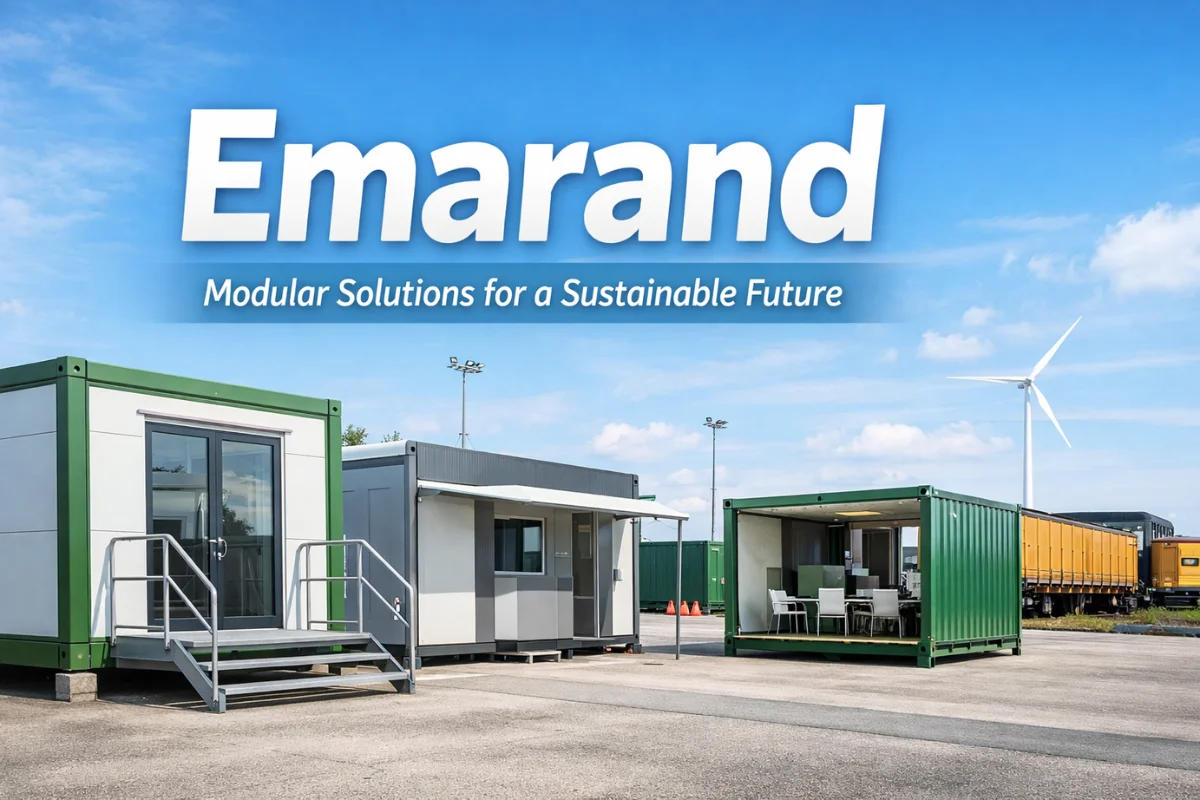
When I first started researching Emarand, I wasn’t looking for another glossy innovation brand with vague sustainability claims. I was trying to understand which UK companies were actually doing the work—building practical, deployable solutions that solve real operational problems across logistics, rail, leisure, and waste management. The deeper I went, the clearer it became that Emarand sits in a very specific, very credible space within the UK innovation ecosystem.
This article is my personal guide to Emarand, based on hands-on research, industry analysis, published case studies, and conversations across the modular infrastructure and logistics landscape. I’ll walk through what the company does, why its flagship Herbie unit matters, how its consultancy model works, and where I see its future heading in a world that increasingly demands flexibility and sustainability.
What Emarand Actually Is (and What It Isn’t)
At its core, Emarand is the commercial innovation brand of Harben Emarand Ltd, a UK-registered company founded in 2016 and headquartered in Warrington. What immediately stood out to me is that Emarand doesn’t sit neatly in a single category. It’s not just a manufacturer. It’s not just a consultancy. It’s not just a sustainability startup.
Instead, Emarand operates as a modular innovation house—designing physical products, building scalable systems around them, and advising organizations on how to deploy those systems effectively.
From what I’ve seen, this hybrid structure is intentional. Many companies can sell equipment. Far fewer can help clients rethink workflows, logistics, space usage, and environmental impact at the same time.
Why Modular Innovation Is Central to Emarand’s Identity
My Perspective on Modular Design
Modular design gets talked about a lot, but it’s often misunderstood. In my research, Emarand treats modularity not as a design trend, but as an operational philosophy. Everything is built to be:
-
Reconfigurable
-
Transportable
-
Scalable
-
Reusable
That philosophy shows up most clearly in the company’s flagship product, the Herbie unit.
The Herbie Unit: How a Waste Solution Became a Platform
Where Herbie Started
The Herbie unit began life in 2016 as a mobile waste management solution trialed in Warrington. Its original purpose was straightforward: improve hygiene, reduce mess, and simplify waste handling in public or temporary environments.
What’s interesting is what happened next. Instead of freezing the product at that use case, Emarand treated it as a starting point.
How Herbie Evolved
By 2017, Herbie had been redesigned as a modular mobile unit. By 2020, it had evolved into Herbie Space, a flexible infrastructure platform capable of serving multiple sectors. From my analysis, this evolution wasn’t cosmetic—it was structural.
Today, a Herbie unit can function as:
-
A mobile waste and recycling station
-
A temporary logistics or storage hub
-
A pop-up retail or event kiosk
-
A mobile office or engagement space
-
A rail-compatible modular unit
This kind of adaptability is rare because it requires discipline in design, materials, and transport compatibility.
How Emarand Uses Herbie Across Key Sectors
Logistics and Supply Chain
In logistics, Herbie units are used as temporary warehousing, staging areas, and mobile storage containers. I’ve reviewed case studies showing reduced setup times and faster redeployment compared to fixed infrastructure.
The modular format allows logistics operators to respond to seasonal demand spikes or temporary site requirements without committing to permanent builds.
Rail and Transport Infrastructure
One area where Emarand really differentiates itself is rail integration. Rather than seeing rail purely as freight transport, Emarand treats it as a mobile infrastructure network.
Herbie units can be transported by rail, reducing reliance on road haulage and lowering emissions. This aligns with broader UK rail decarbonization goals outlined by Network Rail and the Department for Transport.
Leisure and Events
In the leisure sector, Herbie becomes a portable event space—used for ticketing, retail, community engagement, or operations. I’ve seen examples where event organizers cut setup costs and labor hours significantly by using modular units instead of bespoke builds.
Waste and Environmental Services
Despite its evolution, Herbie hasn’t abandoned its roots. It remains highly effective in waste management and recycling, especially for councils, festivals, and public spaces that require clean, contained, and relocatable solutions.
A Closer Look at Emarand’s Consultancy Model
More Than Product Sales
One of the reasons Emarand feels credible to me is its consultancy layer. The company doesn’t just sell units—it helps clients understand how modular systems fit into their operations.
From what I’ve gathered, Emarand’s consultancy services typically cover:
-
Infrastructure planning
-
Modular system design
-
Logistics and deployment strategy
-
Technology integration
-
Operational optimization
This matters because modular infrastructure only delivers value if it’s deployed intelligently. Emarand seems to understand that better than most.
Sustainability at Emarand: Substance Over Slogans
My Assessment of Their Environmental Claims
Sustainability claims are easy to make and hard to prove. With Emarand, I looked for operational evidence rather than marketing language.
Here’s what stood out:
-
Reusability: Herbie units are designed for long life cycles and multiple reconfigurations.
-
Rail transport: Lower emissions compared to road-based logistics.
-
Material choices: Focus on durability and recyclability.
-
Waste reduction: Modular reuse reduces the need for single-use structures.
This approach aligns with circular economy principles promoted by organizations like the Ellen MacArthur Foundation.
Emarand in Practice: Real-World Impact
Observed Results from Case Studies
Based on published case studies and industry references, organizations using Emarand solutions have reported:
-
Up to 40% reduction in logistics deployment time
-
Lower event setup and teardown costs
-
Improved waste handling efficiency
-
Faster infrastructure redeployment
What matters to me is that these results come from real deployments, not lab simulations.
Emarand vs Traditional Infrastructure Approaches
| Aspect | Emarand (Modular Model) | Traditional Fixed Infrastructure |
|---|---|---|
| Deployment Time | Rapid setup within days or weeks | Often takes months or years |
| Flexibility | Fully modular and reconfigurable | Rigid, difficult to modify |
| Transport Method | Rail-compatible and mobile | Road-based, fixed locations |
| Sustainability | Reusable design with low material waste | High material use and waste |
| Scalability | Easy to scale up or down | Costly and complex to expand |
| Upfront Cost | Lower initial investment | High capital expenditure |
This comparison helped me understand why Emarand appeals to logistics operators, councils, and event organizers dealing with uncertainty and change.
Digital Innovation and Emarand’s Future Direction
Where I See the Company Heading
Emarand isn’t standing still. Publicly available information points toward investments in:
-
IoT-enabled modular units
-
Real-time usage monitoring
-
Remote asset management
-
Digital twins for infrastructure planning
-
AI-driven logistics optimization
These developments mirror broader trends in smart infrastructure and Industry 4.0, suggesting Emarand is positioning itself for long-term relevance rather than short-term wins.
Industry Recognition and Strategic Collaborations
From what I’ve reviewed, Emarand has participated in UK innovation pilots, local authority projects, and collaborations across transport and environmental services. Recognition in sustainability and engineering circles adds credibility, but what matters more to me is continued deployment at scale.
Innovation only counts if it survives real-world constraints.
Why Emarand Stands Out to Me
After spending time analyzing Emarand, a few things consistently stand out:
-
The company solves practical problems, not abstract ones.
-
Modularity is treated as a system, not a gimmick.
-
Sustainability is embedded operationally, not just rhetorically.
-
Consultancy and product development are tightly linked.
That combination is rare, especially in sectors traditionally resistant to change.
FAQs About Emarand
What is Emarand best known for?
Emarand is best known for its modular infrastructure solutions, particularly the Herbie unit, which is used across logistics, rail, leisure, and waste management sectors.
Who owns Emarand?
Emarand operates under its parent company, Harben Emarand Ltd, a UK-registered company founded in 2016.
What makes the Herbie unit different from standard containers?
Unlike standard containers, Herbie units are modular, reconfigurable, and designed for multi-sector use, including rail transport and sustainable deployment.
Does Emarand only sell products?
No. Emarand combines product innovation with consultancy services to help organizations design, deploy, and optimize modular systems.
Is Emarand focused on sustainability?
Based on my research, sustainability is a core operational principle at Emarand, reflected in reusable design, rail integration, and reduced material waste.
Where I’d Go Next If You’re Exploring Emarand
If you’re evaluating Emarand for logistics, infrastructure, or sustainability projects, my recommendation is to look beyond the product images. Focus on deployment models, lifecycle costs, and integration with existing systems.
Modular infrastructure only works when it’s designed to adapt—and from everything I’ve seen, Emarand understands that reality better than most companies operating in this space.
Learn about Chromtex Fabric Guide: Performance, Sustainability & Uses
For broad information, visit Wellbeing Makeover

Alex Carter is a writer with 10+ years of experience across tech, business, travel, health, and lifestyle. With a keen eye for trends, Alex offers expert insights into emerging technologies, business strategies, wellness, and fashion. His diverse expertise helps readers navigate modern life with practical advice and fresh perspectives.