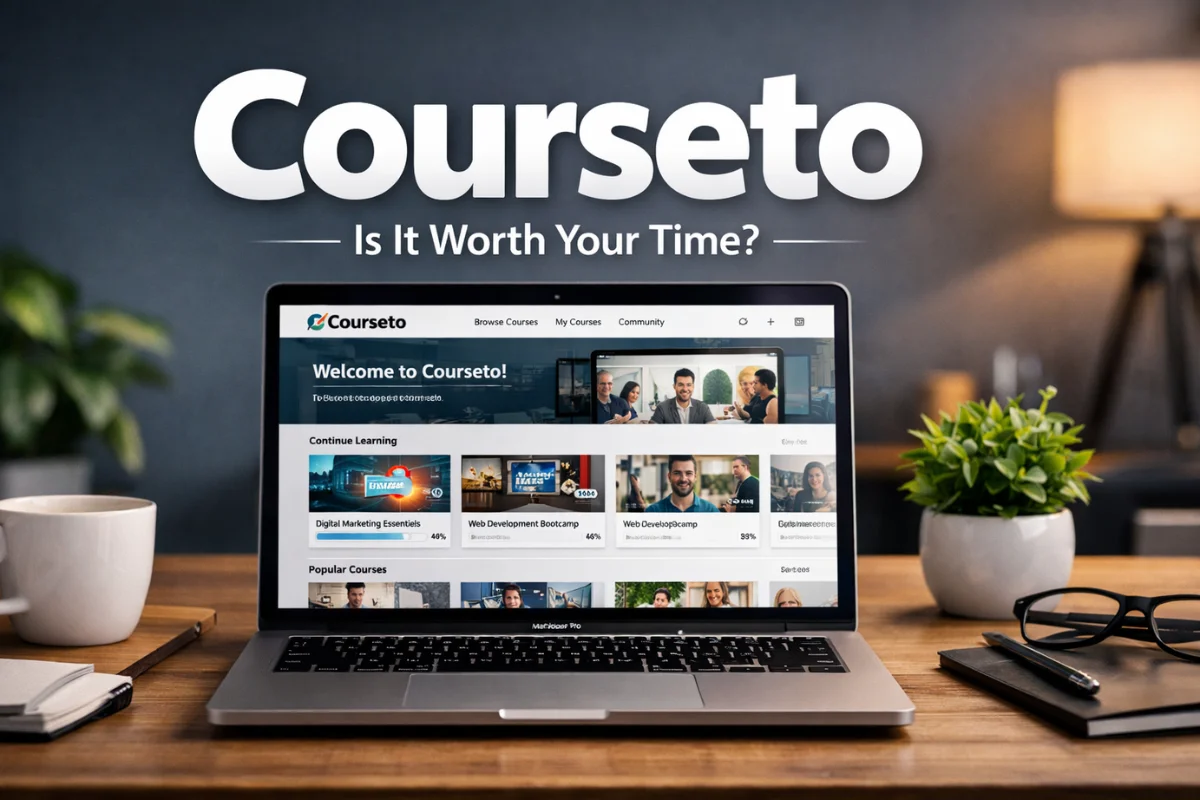
I’ve spent a lot of time on e-learning platforms over the years — cycling through Udemy libraries, starting Coursera specializations, and occasionally abandoning both halfway through. So when I first came across Courseto, my expectations were measured. The platform positions itself not as the biggest learning marketplace on the internet, but as one of the most deliberate. That distinction, it turns out, matters a great deal.
Courseto is an online education platform built around a premise that most of its competitors ignore: fewer, better courses beat more, mediocre ones. In a market where platforms brag about hosting 200,000+ courses, Courseto is making a quieter but arguably more compelling argument — that curation and practical outcomes are what learners actually need.
This review covers what Courseto is, who it’s built for, how it stacks up against other platforms, and whether it’s worth your time and money in 2026.
What Is Courseto, and Why Does It Exist?
At its core, Courseto is a curated online learning platform offering courses across digital marketing, technology, business, entrepreneurship, creative arts, and personal development. But the “why” behind its existence is more interesting than the “what.”
The platform was built in response to a real problem: most online learners never finish what they start. Research from MIT OpenCourseWare and similar institutions has consistently shown that completion rates on massive open online courses (MOOCs) hover around 5–15% on average. Source: Jordan, K. (2015). MOOC completion rates: The data. katyjordan.com
Courseto’s answer to this is structural: build shorter, more focused learning paths with real-world assignments embedded throughout, rather than expecting learners to self-motivate through 40 hours of passive video content.
I think this philosophy is the platform’s most important feature — and it’s not something you see listed on a comparison chart.
Who Uses Courseto?
The platform isn’t trying to be everything to everyone, and that’s refreshing. From what I can tell, Courseto primarily serves four types of people:
- Working professionals who want to upskill without enrolling in a degree program. Think of a project manager who needs to understand data analytics, or a marketer expanding into paid advertising.
- Entrepreneurs and freelancers who need practical knowledge fast — how to build a website, run an ad campaign, or manage their own e-commerce store.
- Students looking for a more affordable and flexible complement to traditional education, particularly in tech and business.
- Instructors who want to create and sell their own courses without fighting through complex technical infrastructure or giving up most of their revenue to the platform.
Core Features Worth Knowing About
Self-Paced, Mobile-First Learning
Every course on Courseto is available across desktop, tablet, and mobile — and you get lifetime access once you enroll. This matters more than most platforms acknowledge. I’ve personally gone back to refresh a digital marketing module six months after completing it, when I was launching a new campaign. That kind of access changes how you relate to learning materials.
The self-paced format means no cohort deadlines, no synchronous sessions you have to schedule around, and no penalization for going slower through dense content.
The Course Builder for Instructors
If you’re on the instructor side, Courseto offers a drag-and-drop course builder that supports video, audio, PDFs, quizzes, slides, and interactive assessments. According to the platform’s own documentation, instructors can map out and publish a multi-module course in roughly 90 minutes, which is significantly faster than comparable tools I’ve tested.
The builder also supports automation: welcome messages, progress reminders, certificate delivery, and upsell triggers can all be configured once and run without manual intervention. For solo creators managing course content and student engagement simultaneously, this is not a small convenience.
Certification and Professional Recognition
Courseto’s certificates are not generic PDFs. They include verification codes and instructor endorsements, and are designed to be shared directly on LinkedIn or added to a resume portfolio. The platform has pursued partnerships with industry bodies to develop certificates that carry actual professional weight — not just proof of passive consumption.
According to user feedback on the platform, several learners have cited Courseto certifications as a factor in securing new roles or freelance clients, particularly in SEO, digital advertising, and web development.
Community and Peer Interaction
One feature I didn’t expect to find meaningful is the community layer. Courseto includes discussion forums and peer review components built into courses — not bolted on as an afterthought. Research from the Online Learning Consortium suggests that discussion-based learning can improve completion rates by up to 50%, and Courseto’s design clearly reflects that understanding. Source: Online Learning Consortium. (2023). Quality Scorecard for Online Learning Programs. onlinelearningconsortium.org
Courseto vs. the Competition: An Honest Comparison
There are a few ways to look at how Courseto compares to better-known platforms. Here’s my honest breakdown:
| Feature | Courseto | Udemy | Coursera | Skillshare |
|---|---|---|---|---|
| Pricing model | $50–$500 per course | $10–$200 per course | $200–$3,000+ | ~$168/year subscription |
| Content curation | High — reviewed for quality | Low — open marketplace | High — university-vetted | Moderate |
| Practical focus | Core emphasis | Inconsistent | Theory-heavy | Creative-leaning |
| Instructor tools | Comprehensive | Basic | Limited | Moderate |
| Certification value | Verified + endorsable | Basic completion cert | Accredited credentials | Minimal |
| Community features | Active forums, peer review | Minimal | Moderate | Creative community niche |
| Mobile access | Full, 24/7 | Full | Full | Full |
Udemy wins on sheer volume and low upfront pricing. Coursera wins if you need university-backed credentials. Skillshare is better for purely creative pursuits. But Courseto occupies a specific position that none of them fully cover: affordable, practical, business-aligned education with genuine quality control and instructor-friendly infrastructure.
For someone who knows what skill they want and needs to apply it within the next 90 days — not in two years after completing a degree — Courseto is consistently the stronger choice.
Course Categories Available on Courseto
Business and Entrepreneurship
This is where Courseto’s practical philosophy shows up most clearly. Courses here don’t just teach startup theory — they walk through funding models, business plan construction, and growth strategy using real case examples. If you’re building something, these are courses you’ll actually use.
Digital Marketing
Possibly the strongest category on the platform. Courseto’s digital marketing curriculum covers SEO, paid search, and social advertising, email automation, content strategy, and analytics. These are current, job-market-aligned topics where demand for skilled practitioners continues to outpace supply — the U.S. Bureau of Labor Statistics projects a 10% growth rate for marketing specialists through 2030. Source: U.S. Bureau of Labor Statistics, Occupational Outlook Handbook, Marketing Specialists, 2024. bls.gov/
Technology
Covering AI fundamentals, programming languages, cybersecurity, data management, and cloud computing, the tech curriculum is designed for non-CS graduates as much as it is for developers. Someone in operations or sales who wants to become more technically literate will find meaningful entry points here without drowning in jargon.
Personal Development and Creative Arts
Leadership, communication, productivity, graphic design, video editing, and writing round out the catalog. These aren’t filler categories — they’re included because the platform understands that career growth is rarely just about hard skills.
The Instructor Side: Building a Course Business on Courseto
I want to spend more time here than most reviews do, because the instructor experience is genuinely one of Courseto’s differentiators.
On platforms like Udemy, the revenue model has historically favored the platform. Courses get discounted aggressively during sales, and instructors often receive a fraction of the original list price. Courseto’s model is structured differently — revenue sharing is designed to reward instructors fairly, with recurring income streams available once a course gains traction.
The platform also provides analytics that show exactly how students move through content: where they pause, what they replay, and at what point they disengage. This data is genuinely useful for improving course quality over time, not just for tracking enrollment numbers.
For professionals who have real expertise and want to monetize it without becoming full-time content creators, Courseto’s infrastructure removes enough friction that it’s actually viable.
Pricing: What You Actually Pay
Individual courses on Courseto are priced between $50 and $500, depending on depth and specialization. This sits above Udemy’s often-discounted pricing but well below Coursera’s university-partnered programs or any traditional bootcamp.
There are free introductory lessons available for many courses — a genuine free tier, not just a teaser trailer. This removes the risk of making an expensive commitment before you know whether the instructor’s style suits you.
Specialization tracks, which bundle multiple courses toward a defined outcome, represent the best value on the platform. Completing a full digital marketing or web development track costs significantly less than a comparable bootcamp and offers more flexibility in how and when you work through it.
What Courseto Does Well — and Where It Could Improve
Strengths
The curation is real. Unlike platforms where anyone can publish anything and quality varies wildly, Courseto reviews content before it goes live. This shows in the consistency of production quality and the relevance of material to actual job market demands.
The automation tools for instructors are legitimately well-designed. Triggers for student communication, certificate delivery, and upsells work without requiring technical expertise to configure.
Community is built into the learning experience rather than added as an afterthought.
Areas to Watch
The catalog, by design, is smaller than Udemy or Coursera. If you’re looking for a highly niche technical certification or an obscure subject area, Courseto may not have it yet.
Brand recognition is still developing. In a job market where hiring managers may not yet recognize the Courseto name the way they recognize Coursera, the verification codes on certificates matter — but the platform’s name alone may carry less weight initially.
The higher price point relative to Udemy may create friction for learners who are used to $12 courses during flash sales. That said, the ROI case is strong: a $200 course that you complete and apply is worth considerably more than a $15 course you abandon.
My Overall Take
Courseto is not trying to win by being the largest platform in the room. It’s trying to win by being the most useful one — and that’s a harder, slower, but ultimately more defensible position.
For learners who are serious about applying what they study, not just collecting certificates, the platform’s focus on practical assignments, real-world projects, and interactive engagement makes it more likely that you’ll actually finish what you start. And finishing matters. A completed $200 course is more valuable than an abandoned $2,000 one.
For instructors building a course-based income stream, the combination of fair revenue sharing, comprehensive analytics, and automation infrastructure makes Courseto worth serious consideration alongside — or even instead of — larger, more crowded marketplaces.
The platform isn’t perfect, and its catalog will need to deepen over time to remain competitive as learner expectations grow. But the philosophy behind it is sound, and the execution is more polished than I expected.
If you’re evaluating online learning platforms for yourself or your team, Courseto is worth a closer look — especially if practical outcomes and course completion are your actual goals, not just access to a large library.
FAQs
1. Is Courseto legitimate?
Yes. Courseto is a real online learning platform with a reviewed course catalog, verified certificates, and a functional instructor ecosystem. It’s a newer player relative to Udemy or Coursera, but it operates with clear quality standards and a transparent revenue model for instructors.
2. How does Courseto compare to Udemy?
Udemy offers a larger, cheaper catalog, but quality varies widely since it’s an open marketplace. Courseto has a smaller, curated library with stricter content standards — making it more consistent, even if it has fewer options on niche subjects.
3. Can I get a refund if I’m not satisfied with a course?
Courseto’s refund policy follows standard e-learning practices and typically includes a satisfaction window after purchase. Always review the specific course’s terms before enrolling, as policies can vary by instructor.
4. Are Courseto certificates recognized by employers?
Courseto certificates include verification codes and instructor endorsements, making them more credible than a generic completion badge. Employer recognition depends on the field — in digital marketing and tech, portfolio work often matters more than the certificate name alone.
5. How much can instructors earn on Courseto?
Earnings vary significantly based on course topic, pricing, and audience size. The platform’s revenue-sharing model is more favorable to instructors than many larger marketplaces, with some popular tech courses reportedly generating over $20,000 in cumulative income.

I’m Salman Khayam, the founder and editor of this blog, with 10 years of professional experience in Architecture, Interior Design, Home Improvement, and Real Estate. I provide expert advice and practical tips on a wide range of topics, including Solar Panel installation, Garage Solutions, Moving tips, as well as Cleaning and Pest Control, helping you create functional, stylish, and sustainable spaces that enhance your daily life.