
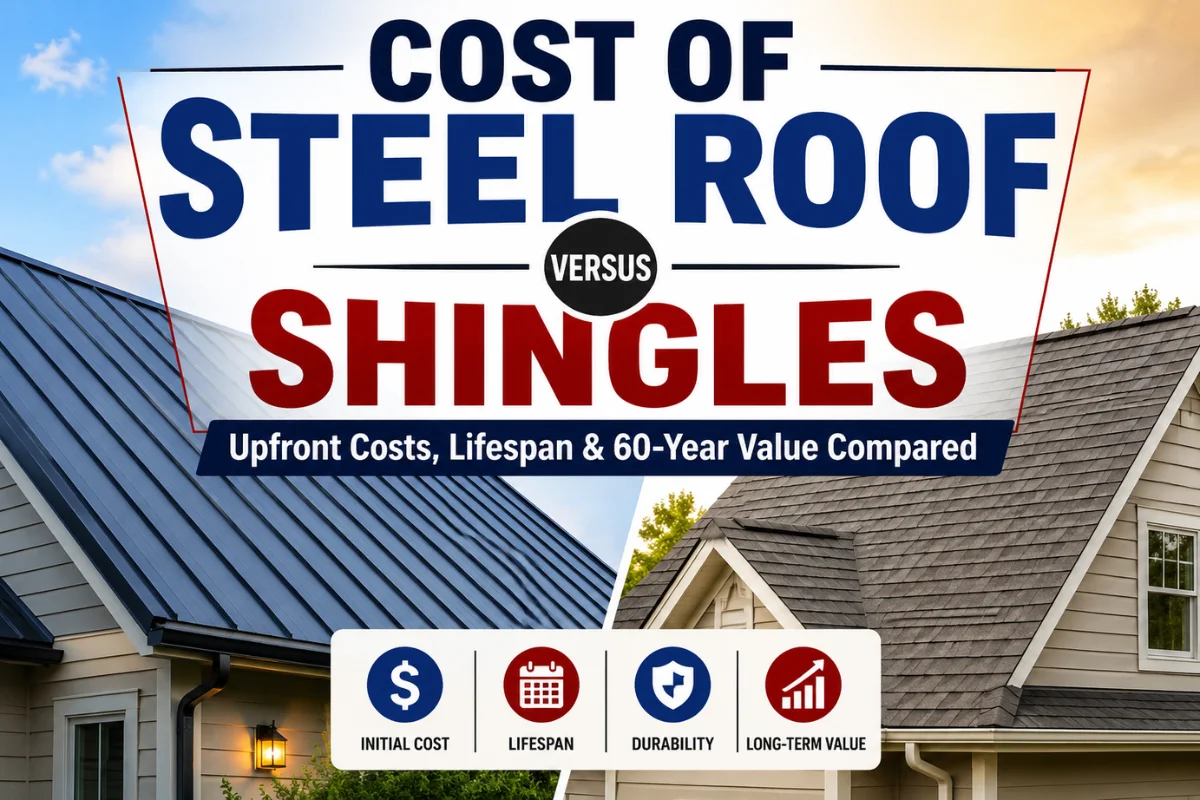
When homeowners ask about the cost of steel roof versus shingles, they’re usually staring down a real decision — one that involves five figures and a roof that needs to last a generation. Here’s the short answer: asphalt shingles typically run $3.50 to $6.50 per square foot installed, while steel roofing costs $8 to $20 per square foot installed, depending on the style and profile. Steel costs more upfront, sometimes two to three times as much, but it generally lasts two to four times longer. So the real cost comparison only makes sense when you look at the full lifespan of each option — not just what hits your bank account this year.
I’ve personally worked through this decision on a 2,200-square-foot home, and the number-crunching was eye-opening. Three contractors quoted me wildly different figures, two of them framed the conversation entirely around upfront cost, and only one walked me through lifetime value. That experience — combined with months of research — is what shaped this article. Here’s everything I wish I’d known before I started calling contractors.
Why the Cost of Steel Roof versus Shingles Differs So Much

The difference in upfront cost comes down to materials, installation labor, and manufacturing complexity. Asphalt shingles are mass-produced, widely available, and installed by virtually every roofing contractor in the country. The raw materials — a fiberglass mat saturated with asphalt and coated with granules — are inexpensive to manufacture and ship. That simplicity translates directly into lower installed costs.
Steel roofing panels — whether standing seam, exposed fastener, or stamped metal tiles — require more precise fabrication, specialized fastening systems, and contractors with specific training. The panels are often custom-rolled to the exact dimensions of your roof at a nearby coil-processing facility, which means less waste but more lead time and coordination. Flashing details around chimneys, valleys, and penetrations demand tighter tolerances than shingles, which adds to labor hours.
That said, the premium you pay for steel is not arbitrary. You’re paying for a product that performs differently at almost every level: fire resistance, wind uplift, snow shedding, energy efficiency, and lifespan. Understanding those differences is exactly what allows you to compare costs fairly — and what prevents you from making a $40,000 decision based on incomplete information.
Breaking Down the Numbers: Steel Roof Cost versus Shingles

Asphalt Shingles: Full Cost Breakdown
Asphalt shingles remain the most popular roofing material in North America for a simple reason: they’re affordable and familiar. The installed cost typically breaks down like this:
- 3-tab shingles are the most basic option, usually costing $3.50 to $4.50 per square foot installed. They carry a 20–25 year rated lifespan, though real-world performance in harsh climates often falls short of that.
- Architectural (dimensional) shingles — the most commonly sold product today — run $5.00 to $6.50 per square foot installed. They carry 30-year warranties and are noticeably thicker than 3-tab.
- Premium designer shingles (made to mimic slate or wood shake) can hit $8.00 to $10.00 per square foot installed, which actually overlaps with entry-level steel.
For a 2,000-square-foot home with a moderately pitched roof (requiring roughly 22–25 squares of material), you’re typically looking at:
- 3-tab: $7,700 – $11,250 total installed
- Architectural: $11,000 – $16,250 total installed
- Premium designer: $17,600 – $25,000 total installed
Steel Roofing: Full Cost Breakdown
Steel roofing comes in several distinct profiles, each with different costs:
- Exposed fastener corrugated or ribbed panels are the most affordable steel option, typically $8 to $12 per square foot installed. These are often seen on agricultural buildings but are increasingly used on residential homes for their rugged aesthetic. Lifespan: 30–50 years.
- Standing seam steel roofing is the premium residential option, with concealed fasteners and a clean, modern profile. Expect $14 to $20 per square foot installed, sometimes higher in labor-intensive markets. Lifespan: 40–70 years.
- Steel shingles or metal tiles — designed to mimic asphalt, slate, or wood — typically fall in the $10 to $16 range per square foot installed and offer a middle ground between cost and aesthetics.
For that same 2,000-square-foot home:
- Exposed fastener steel: $17,600 – $26,400 total installed
- Steel shingles/tiles: $22,000 – $35,200 total installed
- Standing seam: $30,800 – $44,000 total installed
The Comparison Table: Steel Roof Cost versus Shingles Side by Side
The 60-Year Cost Argument: Where Steel Actually Wins
This is the piece that most online comparisons gloss over, and it changed my own thinking entirely. When you evaluate the cost of a steel roof versus shingles over a full 60-year period rather than just day one, the financial picture reverses entirely.
If you put architectural shingles on a 2,000-square-foot home today and spend $14,000, you’ll likely need to re-roof in 25 years. That second roof might cost $18,000–$22,000 (adjusted for material and labor inflation). A third replacement at the 50-year mark could run $23,000 or more. Over 60 years, your cumulative spend on asphalt shingles could approach $55,000–$60,000.
A standing seam steel roof installed today for $38,000 may never need replacing within the same 60-year window. Even factoring in periodic inspections and touch-up sealant, you’re looking at a 60-year spend closer to $40,000–$45,000.
The math shifts even more when you account for energy savings. Steel roofs, particularly those with reflective Kynar or PVDF coatings, can reduce cooling loads by 10%–25% in warm climates. On a home spending $2,400/year on energy, that’s potentially $240–$600 in annual savings — or $14,400–$36,000 over 60 years.
Factors That Shift the Steel Roof vs Shingles Cost Higher or Lower

Roof Complexity
Both materials cost more on steep, multi-faceted roofs with lots of valleys, dormers, and penetrations. A simple gable roof costs less to install than a complex hip roof with skylights and chimneys. Steel, with its longer panels and more demanding cutting requirements, tends to see a bigger price jump on complex rooflines compared to shingles.
Geographic Labor Markets
In high cost-of-living metros — think Seattle, New York, San Francisco — roofing labor can add 30%–50% to the installed cost of either material. In rural or mid-sized markets, the same job may cost significantly less. I’ve seen identical scope-of-work quotes vary by $8,000–$12,000 simply because of zip code. This is one reason that national average figures published online can be misleading. The number that matters is the number your local contractors quote you, not what a cost aggregator says is typical.
It’s also worth noting that steel roofing contractors tend to be less common than shingle crews, which can limit your ability to comparison-shop and may give a single well-regarded contractor more pricing leverage in your area. In markets with one or two quality metal roofers and ten asphalt crews, the competition dynamic doesn’t favor the buyer of steel.
Underlayment and Decking Condition
Neither material calculation includes deck repair. If your sheathing is rotted, damaged, or insufficient (older homes sometimes have spaced sheathing designed for wood shakes), you’ll pay $2–$5 per square foot extra for re-decking. This cost applies equally to both roofing types.
Coil vs. Structural Steel
Not all steel is created equal. Gauge (thickness) matters significantly. Most residential steel roofing uses 26-gauge or 24-gauge steel. Thicker 24-gauge panels cost more but resist denting better and hold fasteners more securely. The difference between 26-gauge and 24-gauge standing seam can be $2–$4 per square foot installed.
Regional Climate and Insurance Incentives
This is something I haven’t seen discussed widely. In hurricane-prone areas like Florida, Texas Gulf Coast, and the Carolinas, some insurance carriers offer premium reductions of 20%–35% for metal roofing with impact and wind ratings. In wildfire-prone regions of California and Colorado, steel’s Class A fire rating can similarly lower insurance costs. These savings don’t appear in your contractor quote, but they’re real and ongoing.
Hidden Costs That Contractors Don’t Always Mention

Any honest look at the cost of a steel roof versus shingles has to account for line items that rarely appear in a contractor’s base quote. Both materials carry hidden costs, but they’re different in character — and knowing them upfront prevents budget surprises mid-project.
Noise Mitigation for Steel
Standing seam and corrugated steel can be noisier in heavy rain and hailstorms without proper insulation. Adding a quality underlayment (synthetic felt or rubberized self-adhering membrane) reduces noise significantly, but it adds $0.50–$1.50 per square foot to the project. This cost is often not itemized in base quotes.
Gutter Compatibility
Steel roofs, particularly standing seam, can shed heavy snow rapidly and in sheets. Without proper snow guards and gutter guards, this can damage gutters and create safety hazards. Properly specified snow retention systems add $2–$5 per linear foot along eave edges.
Fastener and Sealant Maintenance for Exposed Fastener Metal
Exposed fastener panels — the cheaper steel option — use rubber-gasketed screws that compress against the metal to create a waterproof seal. Those gaskets degrade over 15–25 years and should be re-tightened or replaced. This is a low-cost but frequently overlooked maintenance item that doesn’t apply to standing seam.
Tear-off and Disposal
Both roofing types require the tearoff of existing material (unless the installer allows overlay, which has its own drawbacks). Asphalt shingles are heavy, and disposal fees run $75–$200 per square. Steel tear-off, if you’re replacing old metal, is more manageable since steel is typically recycled — some contractors will credit you for the scrap metal value.
When Shingles Are the Right Financial Decision

Steel isn’t always the smart choice, and I think it’s worth being clear about that. The cost of steel roof versus shingles only tilts decisively in steel’s favor under specific conditions — long ownership horizon, challenging climate, and a home value high enough to absorb the premium. Outside those conditions, shingles remain a rational and well-proven choice. If you’re planning to sell your home within the next 7–12 years, the return on a standing seam steel roof may not fully materialize in resale value. Buyers recognize quality, but they rarely pay dollar-for-dollar for premium materials.
Similarly, in lower-cost housing markets where home values cap out at $150,000–$200,000, spending $35,000–$40,000 on a steel roof is difficult to justify on a purely financial basis. A well-installed architectural shingle roof at $12,000–$14,000 is often the more rational choice.
And if your existing deck requires full replacement — adding $7,000–$12,000 to the project — the gap between steel and shingles effectively doubles in percentage terms, which changes the lifetime cost math considerably.
When Steel Is Worth Every Dollar
If you’re planning to stay in your home long-term (15+ years), live in a climate with extreme weather (high wind, heavy snow, wildfire risk, or intense sun), or if resale premium matters to you, steel earns its cost premium decisively. Homes with standing seam roofs consistently sell faster and at slight premiums in markets where buyers understand what they’re looking at.
For my own home, I ultimately chose 24-gauge standing seam after running the numbers over a 30-year horizon. The deciding factors were insurance premium reduction (I’m in a high-wind zone), the energy efficiency benefit in a hot climate, and the fact that I had no intention of selling within the next 20 years. At year three, no regrets.
If you’re weighing similar factors and want a second opinion tailored to your specific situation, feel free to contact Wellbeing Makeover — our team can help you think through the full picture.
DIY Installation and How It Changes the Metal Roof vs Shingles Cost Equation

Asphalt shingles are one of the few roofing materials that experienced DIYers can install on low-slope roofs with manageable risk. The savings can be significant — $3,000–$6,000 on a typical project. If you’re physically capable, have a helper, and are comfortable on a ladder, installing architectural shingles is a legitimate way to reduce the cost gap with steel.
Steel roofing, however, is not generally suited to DIY. The panels require precise cuts, proper seaming, and correctly torqued fasteners. Mistakes compromise waterproofing in ways that aren’t always immediately visible — a slightly misaligned standing seam clip can cause a leak two years after installation that’s nearly impossible to diagnose without tearing back a section. For steel, professional installation is not optional — it’s part of the warranty validity in most cases, and it’s also how you protect a $35,000+ investment.
What the Industry Doesn’t Advertise: Steel Roof vs Shingles Cost Over Real Lifespans
One thing that rarely surfaces in roofing comparisons is the concept of effective lifespan versus rated lifespan for asphalt shingles. A 30-year shingle carries a prorated warranty — meaning after the first 10 years, the manufacturer’s coverage drops sharply. If your shingles fail at year 20, the payout may cover only a fraction of replacement costs.
Beyond warranty fine print, real-world performance in hot climates, regions with temperature swings, or areas with heavy tree cover (algae and moss accelerate granule loss) can shorten an asphalt roof’s effective life by 5–8 years. UV exposure in the South degrades asphalt faster than the same product installed in Minnesota. Steel, by contrast, degrades much more slowly and predictably. The Galvalume or Galvanized substrate resists corrosion, and quality paint systems (Kynar 500 or Hylar 5000 PVDF coatings) carry 30–40 year fade and chalk warranties that reflect real-world performance reasonably accurately.
This means the true cost of steel roof versus shingles, when measured against realistic — not manufacturer-rated — lifespans, tends to close the gap even further in steel’s favor than the standard numbers suggest.
Frequently Asked Questions
How long does a steel roof last compared to shingles?
Steel roofs typically last 40–70 years, while asphalt shingles generally last 20–30 years — meaning steel may outlast two or three shingle roofs over the same period.
Does a metal roof increase home value more than shingles?
Yes, generally. Metal roofing, particularly standing seam, tends to add 1%–6% to resale value and is considered a premium feature in most real estate markets.
Is a steel roof louder than shingles during rain?
Without proper underlayment, steel can be noisier. With a quality synthetic underlayment or spray foam insulation, the sound difference compared to shingles is minimal to non-existent.
Can you put a steel roof over existing shingles?
In most jurisdictions, you can overlay steel over one layer of asphalt shingles, which eliminates tear-off costs. However, you should always inspect the decking condition first, as problems hidden under existing shingles will be amplified under a new roof.
Does insurance cost more or less with a steel roof?
In most cases, less. Steel’s Class A fire rating and high wind resistance qualify many homeowners for discounts of 10%–35%, depending on insurer and region, especially in hurricane, hail, or wildfire-prone areas.
Making the Right Call for Your Home
The cost of steel roof versus shingles is not a simple sticker-price comparison — it’s a total-cost-of-ownership question that deserves careful analysis based on your climate, your timeline, your home’s value, and your risk tolerance. Shingles wins on upfront affordability and flexibility. Steel wins on longevity, energy performance, and long-term value when you stay in the home.
Take the time to get three quotes for each option, ask contractors to break out material, labor, and underlayment costs separately, and run the 30-year numbers for your specific situation. The answer won’t be the same for every homeowner — but it will be clear once you have the right data in front of you.
For deeper guidance on home improvement decisions that affect your quality of life and financial wellbeing, explore our online services at Wellbeing Makeover.
Other Resources
- Banksia Grove West Primary School Construction Update
- The Importance of Proper Roof Flashing Explained
- Metal Roofing Inner City Melbourne: Complete Guide

I’m Salman Khayam, the founder and editor of this blog, with 10 years of professional experience in Architecture, Interior Design, Home Improvement, and Real Estate. I provide expert advice and practical tips on a wide range of topics, including Solar Panel installation, Garage Solutions, Moving tips, as well as Cleaning and Pest Control, helping you create functional, stylish, and sustainable spaces that enhance your daily life.