
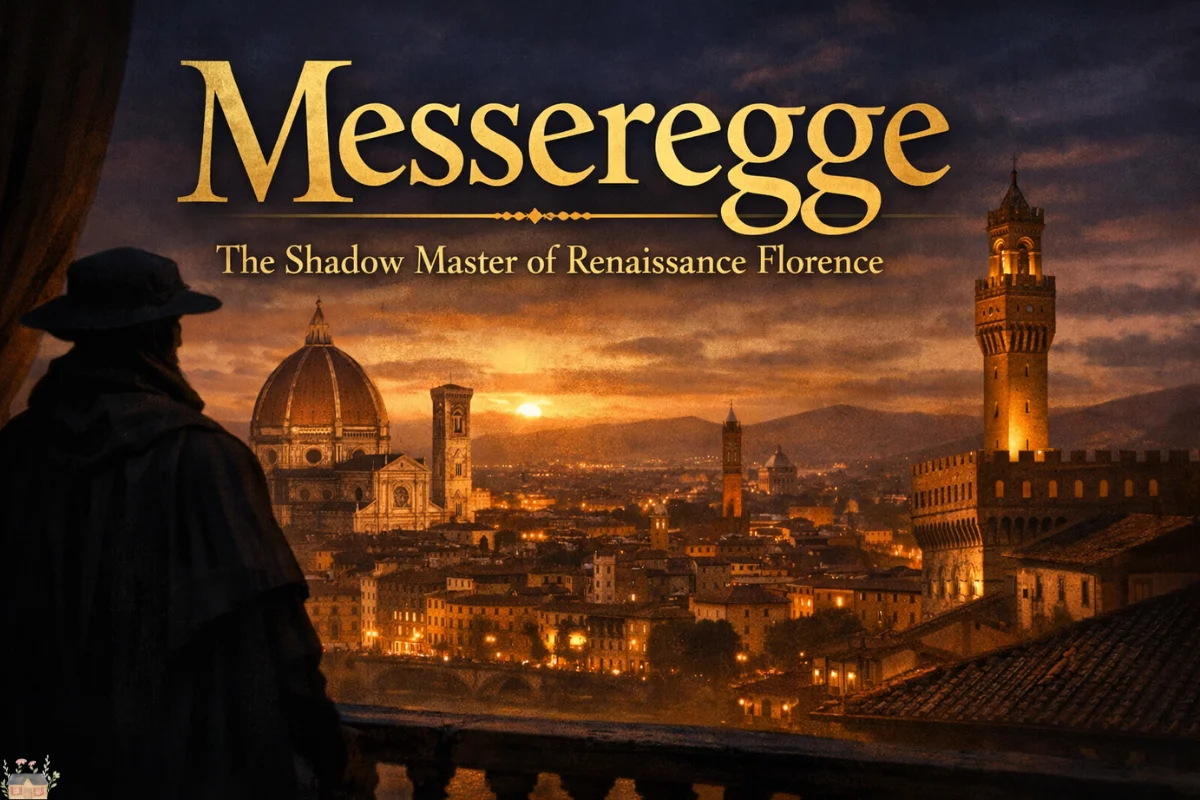
The name Messeregge does not appear in tourist guidebooks alongside Brunelleschi’s dome or Botticelli’s Primavera. You will not find his portrait hanging in the Uffizi, nor will docents gesture toward his tomb in Santa Croce. Yet in the labyrinthine corridors of Florentine power, no figure loomed larger during the closing decades of the fifteenth century. Messeregge—the honorific by which history remembers Reggio della Scala—was the man the Medici consulted before they consulted each other, the strategist who understood that military victory meant nothing without political translation, and the noble exile who transformed himself into the republic’s indispensable anchor.
His story forces us to confront an uncomfortable truth about the Renaissance: the artists we revere were often instruments of men we have forgotten. To understand Florence at its apex, one must understand Messeregge.
Table of Contents
ToggleThe Architecture of a Title: What “Messeregge” Really Meant
Before examining the man, we must excavate the name. “Messeregge” represents a linguistic fossil, preserving how contemporaries perceived Reggio della Scala’s dual nature. Unlike formal titles inscribed on official documents—capitano del popolo, gonfaloniere di giustizia, condottiero—this appellation emerged organically from the streets and salons of Florence. It was vernacular shorthand for power that lacked a clean institutional definition.
The contraction carries subtle connotations that literal translations miss. “Messer” descended from the Latin dominus but had, by the fifteenth century, become a term of ambiguous weight. It signified neither nobility nor office exclusively; rather, it acknowledged that a man possessed autorità—that intangible currency that made others defer, listen, and obey. When Florentines said “Messeregge,” they were not simply shortening syllables. They were naming a category of power that had no official seat in government.
This distinction matters because it reveals how Renaissance political culture actually functioned. The formal structures—the Signoria, the councils, the guild tribunals—were visible, documented, and constrained by law. But alongside them operated a parallel system of influence, personal loyalty, and extrainstitutional authority. Messeregge inhabited both worlds simultaneously, translating between them with the fluency of a native speaker.
The Exile’s Calculus: From Verona to Florence
Reggio della Scala arrived in Florence not as a celebrated mercenary seeking a contract but as a refugee carrying the weight of his family’s collapse. The Della Scala had ruled Verona for over a century before being overthrown in 1387, their territories absorbed by the expanding Visconti state. By Reggio’s generation, the family existed in political exile—noble in name, dispossessed in reality.
This background shaped everything that followed. Unlike condottieri who sold their swords to the highest bidder, Reggio understood displacement intimately. He grasped that power lost could be rebuilt, but only through different currencies. The Della Scala name still carried weight across northern Italy; noble memory is long, and old alliances leave residual adhesions. Reggio leveraged this heritage not to reclaim Verona—a project he recognized as fantasy—but to position himself as a node connecting Florence’s mercantile elite with the older aristocratic networks they needed for diplomacy.
His decision to settle in Florence rather than Milan or Venice was itself a strategic calculation. Milan under the Sforza offered immediate employment for a military man, but Florence offered something more valuable: a power structure sufficiently fragmented to permit entry. The republic’s factional rivalries created demand for neutral intermediaries. A man with noble lineage but no entrenched local loyalties could occupy spaces closed to native Florentines entangled in generational feuds.
The Condottiero as Political Animal
We must abandon the anachronistic notion that Renaissance condottieri resembled modern generals. The condotta—the contract between a military captain and a city-state—was a business arrangement, not a commission. Condottieri raised their own companies, invested their own capital, and expected returns beyond salary. They operated as business-minded merchants of war.
Messeregge distinguished himself not through exceptional battlefield brilliance but through exceptional contractual sophistication. He understood that military force was a wasting asset unless converted into durable political capital. His campaigns for Florence against Lucca and later against the Papal States were competent but unspectacular. What mattered was what happened after the fighting stopped.
While other condottieri retired to their estates or sought new employers, Messeregge remained in Florence, attending council sessions, cultivating relationships with prominent families, and—crucially—lending his personal credit to underwrite civic projects. When the Signoria needed funds to fortify the eastern walls, Messeregge advanced the money. When the Studio Fiorentino struggled to attract humanist scholars, Messeregge endowed lectureships. These measures achieved a pair of strategic aims: they demonstrated commitment to the republic’s welfare while weaving the condottiero into the fabric of Florentine institutional life.
This strategy required patience many mercenary captains lacked. Condottieri operated in short-term cycles defined by campaign seasons and contract renewals. Messeregge thought in generational arcs.
The Medici Calculus: Why Lorenzo Needed Messeregge
The marriage between Messeregge and Maddalena de’ Medici—Lorenzo the Magnificent’s sister—is typically framed as the condottiero’s greatest social ascent. This interpretation gets the vector wrong. Yes, Messeregge gained proximity to Florence’s most powerful family. But Lorenzo gained something equally valuable: a credible military ally whose loyalty was secured by kinship rather than contract.
Consider the Medici position in the 1470s. The Pazzi Conspiracy of 1478 had revealed the family’s vulnerability; Giuliano de’ Medici lay assassinated in the cathedral, and Lorenzo had narrowly escaped the same fate. Papal support for the conspirators, combined with King Ferdinand of Naples’ hostility, left Florence isolated and Lorenzo shaken. The Medici bank, long the family’s foundation, was showing cracks under poor management and changing European financial conditions.
In this context, Messeregge represented something the Medici desperately needed: legitimate martial authority untainted by the recent crisis. He was not implicated in the Pazzi network. His Della Scala lineage provided diplomatic access to northern Italian courts suspicious of Medici commercial dominance. And his personal company—seasoned veterans loyal to their captain rather than to Florence’s volatile politics—offered a private military asset the republic’s citizen militias could not match.
The marriage contract, signed in 1480, was remarkably balanced. Maddalena brought a dowry appropriate to her station, but Messeregge did not simply absorb Medici wealth. He transferred significant properties in the Veronese region to Medici control, effectively extending their commercial network into territories where their banking operations had struggled. This was a merger, not an acquisition.
| Asset | Medici Contribution | Messeregge Contribution |
|---|---|---|
| Financial | 8,000 florins dowry; banking access | Control of Verona trade routes; regional property |
| Political | Florentine governing access | Della Scala noble networks; independent diplomatic channels |
| Military | None directly | 300 heavy cavalry; 500 infantry; siege engineering expertise |
| Symbolic | Association with cultural patronage | Legitimate feudal nobility; condottiero prestige |
The Shadow Republic: Messeregge’s Institutional Innovations
Historians have insufficiently recognized Messeregge’s most enduring contribution: the informal security council he convened during Florence’s periodic crises. This body, undocumented in official records but referenced repeatedly in private correspondence, brought together key figures from competing factions to coordinate responses to external threats.
The structure was deliberately amorphous. No minutes were kept. No formal votes were recorded. Messeregge hosted these gatherings at his residence on Via Larga, near the Medici palace, but institutionally separate. Attendees included Medici partisans, prominent guildsmen skeptical of Medici ambition, senior military officers, and representatives of Florence’s subject cities.
This innovation addressed a fundamental weakness in Florentine governance. The republic’s formal councils were designed for deliberation, not speed. Emergency response required bypassing constitutional processes that could consume days while crises intensified. Messeregge’s shadow council provided a mechanism for rapid coordination without formally subverting republican institutions.
Critics—and there were many—accused him of operating an extraconstitutional junta. Supporters argued he preserved republican government by preventing the panic that might have driven Florence to accept a princely ruler. The ambiguity was intentional. Messeregge understood that informal power exercised discreetly provoked less resistance than formal authority openly claimed.
Patronage as Statecraft: The Cultural Dimension
Messeregge’s relationship with Renaissance art and humanism differed fundamentally from Medici patronage. The Medici collected culture as they collected debts: systematically, publicly, with an eye toward legacy and political messaging. Messeregge patronized differently—individually, often anonymously, with emphasis on utility rather than display.
His support for the humanist scholar Angelo Poliziano exemplifies this approach. When Poliziano faced censure from ecclesiastical authorities for his vernacular poetry, Messeregge quietly facilitated his relocation to a more tolerant academic environment. No grand library bears Messeregge’s name. No chapel frescoes depict him kneeling before saints. His patronage was operational rather than monumental.
This restraint was strategic. In a republic suspicious of aristocratic display—a suspicion rooted in genuine anti-magnate legislation dating to the thirteenth century—overt cultural magnificence could trigger political liability. Messeregge calibrated his visibility carefully, patronizing works that served practical purposes. The fortification drawings he commissioned from Giuliano da Sangallo were not decorative; they were instruments of military engineering. The maps he sponsored of Florentine territorial holdings improved tax assessment and resource allocation.
Yet this utilitarian approach produced cultural consequences nonetheless. Messeregge’s insistence that artists address practical problems encouraged technical innovation. Sangallo’s military architecture influenced later Renaissance fortification theory. The cartographic techniques developed under Messeregge’s patronage advanced Florentine surveying capabilities. Utility and beauty, in this context, proved complementary rather than contradictory.
The Problem of Succession: Why Messeregge Had No Heirs
Any student of Renaissance power must grapple with an uncomfortable question: why did Messeregge’s influence die with him? His marriage to Maddalena produced no surviving children. His political network, so carefully cultivated, dispersed rapidly after his death in 1502. Within a generation, the name Messeregge had faded from Florentine political discourse.
A number of interpretations merit consideration. The simplest—biological misfortune—cannot be dismissed. Renaissance infant mortality claimed even privileged children with grim regularity. But the evidence suggests Messeregge made deliberate choices that constrained his legacy.
Unlike the Medici, who systematically groomed successors across generations, Messeregge operated as a single-person enterprise. He shared sensitive information with no one. He was hesitant to entrust others with responsibility. His network was a star configuration with himself as the sole hub; when the hub disappeared, the spokes lacked the capacity to interconnect independently.
This was not incompetence but temperament. Messeregge had witnessed his family’s destruction in Verona when Della Scala heirs proved unequal to their inheritance. He may have concluded that dynastic ambition was a trap—that building institutions capable of surviving flawed successors was impossible. Better, perhaps, to maximize influence during one’s own lifetime than to dilute it preparing for a future one could not control.
The Medici, who thought generationally, viewed this orientation with suspicion. Lorenzo once remarked that Messeregge governed “like a man who believes the world ends at his own death.” The observation was not entirely inaccurate.
Reframing Messeregge: Beyond the “Power Behind the Throne”
The conventional framing—Messeregge as éminence grise, the hidden hand manipulating visible authorities—captures something true but misses something essential. Messeregge did not operate in secrecy. Contemporaries knew exactly who he was and what he did. The question was not whether he exercised power, but how to categorize power that corresponded to no constitutional office.
This is the distinction that truly counts. Messeregge was not the power behind the throne; Florence had no throne. He held no place at a king’s side—because no king ruled there. He was not the cardinal-nephew managing papal governance; the Florentine church operated under different constraints.
What was he, then?
He was the republic’s stabilizer. In a system designed to produce equilibrium through competition, Messeregge functioned as an external weight, dampening oscillations that threatened institutional collapse. He did not control outcomes so much as constrain extremes. Factions knew he would oppose any effort to overthrow the republican government. Foreign powers knew his military capacity would resist invasion. Domestic rivals knew he would broker compromises rather than exploit divisions.
This stabilizing function required precisely the qualities Messeregge possessed: independence from entrenched factions, credibility with multiple constituencies, and sufficient personal force to make opposition costly. It also required the peculiar institutional ambiguity his career embodied. Formal authority would have compromised his effectiveness, transforming him from neutral arbiter into partisan actor. Informal influence, paradoxically, enabled more substantive intervention than any office could have provided.
Messeregge in Contemporary Context: Lessons for the Present
The Renaissance tempts us toward antiquarian fascination—the pleasure of contemplating a world sufficiently distant to feel irrelevant. But Messeregge’s career illuminates dynamics that persist in contemporary organizational life, political systems, and professional practice.
The value of extrainstitutional influence. Modern professionals often conflate authority with formal position, assuming that organizational charts accurately depict power distribution. Messeregge demonstrates otherwise. His influence derived not from title but from demonstrated competence, cultivated relationships, and the trust accumulated through consistent reliability. These assets transfer across institutional boundaries in ways formal authority cannot.
The importance of translation skills. Messeregge’s signal capacity was his fluency across domains—military to political, aristocratic to mercantile, Florentine to foreign. He connected worlds that operated on different assumptions, different vocabularies, and different metrics of value. In contemporary contexts characterized by hyperspecialization, this integrative capacity has become increasingly rare and correspondingly valuable.
The difficulty of converting personal power into durable systems. Messeregge’s posthumous disappearance offers sobering instruction. Influence built entirely on personal capacity—unsupported by institutional structures, undocumented in accessible systems, untransmitted to capable successors—expires with its holder. Building for the long term requires sacrificing some short-term efficiency to create durable mechanisms that outlast individual careers.
FAQs About Messeregge
Was Messeregge a Medici employee or an independent actor?
Neither categorization fits precisely. He commanded his own military company under contract to Florence, maintained independent diplomatic relationships with other Italian states, and owned substantial property outside Florentine jurisdiction. The marriage to Maddalena created kinship ties but not subordination. He cooperated with Medici objectives when aligned with his own and pursued independent courses when they diverged.
Why isn’t Messeregge better known?
Three factors explain his relative obscurity. First, he left no surviving children to memorialize him. Second, his papers were dispersed after his death rather than forming a coherent archival collection. Third, his mode of operation—discreet, informal, undocumented—generated less documentary evidence than the official correspondence and public commissions that preserve memory of more visible figures.
Did Messeregge ever attempt to reclaim Verona?
No evidence suggests he seriously pursued the restoration of the Della Scala rule. He visited Verona periodically and maintained relationships with families who had displaced his own, but these contacts appear oriented toward commerce and diplomacy rather than conspiracy. His pragmatic temperament recognized that the fourteenth century had closed permanently.
What was Messeregge’s relationship with Savonarola?
This remains among the murkier aspects of his career. Messeregge was in Florence during Savonarola’s ascendancy but maintained careful distance from the Dominican preacher’s movement. Private correspondence suggests he viewed Savonarola’s prophetic claims with skepticism while recognizing the friar’s utility as a counterweight to Medici restoration efforts. Characteristically, he kept options open and commitments minimal.
The Verdict of History
The Renaissance commemorates its artists, its princes, its saints, and its villains. It has been less generous to its stabilizers—the figures who maintained the conditions that made cultural flourishing possible without themselves producing culture. Messeregge belongs to this neglected category.
He did not paint chapels or compose poetry. He did not conquer kingdoms or reform churches. He did not leave behind masterpieces or manifestos or movements bearing his name. What he left behind was Florence itself: intact, independent, still governed by republican forms, still capable of producing the art and thought we now regard as civilization’s inheritance.
That is no minor inheritance. It is merely a quiet one.
In the echo chambers of our own era, where influence is measured by follower counts and authority by certification, Messeregge’s career offers an alternative model. Power, properly understood, is not the capacity to command attention. It is the capacity to shape outcomes. One can exercise profound influence without ever appearing in the spotlight—indeed, sometimes because one never appears there.
The name on the palace walls is Medici. The hand that steadied the palace was Messeregge’s.
For broader information, visit Wellbeing Makeover

Alex Carter is a writer with 10+ years of experience across tech, business, travel, health, and lifestyle. With a keen eye for trends, Alex offers expert insights into emerging technologies, business strategies, wellness, and fashion. His diverse expertise helps readers navigate modern life with practical advice and fresh perspectives.