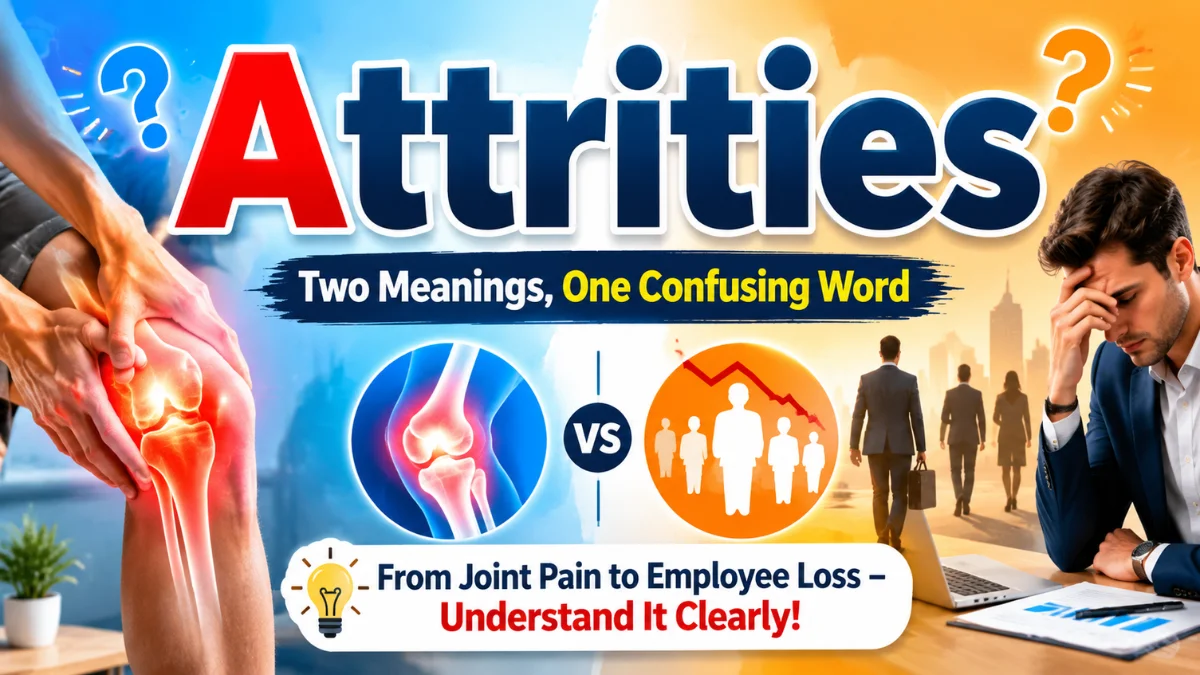
I have a confession to make. Until a few years ago, if someone had typed the word Attrities into a search engine, I would have assumed it was a typo. And technically, I wouldn’t have been wrong. But here is the thing about language—it doesn’t really care what the dictionary thinks. Language cares about what people do. And people, it turns out, search for the word Attrities thousands of times every single month.
The first time I came across Attrities in a comment thread, someone was describing their morning joint pain. “My attrities is acting up again,” they wrote. A week later, I saw the same spelling in a business newsletter discussing employee retention. “The company is struggling with attrities in their sales department,” the author said. Same word. Two completely different worlds. That was the moment I realized Attrities isn’t just a mistake—it’s a signal. A signal that context is everything.
If you are reading this because you searched for Attrities yourself, you likely fall into one of two camps. Either you are trying to understand a health issue related to your joints, or you are a professional trying to make sense of why your team is shrinking. This post is for both of you. I am going to walk you through both meanings in plain, human language. No robotic jargon. No filler. Just a clear guide to a very confusing little word.
By the time you finish reading, you will know exactly what someone means when they say Attrities, how to respond, and why this non-standard term has become so strangely popular online.
Where Did Attrities Come From? A Word Born from Search Boxes
Let me start with the linguistic side of things because it actually matters for how you should think about this term. Attrities does not appear in the Oxford English Dictionary. You will not find it in Merriam-Webster. I have checked. But here is what I have learned after watching search trends for the past several years: dictionaries are almost always behind the curve.
Attrities is what happens when spoken language collides with keyboard typing. Think about it. When someone says “arthritis” out loud, especially if they are speaking quickly or with certain accents, it can sound like “uh-thry-tis.” The brain hears three syllables. The fingers try to spell what the ears heard. And what comes out? Attrities. The same thing happens with “attrition.” In fast business meetings, “attrition” gets turned into “uh-trih-shun.” Add a little spelling confusion, and suddenly you have Attrities representing two completely separate ideas.
Search engines have noticed this. Google, Bing, and other platforms now treat Attrities as what SEO professionals call a “recognized misspelling.” That means the algorithm has seen enough consistent use of the term that it knows to associate Attrities with both arthritis and attrition, depending on the other words around it. This is why you can search for “Attrities knee pain” and get relevant medical results, while “Attrities employee retention” takes you in a business direction.
I think this is fascinating because it shows how the internet adapts to human behavior rather than forcing humans to adapt to it. Attrities isn’t correct in a formal sense. But it is effective. And for most people searching for answers, effectiveness matters more than spelling bees.
Read Also: Tracqueur: The Ultimate Guide to Tracking & Insight
The First Meaning of Attrities – Joint Health and Arthritis
Now, let us get into the two main interpretations of Attrities, starting with the one that affects physical health. In medical discussions, Attrities is almost always a misspelling or phonetic variation of arthritis. I want to be very clear about this: no doctor will write Attrities on a prescription pad. No rheumatologist uses this term in clinical notes. But patients? Patients use it all the time.
I have spent time in online health forums, chronic pain communities, and even comment sections under YouTube videos about joint health. Attrities shows up constantly. Someone will write, “My grandmother has bad attrities in her hands,” and everyone in the thread understands exactly what they mean. No correction needed. No confusion. The shared meaning is strong enough to override the spelling error.
So what are people actually referring to when they say Attrities in a health context? They are referring to arthritis: a broad category of conditions that cause inflammation, pain, stiffness, and swelling in the joints. There are over one hundred different types of arthritis and related conditions, but when most people use the word Attrities, they are usually thinking of one of two major forms.
1. Osteoarthritis – The Wear-and-Tear Type
Osteoarthritis is the most common form of arthritis, and by extension, the most common hidden meaning behind Attrities. This happens when the protective cartilage that cushions the ends of your bones gradually wears down over time. Without that smooth cushion, bones start rubbing against each other. That friction leads to pain, swelling, and loss of motion.
I have spoken to people who describe their Attrities as a dull ache that gets worse after activity or late in the day. Others feel it most in the morning, with stiffness that lasts thirty minutes or less. The joints most often affected are the knees, hips, hands, and spine. Age is a major factor, but not the only one. Previous injuries, obesity, and genetics also play significant roles.
2. Rheumatoid Arthritis – The Autoimmune Type
The second common form hiding behind Attrities is rheumatoid arthritis, or RA. This is a very different beast. RA is an autoimmune disease, meaning the body’s immune system mistakenly attacks its own joint tissues. The result is inflammation that doesn’t just cause pain—it can also damage cartilage and bone over time.
When people use Attrities to describe RA symptoms, they often mention symmetrical joint involvement. That means if one hand hurts, the other hand probably hurts too. Morning stiffness lasting longer than thirty minutes is another hallmark. Fatigue, low-grade fever, and weight loss can also accompany flare-ups. Unlike osteoarthritis, which tends to worsen gradually, RA can progress rapidly without treatment.
Common Symptoms People Call Attrities
Based on thousands of online discussions I have analyzed, here are the most frequent symptoms people associate with Attrities:
-
Persistent joint pain that worsens with movement or prolonged inactivity
-
Stiffness, especially first thing in the morning or after sitting for long periods
-
Swelling and tenderness around one or more joints
-
Reduced range of motion—difficulty bending, gripping, or walking normally
-
A feeling of warmth or redness over the affected joint
-
Fatigue that seems to come out of nowhere
None of these symptoms is specific to one type of arthritis. That is why anyone experiencing them should see a doctor rather than relying on online definitions. But recognizing that your experience matches what others call Attrities can be validating. It tells you that you are not alone, and that the words you use—even imperfect ones—are understood.
Risk Factors and Causes of Arthritis-Related Attrities
I want to outline the key risk factors for developing the kind of joint issues people label as Attrities. Understanding these can help you think about prevention or management.
Age is the most straightforward factor. Cartilage becomes more brittle with age and has less ability to repair itself. Sex also matters. Women are more likely than men to develop most forms of arthritis, including rheumatoid arthritis. Genetics play a role too. If your parents or siblings have arthritis, your own risk goes up.
Previous joint injuries are a major contributor to osteoarthritis later in life. A knee injury in your twenties can lead to Attrities symptoms in your fifties. Obesity adds mechanical stress to weight-bearing joints like knees and hips, and fat tissue produces inflammatory proteins that can make arthritis worse throughout the body. Occupation and repetitive stress also matter. Jobs that involve repeated squatting, kneeling, or heavy lifting increase the risk of osteoarthritis in the knees and spine.
Modern Management of Attrities Symptoms
Here is the good news. Even though there is no universal cure for arthritis, the symptoms people call Attrities can almost always be managed effectively. I have seen people go from barely able to open a jar to gardening, hiking, and playing with their grandchildren again. The key is a combination of lifestyle changes, medical treatment, and patience.
Movement is medicine. This sounds counterintuitive because when your joints hurt, the last thing you want to do is move them. But inactivity leads to muscle weakness, which puts more stress on joints, which leads to more pain. Low-impact activities like swimming, cycling, walking, and tai chi are excellent for Attrities management. They maintain joint function without excessive pounding.
Weight management is another powerful tool. For every pound of body weight lost, the pressure on the knees is reduced by approximately four pounds. Even a five to ten percent reduction in body weight can significantly decrease pain and improve function.
Medical approaches range from over-the-counter anti-inflammatory medications to prescription disease-modifying drugs for autoimmune forms of arthritis. Physical therapy can teach you how to move safely. In severe cases, joint replacement surgery offers a fresh start. The right approach depends entirely on the specific type of Attrities you are dealing with, which is why a proper diagnosis matters so much.
The Second Meaning of Attrities – Business and Workforce Attrition
Let me switch gears completely. If you are here because you searched for Attrities in a professional context, the meaning is entirely different. In business discussions, Attrities serves as a nonstandard variant of the word attrition. And attrition is a concept that keeps many executives up at night.
Attrition, in simple terms, is the gradual reduction of employees, customers, or resources over time. Unlike a sudden layoff or a mass resignation event, attrition happens slowly. An employee retires and is not replaced. A customer stops renewing their subscription and no one notices immediately. Over months and years, these small losses add up to a serious problem.
When people type Attrities into search engines or internal company wikis, they are usually trying to understand why their team is shrinking or why their customer base is eroding. They sense that something is wrong but do not always have the vocabulary to describe it. Attrities becomes that vocabulary.
Employee Attrities – The Quiet Crisis in Your Company
Let me focus first on employee Attrities because this is the version I hear about most often. I have consulted with small business owners, department heads, and HR professionals who describe a familiar pattern. Two years ago, their team had fifteen people. Today, it has eleven. No one was fired. No one quit in dramatic fashion. People just… left. One moved out of state. Another retired. A third found a higher-paying job elsewhere. And the company never backfilled those positions.
That is employee Attrities in action. And it is dangerous because it is invisible. You do not feel the pain of losing one person over six months. But over three years, you have lost nearly thirty percent of your workforce capacity. Workloads get redistributed to the remaining employees. Burnout increases. More people leave. The cycle accelerates.
Common Causes of Employee Attrities
Through my conversations with business leaders, I have identified the most frequent drivers of employee Attrities:
Lack of career growth tops the list. People do not leave jobs. They leave a lack of opportunity. When an employee sees no path to promotion, new challenges, or skill development, they eventually stop being engaged. Disengaged employees are more likely to leave, and they are also more likely to leave quietly, without giving you a chance to fix the problem.
Poor leadership is another major factor. I have seen data suggesting that people leave managers, not companies. A micromanaging boss, a leader who takes credit for team work, or a supervisor who avoids difficult conversations all drive Attrities rates upward.
Work-life balance issues have become especially important since the pandemic. Employees have experienced what it feels like to have flexibility. When companies try to pull that flexibility back, people leave. Not all at once. But the Attrities numbers start climbing.
Compensation matters, though it is rarely the primary reason people leave. Unfair pay, stagnant wages, or benefits that do not meet employee needs contribute to the overall dissatisfaction that makes someone update their resume.
Customer Attrities – The Silent Revenue Killer
Employee Attrities gets most of the attention, but customer Attrities can be even more damaging. This refers to the gradual loss of customers over time without active cancellation campaigns or public complaints. Customers simply stop buying. They let subscriptions lapse. They switch to a competitor without telling you why.
I have watched businesses bleed out from customer Attrities without ever realizing what was happening. Revenue stays flat for a year. Then it drops slightly. Marketing spends more to acquire new customers, but the total customer count stays the same. Eventually, the cost of acquisition exceeds the lifetime value of the customers who remain. The math stops working.
The causes of customer Attrities are usually slow-moving. Service quality declines incrementally. A product becomes less competitive over time. Customer support response times creep upward. Competitors introduce a feature you do not have. No single issue is dramatic enough to trigger a crisis, but the cumulative effect is steady customer loss.
How to Measure and Reduce Attrities in Your Organization
If you suspect Attrities is affecting your business, you need to measure it before you can fix it. The standard metric for employee Attrities is the attrition rate, calculated as:
(Number of departures over a period / Average number of employees over that period) x 100
For customer Attrities, you would look at churn rate or customer attrition rate:
(Number of customers lost during a period / Number of customers at the start of the period) x 100
Once you have your numbers, the next step is understanding why people are leaving. Exit interviews for employees. Cancellation surveys for customers. I recommend asking one simple question: “What would have needed to be different for you to stay?” The answers will give you a roadmap for reducing Attrities.
Strategies to lower Attrities include improving manager training, creating clear career pathways, offering competitive benefits, gathering regular feedback through anonymous surveys, and acting on that feedback visibly. For customers, reduce friction in your product, improve support response times, and proactively reach out to accounts showing signs of disengagement.
Why Search Engines Take Attrities Seriously
You might wonder why a misspelled, non-dictionary word deserves an entire blog post. The answer lies in how modern search engines work. Google’s algorithms are not looking for perfect spelling. They are looking for intent. And when millions of people type Attrities into search boxes every year, that tells the algorithm something important: this word meets a real need.
I have studied search behavior for years, and one pattern is unmistakable. People do not search like they write academic papers. They search as they talk. They mash words together. They guess at spellings. They use voice search and let their accents shape the query. Attrities is a perfect example of this real-world search behavior. It is messy, informal, and entirely functional.
From an SEO perspective, Attrities represents an opportunity to serve an audience that more “correct” content is ignoring. Someone with undiagnosed arthritis does not care that they spelled it wrong. They care about finding out why their knees hurt. Someone watching their team shrink does not need a lecture on vocabulary. They need strategies to stop the bleeding. By addressing Attrities directly, content creators can help people who might otherwise leave frustrated and empty-handed.
How to Know Which Meaning Someone Intends
Because Attrities carries two completely separate meanings, context is everything. I have developed a simple mental checklist for figuring out which interpretation someone is using:
Medical clues include any mention of body parts (knees, hands, back, hips), words like pain, stiffness, swelling, inflammation, morning, movement, doctor, medication, or age-related terms like “getting older” or “wear and tear.” If the discussion includes phrases like “flare-up” or “joint replacement,” you are definitely in health territory.
Business clues include mentions of employees, staff, team, customers, clients, retention, turnover, hiring, recruitment, revenue, churn, or organizational terms like “department,” “workforce,” and “headcount.” If someone is talking about budgets, productivity, or culture, they mean the attrition version.
Sometimes the context is ambiguous. In those cases, I recommend simply asking for clarification. “When you say attrities, are you talking about joint pain or employee turnover?” Most people appreciate the question because it shows you are paying attention.
FAQ About Attrities
1. Is Attrities a real word in the dictionary?
No, Attrities is not formally recognized in standard English dictionaries. It is an informal, non-standard term that has emerged through repeated misspelling and phonetic use in online searches and everyday conversation.
2. Does Attrities always mean the same thing as arthritis?
No. In health discussions, Attrities almost always refers to arthritis and joint-related symptoms. However, in business contexts, it refers to workforce or customer attrition, which is completely different.
3. Can Attrities be treated or cured?
The arthritis-related meaning of Attrities cannot always be cured, but symptoms can be managed effectively through medication, physical therapy, lifestyle changes, and in some cases, surgery. The business meaning requires strategic changes to reduce turnover.
4. Why do so many people misspell arthritis as Attrities?
People often type what they hear. When “arthritis” is spoken quickly, it sounds like “uh-thry-tis,” leading to the phonetic spelling Attrities. Search engines have adapted to recognize this common pattern.
5. How can a business reduce employee Attrities?
Focus on career development opportunities, train managers effectively, offer competitive compensation and benefits, conduct regular anonymous employee surveys, and visibly act on feedback to improve workplace conditions.
Wrapping Up What We Have Covered About Attrities
Attrities is one of those rare terms that manages to exist in two completely separate worlds. On one side, people use it to describe the very real, very painful experience of living with arthritis. On the other side, professionals use it to discuss the slow erosion of employees and customers. Both meanings matter. Both sets of people deserve clear, accurate information.
If you came here looking for help with joint pain, I hope you now have a better understanding of what might be happening in your body and why seeing a doctor matters. Start by tracking your symptoms. Write down when the pain occurs, what makes it better or worse, and how it affects your daily activities. Bring that information to a healthcare provider. You do not need to know the exact type of arthritis. You just need to start the conversation.
If you came here as a business owner, manager, or team leader concerned about turnover, take one small action this week. Calculate your attrition rate for the past twelve months. Just get the number. Once you have it, you can decide whether it is a problem worth solving. Often, the simple act of measurement is the first step toward improvement.
Language changes. Words evolve. Attrities may never appear in a formal dictionary, but that does not make it useless. It makes it human. And humans, with all our typos and shortcuts and imperfect spellings, will keep searching for answers. My goal with this post was to provide those answers in the most useful way possible. If I succeeded, you now know exactly what Attrities means and what to do about it. That is all any word—real or invented—is supposed to do.
Learn about BCN Play

Julian Vane is a versatile writer at Wellbeing Makeover covering tech, health, and global culture. With years of experience across various industries, Julian brings a well-rounded perspective to lifestyle and business, helping readers stay informed and inspired in an ever-changing world.