
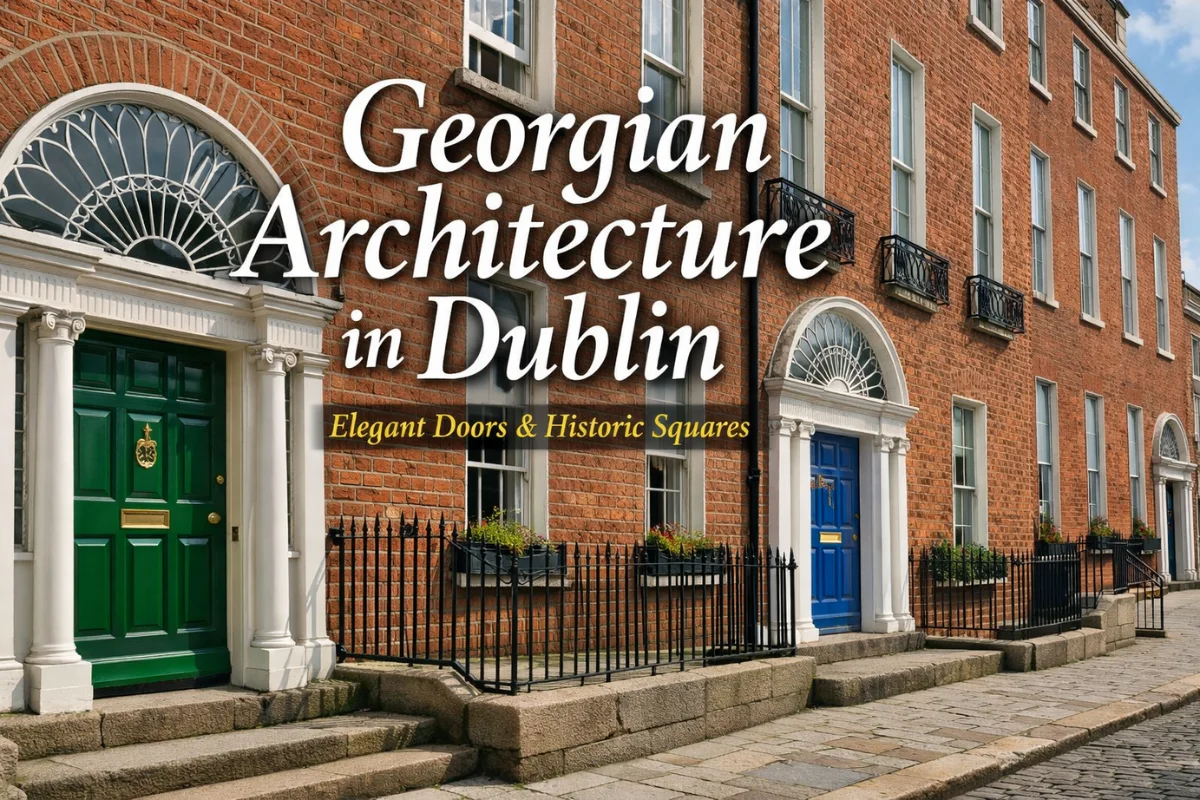
Georgian architecture in Dublin refers to the distinctive neoclassical building style that flourished in the Irish capital between roughly 1714 and 1830, during the reigns of Britain’s four King Georges. Characterized by symmetrical facades, red-brick exteriors, sash windows, and ornate fanlights, Dublin’s Georgian streets represent one of Europe’s best-preserved examples of 18th-century urban planning and design.
The Historical Roots of Georgian Dublin
Dublin’s transformation into a Georgian city was not accidental. It was the direct result of wealth, ambition, and coordinated civic planning during a period when the Anglo-Irish ruling class sought to reshape the capital in a grand, continental image.
The Wide Streets Commission, established in 1757, was one of the earliest town planning bodies in the world. It oversaw the creation of wide, orderly streets lined with uniform buildings — a deliberate departure from the cramped medieval lanes that had defined the city before. Developers and landlords commissioned rows of townhouses designed to project prosperity, and architects drew heavily from the Palladian and neoclassical influences spreading across Britain and Europe at the time.
Georgian Dublin grew rapidly on both the north and south sides of the River Liffey, with wealthy families building elegant townhouses around newly laid-out squares. This period produced some of the most recognizable streetscapes in the city, many of which remain standing today.
Defining Features of Dublin’s Georgian Buildings
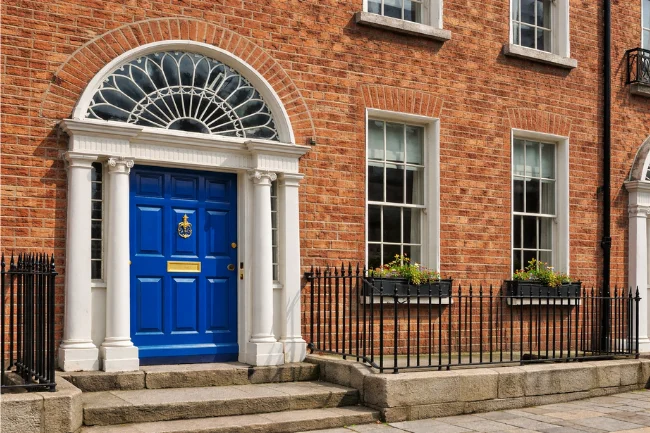
To fully appreciate Georgian architecture in Dublin, it helps to understand both the exterior details and interior logic that give these buildings their distinctive character. While there is a broad consistency to the style, subtle variations developed over the decades.
Exterior Elements
The most immediately recognizable feature of Dublin’s Georgian houses is the fanlight — a semicircular or elliptical window placed above the front door. Dublin fanlights became increasingly elaborate over time, with intricate wrought-iron or lead tracery patterns that were often unique to individual houses.
Other defining exterior features include:
Interior Layout and Details
Inside, the townhouses that define Georgian architecture in Dublin followed a predictable plan: a long entrance hall leading to reception rooms at the front, with a staircase rising toward upper-floor bedrooms. Ceilings were decorated with ornate plasterwork — Dublin craftsmen, particularly the Francini brothers and later the firm of Michael Stapleton, produced some of the finest decorative plaster ceilings in the British Isles.
The proportions followed strict classical rules derived from ancient Roman and Greek architecture. Rooms were tall, windows were large, and every detail — from cornices to doorcases — was designed with careful attention to symmetry. For those interested in how architectural symbols and spatial designations were used in planning these properties, our guide on the TS symbol in architectural floor plans offers useful background.
The Great Georgian Squares of Dublin
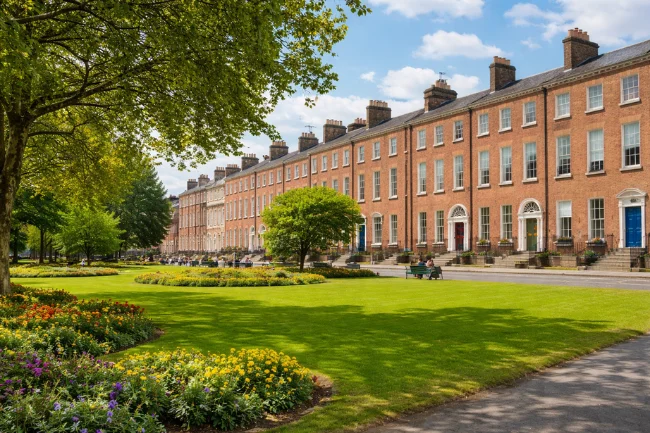
The squares are the heart of Georgian architecture in Dublin, and no visit to the city is complete without walking at least one of them in full. Each square has its own character, history, and social significance, yet all share the same essential vocabulary of red brick, uniform rooflines, and carefully proportioned facades.
Merrion Square
Merrion Square is widely considered the finest example of Georgian architecture Dublin has to offer and one of the best-preserved Georgian squares in Europe. Laid out in the 1760s, its four sides are lined with four-story brick townhouses of remarkable uniformity and quality. Notable former residents include Daniel O’Connell, W.B. Yeats, and Oscar Wilde, whose childhood home stood at No. 1.
The Visit Dublin guide to Georgian architecture highlights Merrion Square as the essential starting point for any exploration of the city’s built heritage — and it is easy to see why. The quality of the ironwork, fanlights, and door surrounds here is exceptional.
Fitzwilliam Square
Smaller and more intimate than Merrion Square, Fitzwilliam Square represents Georgian architecture in Dublin at its most refined domestic scale. Completed in the early 19th century, it remains a private residential square today — the last in the city where the central garden is still reserved exclusively for residents of the surrounding houses.
St. Stephen’s Green
St. Stephen’s Green is Dublin’s most visited park, but its surroundings tell a Georgian story too. The north side of the green retains a number of significant Georgian buildings, including the historic Shelbourne Hotel, while the overall streetscape preserves the character of 18th-century urban planning.
Parnell Square
Located on the northside of the Liffey, Parnell Square (originally Rutland Square) was one of the first Georgian squares in Dublin, laid out in the 1750s. Though it has suffered more from redevelopment than its southside equivalents, it remains an important part of the city’s Georgian story and is home to the Dublin Writers Museum and the Hugh Lane Gallery.
The North-South Divide in Georgian Dublin
The social geography of Georgian Dublin shifted dramatically over the 18th and 19th centuries. In the mid-1700s, the north side of the city — particularly around Henrietta Street and Mountjoy Square — was the fashionable address for the wealthiest families. Henrietta Street, developed from the 1720s, contains some of the largest and grandest Georgian townhouses in the city.
However, as the century progressed and Dublin Castle (the seat of British administration) remained on the south side, fashionable society gradually migrated southward toward Merrion Square and Fitzwilliam Square. This migration left the northside with a legacy of once-grand houses that were later subdivided into tenements during the 19th century.
Today, organizations like the Dublin Tenement Museum at 14 Henrietta Street offer a remarkable look at how these buildings evolved from aristocratic townhouses to overcrowded working-class dwellings — and how they survive as layered records of Irish social history.
Public Buildings: Georgian Architecture Beyond the Townhouse
Georgian architecture in Dublin extends well beyond domestic housing. The period produced several of the city’s most iconic civic and institutional buildings.
- Leinster House, built in 1745 and now home to the Irish parliament (the Oireachtas), is the grandest Georgian mansion in the city. Its design is said to have influenced James Hoban when he drew up plans for the White House in Washington, D.C. — a connection that holds particular resonance for American visitors.
- The Custom House, completed in 1791 to designs by James Gandon, represents the high point of neoclassical public architecture in Ireland. Its long riverside facade, domed centerpiece, and elaborate sculptural program made it one of the most ambitious buildings of its era in the British Isles.
- The Four Courts, also by Gandon and completed in 1802, shares the same monumental ambition. Both buildings suffered damage during the Irish Civil War of the early 1920s but were subsequently restored.
- Trinity College Dublin contains significant Georgian-era additions, including the Palladian facade facing College Green, completed in the 1750s, which frames one of the city’s most photographed public spaces.
Preservation Challenges and Ongoing Conservation
Georgian architecture in Dublin has not survived without cost or controversy. The mid-20th century saw extensive demolition of historic buildings, particularly in the area known as Fitzwilliam Street Lower, where a continuous terrace was demolished in the 1960s to make way for an electricity board office — a decision now widely regarded as one of the greatest planning failures in Irish history.
Since then, attitudes have shifted considerably. The surviving fabric now enjoys strong legal protections through the Planning and Development Acts, and organizations such as the Irish Georgian Society have campaigned effectively for conservation since 1958. Many of the surviving houses have been restored to their original appearance or adapted sensitively for modern use as offices, embassies, and hotels.
The challenge today is balancing heritage protection with the practical needs of a growing city. Some protected structures remain vulnerable to neglect or incremental alteration, and debates over development in historically sensitive areas continue.
Visiting Georgian Dublin: Practical Guidance for Travelers
For visitors from the United States and elsewhere, Georgian architecture in Dublin is highly accessible. The Georgian core of the city — centered on Merrion Square, Fitzwilliam Square, and St. Stephen’s Green — is compact and walkable, making it easy to cover on foot.
Several options exist for guided exploration. Architectural walking tours operate regularly and provide context that is hard to glean from street-level observation alone. The Irish Architectural Archive, located on Merrion Square, maintains an extensive collection of drawings, photographs, and documents related to Irish architecture and is open to the public.
For those interested in interior spaces, Number Twenty Nine on Lower Fitzwilliam Street offers a fully restored Georgian townhouse experience, furnished and presented as it would have appeared around 1790. It is one of the few places where visitors can experience the full vertical sequence of rooms from the basement kitchen to the servants’ quarters.
If you are exploring architectural geometry in older buildings, you may also find it useful to understand how spaces were proportioned — our overview of the half-moon shaped architectural space is a helpful companion for understanding how curved and semicircular forms appear throughout Georgian interiors and fanlights.
Frequently Asked Questions
What makes Dublin’s Georgian architecture unique compared to other Georgian cities?
Dublin’s Georgian architecture is distinguished by its exceptional fanlights, the quality of its decorative plasterwork, and the remarkable continuity of its streetscapes. Unlike London or Edinburgh, much of Dublin’s Georgian fabric was built within a relatively concentrated period and geographic area, giving it a cohesion that is rare elsewhere in Europe.
When was the Georgian period in Dublin?
The Georgian era in Dublin spans roughly 1714 to 1830, corresponding to the reigns of George I through George IV. The most intensive phase of construction in Dublin occurred between approximately 1750 and 1800, when the city’s major squares and wide streets were developed.
Is Dublin’s Georgian Quarter a UNESCO World Heritage Site?
As of the time of writing, Georgian Dublin is not a UNESCO World Heritage Site, though it has been discussed as a candidate. It is protected under Irish national planning legislation, and several individual buildings are listed as protected structures on the National Inventory of Architectural Heritage.
What is the significance of the fanlight in Dublin Georgian architecture?
The fanlight — a glazed window above the front door — became a hallmark of Dublin Georgian design. Over time, Dublin craftsmen developed increasingly elaborate tracery patterns in wrought iron and lead, making each fanlight effectively a unique work of decorative art. They also served the practical function of bringing light into hallways.
How does Leinster House relate to the White House in Washington, D.C.?
Leinster House, completed in 1745 and now home to Ireland’s parliament, is widely cited as an influence on architect James Hoban when he designed the White House. Hoban, who was born in Ireland, is thought to have drawn on the proportions and character of Leinster House when submitting his winning design in the 1792 competition. The connection has been acknowledged by historians and officials on both sides of the Atlantic.
A Living Architectural Legacy
Georgian architecture in Dublin is not simply a preserved relic — it continues to define how the city looks, feels, and functions. The squares, streets, and public buildings of the 18th century remain central to daily life in a 21st-century capital, used as offices, embassies, cultural institutions, and homes.
For anyone with an interest in European urban history, neoclassical design, or simply the visual pleasure of a well-proportioned street, Dublin offers something genuinely rare: a coherent, largely intact Georgian cityscape that can be explored at walking pace. A good starting point is Merrion Square on a clear morning, when the red brick catches the light, and the painted doors and polished fanlights are at their most striking.
For deeper research into specific buildings or architects, the resources provided by the Irish Georgian Society and the Irish Architectural Archive are authoritative and freely accessible online. You might also find it helpful to explore how specific architectural materials and finishes — such as those discussed in our guide to gessolini — were used in period restoration and interior finishing work.

I’m Salman Khayam, the founder and editor of this blog, with 10 years of professional experience in Architecture, Interior Design, Home Improvement, and Real Estate. I provide expert advice and practical tips on a wide range of topics, including Solar Panel installation, Garage Solutions, Moving tips, as well as Cleaning and Pest Control, helping you create functional, stylish, and sustainable spaces that enhance your daily life.