
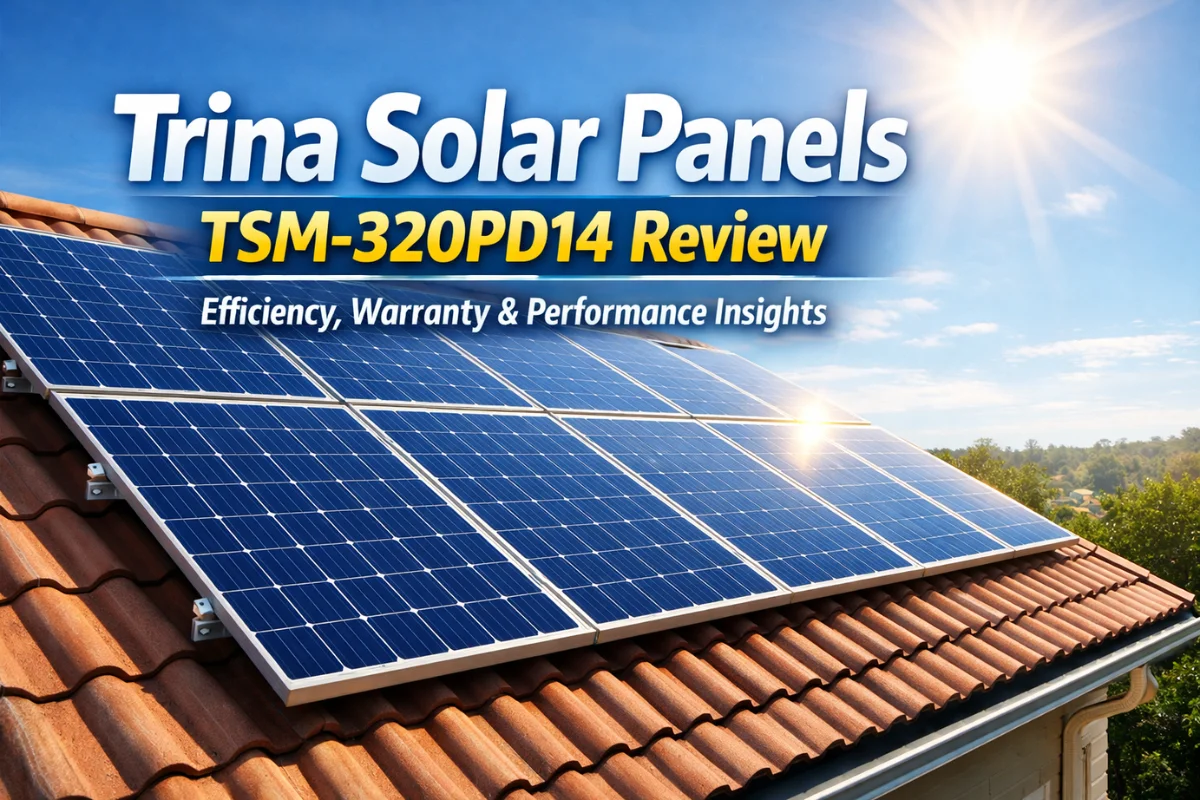
The Trina Solar TSM-320PD14 is a 320-watt polycrystalline photovoltaic panel designed for residential and light commercial installations. This Trina Solar panels TSM-320PD14 review covers its competitive pricing, solid efficiency ratings, and a strong manufacturer’s warranty — key reasons this panel has been a widely purchased option in the U.S. solar market for homeowners seeking reliable energy output at an accessible cost.
When evaluating solar panels for a home or small business installation, brand credibility, wattage output, degradation rates, and long-term warranty coverage all play a significant role in the purchasing decision. The Trina Solar TSM-320PD14 sits squarely in the budget-to-mid-range tier, but that label does not tell the full story. Trina Solar, founded in 1997, has grown into one of the largest solar manufacturers in the world, and this particular model reflects years of manufacturing refinement. This Trina Solar panels tsm-320pd14 review breaks down everything a U.S. buyer needs to know before committing.
Trina Solar TSM-320PD14 Review: Brand Background and Credibility
Before analyzing this specific panel, context about the manufacturer matters. Trina Solar is headquartered in China but operates globally, with distribution and sales infrastructure throughout North America. The company consistently ranks among the top-tier solar manufacturers by shipment volume, and its products are frequently evaluated and rated by third-party platforms, including EnergySage, one of the most trusted solar comparison resources in the United States.
Trina Solar carries a Bloomberg Tier 1 designation, which means institutional investors consider the company financially stable enough to back projects financed by major lenders. For a residential buyer, this translates to confidence that the company is likely to honor its 25-year product warranty without going out of business. That backstory is relevant because any panel is only as good as its manufacturer’s ability to stand behind it.
Trina Solar Panels TSM-320PD14 Review: Full Specifications

The TSM-320PD14 is part of Trina Solar’s Duomax series and uses polycrystalline silicon cells. The table below, drawn from this Trina Solar panels TSM-320PD14 review, summarizes the key technical specifications to consider before purchasing:
Independent panel data compiled by SolarReviews further substantiates these ratings and includes user feedback from verified purchasers across the country.
TSM-320PD14 Review: Efficiency and Real-World Performance

An efficiency rating of approximately 16.5% falls into the standard polycrystalline range. For comparison, premium monocrystalline panels often achieve 20% or higher, but they also carry a noticeably higher price per watt. The TSM-320PD14 is not designed to compete with high-efficiency mono panels—it is designed to deliver consistent, dependable production over decades at a value-oriented price point.
In real-world conditions, this panel performs well on south-facing roofs with minimal shading. The temperature coefficient of -0.41% per degree Celsius is a key figure for U.S. homeowners in warmer climates such as Arizona, Texas, or Florida. That number means the panel’s output drops by 0.41% for every degree above the 25°C STC baseline. Compared to some competitors in the same class, this coefficient is average—better panels in this category come in around -0.38%, while worse ones can hit -0.45%.
One feature worth noting is the dual-glass construction available in the Duomax variant. A glass backsheet rather than a polymer one can significantly improve durability in high-humidity or coastal environments where standard polymer backsheets tend to degrade faster over time. If you are installing near the ocean or in a region with heavy rainfall, the dual-glass configuration offers a meaningful longevity advantage.
Installation Considerations for U.S. Homeowners
The TSM-320PD14 is compatible with standard racking systems and mounting hardware used by most U.S. solar installers. At approximately 49.6 pounds per panel, it falls within the manageable weight range for typical residential roof structures, though installers will always conduct a structural assessment before proceeding.
If your system uses a string inverter setup, understanding how your panels will be wired together in series and parallel configurations is important. A helpful resource on this is a 24V solar panel diagram with converter, charger, and inverter, which illustrates how wiring layouts affect system voltage and overall efficiency.
The panel is also compatible with microinverter and DC optimizer systems, which can partially offset performance loss in shaded conditions. While the TSM-320PD14 does not have built-in bypass diodes that rival the shade tolerance of some premium mono panels, pairing it with optimizers can bring its real-world output closer to its rated potential on partially shaded rooftops.
Warranty Coverage: What Is and Is Not Included
Warranty terms are one of the most critical factors when selecting a solar panel, and the TSM-320PD14 holds up reasonably well here. The 10-year product warranty covers manufacturing defects and workmanship issues. The 25-year linear power warranty guarantees that the panel will produce at least 80.7% of its rated output by year 25, starting with a first-year maximum degradation of 2.5% and then no more than 0.7% per year thereafter.
This linear warranty structure is a positive sign compared to older step-based warranties that were less transparent. However, homeowners should understand that warranty claims are handled through the installer in most cases, not directly with Trina Solar. Choosing a licensed, reputable solar installer is therefore essential for warranty protection to be practical rather than theoretical.
Timing your installation also matters. If you are unsure about the optimal time of year to have panels put on your roof, reviewing guidance on when is the best time to install solar panels can help you coordinate with your installer for the most efficient and cost-effective process.
Trina Solar TSM-320PD14 Review: Pricing and Value Comparison
The TSM-320PD14 is generally priced competitively in the U.S. wholesale and residential markets. While exact pricing varies by distributor, installer margin, and regional demand, this Trina Solar panels TSM-320PD14 review finds that the model historically falls in the lower-to-mid cost range per watt among panels with equivalent warranties. For homeowners focused on maximizing the number of panels within a fixed budget, the Trina TSM-320PD14 offers a reasonable path to a larger system size without a proportionate increase in cost.
The trade-off compared to premium options is straightforward: lower cost comes with lower efficiency, meaning you need more physical roof space to produce the same total output as a smaller array of high-efficiency panels. For homes with ample south-facing roof space and no shading obstructions, this trade-off is perfectly acceptable. For homes with limited roof space or complex shading, upgrading to a higher-efficiency panel may be more cost-effective in the long run.
Maintenance and Long-Term Upkeep
Like all solar panels, the TSM-320PD14 requires minimal but consistent maintenance. Dust, bird droppings, pollen, and debris accumulation can reduce output by 5% to 15% over time, depending on your climate and local environment. Routine cleaning is the most impactful simple maintenance task an owner can perform. Using the right tools matters—a soft brush for solar panel cleaning is recommended to avoid scratching the glass surface, which can compromise light transmission and long-term durability.
Beyond cleaning, periodic inspection by a certified solar technician every three to five years is a sound practice. Technicians check for micro-cracks, delamination, junction box integrity, and electrical connection health—factors that are not always visible from the ground but can meaningfully affect output and safety over time.
Who Should Consider the TSM-320PD14
This panel is a good fit for homeowners who prioritize budget efficiency over maximum power density. Specifically, it is well-suited for:
- Homeowners with large, unobstructed roof areas in mid-to-high sun regions
- Buyers seeking a reputable brand without a premium mono panel price
- Installers building larger residential or small commercial arrays where cost-per-watt matters significantly
- Projects in coastal or humid climates where dual-glass durability is an advantage
It is a less ideal fit for homes with limited roof space, complex shading patterns, or buyers who need to maximize output from every square foot of available surface area.
Final Thoughts
The Trina Solar TSM-320PD14 represents a dependable, value-oriented option in the residential polycrystalline panel segment. Its 320-watt output, 25-year linear power warranty, and Trina Solar’s established manufacturing reputation make it a credible choice for homeowners seeking long-term energy production without paying a premium-tier price. The efficiency and temperature coefficient figures are competitive within its class, and the dual-glass build option adds meaningful durability for challenging environments.
Before finalizing any solar purchase, getting multiple quotes from licensed installers and comparing the Trina Solar panels TSM-320PD14 against current alternatives is always a wise step. Solar technology evolves quickly, and a professional assessment of your specific roof, location, and energy goals will yield a more personalized recommendation than any general review can provide.
Frequently Asked Questions
Is the Trina Solar TSM-320PD14 still a good solar panel to buy?
The TSM-320PD14 remains a solid budget-to-mid-range option for homeowners with ample roof space. Its 25-year linear power warranty and Trina Solar’s Tier 1 manufacturer status provide reliable long-term confidence. However, newer monocrystalline models may offer better efficiency per dollar depending on current market pricing in your area.
What is the efficiency rating of the Trina TSM-320PD14?
The TSM-320PD14 has a module efficiency of approximately 16.5%. This is within the standard range for polycrystalline panels. While not as high as premium monocrystalline panels (which can reach 20%+), it offers adequate performance for most residential installations with sufficient roof area.
Trina Solar Panels TSM-320PD14 Review: How Long Does the Warranty Last?
The panel comes with a 10-year product warranty covering manufacturing defects and a 25-year linear power output warranty. Trina Solar guarantees the panel will produce at least 80.7% of its rated output by year 25, with annual degradation capped at 0.7% after the first year.
How does the TSM-320PD14 perform in hot climates?
The panel has a temperature coefficient of -0.41% per degree Celsius above 25°C. In hot climates like the American Southwest, output will decrease moderately on peak summer days. This performance is typical for polycrystalline panels. Proper ventilation underneath the mounting system can help minimize heat-related losses.
What is the difference between the Trina TSM-320PD14 and monocrystalline Trina panels?
The TSM-320PD14 uses polycrystalline silicon cells, which are less expensive to manufacture but slightly less efficient than monocrystalline alternatives. Monocrystalline Trina panels generally offer higher efficiency ratings, better low-light performance, and a sleeker appearance, though they carry a higher upfront cost per watt.

I’m Salman Khayam, the founder and editor of this blog, with 10 years of professional experience in Architecture, Interior Design, Home Improvement, and Real Estate. I provide expert advice and practical tips on a wide range of topics, including Solar Panel installation, Garage Solutions, Moving tips, as well as Cleaning and Pest Control, helping you create functional, stylish, and sustainable spaces that enhance your daily life.