
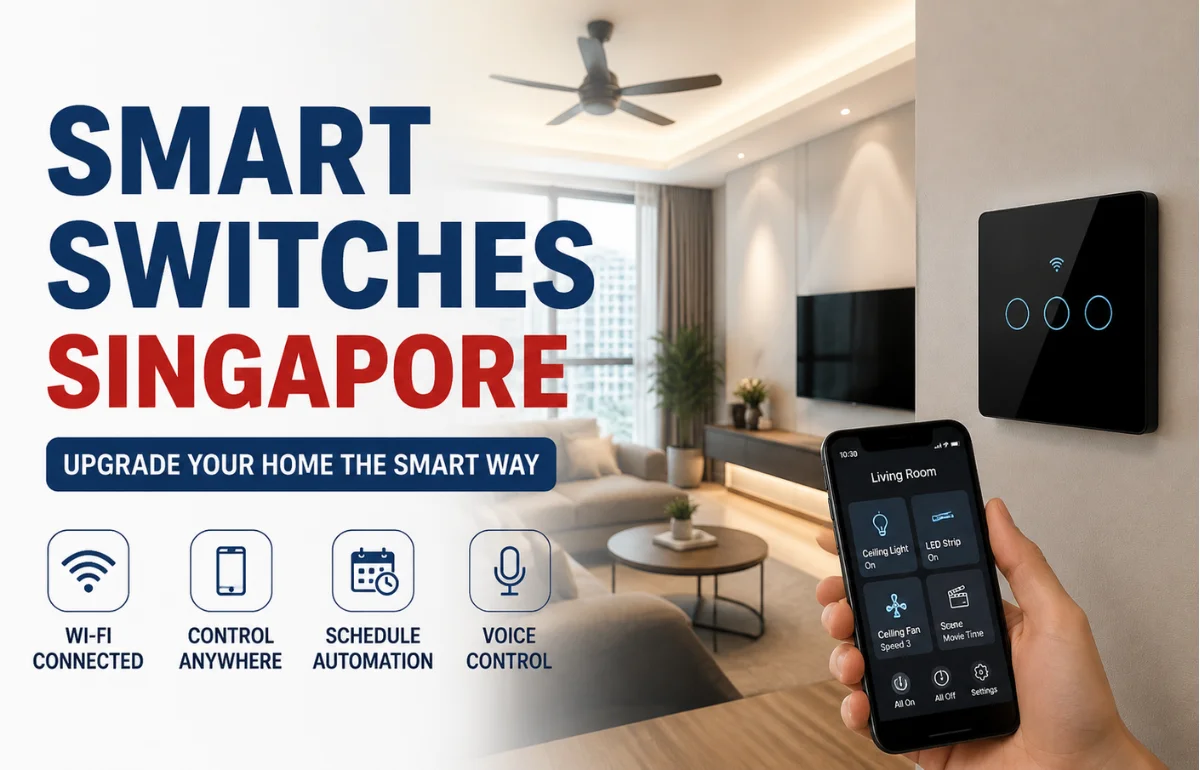
Smart Switches Singapore solutions have become one of the most practical ways for homeowners to upgrade to a smart home without major renovation work. While many HDB flat owners assume that smart lighting requires full electrical rewiring, modern smart switch technology has largely eliminated that barrier. Understanding how these switches work can open up a simple, cost-effective path to smarter lighting, fan control, and home automation.
What Smart Switches Actually Do
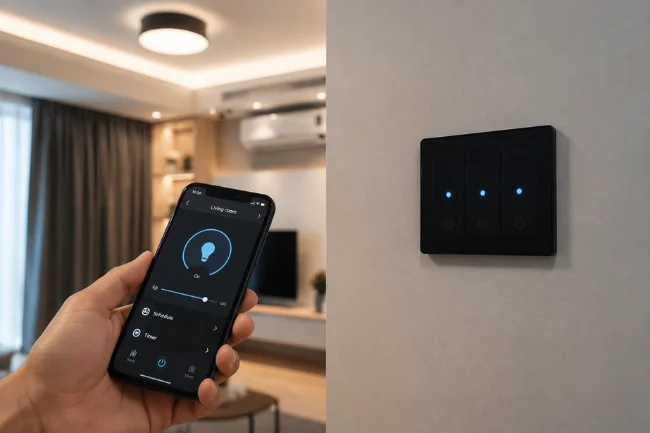
A smart switch replaces a standard wall switch and connects to the home’s WiFi network. Once connected, it can be controlled remotely via a smartphone app, scheduled to switch on or off at set times, incorporated into scenes that control multiple lights simultaneously, and integrated with voice assistants such as Amazon Alexa or Google Home. The LED lighting connected to the switch requires no modification — the intelligence is entirely in the switch itself. This means any existing LED fitting, downlight, or strip light can become a smart-controlled fixture without touching the fixture at all.
Most smart switches sold for Singapore homes fall into one of three categories, and the right choice depends on the existing wiring at the switch position, the budget, and how much manual override control a household wants to retain. The table below summarises the main types found in local showrooms.
The No-Neutral-Wire Challenge — and How It Is Solved
The most common technical barrier for smart switch installation in Singapore HDB flats is the absence of a neutral wire at the switch position. Traditional Singapore wiring runs only the live wire to wall switches, returning via the light fitting. Most smart switches require a neutral wire to maintain the WiFi connection when the light is switched off.
Modern smart switch designs address this in two ways. The first is a non-neutral or single-wire design that draws a very small amount of current through the connected light fitting to maintain its electronics, suitable for most LED fittings above a minimum wattage. The second is a smart switch with a built-in neutral bypass module that is installed at the light fitting location rather than the switch. Both approaches allow smart switch installation in standard HDB wiring without any additional cabling, provided the installation is carried out by a licensed electrician.
The Housing & Development Board of Singapore permits smart switch installation in HDB flats, provided the work is carried out by a licensed electrician and complies with the relevant SS 638 wiring standards. Homeowners should always verify compliance with their renovation contractor before proceeding.
One detail that trips up many first-time buyers is the minimum load requirement on single-wire smart switches. Because the switch draws a small standby current through the light fitting, very low-wattage LED bulbs (typically under 3W) sometimes cause a faint glow or flicker when “off,” since there isn’t enough load to fully dissipate the standby draw. This is not a fault — it is a known characteristic of single-wire designs. Three practical fixes used by electricians in Singapore are:
- Pairing the switch with an LED bulb rated above the manufacturer’s minimum wattage (usually printed on the switch packaging or datasheet).
- Adding a small bypass capacitor (sometimes called a “miniature load” or “dummy load”) at the light fitting to absorb the standby current.
- Switching to a neutral-bypass model instead, which routes the standby current through a dedicated module rather than the bulb itself.
A licensed electrician will typically check the wattage of the existing fitting before recommending which of the two non-rewiring approaches to use, which is why DIY installation without an electrician’s assessment is generally discouraged, even though the switches themselves are sold as plug-and-play.
Extending Smart Control to Ceiling Fans
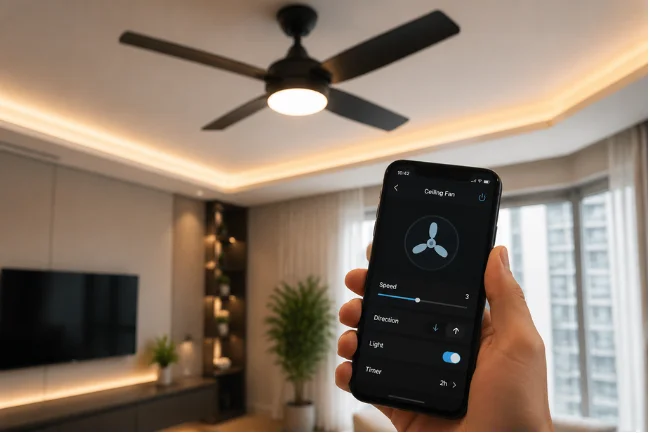
Smart control is not limited to lighting. Singapore’s heat makes ceiling fans a fixture in most bedrooms and living rooms, and integrating fan control into a smart home system delivers meaningful convenience and energy savings. Smart-compatible ceiling fan Singapore models allow speed, direction, and integrated light control from the same app used for smart switches — eliminating the need for multiple remote controls and enabling whole-room scenes that set both lighting and airflow simultaneously. Scheduling the fan to slow down overnight and switch off before a morning alarm is a small automation that meaningfully improves sleep comfort.
The energy case for smart fan control is also worth noting. A ceiling fan left running on medium speed overnight in an unoccupied room draws a small but constant load. Over a typical 31-day month, the difference between a fan that is manually forgotten and one that is scheduled to switch off after a set period can be noticeable on the utility bill, especially across multiple bedrooms. The table below gives a rough sense of the comparison for context (figures are illustrative, based on a standard 60W ceiling fan motor and Singapore’s typical residential electricity tariff).
*Cost estimates use an illustrative tariff and are intended only to show relative savings, not exact utility figures. Actual costs depend on the prevailing SP Group tariff, fan motor wattage, and household usage patterns.
Smart Lighting Ecosystems
For homeowners who want to go beyond individual switch control, smart lighting ecosystems allow groups of switches, dimmers, and smart fixtures to be controlled as a unified system. A single “Good Night” scene can dim all living room lights to 10%, switch off the kitchen, and set the bedroom fan to low speed — activated by a single tap or voice command. For modular living room layouts where the lighting arrangement may change, power track systems with smart-compatible spotlight heads provide both physical flexibility and control flexibility in a single installation.
Choosing between the major smart home protocols available in Singapore can be confusing, since switches, fans, and ecosystems don’t all speak the same language out of the box. The comparison below covers the three protocols most relevant to local homeowners.
Cost Considerations for a Smart Switch Upgrade
One of the reasons smart switches have become the practical entry point into home automation in Singapore is the relatively low upfront cost compared with a full smart home rewiring project. A typical 3-room or 4-room HDB flat has between 10 and 16 switch points across the living room, bedrooms, and common areas. Replacing all of them with smart switches, including labour, generally falls within a predictable range, summarised below.
Compared with rewiring an entire flat to bring a neutral wire to every switch position — which involves hacking into walls, replastering, and repainting — the non-rewiring approach typically completes in a single day per room and avoids the disruption, debris, and repainting costs that come with structural electrical work. This is the main reason smart switch adoption has accelerated in resale HDB flats in particular, where major rewiring is often impractical without a full renovation already underway.
What to Do Next
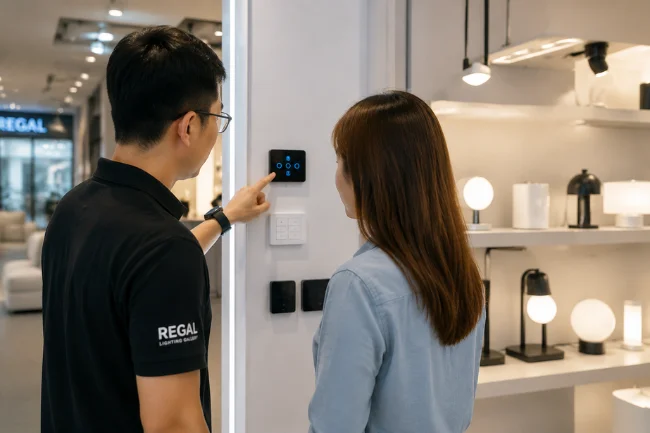
The best starting point for any smart switch upgrade is a working demonstration. Reading about scene control and scheduling conveys the concept; experiencing it in a showroom makes the practical value immediately clear. Homeowners looking to explore compatible products can browse the smart switches Singapore range at Regal Lighting Gallery, where working demonstrations are available in-store and staff can advise on compatibility with existing HDB wiring configurations.
Before visiting a showroom or booking an electrician, it helps to walk through the flat and note down a few details for each switch point: whether the existing wiring is single-wire or has a neutral, the wattage of the connected light fitting, and which rooms would benefit most from scheduling or scene control (bedrooms and the living room are usually the highest-impact starting points). Bringing this information to a showroom consultation generally results in a faster and more accurate recommendation.
FAQs About Smart Switches in Singapore
Do smart switches work in older HDB flats without rewiring?
Yes. Most older HDB flats only have a live wire running to the switch position, and modern smart switches are specifically designed around this limitation. Single-wire smart switches or models with a separate neutral bypass module installed at the light fitting both work without adding new cabling, as long as the installation is done by a licensed electrician.
Is it legal to install smart switches in an HDB flat?
Yes, HDB permits smart switch installation as long as the work is carried out by a licensed electrician and complies with SS 638 wiring standards. Homeowners should confirm compliance with their renovation contractor or electrician before installation, particularly if other electrical works are being carried out at the same time.
Will a smart switch work with my existing LED lights?
In most cases, yes. The intelligence is built into the switch itself, not the bulb, so no modification to the existing LED fitting, downlight, or strip light is required. The one exception is very low-wattage LED bulbs paired with single-wire smart switches, which can sometimes flicker faintly when off; this is usually resolved by choosing a slightly higher-wattage bulb or a neutral-bypass switch instead.
Can smart switches control ceiling fans as well as lights?
Yes. Smart-compatible ceiling fan models allow fan speed, direction, and integrated lighting to be controlled from the same app used for smart switches, which means a single scene can adjust both the lights and the fan in a room at once, rather than requiring separate remotes for each.
What is the difference between a smart switch and a smart bulb?
A smart switch replaces the wall switch and controls whatever light fitting is wired to it, regardless of the bulb type, while a smart bulb is a self-contained unit that must be screwed into a standard socket and typically needs the wall switch left permanently on. For most Singapore homes with built-in downlights or LED strips, a smart switch is the more practical option since it works with fittings that can’t be swapped for a bulb.

I’m Salman Khayam, the founder and editor of this blog, with 10 years of professional experience in Architecture, Interior Design, Home Improvement, and Real Estate. I provide expert advice and practical tips on a wide range of topics, including Solar Panel installation, Garage Solutions, Moving tips, as well as Cleaning and Pest Control, helping you create functional, stylish, and sustainable spaces that enhance your daily life.