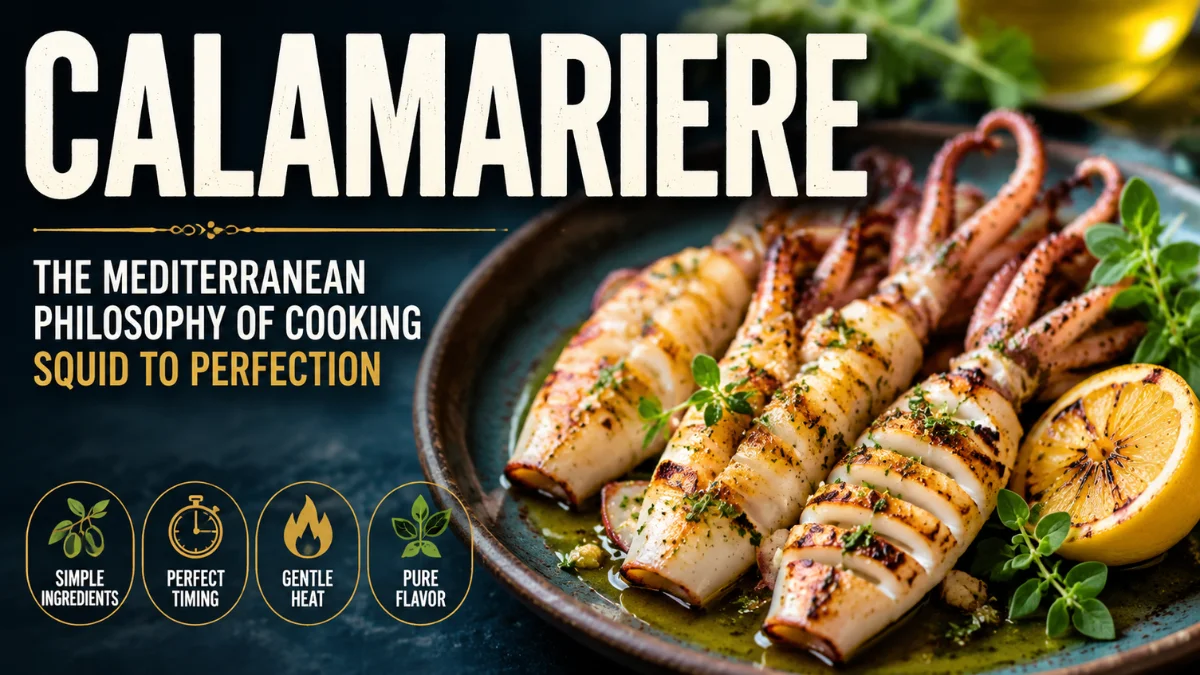
I still remember the first time I tasted squid prepared not as a dish, but as a statement. It was on a small Greek island, at a taverna with no menu. The cook—a woman in her seventies—simply said, “Kalamari me agapi” (squid with love). What arrived wasn’t fried rings with marinara sauce. It was tender, slightly charred squid tentacles resting in a pool of local olive oil, fresh oregano, and a squeeze of lemon. That meal introduced me to something I’ve since learned to call Calamariere.
Calamariere isn’t a single recipe you’ll find in a cookbook. It’s a Mediterranean culinary philosophy focused on preparing squid with deep respect for texture, freshness, and balance. It rejects the idea that squid is merely a vehicle for batter or heavy sauces. Instead, Calamariere elevates squid to the center of the plate using precise techniques and simple, high-quality ingredients. Think olive oil, wild herbs, garlic, citrus, and ripe tomatoes—nothing more, nothing less.
In this post, I’ll walk you through what Calamariere really means, where it comes from, how to cook by its rules, and why it’s becoming a quiet force in both traditional seaside kitchens and modern global gastronomy.
The Real Meaning of Calamariere (Beyond the Plate)
Let me clear something up right away. You won’t find “Calamariere” in most Italian or Greek dictionaries as a traditional term. That’s because it’s a modern conceptual word—coined to describe a timeless approach. Linguistically, it builds on “calamari,” the plural of calamaro (Italian for squid), and adds a suffix that suggests a practitioner or a dedicated method. Think sommelier for wine or charcutier for preserved meats. Calamariere implies someone who knows squid intimately.
But here’s the key: Calamariere is not a person. It’s a philosophy. It says that squid deserves the same care we give to a prime cut of fish or a delicate shellfish. No more rubbery, overcooked rings. No more drowning the natural sweetness in heavy breading. The Calamariere way treats squid as a refined ingredient that responds to timing, heat, and fresh companions.
Why This Philosophy Emerged Now
You might wonder why we need a new term for old cooking. The answer lies in how global food culture has changed. Over the past decade, diners and home cooks have become obsessed with “authentic” Mediterranean cuisine—but often that authenticity gets reduced to a checklist (olive oil, lemon, oregano). Calamariere goes deeper. It forces you to ask: Am I actually respecting this squid? That question matters because squid is one of the most misunderstood proteins in the kitchen.
The Linguistic and Cultural Roots of Calamariere
To understand Calamariere, we need to look at how Mediterranean coastal communities have always treated squid. Fishermen from Sicily to Crete to the Turkish coast never considered squid “trash seafood.” Historically, it was affordable and abundant, but it was also prepared with genuine skill. They knew that a few seconds too long over heat turned a tender catch into a chewy disaster.
The word Calamariere borrows from this generational knowledge. It’s not tied to one language because Mediterranean cooking doesn’t respect borders. In Spain, you’ll find chipirones (baby squid) cooked in their own ink. In Croatia, lignje na žaru (grilled squid) with parsley and garlic. In Lebanon, kalamaresh stuffed with rice and herbs. All of these could fall under the Calamariere umbrella. That’s the beauty of this philosophy: it adapts to local ingredients while holding firm to a core belief—simplicity, precision, respect.
These principles remain central to many Mediterranean seafood cooking traditions, where freshness, technique, and regional ingredients are valued above complex preparation methods.
| Aspect | Traditional Calamari (Fried Rings) | Calamariere Philosophy |
|---|---|---|
| Primary cooking method | Deep-frying in batter | Grilling, sautéing, braising, or quick-searing |
| Flavor focus | Batter and dipping sauce | Squid’s natural sweetness and texture |
| Key ingredients | Flour, oil, marinara | Olive oil, herbs, citrus, garlic, tomatoes |
| Texture goal | Crispy exterior, chewy interior | Tender, delicate, or silky (method-dependent) |
| Cultural role | Appetizer or bar snack | Main course or centerpiece of a meal |
| Skill requirement | Low to moderate | Moderate to high (timing and heat control) |
This table isn’t meant to bash fried calamari—I’ve enjoyed plenty of it. But the Calamariere approach asks more from both the cook and the eater.
The Core Principles of Calamariere Cooking
After spending years cooking alongside Mediterranean home cooks and a few professional chefs, I’ve distilled Calamariere down to four non-negotiable rules.
1. Freshness Above Everything Else
Frozen squid can work in a pinch, but Calamariere really demands fresh or very recently frozen (ideally never frozen). Why? Fresh squid has a translucent, almost opalescent flesh. When you press it, it springs back. The smell should be like the ocean—clean and briny, never fishy or ammoniated. I’ve bought squid directly from fishermen in Puglia, and the difference is night and day. Fresh squid cooks faster, stays more tender, and absorbs seasonings without releasing excess water.
2. Meticulous Cleaning and Preparation
This is where many home cooks rush. Calamariere teaches patience. You need to remove the quill (that plastic-like piece inside the body), peel off the purple membrane if it’s thick, and clean out the innards thoroughly. Some chefs keep the ink sac for sauces; I recommend that only if you’re experienced. The tentacles and fins are treasures—never discard them. Slice the body into rings or leave it whole for stuffing. But here’s the secret: score the outside of the body lightly in a crosshatch pattern. That small act prevents curling and helps the squid cook evenly.
3. Precision Timing and Gentle Heat
Squid is a paradox. Cook it for 30 seconds or less over high heat (grill or blazing pan), and it’s tender. Cook it for over two minutes at that same heat, and it turns rubbery. Alternatively, braise it for 45 minutes to an hour in a liquid like tomato sauce or wine, and it becomes butter-tender again. Calamariere embraces both paths, but rejects the middle ground. There’s no “just cook it until done” vagueness. You either flash-sear or slow-simmer. Nothing in between.
4. Letting Ingredients Speak, Not Shout
You will never see a complicated spice blend in Calamariere cooking. No ten-ingredient marinades. The Mediterranean palette is famously restrained: good extra virgin olive oil, sea salt, fresh garlic, lemon or orange zest, parsley, oregano, thyme, and maybe a pinch of chili flake. Tomatoes appear in summer. That’s it. The philosophy holds that if you need to mask the squid’s flavor, you’ve failed somewhere else—likely freshness or technique.
Regional Variations Across the Mediterranean
One of the most exciting things about Calamariere is how it shifts from coast to coast. I’ve traveled extensively to understand these differences, and here’s what I’ve learned.
Southern Italy and Sicily
Here, Calamariere often means calamari ripieni (stuffed squid). The bodies are filled with breadcrumbs, garlic, parsley, pecorino cheese, and sometimes a bit of squid tentacles chopped fine. Then they’re simmered in a light tomato sauce with a splash of white wine. The texture ends up soft and spoon-tender. This version respects the original Calamariere focus on gentle heat and regional produce.
Greece and Crete
Greek island cooking takes a bolder approach. Whole small squid are cleaned, scored, and marinated briefly in olive oil, lemon juice, and dried oregano. Then they hit a very hot charcoal grill for maybe 60 seconds per side. The result is smoky, charred in spots, and still slightly translucent at the thickest part. Served with a ladle of ladolemono (oil-lemon emulsion) and bread for sopping. That’s Calamariere in its most primal form.
Spain (especially Galicia and Andalusia)
Spaniards might not use the word Calamariere, but the concept lives in dishes like chipirones a la plancha (grilled baby squid) or calamares en su tinta (squid in its own ink). The latter is a slow braise that transforms the squid into a dark, almost mystical stew. That version challenges the idea that Calamariere only means quick cooking. As I said earlier, slow braising is fully acceptable—it’s the middle ground that fails.
Croatia and Montenegro
Along the Adriatic, you’ll find lignje na žaru served with blitva (Swiss chard with potatoes and garlic). The squid is often stuffed with prosciutto and cheese before grilling. This regional twist adds a savory, salty punch while still respecting the Calamariere mandate of high-quality, simple ingredients.
Turkey and the Levant
In Turkey, kalamar tava is the famous fried version, but the Calamariere approach appears in kalamar dolma (stuffed squid with rice, currants, and pine nuts) and grilled whole squid with sumac and parsley. The use of sumac—a tangy, lemony spice—is a brilliant example of how Calamariere adapts without losing its soul.
Nutritional Value of Cooking the Calamariere Way
I don’t usually lead with health benefits when I talk about food I love. But the Calamariere philosophy aligns so naturally with modern nutritional science that it’s worth mentioning.
Squid is a lean protein. A 100-gram serving of cooked squid contains roughly 15-18 grams of protein, less than 2 grams of fat, and only about 90-100 calories before oil is added. It’s rich in selenium (important for thyroid and immune function), vitamin B12, phosphorus, and copper.
For more natural approaches to health and wellness, visit Well Health Organic. Unlike farmed salmon or shrimp, wild squid has no added antibiotics and very low mercury levels compared to larger predatory fish.
When you prepare squid the Calamariere way—using olive oil (heart-healthy monounsaturated fats), fresh herbs (antioxidants), and minimal salt—you end up with a meal that supports cardiovascular health and weight management.
The Mediterranean diet has been studied for decades, and squid prepared this way fits right into its most protective patterns. For another deep dive into Mediterranean-inspired wellness, explore this nutrition & wellness guide on pravi celer benefits.
Source: Harvard T.H. Chan School of Public Health on Mediterranean diet principles
Calamariere in Modern and Fine Dining
I’ve watched Calamariere quietly move from rustic tavernas to Michelin-starred kitchens. Chefs like José Andrés (who grew up in Spain) and Noma’s former seafood specialist have played with squid in ways that echo this philosophy. At a restaurant in Barcelona, I once ate a dish called “Calamariere del Mar”—thin slices of raw squid “cooked” only in citrus juice and olive oil, served with sea fennel and pickled shallots. The texture was almost creamy. The chef told me, “We never fry it. Frying is for tourists. This is for people who understand squid.”
That might sound elitist, but I disagree. Calamariere is accessible to anyone with a decent pan, fresh squid, and the willingness to pay attention. You don’t need a restaurant budget. You need respect for timing.
How Calamariere Differs from “Calamari” on Menus
If you see “calamari” on a menu in North America or the UK, you can almost guarantee it means fried rings with a dipping sauce. That’s fine for what it is—a bar snack. But Calamariere turns squid into a main event. You’ll find it described as “grilled whole squid,” “stuffed calamari in tomato sauce,” “squid braised in ink,” or simply “Calamariere-style” if the chef knows the term. The price is often higher, and for good reason: it requires skill and fresh ingredients.
My Personal Calamariere Method (What I’ve Learned Through Failure)
I’ll be honest with you. I ruined a lot of squid before I understood Calamariere. The first five or six times I tried to grill squid at home, it came out like rubber bands. I was afraid of undercooking seafood (a common fear), so I left it on the heat too long. The solution turned out to be counterintuitive: either cook it for less than 60 seconds per side over high heat, or commit to a slow braise of at least 45 minutes. There is no safe middle.
Here’s my go-to Calamariere recipe for two people, developed after dozens of failures:
-
Buy two large fresh squid (about 1 pound total). Ask the fishmonger to clean them, but keep the tentacles.
-
At home, rinse and pat dry. Score the outside of the bodies lightly with a sharp knife.
-
Whisk together 3 tablespoons of good olive oil, 2 minced garlic cloves, the zest of 1 lemon, 1 teaspoon of dried oregano, and salt.
-
Marinate the squid (bodies and tentacles) for no more than 15 minutes. Longer than that, and the acid starts “cooking” the surface.
-
Get a cast-iron pan or charcoal grill screaming hot. I mean, you can only hold your hand an inch above the grate for 2 seconds.
-
Lay the squid flat. Grill for 45 seconds. Flip. Grill for 45 seconds. Remove immediately.
-
Squeeze fresh lemon over the top, drizzle a little more raw olive oil, and sprinkle with flaky salt and chopped parsley.
-
Eat within 3 minutes.
That’s Calamariere. No batter. No deep fryer. No marinara. Just squid, fire, olive oil, and herbs.
Common Mistakes to Avoid (From Someone Who Made Them All)
I’ve seen the same errors repeated across home kitchens and even some restaurants. Here’s what to watch for.
Over-marinating with acid – Lemon juice or vinegar will turn the outer layer of squid mushy and opaque if left too long. Stick to 15-20 minutes max.
Using low-quality olive oil – Calamariere relies on olive oil as a primary flavor, not just a cooking fat. Don’t use the cheap stuff. Buy a medium-priced extra virgin from a single origin if you can.
Forgetting the tentacles – I’ve seen people throw tentacles away. Those are the most flavorful parts. They crisp up beautifully and have a completely different texture. Treasure them.
Fear of undercooking – This is the biggest one. We’re taught that undercooked seafood is dangerous. But squid is not like chicken or pork. Quick-seared squid is safe if fresh. Slightly translucent in the center is fine—preferable, even.
Global Recognition and Why Calamariere Matters Now
Mediterranean cuisine has never been more popular. The World Health Organization has recognized the Mediterranean diet as one of the healthiest on the planet. But with popularity comes dilution. Every chain restaurant now sells “Mediterranean bowls” that have little connection to actual coastal cooking. Calamariere pushes back against that trend. It insists on specificity.
I’ve seen food bloggers in California and food influencers in Tokyo start using the term. A quick search shows that Google searches for “Calamariere” have grown steadily over the last two years, though it’s still a niche keyword. That’s fine with me. Some concepts shouldn’t go mainstream to the point of losing meaning.
What makes Calamariere relevant in 2026 and beyond is its alignment with broader food movements: nose-to-tail (or fin-to-tentacle) cooking, sustainable seafood, low-processed ingredients, and cultural storytelling. It’s not a fad. It’s a return to fundamentals.
Comparison: Calamariere vs. Other Seafood Philosophies
To help you see where Calamariere fits in the broader culinary landscape, here’s a second comparison.
| Philosophy | Protein Focus | Key Technique | Flavor Principle |
|---|---|---|---|
| Calamariere | Squid | Flash-sear or slow braise | Simplicity, olive oil, herbs |
| Ceviche | Raw fish/shellfish | Acid “cooking” (citrus) | Bright, sour, fresh |
| Nuevo Latino | Various seafood | Grilling, raw preparations | Bold, spicy, fruit-accented |
| Japanese Sashimi | Multiple fish | Raw, precise cuts | Pure, unadorned, soy/wasabi |
| Southern Fried | Squid (calamari), shrimp, fish | Deep-frying | Battered, crispy, dipping sauces |
Calamariere stands alone in its laser focus on squid and its rejection of heavy batters or sauces that mask the primary ingredient.
The Cultural Significance: More Than a Cooking Method
I can’t separate Calamariere from the Mediterranean way of life. In the villages where I’ve learned to cook, meals are slow. People sit for hours. The squid might come from a boat that left at 4 AM and returned at noon. By 2 PM, it’s on a grill. That immediacy—the short distance from sea to table—is part of the philosophy. Calamariere doesn’t travel well as a frozen, pre-breaded product. It demands that you be present.
That’s why I think the term resonates with people who feel overwhelmed by complex recipes and processed foods. Calamariere gives you permission to do less. Use fewer ingredients. Trust your instincts. And respect the squid.
FAQs
1. Is Calamariere an actual traditional dish in Italy or Greece?
No, it’s a modern conceptual term describing a traditional Mediterranean approach to cooking squid with precision and simplicity.
2. Can I use frozen squid for Calamariere-style cooking?
Yes, but thaw it slowly in the refrigerator and pat it extremely dry to remove excess water before cooking.
3. What’s the best cooking method for a beginner trying Calamariere?
Start with a quick sauté in a very hot pan with olive oil and garlic for 45-60 seconds per side.
4. Does Calamariere include fried squid?
Generally, no, because deep-frying masks natural texture and flavor, but lightly dusted and shallow-fried squid can be an exception if done minimally.
5. Where can I find restaurants that serve true Calamariere dishes?
Look for Greek, Italian, Spanish, or Croatian restaurants that emphasize whole grilled or stuffed squid rather than fried appetizers.
Conclusion
Calamariere has changed how I cook—not just squid, but all seafood. The lesson is simple: start with the best ingredient you can find. Use your hands to clean and prepare it with care. Apply heat with intention, not fear. And then get out of the way. Let the olive oil, the sea salt, and the lemon speak for themselves.
If you’ve never cooked squid at home because you’re worried about ruining it, I hope this post gives you the confidence to try. Buy one fresh squid from a reputable fish counter. Heat a pan until it smokes. Cook it for 45 seconds. Taste it. You might surprise yourself.
Your next step – This week, visit a local fish market and ask for whole, fresh squid (not pre-cut rings). Try my 45-second skillet method. Then leave a comment below or send me a message about how it turned out. I read every response.

Julian Vane is a versatile writer at Wellbeing Makeover covering tech, health, and global culture. With years of experience across various industries, Julian brings a well-rounded perspective to lifestyle and business, helping readers stay informed and inspired in an ever-changing world.