
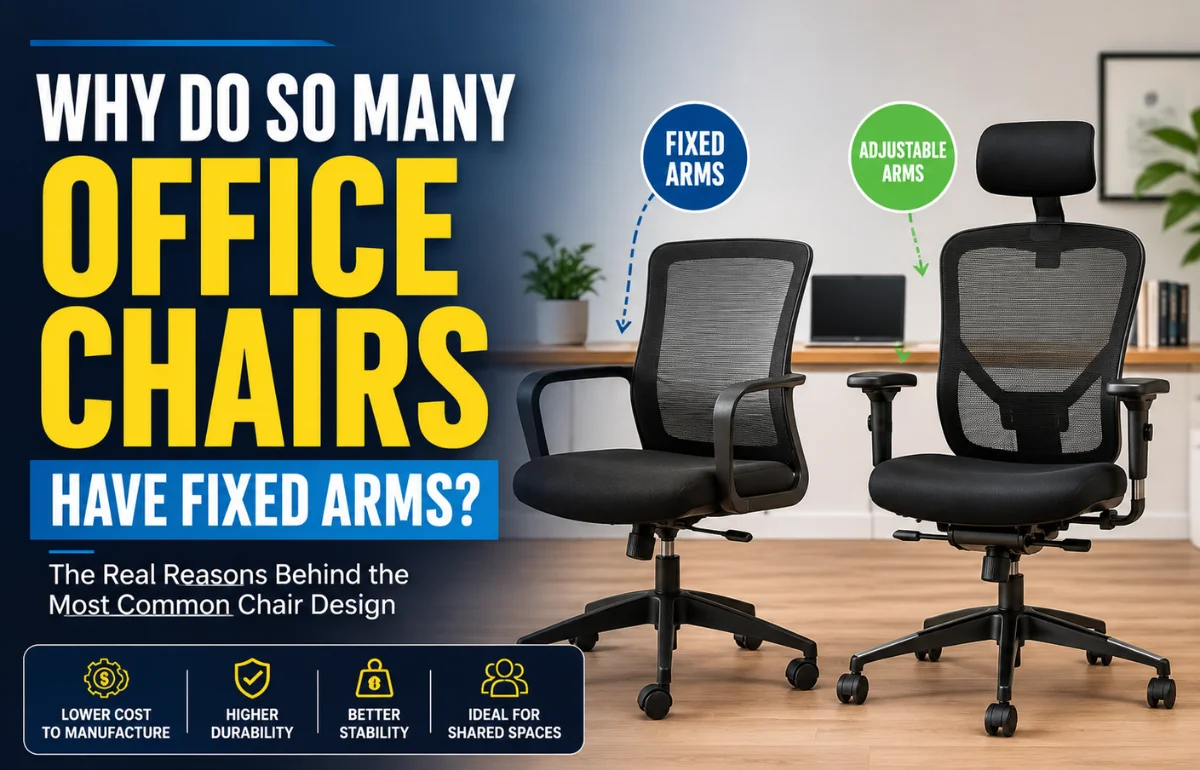
If you’ve spent any time shopping for a desk chair, you’ve probably noticed that a surprising number of office chairs have fixed arms — armrests that don’t move, adjust, or fold. So why do so many office chairs have fixed arms when adjustable ones seem more practical? The short answer is cost.
Fixed arms are significantly cheaper to manufacture, and for most budget and mid-range chairs, they represent the simplest engineering solution that still provides elbow support. But that’s only part of the story. There are structural, ergonomic, commercial, and even workplace-specific reasons that explain why this design remains so dominant in offices, home setups, and commercial environments worldwide.
Why Office Chairs Have Fixed Arms: The Manufacturing Economics
Let’s be practical about this. Every component that moves is a component that can break, require calibration, and cost more to produce. Adjustable armrests — whether they raise, lower, pivot, or slide — involve multiple plastic or metal mechanisms, locking pins, height columns, and sometimes foam padding that needs to accommodate a range of positions. That adds material costs, assembly time, and quality control requirements.
Fixed arms, by contrast, are a single molded piece attached to the chair’s frame at the factory. There are no moving parts to fail, no tolerances to meet, and no height-adjustment systems to test. For a manufacturer producing tens of thousands of chairs a year, eliminating that mechanism from the design isn’t a lazy shortcut — it’s a calculated decision that directly controls the final retail price.
This is why most office chairs have fixed arms in the $80–$200 price range as standard. The savings from simplifying the arm assembly get passed on in the form of a lower sticker price, which matters enormously in bulk procurement — think open-plan offices ordering 50 to 200 chairs at a time.
Structural Stability: Another Reason Office Chairs Have Fixed Arms

Here’s something most people don’t consider: fixed arms often serve a structural role in the chair’s overall frame. Because they’re rigidly attached to the seat shell or the back frame, they act as braces that distribute load and reduce flex in the chair’s body.
With adjustable armrests, the connection between the arm mechanism and the chair body must be strong enough to handle lateral force, weight-bearing (people frequently use armrests to push themselves up from the seat), and repeated movement over the years of use. That requires either heavier-duty materials or engineered reinforcements elsewhere in the structure.
Fixed arms sidestep all of that. They attach firmly and transfer force directly, which is why some heavier-duty contract-grade chairs — the type specified by commercial furniture designers for durability over a 10- to 15-year lifespan — still use fixed arms even at relatively high price points.
It’s also worth noting that many adjustable arm systems develop wobble over time. The tolerances in height-adjustment mechanisms loosen with repeated use, and what started as a firmly positioned armrest gradually becomes something that shifts slightly under your elbow as you work. For users who find that annoying (and many do), a well-made fixed arm that stays exactly where it was bolted often feels more solid and reliable than a worn adjustable mechanism. Contract furniture specifications for hospitality, education, and healthcare environments frequently prioritize this kind of long-term consistency over short-term ergonomic flexibility.
The Ergonomic Argument: When Office Chairs With Fixed Arms Are Actually Fine
There’s a widespread assumption in ergonomics circles that adjustable always means better. For sitting posture, that’s usually true in theory. But in practice, most people who work at a standard desk height (around 28–30 inches) and have an average torso height will find that a well-designed fixed armrest hits an acceptable support position without adjustment.
The standard ergonomic recommendation is that armrests should allow your shoulders to relax, your elbows to bend at roughly 90 to 110 degrees, and your forearms to rest without causing you to hunch or reach upward. Many fixed arms on mid-market chairs are positioned within this range for a person of average proportions sitting at a conventional desk.
Where fixed arms become a genuine problem is at the extremes — very tall individuals, people with unusually long or short torsos, those with specific musculoskeletal conditions, or workers who frequently alternate between keyboard use and writing. For these users, the inability to adjust arm height or width can contribute to shoulder tension, wrist strain, and poor neck alignment over time.
If you’re someone whose work involves a lot of varied postures, it’s worth exploring whether your chair setup is serving your body well. Our services include ergonomic wellbeing guidance that can help you assess your workspace and identify what changes would make the most meaningful difference.
Commercial Settings: Why So Many Office Chairs Have Fixed Arms

Walk into any call center, co-working space, hotel business lounge, or open-plan corporate office, and you’ll find the same pattern — rows of office chairs with fixed arms. The reasons go beyond price.
In commercial settings, chairs are maintained (or replaced) on a predictable schedule, not adjusted individually. The assumption is that the chair will be used by multiple people in shifts, or will simply need to hold up under high-frequency use without requiring maintenance. In that context, fewer moving parts means fewer service calls, lower maintenance costs, and more predictable lifecycle replacement.
There’s also a uniformity consideration. When an organization orders 200 identical chairs, they want them to look identical, behave identically, and be swappable. Adjustable armrests introduce variables — someone adjusts them and doesn’t reset them, a mechanism gets sticky, or different staff configure them differently. Fixed arms eliminate that variation entirely.
Fixed vs. Adjustable Arms: A Direct Comparison
To make this concrete, here’s how the two types stack up across the factors that matter most:
| Factor | Fixed Arms | Adjustable Arms |
|---|---|---|
| Cost | Lower — fewer parts, simpler assembly | Higher — mechanism adds $20–$80+ to retail price |
| Durability | Generally higher — no moving parts to wear | Variable — depends on mechanism quality |
| Ergonomic flexibility | Limited — best for average proportions | High — suits a wider range of users |
| Maintenance | Minimal | May require mechanism adjustment or replacement |
| Structural rigidity | Often stronger — arms brace the frame | Can add flex at the attachment point |
| Suitability for shared use | Excellent — no per-user configuration | Good, but relies on users to readjust |
| Best for | Budget environments, uniform office setups | Individual workstations, ergonomically diverse teams |
| Under-desk clearance | May prevent chair from tucking in fully | Some designs allow folding or removal for tight spaces |
One thing this table highlights: neither type is universally superior. The right choice depends entirely on who’s sitting, for how long, and what the chair needs to accomplish in its environment.
The Hidden Cost of Getting This Wrong
There’s a cost that doesn’t show up in any furniture budget spreadsheet: musculoskeletal discomfort and the productivity drag that comes with it. Research from occupational health fields consistently links poorly fitted seating to increased rates of neck pain, shoulder tension, and upper limb disorders in desk workers.
Fixed arms become a problem not because they’re inherently bad, but because they’re often paired with chairs that weren’t designed with the actual user’s measurements or tasks in mind. In a cost-driven procurement decision — where a company buys whatever keeps the chair budget under a certain per-unit figure — the person sitting for eight hours a day bears the physical cost of that compromise.
This is especially relevant in hot-desking environments, where a person might sit at a different chair every day. A fixed arm that happens to suit one person’s proportions may create constant shoulder elevation for someone else. When that discomfort accumulates over weeks and months, it shows up as sick days, physiotherapy appointments, and reduced concentration.
When Office Chairs With Fixed Arms Create Real Problems

There are specific scenarios where office chairs have fixed arms that go from an acceptable trade-off to an active obstacle.
The first is desk-height mismatch. If the armrests on your chair sit higher than your desk surface, they’ll force you to sit further back than you naturally would — or hold your shoulders in a raised position while typing. Either way, your posture suffers.
The second is tight workspace clearance. A chair with fixed arms that protrude to the sides can’t tuck fully under certain desks. This means you’re always sitting slightly further from your screen and keyboard than is ideal, which in turn causes you to lean forward and lose the back support the chair is supposed to provide.
The third is armrests that are too narrow or too wide for the user’s shoulder width. A chair designed for average proportions may place the arms either too close together (causing elbow crowding) or too far apart (providing no support at all) for anyone outside that range.
The Trend Away From Office Chairs With Fixed Arms
The modern ergonomics movement — accelerated considerably by the shift to home-based work after 2020 — has pushed chair design in two opposite directions simultaneously.
On one end, armless task chairs have gained popularity for users who prefer to work with their forearms on the desk surface itself, finding that any fixed arm creates interference with their natural posture. Many designers and architects favor armless chairs aesthetically as well, since they create a cleaner visual profile.
On the other end, fully adjustable 4D and 5D armrests — which allow height, depth, width, and pivot adjustment — have become a selling point in premium ergonomic seating. Chairs from manufacturers focused on evidence-based ergonomics increasingly treat arm adjustability as a non-negotiable feature rather than a luxury add-on.
The middle ground — office chairs with fixed arms — continues to exist because the market for them is real and large. For someone who isn’t sitting for long hours, who has proportions that happen to suit the chair’s design, or who is constrained to a tight budget, fixed arms remain a reasonable choice.
Practical Tips If Your Office Chair Has Fixed Arms

If your current setup involves a chair with fixed arms and you can’t replace it immediately, there are practical steps that can minimize the ergonomic impact.
Start by assessing the arm height relative to your desk. Your elbows should reach the armrests without your shoulders rising. If the arms are too high for your desk, you may actually be better off removing the armrests entirely — many chairs allow this with a simple screwdriver — than sitting with chronically elevated shoulders.
Check that the chair’s seat height allows your feet to rest flat on the floor (or a footrest) while the armrests remain at a usable height. If adjusting seat height to bring the arms down means your feet dangle, use a footrest to compensate.
Take regular movement breaks. One of the compounding factors in desk discomfort is static loading — holding any one position for too long, regardless of how ergonomically correct it is. Even a well-fitted chair with perfectly positioned fixed arms doesn’t eliminate the need to move.
If you’re dealing with persistent discomfort and want to understand whether your workspace is contributing to it, you’re always welcome to contact Wellbeing Makeover for personalised guidance.
Industry Norms and the Path Forward
The dominance of fixed arms in the office chair market reflects a broader tension in commercial design: the gap between what ergonomic science recommends and what most procurement processes actually prioritize. When a buying decision is made by a facilities manager working to a per-unit budget, “adequate” often wins over “optimal.”
That’s not a cynical observation — it’s a realistic one. And it’s why understanding the reasoning behind fixed arms matters. It’s not that manufacturers don’t know how to build adjustable chairs; it’s that fixed arms represent a deliberate set of trade-offs that make sense within specific constraints.
It’s also worth recognizing that ergonomic standards vary significantly between countries and industries. In some European countries, workplace health regulations require that employers provide adjustable seating for workers who spend more than four hours a day at a screen. In many other markets — including most of North America and large parts of Asia — no such requirement exists, meaning the choice between fixed and adjustable arms falls entirely to cost-driven procurement logic.
The shift in awareness around workplace wellbeing is gradually changing this. More organizations are recognizing that ergonomic furniture investment pays for itself in reduced absenteeism and higher sustained productivity. As that recognition grows, the conversation around seating is moving from “what’s the cheapest option that technically works” toward “what actually supports the people doing the work.”
The post-pandemic period also introduced a new variable: the home office. Millions of workers who had previously sat in employer-provided chairs found themselves buying their own seating for the first time. That personal spending decision — where someone is paying from their own pocket and sitting in the chair themselves — tends to produce different choices than a bulk procurement contract. It’s one of the reasons the market for mid-range ergonomic chairs with adjustable features grew substantially from 2020 onward, even as office chairs with fixed arms continued to dominate in commercial settings.
Frequently Asked Questions
Are fixed armrests bad for ergonomics?
Not inherently — they work well for users whose proportions match the chair’s design, but they become problematic when they don’t align with desk height or the individual’s shoulder width.
Can I remove fixed arms from an office chair?
On most chairs, yes — fixed arms are typically bolted to the seat shell or frame and can be removed with basic tools, which is often a better option than using arms set at the wrong height.
Why are adjustable armrests more expensive?
They require additional components — height columns, locking mechanisms, and pivot joints — all of which add manufacturing cost, assembly time, and quality control requirements to each unit.
Do fixed arms affect how close I can sit to my desk?
Yes, armrests that protrude too wide or sit too high can prevent the chair from tucking under the desk, pushing you further from your keyboard and screen than is ergonomically ideal.
What’s the difference between 2D, 4D, and fixed armrests?
Fixed arms don’t adjust at all, 2D arms adjust in height and sometimes pivot, and 4D arms allow height, width, depth, and angle adjustment — giving the broadest range of fit for diverse users and tasks.
Wrapping Up
So many office chairs have fixed arms because they’re cheaper to produce, more structurally straightforward, easier to maintain in high-use environments, and perfectly adequate for a significant portion of the population sitting at a standard desk. That doesn’t make them the right choice for everyone, and it doesn’t mean the ergonomic limitations don’t matter — they do, particularly for people who sit for extended periods or who fall outside average proportions.
Understanding why a design choice exists is the first step toward knowing when to accept it and when to push back on it. If your current seating setup isn’t serving your body well, that’s worth addressing — whether through a chair upgrade, a workstation reconfiguration, or simply getting clearer on what ergonomic support actually looks like in practice.
Other Resources
- Parriott Wood Kitchen Elegant Design Guide
- Rich-Colored Marble Kitchen Trends for Modern Homes
- Ottans: Sustainable Materials for Modern Design

I’m Salman Khayam, the founder and editor of this blog, with 10 years of professional experience in Architecture, Interior Design, Home Improvement, and Real Estate. I provide expert advice and practical tips on a wide range of topics, including Solar Panel installation, Garage Solutions, Moving tips, as well as Cleaning and Pest Control, helping you create functional, stylish, and sustainable spaces that enhance your daily life.