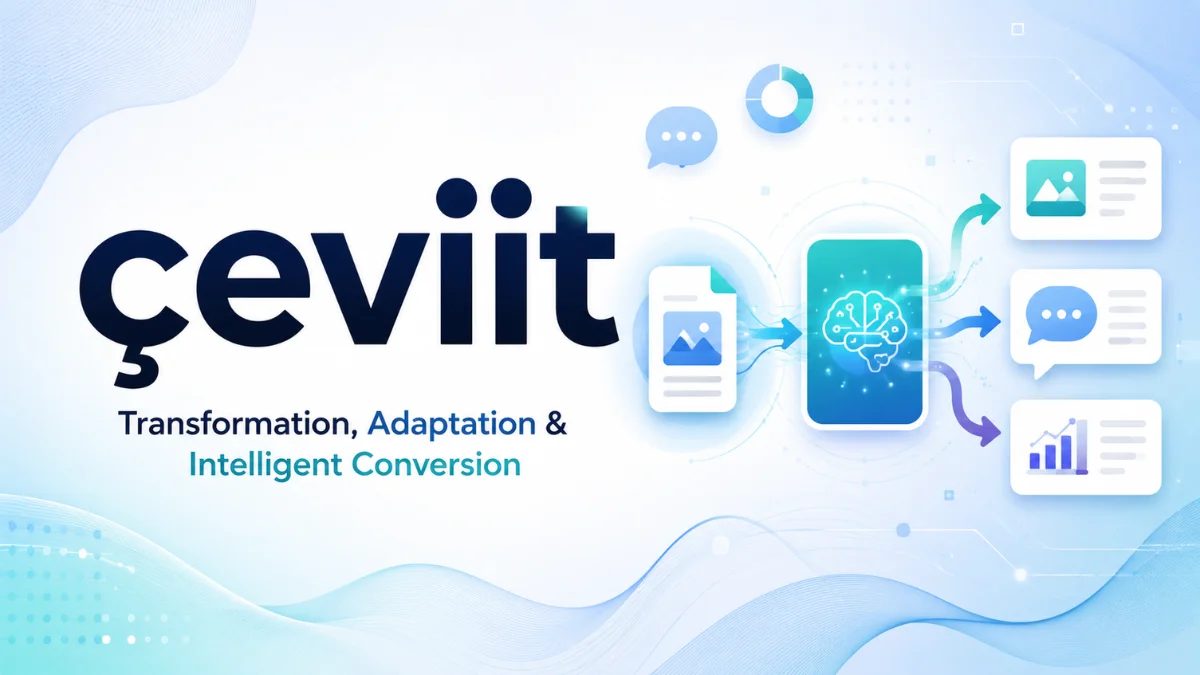
When I think about çeviit, I think about more than simple translation, conversion, or rewriting. To me, çeviit describes the intelligent process of taking an idea, message, format, dataset, or piece of content and adapting it into a new form without losing its original meaning. It is about transformation with purpose. A sentence can become a visual explanation. A technical report can become a simple classroom note. A business document can become a customer-friendly message. A long article can become a social media post while still carrying the same core idea.
That is why çeviit matters today. We live in a world where information moves across platforms, languages, cultures, devices, and audiences faster than ever before. One message rarely stays in one place. A business proposal may need to become a presentation. A lesson may need to become a video script. A research paper may need to become a public-facing article. A brand message may need to shift from a website page to email, social media, customer support, and internal training.
The weak approach is to copy, shorten, translate, or automate everything without thinking. The stronger approach is çeviit. It protects meaning while changing shape. It respects context. It makes communication clearer, more useful, and more accessible.
What Does çeviit Mean?
çeviit can be understood as a thoughtful process of conversion, transformation, and adaptation. It is not limited to changing words from one language to another. It can apply to content, data, design, communication, learning materials, workflows, and digital formats.
At its core, çeviit answers one practical question: how can I move this information into a better form while keeping its true meaning intact?
That question matters because poor conversion damages communication. A message can become shorter but weaker. A translation can be technically correct but culturally awkward. A dataset can become a chart, but hide the real insight. A complex idea can become simple but inaccurate. Good çeviit avoids those mistakes.
I see çeviit as a bridge between original meaning and useful delivery. It takes the source material seriously, then reshapes it for the person, platform, or purpose that needs it.
The Core Idea Behind çeviit
The main idea behind çeviit is preservation through change. That may sound contradictory, but it is exactly what strong communication requires.
When information changes form, something is always at risk. Meaning can be lost. Tone can shift. Details can disappear. Context can break. The audience may misunderstand the message. çeviit reduces that risk by focusing on intent before output.
For example, imagine a doctor explaining a medical report to a patient. The report may contain technical terms, lab values, and clinical language. The patient does not need every technical phrase. They need the meaning, the risk, the next action, and the reassurance that nothing important has been hidden. A good explanation is not a word-for-word copy. It is çeviit in action.
The same idea applies to business, education, marketing, software, journalism, training, and everyday communication.
Why çeviit Is More Than Basic Conversion
Basic conversion is often mechanical. It changes one thing into another without deeply considering the purpose. çeviit is more intelligent because it considers context, audience, accuracy, format, and usefulness.
A file converter can turn a Word document into a PDF. That is conversion. But if someone turns a dense legal document into a clear client summary without losing the legal meaning, that is closer to çeviit.
A translation tool can change words from one language to another. That is translation. But if a translator adapts humor, cultural references, tone, and intent for a different audience, that becomes çeviit.
A chart tool can turn numbers into a graph. That is visualization. But if an analyst selects the right chart, removes noise, highlights the key pattern, and explains what the data means, that is çeviit.
The difference is judgment. çeviit needs more than output. It needs understanding.
çeviit vs Translation, Conversion, and Adaptation
The easiest way to understand çeviit is to compare it with related concepts. These terms overlap, but they are not identical.
This comparison shows why çeviit is useful as a broader concept. It can include translation, conversion, adaptation, and summarization, but it adds a higher standard: the transformed version must still serve the original meaning.
Why çeviit Matters in a Digital-First World
Digital communication has changed how people consume information. Most readers do not stay on one platform. They move between search engines, websites, mobile apps, videos, emails, documents, chats, and social media feeds.
That creates a serious problem. A message written for one format often fails in another.
A 2,000-word report may work on a website but fail in a WhatsApp message. A social caption may work on Instagram but fail as a professional email. A technical manual may work for engineers but fail for customers. A spreadsheet may work for analysts but fail for executives who need quick decisions.
çeviit solves this by reshaping information for the situation without stripping away its meaning. It helps people receive the right version of the same idea.
Good çeviit supports clear and useful digital communication by reshaping information for the reader, platform, and purpose without weakening the original meaning.
In a digital-first world, this is no longer optional. Clear communication now depends on the ability to transform information responsibly.
çeviit in Digital Communication
Digital communication is one of the strongest areas where çeviit appears. Every day, people change messages from one form to another without even naming the process.
A company may write a product update, then turn it into an email announcement, social media caption, website banner, help article, and customer support script. The message stays the same, but the form changes.
That is where many brands fail. They copy the same wording everywhere. The result feels lazy and mismatched. A formal website paragraph does not always work in a mobile notification. A sales-heavy social post may not work in a support reply. A technical update may confuse non-technical users.
Good çeviit respects the channel.
For email, the message may need clarity and structure. For social media, it may need speed and emotional relevance. For a help center, it may need exact instructions. For an executive summary, it may need decision-focused language. The content changes, but the meaning remains stable.
That stability builds trust.
çeviit in Content Creation
Content creation is not only about writing more. Much of modern content work involves reshaping existing knowledge into better formats. This is where çeviit becomes valuable for writers, editors, marketers, teachers, and brand teams.
A single research interview can become a blog post, quote graphic, podcast outline, FAQ page, newsletter, and short video script. But that does not mean every version should sound the same. Each format has its own rhythm.
I often see weak content teams treat repurposing as copying. They take the same words and place them everywhere. That creates repetition, not value.
Strong çeviit works differently. It asks:
- What does the audience need here?
- What must remain unchanged?
- What can be simplified?
- What needs more context?
- What format will make the idea easier to understand?
This is how content becomes useful instead of noisy.
çeviit in Education and Learning
Education depends heavily on çeviit because students rarely learn best from raw information alone. A teacher, tutor, course designer, or educational writer must often transform complex ideas into understandable learning experiences.
A textbook definition may become a classroom example. A theory may become a diagram. A historical event may become a timeline. A scientific process may become a practical demonstration. A difficult paragraph may become a simple explanation for a younger learner.
The goal is not to dumb down the subject. That is the wrong mindset. The goal is to make the subject reachable without making it false.
That distinction matters.
For example, explaining gravity to a child does not require advanced equations. But the explanation should still be accurate. Saying “things fall because the Earth pulls them” is simple and useful. Saying “heavy things always fall faster” is simple but wrong.
Good educational çeviit protects truth while improving understanding.
çeviit in Business Communication
Businesses lose money when communication is unclear. Confusing proposals, vague emails, overloaded reports, weak product descriptions, and poorly adapted training materials slow everything down.
çeviit helps businesses turn information into action.
A financial report can become a board summary. A product specification can become a sales page. A customer complaint pattern can become a staff training note. A legal policy can become employee guidance. A strategy document can become a team checklist.
Each version serves a different audience.
Executives need decisions. Customers need benefits and trust. Employees need clarity. Technical teams need precision. Sales teams need persuasive but accurate talking points.
The mistake many businesses make is assuming one document can serve everyone. It rarely can. A single source of truth is useful, but different audiences need different expressions of that truth.
That is business çeviit at its best.
çeviit in Knowledge Sharing
Knowledge has little value if it stays trapped in the wrong form. Many organizations already have valuable information, but it sits inside long PDFs, scattered notes, old presentations, meeting recordings, spreadsheets, or expert conversations.
çeviit turns that hidden knowledge into usable knowledge.
For example, a company may have years of customer support conversations. Inside those conversations are repeated problems, product gaps, customer expectations, and training opportunities. Without çeviit, that knowledge stays buried. With çeviit, it can become FAQs, internal training, product improvements, onboarding material, and customer education.
The same applies to research, consulting, education, healthcare, software, and public information.
Knowledge sharing is not just about access. It is about usable access. People need information in a form they can understand, trust, and apply.
The Main Benefits of çeviit
The benefits of çeviit are practical. This is not just a theoretical communication idea. It improves real outcomes when used properly.
Better Clarity
The first benefit is clarity. When information is transformed with care, people understand it faster. They do not have to fight through unnecessary complexity, poor structure, or mismatched wording.
Clear information saves time. It also reduces mistakes.
A customer who understands product instructions is less likely to contact support. An employee who understands a policy is less likely to break it. A student who understands a concept is more likely to remember it.
Clarity is not decoration. It is performance.
Wider Accessibility
çeviit also improves accessibility. Not everyone consumes information the same way. Some people need simpler language. Some need visual formats. Some need audio. Some need summaries. Some need translations. Some need examples before theory makes sense.
When information is adapted thoughtfully, more people can use it.
This matters for public websites, education platforms, business documents, healthcare communication, government services, and customer support. Accessibility is not only about disability compliance. It is also about making information genuinely reachable.
Stronger Reach Across Platforms
One message can travel further when it is adapted properly. A blog post can support search traffic. A short version can work on social media. A visual version can work in a presentation. A spoken version can work in a video. A structured version can work in training.
The source idea becomes more valuable because it can live in multiple useful forms.
But reach without meaning is pointless. That is why çeviit is stronger than blind repurposing. It does not chase platforms for the sake of visibility. It adapts the message so each platform carries the idea properly.
Higher Productivity
Good çeviit saves time because it prevents teams from recreating everything from scratch. Existing material can be intelligently reused, reshaped, and improved.
A business does not need to write ten separate messages from nothing. It can create one accurate source, then adapt it for different uses.
That saves effort, but only when quality control is strong. Poor automation can create ten weak versions quickly. Good çeviit creates multiple useful versions responsibly.
Better Trust
People trust communication that feels clear, accurate, and appropriate. They lose trust when content feels copied, careless, robotic, or misleading.
When a message is adapted well, the audience feels understood. The wording fits their needs. The structure respects their time. The meaning stays consistent.
That is how çeviit supports authority. It shows that the communicator understands both the subject and the reader.
The Risks of Poor çeviit
The biggest risk with çeviit is assuming that transformation is automatically improvement. It is not. Bad çeviit can damage meaning faster than no transformation at all.
Loss of Context
Context is the first thing that disappears when content is handled carelessly. A quote can be shortened until it becomes misleading. A report can be summarized in a way that hides uncertainty. A translation can ignore cultural meaning. A chart can make weak data look stronger than it is.
When context disappears, trust follows.
Strong çeviit keeps the surrounding meaning visible. It does not only ask what the words say. It asks what the words mean in that situation.
Over-Automation
Automation can help with çeviit, but it should not replace judgment. Tools can convert formats, summarize text, translate drafts, generate captions, or structure data. Those tools are useful. The problem starts when people stop reviewing the output.
Automated content often misses tone, nuance, audience expectations, and hidden assumptions. It may sound fluent while still being wrong. That is dangerous because fluent errors are harder to spot.
The future of çeviit will include smart tools, but human oversight will remain essential.
Oversimplification
Simplifying content is useful. Oversimplifying it is not.
A complex subject may need easier language, but it should not lose accuracy. This mistake is common in education, marketing, health content, legal explanations, and business reporting.
A simple version should still be honest. If there are limits, conditions, risks, or exceptions, they should not be removed just to make the message sound cleaner.
Audience Mismatch
Good çeviit depends on knowing the audience. Without that, the transformed content may fail.
A beginner does not need expert jargon. An expert does not need shallow explanations. A customer does not need internal technical language. A board member does not need every operational detail. A support agent does not need vague brand slogans.
Audience mismatch creates friction. It makes useful information feel useless.
How I Approach çeviit Properly
When I work with çeviit as a communication method, I start with meaning. Not format. Not word count. Not a platform. Meaning comes first.
I want to know what the original content is truly saying. Then I decide what the new version needs to achieve.
That approach prevents shallow rewriting.
Identify the Core Message
Every piece of content has a central point. Before transforming anything, I look for that point.
A report may contain twenty pages, but its core message might be one decision. A product description may list ten features, but its real value may be convenience or safety. A lesson may contain multiple examples, but the core learning outcome may be one concept.
If the core message is unclear, the transformed version will be weak.
Understand the New Audience
Next, I consider who will receive the new version. Their knowledge level, expectations, language, pain points, and purpose shape the output.
A business owner reading a summary wants different information than a technical specialist. A student wants a different explanation from a researcher. A customer wants a different message from a supplier.
Good çeviit respects that difference.
Choose the Right Format
Format changes how information is understood. A paragraph, table, checklist, diagram, script, FAQ, infographic, report, and presentation all guide attention differently.
The right format depends on the job.
If people need to compare options, a table may work best. If they need to remember a process, a checklist may help. If they need a quick answer, an FAQ may be enough. If they need persuasion, a story or case example may work better.
Format should serve meaning, not the other way around.
Keep Accuracy Visible
During çeviit, I avoid adding unsupported claims. I also avoid removing details that change the meaning. This matters especially in technical, medical, legal, financial, and educational content.
Accuracy does not mean the content must stay complicated. It means the simplified or adapted version must remain faithful.
The best version is clear and correct.
Practical Examples of çeviit
The value of çeviit becomes easier to see through examples.
Example 1: A Research Paper Becomes a Public Article
A research paper may include methodology, statistical analysis, citations, limitations, and academic language. Most general readers will not read it in that form.
Through çeviit, the paper can become a public article that explains the research question, key findings, why it matters, and what should not be misunderstood.
The article should not exaggerate the results. It should not turn a limited finding into a universal claim. It should make the research understandable without making it dishonest.
Example 2: A Product Manual Becomes Customer Support Content
A product manual may be accurate, but difficult for customers to use quickly. Through çeviit, the manual can become setup instructions, troubleshooting FAQs, short videos, and support scripts.
The original technical details remain available, but customers receive the version they actually need.
That reduces confusion and support pressure.
Example 3: A Business Report Becomes an Executive Summary
A business report may contain detailed numbers, department updates, risks, and performance metrics. Senior decision-makers may not need every detail in the first reading.
Through çeviit, the report can become a concise executive summary with key findings, risks, recommended actions, and supporting numbers.
The goal is not to hide details. The goal is to lead with what matters.
Example 4: A Lesson Becomes Multiple Learning Formats
A teacher may explain one topic through a lecture, worksheet, diagram, quiz, and revision note. Each version helps a different part of learning.
That is çeviit in education. The concept remains the same, but the delivery changes so students can understand and remember it.
çeviit and SEO
çeviit also has a strong connection with SEO because search engines reward useful, clear, relevant, and people-focused content. Search visibility is not only about placing keywords on a page. It is about satisfying search intent.
When someone searches for çeviit, they may want a definition, examples, uses, benefits, risks, or practical applications. A strong article should address those needs naturally.
This is where çeviit supports SEO content creation. A topic can be transformed into different helpful sections: definition, explanation, comparison, examples, use cases, questions, and guidance.
Search-friendly content is not created by repeating the keyword endlessly. That looks forced. Better SEO comes from covering the topic deeply and naturally. Related terms such as transformation, adaptation, intelligent conversion, digital communication, content repurposing, contextual meaning, semantic accuracy, knowledge sharing, and accessibility can appear where they genuinely fit.
The reader should never feel like the article was written for a machine. The search engine is not the final audience. The reader is.
çeviit and Human Judgment
The human role in çeviit is not disappearing. In fact, it is becoming more valuable.
As digital tools become faster, people will produce more transformed content. That means the internet will contain more summaries, translations, rewritten posts, converted files, adapted scripts, and automated explanations.
Quantity will rise. Quality will become harder to find.
Human judgment is what separates useful çeviit from mass-produced noise. A person can understand emotional tone, cultural nuance, hidden risk, audience pressure, ethical limits, and real-world consequences.
A tool can help create a version. A skilled human decides whether that version should be trusted.
The Future of çeviit
I believe çeviit will become more important because modern communication is becoming more fragmented. People do not consume information in one standard way anymore. They expect content to meet them where they are.
A single idea may need to become searchable, readable, watchable, shareable, teachable, and actionable. That requires intelligent transformation.
Businesses will use çeviit to improve customer education, internal training, sales communication, and knowledge management. Educators will use it to personalize learning. Content teams will use it to build stronger topic authority. Data teams will use it to explain insights more clearly. Professionals will use it to communicate complex ideas without losing precision.
The future skill is not just creating information. It is reshaping information responsibly.
That is why çeviit belongs in conversations about digital literacy, content strategy, business communication, and knowledge work.
Common Misunderstandings About çeviit
One misunderstanding is that çeviit means making content shorter. Sometimes it does, but not always. A short message may need to become a longer explanation. A simple idea may need examples, context, or evidence. Transformation can expand content as well as reduce it.
Another misunderstanding is that çeviit is only about language. Language is one part, but format matters too. Turning data into a chart, a meeting into action points, or a policy into staff guidance can also be çeviit.
A third misunderstanding is that technology can handle the whole process. Technology can support it, but meaning still needs a human check. Without that, the output may look polished and still fail.
The most dangerous misunderstanding is treating çeviit as decoration. It is not just about making information look better. It is making information work better.
How to Use çeviit in Daily Work
You do not need a complex system to start using çeviit. You need better habits around communication.
Before changing any content, ask what must remain true. Then ask what the new audience needs. After that, choose the best format. Finally, review whether the transformed version still carries the original meaning.
For example, if you are turning a long article into a social post, do not simply pull a random sentence. Find the main point. Decide what the social audience needs to know first. Keep the message sharp. Avoid exaggeration.
If you are turning technical notes into customer content, remove unnecessary jargon but keep the practical details. If you are turning a meeting into action points, separate decisions from discussion. If you are turning data into a chart, highlight the real pattern rather than the most dramatic visual.
This is how çeviit becomes a daily professional skill.
What Makes çeviit Successful?
Successful çeviit has five qualities: accuracy, clarity, relevance, usability, and consistency.
Accuracy means the message remains true. Clarity means the audience can understand it. Relevance means the content fits the reader’s needs. Usability means the new format helps people act, decide, learn, or communicate. Consistency means the message does not contradict the original source.
If one of these qualities is missing, the transformation becomes weak.
A beautifully written summary that changes the meaning is not successful. A perfectly accurate technical version that nobody understands is not successful either. A fast, automated version that sounds smooth but lacks context is not successful.
The best çeviit balances all five qualities.
Why çeviit Is a Future-Facing Skill
The people who communicate well in the future will not only be the people who know the most. They will be the people who can move knowledge across contexts without damaging it.
That is the real value of çeviit.
A manager who can translate strategy into team action will be more effective. A teacher who can turn difficult concepts into clear lessons will help more students. A writer who can reshape complex ideas into useful content will build stronger authority. A business that can adapt messages across platforms will communicate with more trust.
Information is everywhere. Useful information is still rare.
çeviit helps close that gap.
Final Thoughts
çeviit is the intelligent practice of transforming ideas, content, data, or formats while preserving original meaning. It matters because communication today rarely stays in one place, one language, one format, or one audience group. The same message often needs to move across platforms, people, and purposes.
Used well, çeviit improves clarity, accessibility, reach, productivity, and trust. Used carelessly, it creates confusion, weakens context, and turns meaningful content into shallow output.
My advice is simple: before changing any message, understand it first. Then adapt it with purpose. If you work with content, education, business communication, SEO, data, or digital platforms, start treating çeviit as a great skill rather than a casual task. That shift will make your communication sharper, more useful, and far harder to ignore.

Julian Vane is a versatile writer at Wellbeing Makeover covering tech, health, and global culture. With years of experience across various industries, Julian brings a well-rounded perspective to lifestyle and business, helping readers stay informed and inspired in an ever-changing world.