
If you’ve ever wondered what happens when someone ends up pooping in a pool — whether it’s a toddler who couldn’t hold it, a freak accident, or something you read about in a news story — you’re not alone. Pooping in a pool is an uncomfortable topic that most people avoid, but it’s genuinely one of the most important public health issues in recreational water safety. I’ve spent time going through the science, the CDC guidelines, and real-world pool management data to break this down properly. This isn’t just a “gross” conversation — it’s a critical one for anyone who swims in public or semi-public pools.
What Happens When Someone Poops in a Pool
When fecal matter enters pool water, it doesn’t just disappear. Even a small amount — roughly 0.14 grams, which is what the CDC estimates the average person carries on their body after a bowel movement — can introduce millions of bacteria and parasites into the water.
The main concern with pooping in a pool isn’t the smell or the visual. It’s the microorganisms that come with it, specifically:
- Cryptosporidium (Crypto) — a parasite with a hard outer shell that makes it extremely resistant to chlorine
- E. coli O157:H7 — a dangerous strain of bacteria
- Giardia — another parasitic organism
- Norovirus — a highly contagious virus that causes severe gastrointestinal illness
Cryptosporidium is particularly problematic. According to the CDC, this parasite can survive in a properly chlorinated pool for up to 10 days. Standard chlorine levels that kill most bacteria in minutes are largely ineffective against Crypto’s protective outer shell. This is why pooping in a pool — formally called a “fecal contamination event” in public health literature — is treated as a serious situation requiring a specific response protocol.
The Chemistry Behind Pooping in a Pool: What Chlorine Does (and Doesn’t Do)
Most people assume that chlorine kills everything in a pool more or less instantly. That assumption is partly correct but dangerously incomplete when it comes to fecal contamination.
Chlorine works by forming hypochlorous acid when dissolved in water. This acid attacks the cell membranes and enzymes of most microorganisms, neutralizing them within seconds to minutes. For common bacteria like Staphylococcus aureus or E. coli, chlorine at the recommended concentration of 1–3 ppm is highly effective.
The problems arise with:
- Combined chlorine (chloramines): When chlorine reacts with nitrogen-containing compounds from urine, sweat, and fecal matter, it forms chloramines — less effective disinfectants that irritate eyes and skin, and are responsible for that strong “pool smell” people often mistake for too much chlorine. It’s actually the opposite.
- Cryptosporidium’s resistance: The CDC’s guidance on responding to fecal incidents notes that a Crypto inactivation protocol requires raising free chlorine to 20 ppm and maintaining that level for over 28 hours with the pump running.
- pH balance disruption: Fecal matter can shift the pool’s pH, directly affecting chlorine’s efficiency. Chlorine is most effective between pH 7.2 and 7.8. At pH 8.0, it’s about 22% as effective.
Formed Stool vs. Diarrheal Release: Why the Type of Pooping in a Pool Matters
Not all fecal incidents are treated equally — and this surprises most people.
Formed Stool Incidents
A formed stool incident is considered lower risk. Most pathogens remain contained within the stool itself. The recommended response involves:
- Clearing the pool immediately
- Removing as much of the stool as possible using a net or scoop (never a vacuum)
- Raising free chlorine to at least 2 ppm with pH between 7.5 and 8.0
- Waiting approximately 25 minutes before allowing swimmers back in
Diarrheal Pooping in a Pool
This is far more serious. Diarrheal fecal matter disperses immediately and widely throughout the water, releasing a significantly higher concentration of pathogens — especially Cryptosporidium. The response protocol includes closing the pool, implementing the full hyperchlorination procedure, and testing water quality before reopening — often meaning the pool stays closed for 24 hours or longer.
| Factor | Formed Stool | Diarrheal Release |
|---|---|---|
| Pathogen dispersion | Low | High |
| Cryptosporidium risk | Lower | Significantly higher |
| Chlorine response needed | 2 ppm, 25-min contact | 20 ppm, 28+ hours |
| Typical pool closure | 30–60 minutes | 24 hours or more |
| Risk if untreated | Moderate | Severe |
How Common Is Pooping in a Pool?
More common than most people want to believe.
A 2013 CDC study found that 58% of public pool filter samples tested positive for E. coli — a direct indicator of fecal contamination. This doesn’t mean every pool is a biohazard, but it does indicate that pooping in a pool is not a rare, isolated event.
The CDC also reports that from 2000 to 2014, there were 493 recreational water illness outbreaks in the U.S. linked to pools, water parks, and splash pads. Cryptosporidium was responsible for the vast majority of gastrointestinal illness cases in those outbreaks.
Young children are disproportionately responsible for fecal contamination incidents — not because they’re irresponsible, but because their bowel control is still developing and swim diapers are widely misunderstood as a containment solution.
The Swim Diaper Problem and Pooping in a Pool
Swim diapers — both disposable and reusable — are not designed to contain fecal matter for extended periods. They are designed to prevent solid waste from immediately falling into the pool, giving parents a brief window to remove and change the child. They are not a seal. Liquid still passes through them freely.
The American Academy of Pediatrics and the CDC both note that swim diapers reduce but do not eliminate the risk of pooping in a pool spreading contamination. A child with a gastrointestinal illness wearing a swim diaper is still a significant contamination risk to everyone in the water.
This is why most public health recommendations suggest that children who are not toilet-trained — or who have had diarrhea in the past two weeks — should not swim in public pools.
Recreational Water Illnesses: What Pooping in a Pool Can Do to Other Swimmers
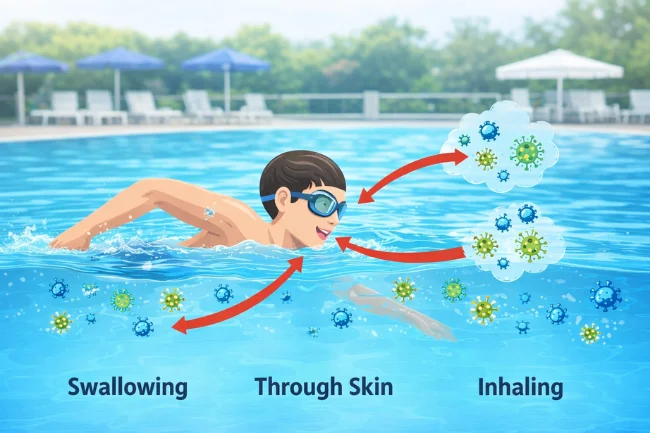
Recreational Water Illnesses (RWIs) is the umbrella term for infections spread by swallowing, breathing, or having skin contact with contaminated pool water. When pooping in a pool occurs — intentionally or accidentally — RWIs are the direct consequence for other swimmers.
The most common RWIs include:
- Cryptosporidiosis: Profuse, watery diarrhea lasting 1–3 weeks. No specific treatment beyond supportive care.
- E. coli infection: Severe stomach cramps, diarrhea (sometimes bloody), and vomiting. In rare cases, it can lead to hemolytic uremic syndrome (HUS), affecting the kidneys.
- Swimmer’s ear: Caused by bacteria, including Pseudomonas aeruginosa. About 2.4 million U.S. healthcare visits annually are linked to it.
- Norovirus gastroenteritis: Highly contagious; just a small number of viral particles can cause illness.
What Pool Operators Must Do After Pooping in a Pool Occurs
Under standard protocols based on the CDC’s Model Aquatic Health Code, pool operators are required to:
- Maintain free chlorine at 1–3 ppm (or 3–8 ppm for hot tubs)
- Maintain pH between 7.2 and 7.8
- Monitor water clarity at all times
- Respond immediately to any fecal incident with the appropriate protocol
- Keep logs of water chemistry checks performed multiple times daily
Failure to respond appropriately to pooping in a pool can result in facility closure by the health department and, in the case of an outbreak, significant legal and civil liability.
Some newer facilities have adopted secondary disinfection systems — UV light or ozone-based — that are highly effective against Cryptosporidium and increasingly recommended as a supplement to traditional chlorination.
How to Protect Yourself from the Risks of Pooping in a Pool
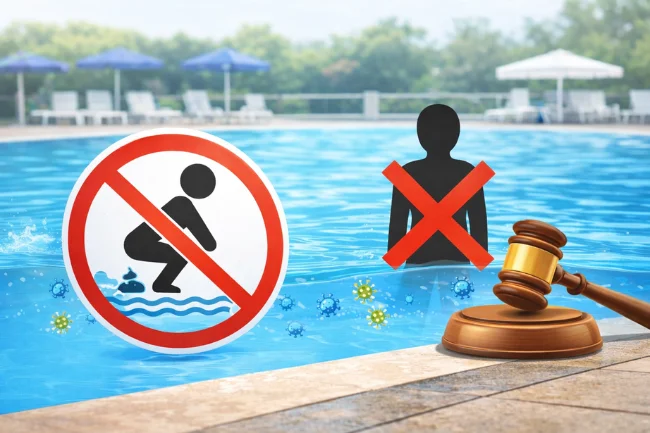
Here’s how to reduce your personal risk:
- Check water clarity. If you can’t see the drain at the deep end, the water doesn’t meet basic clarity standards.
- Pay attention to the smell. A heavy chloramine odor signals high organic contamination.
- Don’t swim with an upset stomach. If you’ve had gastrointestinal symptoms in the past two weeks, you’re a potential source of contamination for others.
- Keep water out of your mouth. The average swimmer accidentally ingests about 1–2 tablespoons of pool water per hour.
- Shower before swimming. A 60-second pre-swim shower removes surface bacteria and organic matter that deplete chlorine.
- Check recent health inspection scores. Many counties make pool inspection records publicly available online.
FAQs About Pooping in a Pool
1. Does chlorine kill everything after pooping in a pool?
No. Cryptosporidium can survive in a properly chlorinated pool for up to 10 days. Full decontamination requires hyperchlorination at 20 ppm for over 28 hours.
2. Can you get sick from swimming in a pool where someone had an accident days ago?
Possibly, if the pool was not properly remediated. Cryptosporidium remains viable in pool water for an extended period without proper treatment.
3. Are swim diapers safe enough to prevent pooping in a pool from spreading contamination?
They reduce the immediate spread of solid waste but don’t prevent transmission of viruses or bacteria. Children who have had diarrhea within the past two weeks should not swim in shared pools.
4. How do I know if a pool has been properly maintained?
Check water clarity, notice any strong chloramine odor, and look up your local health department’s pool inspection records.
5. Is it safe to swallow a little pool water accidentally?
Occasionally swallowing a small amount from a well-maintained pool is unlikely to cause illness — but the CDC recommends avoiding it as a routine precaution.
Final Thoughts on Pooping in a Pool
Pooping in a pool is far more than a social embarrassment — it’s a genuine public health event with documented consequences for swimmers, especially children and immunocompromised individuals. The biology is clear: fecal matter introduces pathogens that chlorine alone cannot always eliminate, and the most dangerous of them — Cryptosporidium — can persist in pool water long after the incident itself.
If you manage a facility, make sure your staff is trained on the CDC’s fecal incident response protocols and that secondary disinfection systems are on your roadmap. If you’re a swimmer, shower before you enter, keep water out of your mouth, and don’t swim when you’re unwell.
For facility managers, the CDC’s Model Aquatic Health Code is freely available at cdc.gov and is the most comprehensive resource for U.S. aquatic facilities.

I’m Salman Khayam, the founder and editor of this blog, with 10 years of professional experience in Architecture, Interior Design, Home Improvement, and Real Estate. I provide expert advice and practical tips on a wide range of topics, including Solar Panel installation, Garage Solutions, Moving tips, as well as Cleaning and Pest Control, helping you create functional, stylish, and sustainable spaces that enhance your daily life.