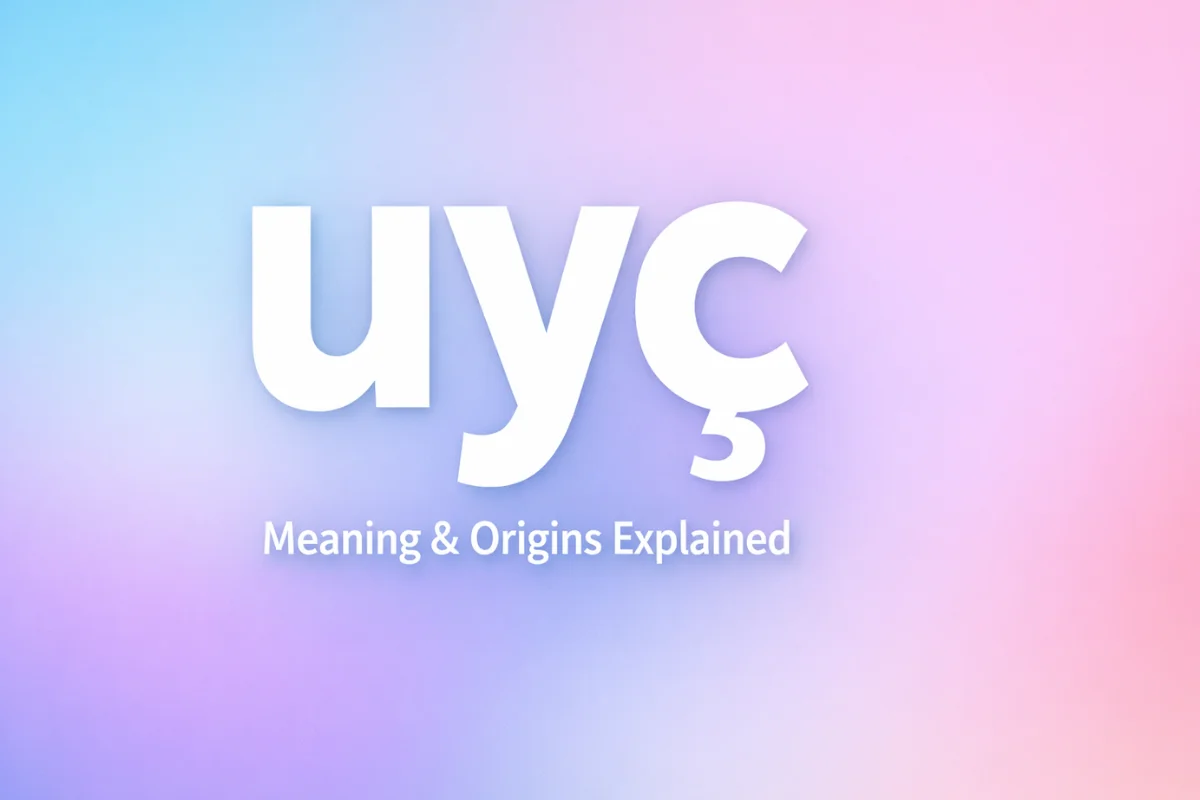
I have always been fascinated by the edges of language — those peculiar expressions and symbols that slip between the cracks of formal dictionaries and academic grammars. When I first encountered the term uyç, my reaction was a mixture of genuine curiosity and linguistic excitement. Here was a word — if we can even call it that in the traditional sense — which seemed to challenge every conventional idea of what a term should look like, sound like, and mean. The presence of the cedilla-bearing character ‘ç’ immediately signalled something beyond the ordinary Latin alphabet, hinting at phonetic traditions rooted in Turkish, Azerbaijani, and other Turkic and European languages. And yet, uyç does not belong neatly to any one of them. That ambiguity, I would argue, is precisely what makes it worth exploring in depth.
Over the course of this piece, I want to walk through what uyç actually is, where it might come from, how it functions in modern communication, and why it matters more than its surface appearance suggests. Whether you are a linguist, a curious reader, or someone who simply stumbled across the term online, I think you will find that uyç opens a surprisingly rich conversation about the nature of language itself.
What Exactly Is uyç? Defining the Undefinable
The honest answer to that question is: uyç resists a single, clean definition. It is best understood as a non-standard linguistic unit — a term that exists somewhere between an emerging word, a phonetic symbol, and a creative expression. Unlike most entries in a dictionary, which carry clearly bounded meanings, uyç operates more like a placeholder with potential; its meaning is context-dependent and, in many ways, still being written by the communities that use it.
What makes uyç immediately distinctive is its visual structure. The character ‘ç’ — known as c-cedilla — is not native to English. You find it in Turkish, where it represents a ‘ch’ sound, in Albanian, in French loanwords, in Azerbaijani, and in several other languages that have adopted or adapted the extended Latin alphabet. When placed alongside the letters ‘u’ and ‘y’, the combination creates something that feels phonetically grounded in a real linguistic tradition, even if the specific term is not formally registered anywhere.
Some researchers and linguists who study emerging digital vocabulary classify terms like uyç under what is sometimes called ‘creative lexical units’ — expressions that are coined through experimentation rather than inherited through historical usage. According to the Oxford Internet Institute, which tracks digital language evolution, a significant proportion of new terms circulating online have no verifiable origin point; they emerge organically through usage and gain meaning through repetition and community adoption. I believe uyç fits this pattern precisely.
The Linguistic Roots of uyç: Tracing a Phonetic Thread
To understand where uyç might come from, it helps to look at the components individually. The letter ‘u’ is, of course, one of the most universal vowels across world languages. The ‘y’ functions differently depending on context — in English, it can be a consonant or a semi-vowel; in Turkish and several other Turkic languages, ‘y’ consistently behaves as a consonant with a ‘yuh’ sound. And then there is ‘ç’, which is where things get particularly interesting.
In Turkish, ç produces a sound equivalent to the ‘ch’ in the English word ‘cheese’. This is significant because Turkish is an agglutinative language — one where words are built by adding suffixes to root forms — and the phoneme that ç represents plays a meaningful role in thousands of words. Azerbaijani, a closely related Turkic language spoken primarily in Azerbaijan and northwestern Iran, shares this character and phonetic system. When I look at uyç through a Turkish or Azerbaijani phonetic lens, the combination could plausibly be sounded out as something resembling ‘oo-ich’ or ‘oo-yich’.
Beyond Turkic languages, the cedilla also appears in French, where ç occurs before ‘a’, ‘o’, and ‘u’ to produce an ‘s’ sound rather than a hard ‘k’. This dual phonetic identity — ‘ch’ in Turkic contexts, ‘s’ in Romance contexts — means that uyç sounds different depending on which linguistic tradition the reader brings to it. That kind of phonetic fluidity is not a flaw; it is actually a hallmark of terms that occupy cross-cultural linguistic space.
It is also worth noting that the sequence ‘uy’ appears in several languages as a diphthong. In Catalan, for example, ‘uy’ is a recognised vowel combination. In Dutch, the digraph ‘uy’ was historically used and later replaced by ‘ui’ in modern orthography. So while uyç may not be a formally documented word in any of these systems, its component parts are deeply embedded in real phonetic traditions.
uyç in the Age of Digital Communication
One of the most compelling ways to understand uyç is to look at the environment in which terms like it tend to thrive: the internet. Online communication has always been a laboratory for linguistic experimentation. From early chatroom slang to the abbreviated vocabulary of SMS culture, from hashtag neologisms to the layered irony of meme language, the digital world has consistently generated new forms of expression faster than traditional lexicographers can catalogue them.
In this context, uyç makes a great deal of sense. Its unusual character set makes it visually striking — the kind of term that catches the eye in a feed or a comment thread precisely because it does not look like everything else. For online communities that value distinctiveness and insider knowledge, a term like uyç carries real social currency. It can function as a username, a brand identifier, a coded in-group marker, or simply a gesture of creative individuality.
I have observed this pattern repeatedly in online subcultures — the deliberate use of non-standard characters to signal membership, creativity, or a conscious departure from mainstream language norms. Research published in the journal Language@Internet has documented how digital communities develop and maintain what linguists call ‘register differentiation’: the use of specific vocabulary to mark group identity and exclude outsiders. Terms like uyç fit naturally into this dynamic.
There is also a practical dimension to this. Search engines and content platforms use algorithms that index and rank content based on keyword patterns. A term like uyç, precisely because it is unusual and not widely used, can occupy a kind of low-competition semantic space online. This makes it valuable not just linguistically, but strategically, which is part of why it appears in content creation, branding, and SEO discussions alongside its more abstract linguistic interest.
How uyç Compares to Other Non-Standard Linguistic Terms
To give you a clearer sense of where uyç sits within the broader landscape of emerging and non-standard language, I have put together a comparison of similar terms and phenomena below:
| Feature | uyç | Leet Speak (e.g., 1337) | Portmanteau (e.g., brunch) | Neologism (e.g. selfie) |
| Origin | Cross-cultural/digital | Early internet/gaming | Deliberate word fusion | Natural cultural emergence |
| Special Characters | Yes (ç cedilla) | Yes (numbers as letters) | No | No |
| Fixed Meaning | No — context-dependent | Yes — within community | Yes — clearly defined | Yes — widely accepted |
| Phonetic Grounding | Yes (Turkic/Romance roots) | Minimal | Yes | Yes |
| Dictionary Status | Not recognised | Informal recognition | Fully recognised | Fully recognised |
| Primary Usage | Creative/online / identity | Online gaming/hacking culture | Everyday language | Everyday language |
| Linguistic Family | Turkic, possibly Romance | English-based | Varies | Varies |
What this table makes clear is that uyç occupies a unique position. Unlike leet speak, which has a relatively fixed decoding system, uyç does not operate as a cipher. Unlike a portmanteau or a neologism, it has not yet settled into a single agreed-upon meaning. It is genuinely in an earlier stage of potential linguistic development, which is, I would argue, the most interesting stage to observe.
Cultural Dimensions: What uyç Tells Us About Identity and Belonging
Language has never been purely a communication tool. It is also a signal of identity — a way of telling the world who you are, where you come from, and which communities you belong to. This is as true for emerging digital terms as it is for regional dialects and national languages. When someone uses uyç in a creative context, they are doing more than stringing characters together; they are making a statement about their relationship to language itself.
My reading of uyç suggests it carries at least three distinct layers of symbolic meaning. The first is individuality. Its rarity ensures that it sets the user apart from the crowd. In a world saturated with content and communication, a term that is genuinely unusual holds attention in a way that common vocabulary cannot. The second layer is cultural fluency. By incorporating a character like ç — which is unfamiliar to many English speakers but natural to Turkish, French, and Azerbaijani speakers — uyç implicitly signals awareness of linguistic diversity. It is a small but meaningful gesture toward multilingualism.
The third layer is creativity. Choosing to use or engage with a term like uyç requires a willingness to operate outside the established norms of language. This reflects a broader cultural tendency, documented by linguist David Crystal in his work on language and the internet, toward playful and experimental engagement with written communication. Crystal has argued that the internet has not degraded language, as critics often claim, but has instead expanded the expressive possibilities available to ordinary users — and terms like uyç are evidence of exactly that expansion.
The Evolutionary Trajectory of uyç: Where Does It Go From Here?
Every word that exists in a dictionary today was once new, strange, or contested. The word ‘quiz’, for example, has a murky origin that some historians trace to 18th-century Dublin. The word ‘robot’ was coined by Czech playwright Karel Capek in 1920 and entered the English language through literary translation. The point is that lexical legitimacy is not a fixed quality — it is something a word earns through use, over time, within communities.
Whether uyç follows a similar path depends on several factors. First, and most importantly, it depends on whether enough people find it useful. Words that meet genuine communicative needs — that name something previously unnamed, or express something previously inexpressible — tend to survive and spread. If uyç can develop a consistent association with a specific concept, community, or context, it has the potential to gain traction.
Second, it depends on visibility. In the pre-Internet era, a term needed to appear in print — in newspapers, novels, or academic journals — to gain legitimacy. Today, viral spread on social platforms can do the same job in a fraction of the time. A single widely-shared post using uyç in a compelling context could accelerate its adoption considerably.
Third, there is the question of phonetic accessibility. Terms that are difficult to pronounce tend to face higher barriers to adoption. As I noted earlier, uyç can be rendered as something resembling ‘oo-ich’ or ‘oo-yich’, which is not inherently difficult — but the unfamiliar character may still give some potential users pause. This is a surmountable obstacle, as the history of borrowed words with unusual characters demonstrates: words like ‘café’, ‘naïve’, and ‘façade’ all use non-standard characters and are now fully absorbed into English.
Practical Applications: Using uyç in Creative and Professional Contexts
As a Brand or Creative Identifier
Because uyç has no pre-existing commercial associations, it is available as a genuinely clean canvas for branding purposes. Businesses and creative projects that want a name with international phonetic resonance, visual distinctiveness, and no baggage from existing vocabulary might find it a compelling choice. Its cross-cultural character also makes it adaptable across multiple linguistic markets.
As a Creative Writing Element
Writers working in experimental or speculative fiction often need terms that feel real without being real — vocabulary that gives a fictional world linguistic texture. A term like uyç, with its phonetic plausibility and cultural ambiguity, could serve this purpose effectively. It reads as authentic rather than invented, which is exactly what world-building requires.
As a Personal or Community Identifier Online
In online spaces — from gaming platforms to creative communities — having a distinctive handle or tag is genuinely valuable. uyç, used as a username or community identifier, would be memorable, visually distinct, and unlikely to already be taken. Its cross-cultural resonance also makes it globally legible without being tied to any single nationality or language community.
As a Subject of Linguistic Research
For students and researchers working in sociolinguistics, digital humanities, or language evolution, uyç represents a useful case study. It embodies questions about how terms emerge, how special characters function in digital communication, and how meaning is constructed in the absence of formal definition. I would not be surprised to see it cited in academic work on neologism and digital lexicography in the coming years.
The Broader Significance: Language Always Outpaces the Dictionary
One of the things I find most intellectually satisfying about a term like uyç is what it reveals about the nature of language more generally. We tend to think of dictionaries as authoritative records of what words mean. But dictionaries are, by definition, retrospective. They document language as it has been used, not as it is being used right now. The living edge of language — the place where new terms are being coined, tested, adapted, and either adopted or discarded — always runs ahead of the printed page.
uyç lives on that living edge. It has not been formally documented or universally defined. And yet it exists: people encounter it, write about it, think about it, and consider using it. That act of encounter and consideration is itself a linguistic event. It shapes how we understand the boundaries of language, the role of special characters in written communication, and the relationship between phonetics, culture, and meaning.
Linguists like Ferdinand de Saussure argued that the relationship between a word and its meaning is essentially arbitrary — there is no natural reason why the letters ‘d’, ‘o’, and ‘g’ should refer to a four-legged domestic animal. What makes that connection stable is convention, repeated use, and social agreement. By that logic, uyç is only a convention away from becoming a word in the fullest sense. All it needs is enough people to agree on what it means.
Conclusion
Exploring uyç has been, for me, a reminder of why language is endlessly fascinating. Here is a combination of three characters that carries no weight in any official dictionary, and yet it has managed to spark genuine curiosity, linguistic analysis, and cultural reflection. That is nothing. That is, in fact, what language does at its best — it creates meaning from the most unlikely of starting points.
Whether uyç becomes a widely recognised term or remains a niche curiosity, its existence is instructive. It tells us something about the communities that use non-standard expressions, about the phonetic traditions encoded in special characters, and about the human drive to create new forms of expression that existing vocabulary cannot quite capture. I hope this piece has given you a richer sense of what uyç is, where it might have come from, and what it might yet become.
If you are a linguist, a language enthusiast, a content creator, or simply someone who loves the edges of language, I would encourage you to keep watching terms like uyç. The next word to enter the dictionary is probably being coined right now in a place no one is formally watching. It might look exactly like this.
FAQs
1. What does uyç mean?
uyç does not carry a single fixed definition. It is best understood as a flexible, context-dependent linguistic expression that can take on different meanings depending on how and where it is used, from creative identity markers to experimental writing contexts.
2. Which language does uyç originate from?
uyç is not officially registered in any specific language. Its component characters — particularly the cedilla letter ‘ç’ — draw from phonetic traditions in Turkish, Azerbaijani, and French, but the term itself appears to have emerged through cross-cultural blending and digital experimentation rather than from a single linguistic source.
3. How is uyç pronounced?
Pronunciation depends on the phonetic tradition you apply. Drawing from Turkish phonetics, where ‘ç’ sounds like ‘ch’ in ‘cheese’, uyç could be rendered roughly as ‘oo-yich’. In a French-influenced reading, where ‘ç’ softens to an ‘s’ sound, it might sound closer to ‘oo-iss’. Neither is definitively correct, which reflects the term’s inherent phonetic flexibility.
4. Can uyç be used for branding or creative projects?
Yes. Because it has no pre-existing commercial or cultural baggage, uyç makes a strong candidate for use as a brand name, creative project title, or online identifier. Its visual distinctiveness and cross-cultural phonetic resonance give it broad appeal without tying it to any single market or tradition.
5. Could uyç ever become a formally recognised word?
It is entirely possible. Many words now considered standard began as informal, non-standard, or contested expressions. If uyç gains consistent usage within a community and develops a stable associated meaning, it has a credible path toward broader recognition — the same path that every word in the dictionary has already travelled.

Julian Vane is a versatile writer at Wellbeing Makeover covering tech, health, and global culture. With years of experience across various industries, Julian brings a well-rounded perspective to lifestyle and business, helping readers stay informed and inspired in an ever-changing world.