
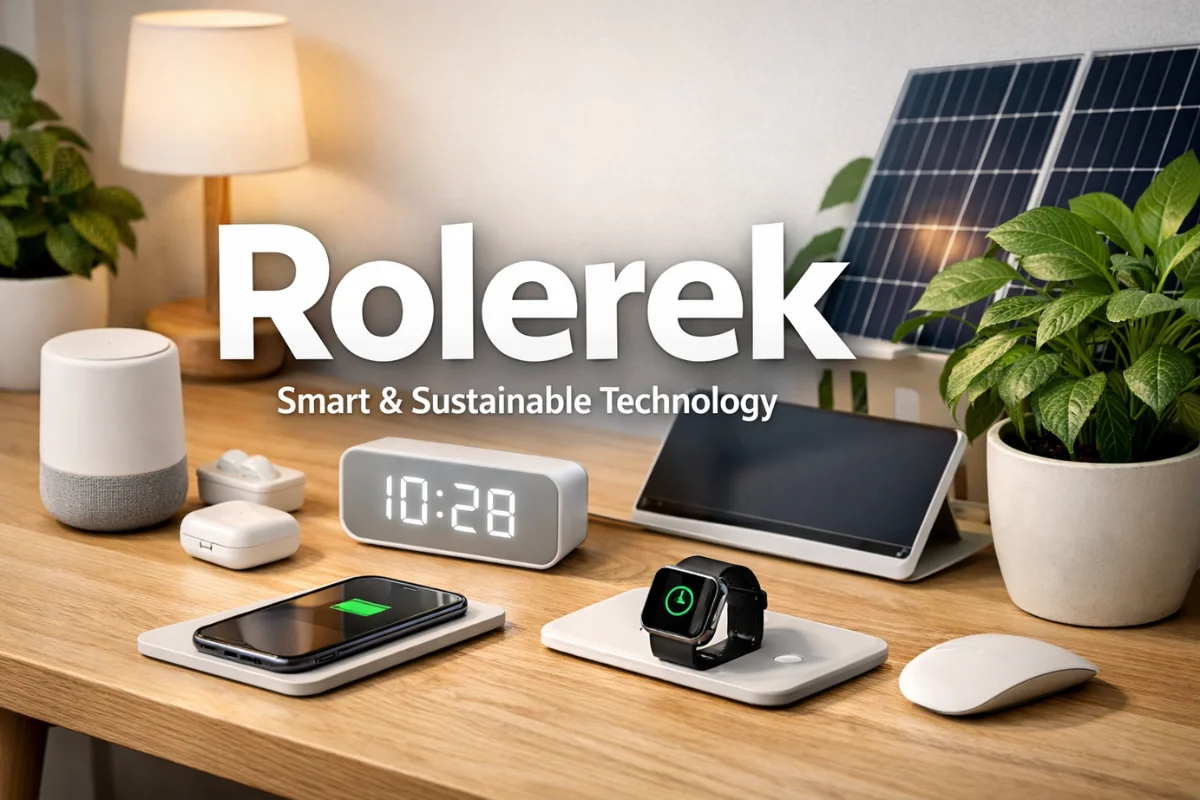
I spend a lot of time evaluating consumer electronics brands, and I’ll be honest — most of them start to blur together after a while. Same promises, same glossy launches, same features nobody asked for. So when I came across Rolerek, I was curious enough to dig deeper. What I found was a brand built on a genuinely different set of priorities: sustainability, practical design, and an honest relationship with the people who actually use its products.
Rolerek is an emerging player in the consumer electronics space, founded by a team of engineers and designers who grew tired of watching the industry prioritize spectacle over substance. Their answer was a brand that builds technology with intention — not to impress at first glance, but to genuinely serve users over the long term. This post explores what Rolerek is, why it matters, and why I think it deserves a serious place in the conversation about the future of tech.
The Origins of Rolerek: Built by People Who Were Frustrated with the Status Quo
Every compelling brand has a founding story, and Rolerek’s is refreshingly grounded. A group of professionals with backgrounds in industrial design, software engineering, and supply chain management came together with a shared conviction: the consumer electronics industry was failing people in subtle but meaningful ways.
Products were being designed to look impressive in unboxing videos, not to hold up three years into daily use. Marketing campaigns focused on spec sheets rather than real-world performance. And sustainability was treated as a checkbox, not a commitment.
Rolerek was founded specifically to challenge those norms. The founders wanted to build electronics that were genuinely useful, responsibly made, and designed to last. That clarity of purpose — rare in an industry often driven by quarterly targets — is what makes Rolerek’s story worth paying attention to.
Sustainability Isn’t a Tagline at Rolerek — It’s Structural
In the consumer electronics world, ‘sustainability’ often amounts to a recycling symbol on the packaging and a vague statement in the about section. Rolerek approaches it differently.
From the earliest stages of product development, the company evaluates materials for both durability and environmental impact. The goal is products that don’t just perform well on day one, but continue performing well for years — reducing the consumer’s need to replace devices every eighteen months and, in turn, reducing waste across the supply chain.
Recyclable materials are prioritized wherever technically viable. Manufacturing processes are assessed with environmental cost in mind. Even packaging reflects this ethos: minimal, functional, and designed to generate as little waste as possible.
What I find most credible about Rolerek’s sustainability approach is that it’s embedded in the business model rather than layered on top of it. When your products are designed to last longer, you don’t have the same financial incentive to push unnecessary upgrades. That structural alignment between sustainability and business practice is genuinely unusual in this industry. Research from the Ellen MacArthur Foundation consistently highlights that circular design principles — prioritizing longevity and recyclability from the outset — are far more impactful than end-of-life recycling programs added as afterthoughts.
Design Philosophy: When Less Is Genuinely More
Minimalism With Purpose
There’s a version of minimalism in tech that’s really just laziness dressed up in clean lines. Rolerek’s version is different. Their minimalist design philosophy is rooted in a specific belief: the best product is one that does exactly what you need it to do, and nothing about it gets in the way of that.
Every device in their lineup is designed with the user experience at the center. Interfaces are intuitive. Controls are where you expect them. The visual language is clean without being sterile. These aren’t accidents — they’re the result of a design process that continually asks whether each element of a product is earning its place.
Usability Over Feature Count
One of the clearest signs of Rolerek’s design maturity is what they leave out. Many tech brands compete on feature count — more settings, more modes, more compatibility — under the assumption that more options signal more value. Rolerek’s position is essentially the opposite.
Their products are built around the core functions that matter most to real users in real contexts. This means fewer decision points, less interface friction, and a product that genuinely fits into your daily life rather than demanding attention and adjustment.
This philosophy aligns with well-established principles in UX design. Don Norman’s foundational work in ‘The Design of Everyday Things’ argues that good design should be invisible — it should guide users naturally without requiring them to think about the tool itself. Rolerek’s product line reads as though that principle was taken seriously from the first concept sketch.
Future-Ready Technology: Built for Real Problems, Not Hypothetical Ones
A lot of consumer technology is designed for an aspirational version of life — a life where you have time to explore every setting, where your ecosystem is perfectly integrated, and where the product’s ambitions match your own. Rolerek builds for the life people actually have.
Their R&D investment is focused on solving genuine friction points: energy management, workspace efficiency, and household convenience. Products are tested and iterated against real-world use cases, not just laboratory benchmarks or focus group ideals.
This approach is sustained by a strong commitment to ongoing development. Regular firmware updates and software enhancements mean that a Rolerek device you buy today isn’t frozen at its launch-day capability. The company treats the relationship with its products as ongoing, not concluded at the point of sale. That’s a meaningful distinction in a market where many devices become functionally obsolete within months because the manufacturer has already moved on.
How Rolerek Compares: A Side-by-Side Look
To give you a clearer sense of where Rolerek sits relative to the broader market, here’s a comparison of key brand characteristics across three categories of consumer electronics companies:
| Feature | Rolerek | Typical Tech Brand A | Typical Tech Brand B |
| Sustainability Focus | Core to brand identity | Occasional marketing claim | Minimal or absent |
| Design Philosophy | Minimalist, user-first | Feature-heavy, trend-driven | Varies by product line |
| Community Feedback Integration | Built into R&D cycle | Limited post-launch surveys | Rarely structured |
| Product Longevity | Designed for long-term use | Average 2-3 year lifecycle | Frequent model turnover |
| Firmware & Software Updates | Regular, future-proofing focus | Inconsistent update cadence | Often discontinued quickly |
| Eco-Friendly Materials | Used from the start | Partial, selective products | Rarely disclosed |
| Target Audience | Thoughtful, value-driven consumers | Mainstream mass market | Budget-first buyers |
The comparison above isn’t meant to suggest that every other brand is failing. There are excellent products from many manufacturers. But as a picture of brand-level priorities and structural commitments, the differences are real and worth understanding before you make a purchasing decision.
Community-Driven Innovation: Why Rolerek Listens Differently
Most tech companies have some form of user feedback mechanism. Product reviews, support tickets, occasional surveys. Rolerek has built something more intentional than that.
The company maintains active channels — forums, direct feedback platforms, structured surveys — where customers can contribute ideas and flag issues. Critically, this isn’t just a customer service function. It feeds directly into the product development cycle. When a consistent pattern of user feedback points toward a usability gap or a missing feature, that signal shapes the next iteration.
I think this matters for a couple of reasons. First, it produces better products. Users who interact with a device daily surface insights that no lab test or internal review would catch. Second, it creates a different kind of customer relationship — one where users feel like participants rather than recipients. That sense of investment builds genuine brand loyalty in a way that no marketing campaign can replicate.
Research from Deloitte’s Global Consumer Survey has repeatedly found that consumers are more loyal to brands they perceive as responsive and transparent. Rolerek’s community-driven approach positions it well on both dimensions.
The Real-World Impact of Rolerek Products
Rolerek’s product line spans home technology and workplace solutions. Whether it’s a smart home device optimized for energy efficiency or a workspace accessory designed to reduce digital clutter, each product is evaluated against a consistent standard: does this actually make the user’s daily experience better?
In the smart home category, Rolerek’s emphasis on energy management has practical appeal at a time when energy costs are a genuine household concern. Products that reduce unnecessary consumption — not through gimmickry but through thoughtful default settings and intelligent automation — deliver measurable value that users feel in their daily lives and their utility bills.
In the workplace context, the minimalist design philosophy translates into products that reduce cognitive load rather than adding to it. In an era of information overload, a tool that does what it’s supposed to do without demanding configuration and troubleshooting is genuinely valuable.
The brand has developed a loyal customer base among users who describe themselves as thoughtful buyers — people who research purchases, who value long-term performance over novelty, and who care about the provenance and environmental footprint of what they buy. That’s a niche that brands frequently claim to serve but rarely do with any real conviction.
International Expansion: The Next Chapter for Rolerek
Having established credibility in its home market, Rolerek is now focused on building an international presence. The company’s core values — sustainability, thoughtful design, community engagement — translate well across markets where consumer consciousness about environmental and ethical production is growing.
European markets, where regulatory frameworks increasingly reward responsible manufacturing, represent a particularly natural fit. The EU’s Ecodesign Regulation, which sets energy efficiency and repairability standards for consumer electronics, aligns closely with the way Rolerek already approaches product development. Brands that are ahead of regulatory requirements tend to navigate market entry more smoothly and build trust with regulators and consumers alike.
Similarly, in markets across Southeast Asia and the Middle East, where a growing middle class is making increasingly sophisticated purchasing decisions, a brand that offers genuine quality and responsible production at a competitive price point has a real opportunity.
What makes Rolerek’s international ambitions credible is that they’re not predicated on abandoning the brand’s founding principles in pursuit of scale. The company’s stated commitment is to grow while maintaining the values that made its products worth buying in the first place. That’s the harder path, but historically it’s the one that builds durable brands.
Why Rolerek Matters in 2025 and Beyond
The consumer electronics industry doesn’t lack for options. What it often lacks is honesty — honest design, honest sustainability commitments, and honest relationships with the people buying the products.
Rolerek matters because it represents a coherent alternative to the dominant model. It demonstrates that you can build electronics that are thoughtfully designed, responsibly produced, and continuously improved through genuine user engagement — and that consumers will respond to that with loyalty and advocacy.
There’s also a broader significance. Every major shift in how industries operate starts with companies willing to do things differently at a smaller scale and prove that the alternative works. Rolerek is doing that in consumer electronics, and the more visibility it earns, the stronger the argument that the mainstream market can and should evolve.
For consumers, the practical implication is straightforward: if you’re in the market for consumer electronics and you care about design quality, environmental responsibility, and long-term value, Rolerek is a brand worth evaluating seriously.
Final Thoughts
I started this piece curious about Rolerek, and I’m ending it genuinely impressed — not by hype or marketing, but by the coherence of what the brand is actually trying to do. Building consumer electronics that are minimal in design, durable in construction, responsible in production, and improved through real user feedback is harder than it sounds. Most companies take shortcuts at each of those steps.
Rolerek, by all available evidence, is trying to do it the right way. And in a market where that’s rare, it deserves recognition.
If you want to explore Rolerek’s product line or follow the brand’s development into international markets, I’d recommend keeping an eye on their official channels and joining their user community. The feedback loop they’ve built isn’t just good for their products — it’s an unusually direct way for consumers to have a voice in the direction a tech company takes. That’s worth participating in.
FAQs
1. What makes Rolerek different from other consumer electronics brands?
Rolerek distinguishes itself through a genuine, structurally embedded commitment to sustainability, minimalist user-first design, and community-driven product development — not as marketing tactics, but as operational principles baked into every stage of how products are made.
2. Are Rolerek products actually sustainable, or is it just greenwashing?
Based on the company’s approach — using recyclable materials from the design phase, prioritizing product longevity to reduce replacement cycles, and minimizing packaging waste — Rolerek’s sustainability commitment appears structural rather than superficial. This is markedly different from brands that add recycling claims at the end of the production process.
3. How does Rolerek incorporate customer feedback into its products?
Rolerek maintains dedicated community forums, direct feedback channels, and structured surveys that feed into the product development cycle. User insights inform both incremental improvements through firmware updates and longer-term design decisions for new products.
4. Is Rolerek available internationally?
Rolerek is actively pursuing international expansion, with a focus on markets where demand for responsibly produced, high-quality consumer electronics is growing — including parts of Europe, Southeast Asia, and the Middle East. Check their official website for current availability in your region.
5. What types of products does Rolerek make?
Rolerek’s product line spans home technology and workplace solutions, including smart home devices focused on energy efficiency and workspace accessories designed to reduce clutter and cognitive load. The common thread across all products is minimal, functional design built for long-term performance.
For broader information, visit Wellbeing Makeover

I’m Salman Khayam, the founder and editor of this blog, with 10 years of professional experience in Architecture, Interior Design, Home Improvement, and Real Estate. I provide expert advice and practical tips on a wide range of topics, including Solar Panel installation, Garage Solutions, Moving tips, as well as Cleaning and Pest Control, helping you create functional, stylish, and sustainable spaces that enhance your daily life.