
When I first started specifying linear lighting for residential and commercial projects, I kept running into the same frustration: LED tape that looked great on paper and mediocre in reality. Hotspots. Visible diodes. Color that shifted between runs. Then I came across the Tech Lighting Essence tape light system, and the difference was immediately obvious — not because it dazzled, but because it didn’t fail in any of the ways I’d come to expect.
This post covers everything you need to know about the Essence tape light line: how it’s built, where it performs best, how to spec and install it properly, and where it honestly falls short. Whether you’re an interior designer, a homeowner tackling a kitchen remodel, or a lighting professional looking for a specification-grade linear solution, this is the resource I wish I’d had when I first encountered this product.
What Is the Tech Lighting Essence Tape Light System?
Tech Lighting’s Essence tape light is a specification-grade, architectural LED strip system built around 24VDC constant-voltage technology. It’s made for permanent, concealed installation — under cabinets, inside coves, along toe kicks, within shelving, and across ceiling recesses. The system is now managed under Visual Comfort & Co., which acquired Tech Lighting, but the Essence branding and product line remain intact.
What separates the Essence tape light from commodity LED strips you’d find at a hardware store isn’t just build quality — it’s the whole philosophy. The system uses a proprietary phosphor mix and hand-selects from over one billion LEDs each year to achieve unmatched color quality and consistency. That sounds like marketing language until you actually see two runs of it side by side on a white surface. There’s no color drift, no visible mismatch between segments. It’s the kind of thing professionals notice immediately and end clients feel without being able to name.
The system is sold in two primary formats: LED tape strips that you mount yourself (either bare or inside channels) and pre-built architectural light channels that arrive as finished fixtures. For the purposes of this guide, I’m focusing primarily on the tape side of the system, which is where most of the flexibility — and most of the specifying decisions — live.
Tech Lighting Essence Tape Light Series: Standard vs. Premium
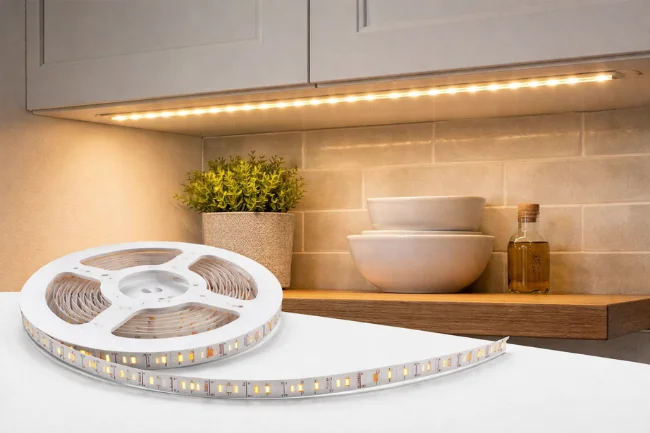
How the Standard Series Essence Tape Light Performs
The Standard Series Essence tape light is designed for budget-conscious projects where you still need clean, consistent light. It’s versatile, well-suited for illuminating tight spaces, and pairs cleanly with Essence channels for a finished appearance. It’s field-cuttable in 1.97-inch increments and available in 8-ft, 16-ft, and 100-ft rolls — practical for projects where quick availability and roll-length flexibility matter.
Why the Premium Series Essence Tape Light Sets the Bar
The Premium Series Essence tape light is where this system earns its reputation. The Premium tier delivers made-to-order, specification-grade, high color quality solutions with 2-step color consistency, CRI 95+, R9 90+, Rf 90, and Rg 95, at a tight LED pitch of 52 LEDs per foot for warm dim and 72 LEDs per foot for static white.
That CRI figure is worth pausing on. A CRI of 95 or above isn’t just a spec box tick — it means artwork looks right, food looks appetizing, skin tones read naturally, and white surfaces don’t take on a green or pink cast. For kitchens, retail spaces, art walls, and hospitality settings, that level of color fidelity matters a great deal.
Static White vs. Warm Dim Essence Tape Light
The choice between static white and warm dim is one of the first decisions you’ll make when specifying Essence tape light.
Static white
Essence tape holds a fixed color temperature regardless of dim level. It’s available in a range of CCTs — typically 2700K, 3000K, and 3500K. This is the right choice for task lighting, commercial applications, and anywhere consistent light quality matters more than mood.
Warm dim
Essence tape light is the option that makes residential designers genuinely appreciate this system. The warm dim LED strip transitions to a warmer CCT as it’s dimmed, simulating the comfortable glow of an incandescent lamp. At full brightness, you might be at 3000K; as you dim toward 10%, it shifts to around 1800K — that amber, candlelight quality that makes a living room feel warm rather than just “lights on low.” If you’ve ever dimmed an LED fixture and had it look cold and clinical at low levels, warm dim Essence tape solves exactly that problem.
Tech Lighting Essence Tape Light Specifications Compared
Here’s a side-by-side comparison of the main Essence tape light configurations to clarify the differences between tiers:
| Feature | Standard Series Static White | Premium Series Static White | Premium Series Warm Dim |
|---|---|---|---|
| Voltage | 24VDC | 24VDC | 24VDC |
| CRI | 90+ | 95+ | 95+ |
| R9 Value | 80+ | 90+ | 90+ |
| LED Pitch | ~60 LEDs/ft | 72 LEDs/ft | 52 LEDs/ft |
| CCT Range | 2700K–3500K | 2700K–3500K | 3000K–1800K (dim-to-warm) |
| Cut Increment | 1.97″ | 3.3″ | 3.3″ |
| Roll Availability | 8 ft, 16 ft, 100 ft | Ordered by foot | Ordered by foot |
| IP Rating | Indoor (IP20) | Indoor (IP20) | Indoor (IP20) |
| Dimming | TRIAC, 0-10V | TRIAC, 0-10V, Lutron | TRIAC, 0-10V, Lutron |
| Mounting | 3M tape included | 3M tape included | 3M tape included |
The outdoor/wet-rated Unilume strips extend the Essence tape light system into damp and wet environments with IP67 ratings, opening up exterior cove lighting, outdoor kitchen applications, and covered patio installations.
Why Even Light Distribution Is Central to Essence Tape Light Performance
One of the things I hear most often from clients who’ve had bad experiences with LED tape is some version of: “It just looked cheap.” When I dig into what they mean, it almost always comes down to the same thing — they could see the individual LEDs. That dotted appearance, that “string of pearls” effect, is what gives consumer-grade tape its persistent bad reputation.
The Essence tape light avoids most of that through a combination of tight LED pitch and quality channel diffusers. Instead of seeing individual LEDs, you see a continuous line of light. That difference matters more than people expect — especially in cove lighting or under-cabinet runs where the tape is relatively close to a bright reflective surface.
The reason Essence tape light achieves this is primarily the LED pitch. The architectural channel versions use 72 LEDs per foot for static white and 52 LEDs per foot for warm dim, paired with a white lens that eliminates pixelation. The closer the LEDs are to each other, the less visible the gaps, especially once light passes through a diffuser lens or bounces off a channel reflector.
For most cove lighting and under-cabinet applications, the lens and channel combination matters just as much as the tape spec itself. Running high-end Essence tape in a bare channel without a diffuser gives you better output than cheap tape, but you’re leaving performance on the table. This system is designed to work as a whole.
Where Tech Lighting Essence Tape Light Works Best
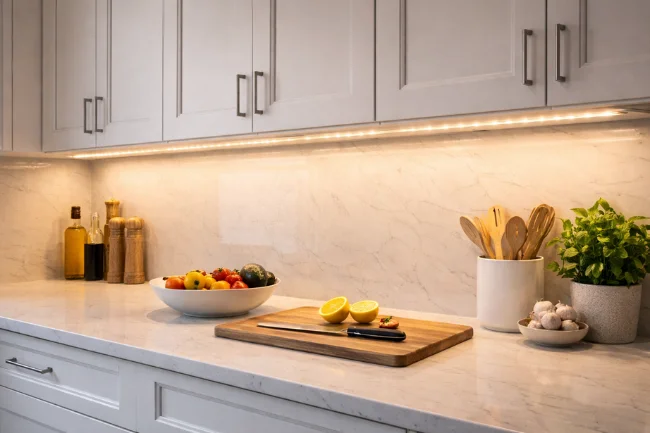
Essence Tape Light for Under-Cabinet Kitchen Lighting
Kitchen under-cabinet lighting is probably the single most common application for Essence tape light — and one where the premium color quality is most immediately visible. The countertop is a close-range surface that most people interact with daily, which means any unevenness, color inconsistency, or visible LED dotting is noticed quickly.
Using a 3000K static white Essence tape light in a surface-mount channel beneath upper cabinet boxes delivers an even, warm-white wash across the work surface that holds up under scrutiny. The high-CRI output means food looks genuinely appetizing rather than fluorescent-washed. For kitchens with a lot of white marble, quartz, or light-painted cabinetry, the 2-step color binning of Premium Essence tape ensures that a 20-foot run looks exactly as consistent at one end as the other.
Cove and Indirect Lighting with Essence Tape Light
Cove installations are where color consistency across the full run becomes non-negotiable. Any LED tape system with poor binning will show warm patches next to cooler ones when a long cove lights up a ceiling. The Essence tape light’s 2-step binning is specifically designed for this use case.
A cove run of warm dim Essence tape light, properly installed and driven, produces a ceiling wash that reads like a continuous gradient — no hotspots, no seams, no visible diodes. For living rooms, dining rooms, and hotel corridors, this is the application that tends to produce the “I don’t know why, but this room feels right” reaction from clients who can’t articulate what good lighting looks like but immediately feel it.
Retail, Gallery, and Accent Applications for Essence Tape Light
The CRI 95+ spec on Premium Essence tape light isn’t only relevant for residential comfort. In retail environments, accurate color rendering directly affects whether merchandise looks the way it should under artificial light. A jewelry display lit with CRI 90 tape and one lit with CRI 95+ Essence tape will produce noticeably different results — the latter makes gemstones and metals look more compelling and accurate to daylight.
Similarly, in gallery or art-display contexts, the Essence tape light’s high R9 value (90+) means deep red tones in paintings and textiles render correctly rather than appearing muted or flat. This is one of the clearer arguments for specifying Essence tape light specifically in high-stakes lighting contexts.
Essence Tape Light and Channel Systems: Why the Pairing Matters
One mistake I see regularly is people buying Essence tape light and running it bare without a channel. The tape is only half the system.
The channel serves several functions simultaneously: it diffuses the light to eliminate pixelation, protects the tape from physical damage, provides a clean finished look in the off state, and, in surface-mount configurations, acts as a proper fixture that conceals mounting hardware entirely.
Essence channels come in surface-mount, recessed, and pendant configurations. For most concealed applications — inside a cove, behind a cabinet face frame, inside shelving — a surface-mount channel with a white or frosted diffuser lens does everything you need. Channels are available in custom lengths ordered in 1-inch increments up to 50 feet, and fixtures longer than 8 feet contain multiple equal-length segments joined in the field with concealed joiners that minimize shadowing at connection points.
Channel finishes include Anodized Black, Satin Aluminum, and Powder Coated White (field-paintable). Anodized Black pairs naturally with dark cabinetry and modern industrial aesthetics. Satin Aluminum reads neutral against most finishes. The powder-coated white can be painted on-site to match any millwork color — a practical detail that matters when the channel is visible rather than concealed.
Pairing the right Essence tape light with the right channel isn’t just a performance decision — it’s the difference between a lighting installation that looks custom-designed and one that looks like someone tucked a strip behind the cabinet.
Power Supplies and Dimming Compatibility for Essence Tape Light
The Essence tape light runs at 24VDC, which means you’ll need a constant-voltage driver to step down from line voltage. Tech Lighting’s Essence power supplies convert 120V or 277V line voltage to 24VDC and are rated Class 2 up to 100W, with a power factor above 0.9 and efficiency above 80%.
Dimming compatibility deserves careful attention. The Essence tape light system supports multiple dimming protocols:
- Reverse-phase, forward-phase, and TRIAC dimming to 0.2%
- Lutron Hi-lume Ecosystem down to 0.1%
- Standard 0-10V down to 5%
- eldoLED 0-10V down to 0.1%
For residential applications, a standard TRIAC or ELV dimmer paired with a compatible driver works well. For commercial or hospitality spaces where precise dimming control is part of the design intent, the Lutron integration delivers smooth performance all the way to near-off. That 0.1% floor is genuinely useful in bedrooms and dining environments where the goal is ambiance at very low light levels without visible flicker.
One practical note: the minimum dimming level varies by dimmer, and Tech Lighting maintains a dimmer compatibility chart on their website worth consulting before committing to a specific dimmer brand. A mismatch between the Essence tape light, driver, and dimmer is one of the most common causes of flickering and buzzing in LED tape installations — and it’s almost always preventable with five minutes of cross-referencing beforehand.
How to Install Tech Lighting Essence Tape Light Correctly
The Essence tape light includes 3M adhesive backing, which makes mounting clean and tool-free for most surface types. For cabinetry, millwork, and painted surfaces, the adhesive holds reliably. For rough or porous surfaces, supplemental mounting clips are available.
The Essence tape light strip is field-cuttable at marked intervals — every 3.3 inches on Premium series tape — so you can trim to exact lengths on the job. Measure carefully before cutting; you can’t extend a cut segment, so a short measurement wastes material and delays the project.
Solderless strip-to-strip and strip-to-wire connectors make electrical connections without requiring a soldering iron, which speeds up installation considerably. Splice boxes and wire management clips keep runs clean inside cabinets and channels.
A practical limit to know: if your run exceeds the maximum continuous length specified for your Essence tape light configuration (typically around 16 feet for Premium series, depending on wattage), feed power from multiple points rather than daisy-chaining. Running too long a section from a single driver end causes a voltage drop that shows up as reduced brightness at the far end of the run. It’s one of the more common installation errors, and one of the easiest to avoid with upfront planning.
Honest Limitations of the Essence Tape Light System
The Tech Lighting Essence tape light is not cheap. The Premium series, especially in custom lengths or pre-built channel form, carries a price point that reflects its specification-grade positioning. If your project involves an unlit closet shelf or a temporary accent display, consumer-grade tape from a reputable manufacturer will serve you adequately.
The made-to-order nature of some Essence tape light configurations means lead times matter for project scheduling. The Standard series in rolls ships quickly; custom channel lengths may carry a lead time of several weeks, depending on volume and finish selection. That’s worth building into your project timeline rather than discovering mid-install.
The Essence tape light system also performs best when installed by someone familiar with low-voltage lighting. Properly sized drivers, appropriate dimmer selection, and correctly routed wiring all matter. Done right, the hardware disappears, and the Essence tape light does its job for a decade or more. Done carelessly, the performance advantages largely disappear with it.
FAQs
1. Can the Tech Lighting Essence Tape Light Be Used Outdoors?
Yes, but only in specific configurations. The standard indoor Essence tape light (IP20) is rated for dry interior locations only. For outdoor or wet-area applications, you’ll need the Unilume IP67-rated strip within the Essence family, which is fully sealed and suitable for covered exterior coves and outdoor kitchen installations.
2. What Driver Do I Need for Essence Tape Light?
You need a 24VDC constant-voltage power supply sized to the total wattage of your tape run. Tech Lighting’s Essence power supplies convert 120V or 277V line voltage and are matched to the system; pairing these with the correct Essence tape light ensures warranty compliance and prevents flickering from driver-tape mismatch.
3. How Does Warm Dim Essence Tape Light Differ from Simply Dimming a Static White Strip?
Static white Essence tape holds its color temperature at all dim levels, which can look cool or clinical at low brightness. Warm dim Essence tape light actively shifts from its rated CCT (around 3000K at full output) toward a warm amber near 1800K as it dims, closely replicating the behavior of incandescent lamps and producing a genuinely warm atmosphere at low levels.
4. At What Increments Can Premium Essence Tape Light Be Cut?
The Premium series Essence tape light is field-cuttable at marked lines every 3.3 inches. The Standard series cuts at 1.97-inch increments. Cuts must be made precisely at the marked points to maintain the circuit integrity of each LED group — cutting between marks leaves a non-functional segment at the end of your run.
5. Is Tech Lighting Essence Tape Light Compatible with Lutron Dimming Systems?
Yes. The architectural channel fixtures and Premium series Essence tape light configurations support Lutron Hi-lume Ecosystem dimming down to 0.1%, making Essence one of the more Lutron-compatible specification-grade tape systems on the market. Always verify your specific driver and dimmer pairing using the compatibility chart on the Tech Lighting website before finalizing a specification.
Final Thoughts on Tech Lighting Essence Tape Light
What makes the Tech Lighting Essence tape light system genuinely useful rather than just premium-priced is the coherence of it — tape, channels, drivers, and accessories designed to work together, backed by color-consistency standards that most manufacturers don’t publish, let alone consistently achieve.
For professional applications where the lighting will be seen closely and expected to last a decade or more, the Premium Essence tape light is a specification I return to regularly. For residential projects where under-cabinet or cove lighting is a meaningful part of the design intent, warm dim Essence tape light inside matching channels is one of the cleaner solutions available at this price tier.
If you’re specifying for a current project, the Visual Comfort website hosts the full Essence catalog with downloadable spec sheets, photometric data, and the dimmer compatibility chart. For custom channel lengths, working directly with a rep or authorized distributor tends to get you faster turnaround and better configuration guidance than ordering without context.
The rooms that feel the most intentional are usually the ones where the lighting is invisible. That’s the quiet promise the Tech Lighting Essence tape light system is built around — and in my experience, it consistently keeps it.

I’m Salman Khayam, the founder and editor of this blog, with 10 years of professional experience in Architecture, Interior Design, Home Improvement, and Real Estate. I provide expert advice and practical tips on a wide range of topics, including Solar Panel installation, Garage Solutions, Moving tips, as well as Cleaning and Pest Control, helping you create functional, stylish, and sustainable spaces that enhance your daily life.