
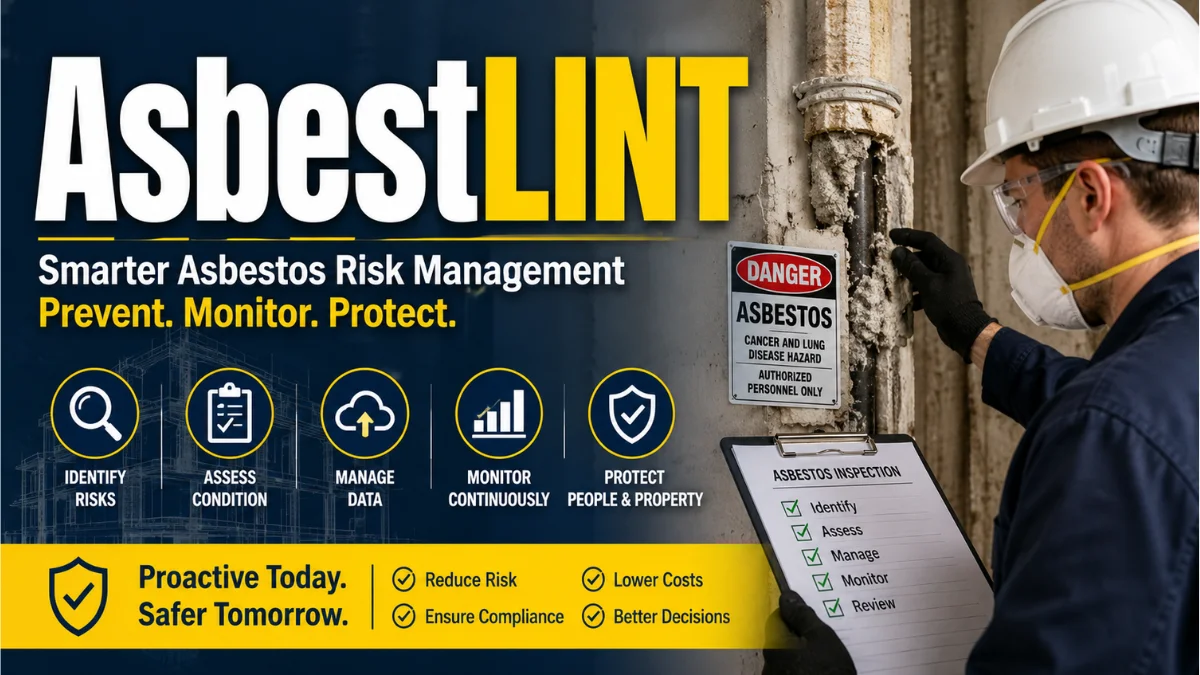
I see AsbestLINT as a smarter way to think about asbestos risk management: not as a one-time inspection, not as a dusty compliance file, and not as something to worry about only when renovation work begins. AsbestLINT is best understood as a preventive framework that brings together structured assessment, data analysis, clear documentation, and continuous monitoring so asbestos hazards can be identified before they become expensive, dangerous, or legally difficult to control.
For decades, asbestos management has often been handled too late. A building owner plans refurbishment, a contractor opens a wall or ceiling, suspicious material appears, work stops, costs rise, and everyone suddenly starts asking why the risk was not identified earlier. That reactive approach is weak. It protects nobody well. It also creates avoidable delays, poor decision-making, and unnecessary exposure risk.
AsbestLINT changes the mindset. Instead of waiting for asbestos-containing materials to become disturbed, damaged, or controversial, it encourages a living risk-management process. I use the word “living” because asbestos risk does not stay frozen after one survey. Buildings age. Materials deteriorate. Tenants change how spaces are used. Maintenance teams drill, cut, patch, remove, and replace. Renovation plans shift. A file that was accurate five years ago can become incomplete today.
That is where AsbestLINT becomes useful. It turns asbestos management into an organised system rather than a scattered set of reports, assumptions, emails, and emergency decisions. It supports better decisions for older buildings, renovation and demolition projects, workplace safety, regulatory compliance, insurance planning, and digital building management.
What AsbestLINT Means in Practical Terms
AsbestLINT is not a replacement for licensed asbestos surveys, laboratory testing, or qualified professional judgement. That would be a dangerous misunderstanding. Instead, I would describe AsbestLINT as a modern asbestos intelligence layer. It helps identify where asbestos risk may exist, how that risk should be prioritised, what evidence supports the assessment, and when further action is needed.
Traditional asbestos management often depends on separate events. A survey is commissioned. A report is issued. A register is created. Maybe the register is reviewed. Maybe it is forgotten until a contractor asks for it. That approach may satisfy a basic administrative need, but it does not always support active risk control.
AsbestLINT pushes the process further. It connects building age, construction materials, survey history, maintenance records, damage reports, environmental conditions, renovation plans, access limitations, and risk scoring. It creates a clearer picture of where asbestos-containing materials may be present and where disturbance is most likely.
This matters because asbestos risk is not only about whether asbestos exists. The real question is whether people may be exposed to airborne fibres. The U.S. Environmental Protection Agency explains that asbestos in good condition and left undisturbed is unlikely to present a health risk, while damaged or disturbed material can release fibres into the air. Managing asbestos in place and keeping it in good repair is often the best approach.
That principle fits directly into the AsbestLINT mindset. The goal is not panic. The goal is control.
Why Asbestos Still Demands Serious Attention
Asbestos was widely used because it performed well. It resisted heat, strengthened materials, and provided insulation. That is why it appeared in roofing, pipe insulation, floor tiles, ceiling products, cement sheets, coatings, gaskets, and other building materials. OSHA describes asbestos as a group of naturally occurring minerals once used in products such as pipe insulation, floor tiles, building materials, vehicle brakes, and clutches because of their heat and corrosion resistance.
The problem is not that asbestos-containing material always causes immediate harm. The problem starts when fibres become airborne and are inhaled. These fibres are too small to be seen with the naked eye, which makes the hazard easy to underestimate. OSHA states that breathing asbestos fibres can cause asbestosis, lung cancer, and mesothelioma, and that asbestos is now highly regulated because of these recognised health risks.
The delayed nature of asbestos-related disease makes prevention even more important. Symptoms and illness may appear years after exposure, which means a poor decision made during maintenance or demolition today can create consequences long after the project is forgotten. That time gap is exactly why I believe a preventive framework like AsbestLINT is more useful than a last-minute inspection culture.
The Weaknesses of Traditional Asbestos Management
Traditional asbestos inspection is not useless. In fact, proper surveys and laboratory analysis remain essential. The weakness lies in treating them as the whole system.
A survey tells you what was inspected, what was found, what was presumed, and what may need further investigation. But it may not always capture every hidden void, inaccessible area, later alteration, damaged material, or maintenance activity. If the report is not turned into a managed register, monitored plan, and practical communication process, its value drops sharply.
The UK Health and Safety Executive says dutyholders should take reasonable steps to find out whether asbestos-containing materials are present, determine their location and condition, and presume materials contain asbestos unless there is strong evidence that they do not. That guidance shows why passive record-keeping is not enough. A building owner or facility manager needs a working system.
Traditional management often fails in five places.
- First, records become outdated. A survey report from years ago may not reflect current conditions.
- Second, inaccessible areas are forgotten. Ceiling voids, risers, ducts, floor cavities, and service routes may remain poorly understood.
- Third, maintenance teams may not receive clear information before work begins.
- Fourth, risk scoring may be inconsistent across buildings or sites.
- Fifth, emergency decisions replace planned control.
AsbestLINT addresses these weaknesses by treating asbestos information as operational data, not just paperwork.
How AsbestLINT Works as a Preventive Framework
The foundation of AsbestLINT is a structured assessment. Instead of relying only on visual inspection or isolated sampling, it encourages a broader risk picture.
I would build an AsbestLINT-style assessment around these factors:
- Building age and construction period
- Known material types and previous asbestos findings
- Survey coverage and limitations
- Areas not accessed during previous inspections
- Condition of suspected or confirmed materials
- Maintenance and repair history
- Renovation, demolition, or intrusive work plans
- Occupancy patterns and worker access
- Environmental stressors such as vibration, leaks, humidity, and impact damage
- Documentation quality and review frequency
This creates a more useful risk profile. For example, an old boiler room with ageing pipe insulation, frequent maintenance access, and incomplete historical survey data should not be treated the same as a sealed, undisturbed material in a rarely accessed area. The risk context is different.
AsbestLINT does not guess blindly. It organises uncertainty. That is valuable because asbestos management often involves unknowns. A responsible system does not pretend that every unknown is harmless. It flags uncertainty, documents it, and assigns the right next action.
AsbestLINT and the Difference Between Presence and Risk
One of the biggest mistakes in asbestos discussions is confusing presence with immediate danger. A material may contain asbestos but present low risk if it is sealed, stable, undisturbed, and properly managed. Another material may present a higher risk if it is damaged, friable, exposed, or likely to be disturbed during work.
AsbestLINT helps separate these two ideas.
The EPA’s public guidance reflects this distinction clearly: asbestos that is in good condition and left undisturbed is unlikely to present a health risk, but risk increases when materials are damaged or disturbed, and fibres become airborne.
A good AsbestLINT system, therefore, asks better questions:
- Where is the material?
- What condition is it in?
- Who may disturb it?
- How often is the area accessed?
- Is there a planned project nearby?
- Was the area fully inspected?
- Is the register current?
- Are contractors being warned before work starts?
- Is the control plan realistic?
That level of questioning is what separates preventive asbestos management from box-ticking.
Comparison: Traditional Inspection vs AsbestLINT Approach
This comparison does not make traditional inspection obsolete. It shows where inspection fits. Inspection is a necessary input. AsbestLINT is the management logic that turns that input into safer decisions.
Role of Data Analysis in AsbestLINT
Data analysis sounds technical, but in this context, it can be very practical. It means using available information to identify patterns and priorities.
For example, a facility manager may oversee twenty buildings. Some are from the 1960s, some from the 1980s, and some are modern. Several have incomplete asbestos registers. A few have recurring roof leaks. Others have upcoming refurbishment plans. Without structured analysis, the manager may treat each issue separately. With AsbestLINT, the manager can rank buildings based on risk signals.
The system may highlight that Building A has older insulation, incomplete survey coverage, and planned ceiling work. Building B may contain confirmed asbestos floor tiles, but they are sealed, labelled, undisturbed, and monitored. Building A may need faster attention, even if Building B has confirmed asbestos.
That is the power of data-led prevention. It prevents resources from being wasted on low-priority concerns while high-risk gaps remain unresolved.
Documentation: The Part Many Organisations Get Wrong
Documentation is not glamorous, but it is where asbestos management succeeds or fails. If asbestos information is buried in old PDFs, scattered spreadsheets, contractor emails, and site folders, it is not truly controlled.
The HSE says an asbestos register should be a live document containing current information on the presence and condition of asbestos-containing materials or presumed asbestos-containing materials. This is a serious point. A register that is not updated is not a reliable register. A plan that nobody follows is not a management plan.
In an AsbestLINT framework, documentation should answer four questions quickly:
- What is known?
- What is presumed?
- What is unknown?
- What action is required next?
That structure protects people and reduces confusion. It also helps during audits, insurance reviews, contractor onboarding, lease negotiations, and project planning.
I would expect a strong AsbestLINT record to include survey dates, material assessments, risk scores, photographs, access limitations, sample results, contractor notes, control measures, review dates, and responsibility assignments. More importantly, it should be understandable to the people who need it.
A perfect technical report that maintenance workers cannot interpret is not good enough.
Continuous Monitoring and Review
Asbestos management should not stop after identification. Monitoring matters because material condition changes.
Water damage can weaken ceiling products. Vibration can affect older insulation. Impact damage can expose hidden layers. Poor maintenance can turn a stable material into a concern. Renovation work can change access routes and disturbance risk.
The HSE advises that asbestos management plans should include monitoring arrangements and be reviewed at least every 12 months or sooner when necessary. That aligns closely with the AsbestLINT idea of continuous oversight.
Continuous monitoring does not always mean expensive sensors or complex software. Sometimes it means scheduled condition checks, contractor reporting, updated photographs, clear labelling, and prompt review after leaks, impact damage, or planned work. Digital tools can make this easier, but the discipline matters more than the technology.
AsbestLINT in Older Buildings
Older buildings are where AsbestLINT becomes especially useful. Many were built or renovated during periods when asbestos-containing materials were common. They may also have decades of undocumented repairs, hidden modifications, and incomplete records.
A basic survey may identify many visible risks, but older buildings often contain complicated service routes and concealed materials. AsbestLINT helps by connecting historical knowledge with current building use.
For example, I would treat these areas as high-priority review zones in older properties:
- Plant rooms
- Boiler rooms
- Pipe runs and service risers
- Suspended ceilings
- Vinyl floor tiles and adhesives
- Roofing sheets
- Fire doors and panels
- Textured coatings
- Electrical cupboards
- Old ducts and insulation boards
The point is not to assume every old building is dangerous. That would be lazy thinking. The point is to assume that older buildings deserve structured evaluation, especially before intrusive work.
AsbestLINT for Renovation and Demolition Projects
Renovation and demolition create some of the highest asbestos risks because materials may be disturbed directly. Cutting, drilling, sanding, breaking, stripping, or removing old materials can release fibres if asbestos is present.
OSHA specifically highlights construction, renovation, repair, demolition, ship repair, and asbestos removal as situations where worker exposure can occur.
This is where AsbestLINT can save serious money and prevent serious mistakes. Before work begins, the framework should identify whether the planned activity could disturb known, presumed, or unknown asbestos-containing materials.
A refurbishment or demolition plan should not begin with vague confidence. It should begin with evidence. If there is not enough information, further survey and analysis may be needed before work starts. HSE guidance states that when work is likely to disturb asbestos, a suitable and sufficient risk assessment must be carried out, and if enough information is not available, survey and sample analysis may be required.
That principle should be central to AsbestLINT. The framework should force the question before a contractor arrives on-site: Do we know enough to work safely?
Workplace Safety Benefits
Asbestos risk management is not only a compliance issue. It is a workplace safety issue.
Maintenance workers, electricians, plumbers, HVAC technicians, roofers, demolition crews, cleaners, and contractors may all face exposure if information is missing or poorly communicated. The people most likely to disturb asbestos are not always the people who created the asbestos register. That gap is dangerous.
AsbestLINT helps close the gap by turning asbestos information into practical workplace controls.
A strong system should make sure that workers know where asbestos is located or presumed, what work restrictions apply, who to contact before disturbing materials, and what emergency procedure should be followed if suspicious material is damaged.
Training also becomes more targeted. Instead of giving generic asbestos awareness and hoping people remember it, an AsbestLINT-informed workplace can show real building-specific risks. That makes the training more relevant and harder to ignore.
Regulatory Compliance and Due Diligence
Regulations differ by country, state, and building type, so nobody should treat AsbestLINT as a substitute for local legal advice. Still, the underlying compliance logic is widely relevant: identify asbestos risk, record it, assess it, manage it, communicate it, and review it.
In the UK, the duty to manage asbestos applies to non-domestic premises and common parts of some multi-occupancy domestic premises. The dutyholder must assess whether asbestos-containing materials are present, record their location and condition, assess exposure risk, prepare a management plan, put it into action, monitor it, and review it.
That is not passive compliance. It is active management.
AsbestLINT supports this type of duty because it creates traceability. It shows what was checked, when it was checked, what evidence was used, what risks were identified, and what actions followed. If a regulator, insurer, tenant, contractor, or internal safety officer asks for proof of control, the organisation is not scrambling through old files.
Good documentation does not guarantee safety by itself. But poor documentation almost always increases risk.
Reducing Liability and Unexpected Costs
The financial case for AsbestLINT is straightforward. Asbestos surprises are expensive.
A delayed discovery can stop a project. Emergency testing can disrupt schedules. Specialist removal may be needed. Workers may need to leave the area. Contamination concerns can spread beyond the original work zone. Legal and insurance issues may follow. Reputation can suffer.
Preventive assessment is cheaper than panic.
AsbestLINT helps reduce liability by making asbestos risk visible earlier. That gives property owners and project managers time to plan budgets, choose competent contractors, arrange surveys, notify relevant parties, phase work properly, and avoid unsafe disturbance.
This is not only about saving money. It is about avoiding the kind of rushed decision-making that leads to exposure.
Digital Building Records and the Future of AsbestLINT
The future of asbestos risk management will be more digital. That does not mean every building needs an expensive software platform immediately. It means asbestos data should become easier to access, update, analyse, and share with the right people.
AsbestLINT fits naturally into digital building management because it can connect asbestos data with asset records, floor plans, maintenance logs, work permits, contractor systems, photographs, and review alerts.
A future-ready AsbestLINT system may include:
- Digital asbestos registers
- QR-linked location records
- Risk dashboards
- Automated review reminders
- Contractor access controls
- Survey limitation tracking
- Condition-change alerts
- Integration with building information models
- Maintenance history analysis
- Audit-ready reporting
The strongest systems will not simply store information. They will warn people before the risk is created.
For example, if a work order is raised for ceiling access in an older corridor, the system could flag a presumed asbestos-containing material nearby. If a roof leak is reported in a zone with asbestos cement sheets, the system could trigger a condition review. If a contractor requests access to a plant room, the system could require acknowledgement of asbestos controls before work begins.
That is where AsbestLINT becomes more than a concept. It becomes operational protection.
Common Mistakes AsbestLINT Helps Prevent
I see the same asbestos management mistakes repeated across buildings and projects. AsbestLINT is useful because it directly challenges them.
One mistake is assuming that no visible damage means no risk. Stable materials may be low risk, but planned disturbance changes the situation.
Another mistake is relying on old surveys without checking their scope. A report may have excluded areas that later become part of a project.
A third mistake is treating presumed asbestos as a minor note. Presumed materials need control until evidence proves otherwise.
A fourth mistake is failing to communicate with contractors. A register that stays in an office folder does not protect someone drilling into a wall.
A fifth mistake is waiting until demolition begins to ask asbestos questions. By then, the project is already exposed to avoidable delay.
AsbestLINT works because it makes these mistakes harder to ignore.
What a Strong AsbestLINT System Should Include
A practical AsbestLINT system does not need to be complicated, but it must be disciplined. I would expect it to include seven core elements.
1. Clear Ownership
Someone must be responsible for asbestos management. Shared responsibility often becomes nobody’s responsibility. The system should identify the dutyholder, deputies, escalation contacts, and review owners.
2. Reliable Building Information
The framework should collect building age, renovation history, previous survey data, material records, photographs, and known limitations. Weak input creates weak decisions.
3. Risk-Based Assessment
Not every material requires the same action. Risk should be based on material type, condition, accessibility, likelihood of disturbance, occupancy, and planned work.
4. Live Documentation
The asbestos register should be current, readable, and accessible to those who need it. It should record confirmed, presumed, and unknown areas.
5. Review and Monitoring Schedule
Materials should be rechecked based on risk. High-risk or vulnerable areas may need more frequent review than stable, sealed, low-disturbance zones.
6. Contractor Communication
Anyone who may disturb building fabric should receive relevant asbestos information before work starts. This is where many systems fail in real life.
7. Action Tracking
Findings must lead to decisions. Actions may include further survey, sampling, sealing, labelling, removal, access restriction, training, or monitoring.
AsbestLINT Is Not a Shortcut
A weak organisation may try to misuse AsbestLINT as a way to avoid proper surveys or laboratory testing. That would defeat the entire purpose.
AsbestLINT should never be used to “clear” a material by assumption. It should not allow unqualified staff to make unsafe calls. It should not replace legal duties. It should not encourage DIY asbestos handling. It should not reduce the role of competent professionals.
The framework is strongest when it improves professional decision-making, not when it pretends expertise is unnecessary.
If there is uncertainty and a planned disturbance, the responsible move is to stop, assess, and involve qualified asbestos professionals. That is not bureaucracy. That is basic risk control.
Why AsbestLINT Matters for Property Owners
For property owners, AsbestLINT provides visibility. It helps answer uncomfortable but necessary questions before tenants, contractors, buyers, regulators, or insurers ask them.
- Do I know where asbestos may be?
- Is my register current?
- Have I reviewed inaccessible areas?
- Are contractors receiving the right information?
- Can I prove that risks are being managed?
- Am I prepared for future refurbishment?
A property owner who cannot answer these questions is exposed. Not necessarily because asbestos is present, but because control is weak.
Why AsbestLINT Matters for Facility Managers
Facility managers sit at the centre of asbestos risk. They deal with maintenance requests, contractor access, occupant concerns, repairs, inspections, and budgets. They need a system that is practical, not theoretical.
AsbestLINT helps facility managers prioritise. It shows which areas need review, which records are incomplete, which materials are deteriorating, and which planned jobs may trigger asbestos risk.
This makes daily decision-making sharper. It also reduces the pressure of last-minute problem-solving.
Why AsbestLINT Matters for Contractors
Contractors need clear information before work begins. They should not have to guess whether a ceiling board, pipe lagging, floor adhesive, or panel may contain asbestos.
An AsbestLINT-informed site gives contractors better pre-work information. It reduces accidental disturbance and supports safer method statements. It also protects responsible contractors from being pushed into unclear work conditions.
A good contractor will welcome better information. A careless contractor may complain about delays. That reaction tells you a lot.
The Future Standard: Prevention Over Reaction
The old asbestos management model was built around discovery. The better model is built around prevention.
AsbestLINT represents that shift. It does not remove the need for surveys, testing, regulation, or expert judgment. It makes them more useful by connecting them to a wider management system.
The future of asbestos risk management will favour organisations that can prove control, not just claim awareness. The winners will be the building owners, facility teams, and project managers who keep live records, monitor conditions, communicate clearly, and act before disturbance happens.
Final Thoughts
AsbestLINT gives asbestos management a more modern and practical direction. It treats asbestos risk as something to be identified early, documented clearly, reviewed regularly, and managed through evidence rather than guesswork. For older buildings, renovation projects, demolition planning, workplace safety, and compliance, that preventive approach is not optional thinking. It is the difference between controlled risk and expensive surprise.
The next sensible move is simple: review the current asbestos records, check whether they are complete and up to date, identify unknown or high-risk areas, and bring in qualified asbestos professionals before any intrusive work begins. A smart asbestos strategy starts before the dust is created.
Learn About Stormuring

I’m Salman Khayam, the founder and editor of this blog, with 10 years of professional experience in Architecture, Interior Design, Home Improvement, and Real Estate. I provide expert advice and practical tips on a wide range of topics, including Solar Panel installation, Garage Solutions, Moving tips, as well as Cleaning and Pest Control, helping you create functional, stylish, and sustainable spaces that enhance your daily life.