
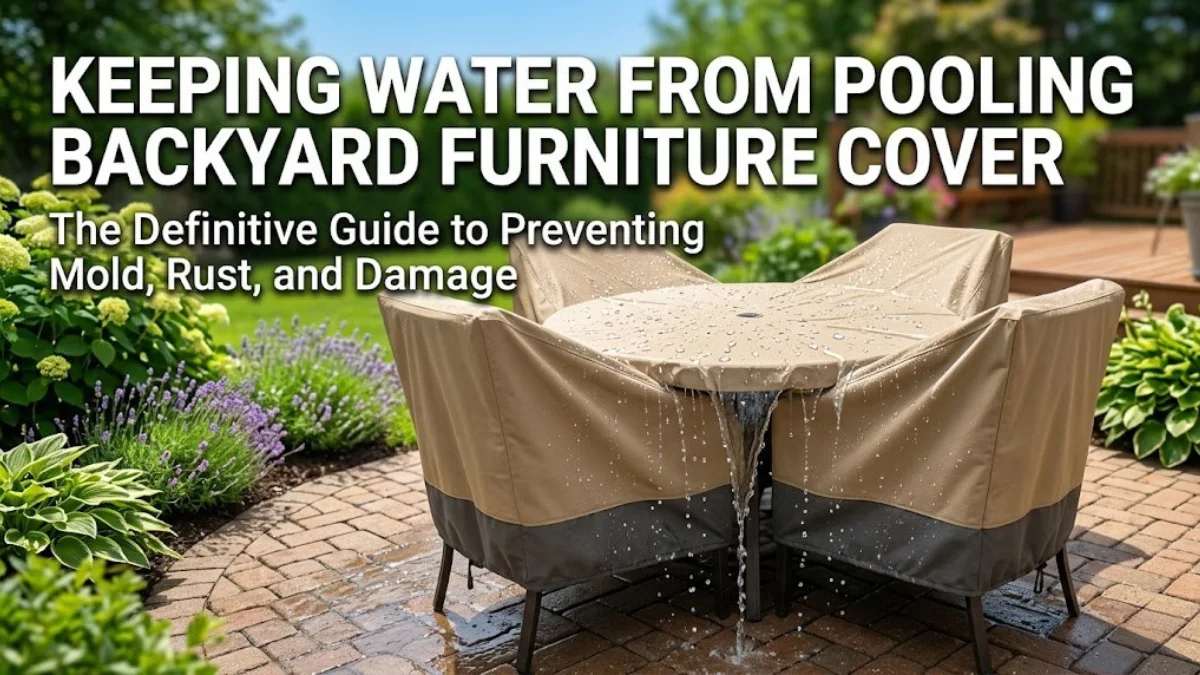
I’ve watched a beautiful teak dining set turn gray and spongy in a single rainy season. Not because the owners neglected it — they had covers on everything. The problem was that those covers were doing the opposite of protecting the furniture. Nobody had thought about keeping water from pooling backyard furniture cover, so water was sitting on top of them for days, slowly soaking through seams, warping wood, and turning fabric cushions into mildew sponges.
If you’ve ever peeled back a furniture cover after a storm and been hit with that damp, musty smell, you already know what I’m talking about. Keeping water from pooling backyard furniture cover is one of those maintenance habits that seems minor until you realize it’s the difference between outdoor furniture that lasts a decade and furniture you’re replacing every two or three years.
This guide covers exactly why pooling water is so destructive, and more importantly, what you can do about it — from practical support systems to material choices and seasonal routines that actually hold up over time.
Why Keeping Water From Pooling Backyard Furniture Cover Is More Important Than You Think
Water is patient. It doesn’t need to flood your patio set to cause serious damage — it just needs to sit still long enough.
Mold and Mildew: The Silent Destroyer Under Your Cover
When water pools on a furniture cover, it creates a consistently damp microenvironment directly above your furniture. According to the EPA, mold can begin growing on moist surfaces within 24 to 48 hours under the right conditions. A heavy cover trapping moisture against wood, fabric, or wicker is basically an ideal incubator.
The result? Cushions that smell like a basement. Wooden frames with black spots that don’t wipe off. Wicker that crumbles when you press it. Once mold or mildew sets into porous materials, it’s nearly impossible to fully remove without professional treatment or replacement.
Rust and Corrosion: What Happens When You’re Not Keeping Water From Pooling Backyard Furniture Cover
Most backyard furniture has at least some metal components — frame joints, bolts, hinges, or full aluminum and steel frames. When water pools on a cover and eventually seeps through, it settles exactly where metal parts connect, which are the spots most vulnerable to oxidation.
Even “rust-resistant” aluminum can develop oxidation pitting over time when exposed to prolonged moisture. Powder-coated steel holds up better, but once that coating chips — and it always does eventually — the exposed metal corrodes fast. Keeping water from pooling backyard furniture cover is a direct investment in protecting those structural components.
What Prolonged Moisture Does to Fabric and Cushions
Outdoor fabric is treated to resist water, but that treatment has limits. Repeated saturation weakens the fibers, fades UV-resistant coatings, and causes stitching to rot. Once a cushion absorbs enough water, it rarely dries out completely in its core — and that interior moisture never fully leaves, leading to persistent odor and eventually foam degradation.
The Core Problem: Why Keeping Water From Pooling Backyard Furniture Cover Is So Challenging
Before fixing the issue, it helps to understand what’s causing it.
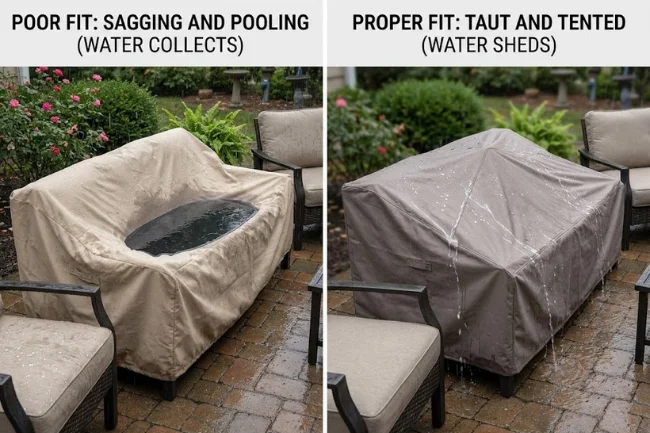
Most outdoor furniture has an irregular shape — chairs with curved backs, sofas with cushion indentations, and tables with recessed surfaces. When you drape a cover over these shapes, the fabric naturally dips and sags in the low spots. Every raindrop that lands on that cover migrates toward those low points and sits there.
A flat, taut surface would shed water naturally. A sagging cover acts like a shallow bowl.
The factors that make pooling worse include covers that are too large for the furniture (more sag), covers made from non-breathable materials (moisture gets trapped even without rain), and furniture positioned on flat ground with no elevation to promote runoff. Understanding these causes is half the battle when it comes to keeping water from pooling backyard furniture cover effectively.
Solution 1: Support Systems for Keeping Water From Pooling Backyard Furniture Cover
This is the single most effective fix for keeping water from pooling backyard furniture cover, and it works on every type of furniture regardless of size.
How a Cover Support System Works
A cover support system lifts the center of the cover, creating a slope — similar to how a tent works. Water hits the cover and flows outward and downward rather than pooling in the middle.
Commercial support poles are adjustable, weatherproof, and designed specifically for this purpose. Brands like Classic Accessories and KoverRoos offer versions compatible with most standard cover sizes. You simply place the pole under the center of the cover before putting it on, and the fabric tents over it.
DIY Alternatives That Actually Work
If you don’t want to buy a dedicated support pole, there are several household options that work reasonably well:
A large plastic storage bin or bucket placed upside down in the center of your table or seating area creates a high point the cover can drape over. A sturdy foam pool noodle bent into an arch and secured under the cover creates a ridge that sheds water to both sides. For L-shaped sectionals, multiple support points — one near each corner of the seating area — work better than a single central post.
The goal in every case is the same: eliminate flat or concave surfaces on the cover’s exterior.
Solution 2: Get the Right Cover Fit
An oversized cover is almost as problematic as no cover at all. When fabric has more surface area than the furniture beneath it, it folds and puddles on itself — creating multiple pooling zones instead of just one.
What to Measure Before You Buy
For table sets, measure the full diameter or length-by-width of the table plus chairs when stacked. For sofas and sectionals, measure total length, depth, and height. Most quality cover manufacturers provide detailed sizing charts, and many offer covers made to specific furniture lines.
Look for covers with elastic hems, drawstring closures, or adjustable buckle straps at the base. These features hold the bottom of the cover snug against the furniture frame, preventing wind from lifting it and water from pooling in folds at the sides.
Fitted vs. Oversized: How Cover Fit Affects Water Runoff
A properly fitted cover costs more upfront, but it will outlast a cheap generic by several seasons while actually doing its job.
Solution 3: Choosing the Right Material for Keeping Water From Pooling Backyard Furniture Cover
Not all outdoor covers are created equal, and the material determines how well the cover handles water.
Materials Worth Paying For
Solution-dyed polyester is one of the best options for outdoor covers. The color is embedded into the fiber rather than applied to the surface, which means UV fading is dramatically slower. High-denier solution-dyed polyester — look for 600D or above — resists water effectively while maintaining flexibility in cold temperatures.
PVC-coated fabrics offer nearly waterproof performance and are excellent for areas with heavy or extended rainfall. The tradeoff is breathability: fully sealed PVC can trap condensation underneath, especially during temperature swings. Look for covers that use PVC on the outer layer but incorporate a breathable inner lining.
Olefin (polypropylene) fabrics are naturally hydrophobic — water doesn’t absorb into the fiber at all, which makes them highly resistant to mildew. They’re also UV-stable and hold up well in direct sun.
What to Avoid
Thin polyester blends under 150D will absorb water rather than repel it. Any cover marketed as “water-resistant” without specifying material weight or coating should be approached with caution — that term is often applied to fabrics that merely slow water absorption rather than preventing it.
Solution 4: Elevate the Furniture Itself
Here’s a fix that complements everything else: raise the furniture slightly off the ground. Even a one-inch elevation on chair and table legs creates enough clearance that water running off a cover doesn’t pool underneath the legs and wick back up into the frame joints.
Small rubber furniture risers, outdoor-rated plastic feet, or even flat river stones work for this. The goal is to break contact between the cover’s drip line and the furniture base.
For furniture stored on a deck or patio, positioning pieces near the edge of the structure — where water naturally drains — is more effective than centering them on a flat surface where runoff has nowhere to go.
Solution 5: Don’t Forget About Ventilation
Pooling water gets most of the attention, but trapped humidity underneath a cover causes nearly as much damage — it just does it more slowly and invisibly. That’s why keeping water from pooling on your backyard furniture cover is only part of the solution; you also need airflow underneath.
Why Trapped Humidity Is Just as Damaging as Rain
When warm, humid air gets sealed under a furniture cover, it condenses on cool surfaces — especially metal joints and wooden legs — during temperature drops at night. This condensation is effectively the same as slow, repeated water exposure. Over a full season, it causes the same mold growth, rust formation, and fabric degradation as direct pooling.
What to Look for in a Well-Ventilated Cover
Quality covers incorporate mesh vent panels, usually positioned near the base on opposite sides to promote airflow. Some high-end covers use a layered construction — a waterproof outer layer, breathable middle membrane — that blocks rain while allowing water vapor to escape.
If your current cover has no ventilation, a simple workaround is to leave a small gap at one corner secured with a clip or bungee cord. It’s not perfect, but it allows some air exchange during dry periods.
Routine Maintenance: Keeping Water From Pooling Backyard Furniture Cover Season After Season
Even the best cover on the market degrades without basic upkeep. The good news is that this doesn’t require much time — maybe 20 minutes after a major storm and an hour or two at the start and end of each outdoor season.
After Every Storm: Inspect for Water Pooling on Backyard Furniture Cover
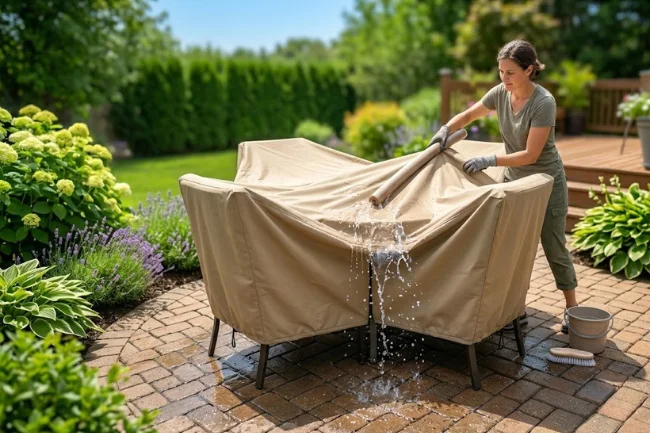
Walk the patio as soon as it’s safe after heavy rain. Shake off any pooled water — a pool noodle or broom handle works well for this without damaging the fabric. This small habit goes a long way toward keeping water from pooling backyard furniture cover between storms. Check whether the cover has shifted and whether the support system (if you’re using one) is still in position.
If the cover is saturated, remove it temporarily and allow it to dry fully before replacing. A wet cover left on furniture for days is counterproductive regardless of material quality.
Seasonal Habits That Extend Cover Life Long-Term
At the start of outdoor season, inspect covers for any tears, worn seams, or areas where the waterproof coating has become visibly worn (you’ll notice this as spots where water absorbs in rather than beads up). Small tears can be sealed with outdoor fabric repair tape; worn coatings can be refreshed with a spray-on waterproofing treatment like Nikwax Tech Wash or 303 Fabric Guard.
At the end of the season, clean covers thoroughly before storage. A mild soap solution and soft brush remove the biological material — pollen, bird droppings, algae — that accelerates fabric breakdown. Rinse completely and allow to fully dry before folding and storing in a dry location. Storing a damp cover accelerates the mildew growth it was designed to prevent.
Proper Cover Storage When the Season Ends
When you do bring covers inside for winter, how you store them matters. Folding a slightly damp cover and sealing it in a bag creates an ideal mold environment over several months of storage.
Always store covers loosely rolled rather than tightly folded — this prevents permanent crease lines that weaken fabric over time. A breathable storage bag or simply a clean shelf in a dry garage works better than a sealed plastic bin.
FAQs About Keeping Water From Pooling Backyard Furniture Cover
1. How Quickly Can Pooled Water Damage Outdoor Furniture?
In warm, humid conditions, mold growth can begin within 24 to 48 hours on saturated fabric or wood. Metal corrosion from prolonged moisture contact develops more slowly but becomes visible within a few weeks of repeated exposure. The damage timeline depends heavily on material — untreated wood and steel are most vulnerable, while aluminum and high-grade synthetic fabrics are more forgiving.
2. Is a Tarp a Good Substitute for a Fitted Furniture Cover?
A tarp provides basic rain protection but typically creates worse pooling problems than a properly fitted furniture cover because tarps are flat and have no structure. If you use a tarp, you still need a support system underneath it to create a slope, and you’ll need to secure it carefully to prevent wind from trapping moisture underneath.
3. What’s the Best Way to Remove Mold From an Outdoor Furniture Cover?
A solution of one cup of white vinegar per quart of water, applied with a soft brush, is effective for surface mold on most fabric covers. For heavier growth, diluted oxygen bleach (not chlorine bleach, which degrades fabric coatings) is more effective. Always test on a small hidden area first, rinse thoroughly, and dry completely in the sun before replacing the cover.
4. Should Furniture Covers Stay On During Winter?
In climates with heavy snowfall, covers should either be removed or checked frequently during winter. Heavy snow accumulation creates the same pooling problem as rain, and frozen water is far more damaging because it expands as it freezes. If covers stay on through winter, a rigid support system that can handle snow load is essential.
5. How Often Should I Reapply a Waterproofing Treatment?
For most covers, a waterproofing treatment like 303 Fabric Guard maintains effectiveness for one to two outdoor seasons with normal use. You’ll know it’s time to reapply when water no longer beads on the surface and instead spreads flat. Some manufacturers recommend reapplying at the start of each season, regardless, which is a reasonable precaution if your area gets significant rainfall.
Final Thoughts on Keeping Water From Pooling Backyard Furniture Cover
Outdoor furniture takes a beating. Sun, wind, temperature swings, and rain are relentless, and no cover eliminates all of that exposure. But keeping water from pooling backyard furniture cover is genuinely one of the highest-return habits you can build into your outdoor maintenance routine.
The framework is simple: create a slope so water runs off, choose materials that repel rather than absorb, ventilate to prevent trapped moisture, and inspect regularly enough to catch problems before they compound. None of this is expensive or time-consuming — and it protects an investment that, with proper care, should serve you comfortably for a decade or more.
If you’re ready to start, the first step is walking your patio after the next rain and checking where water collects on your current covers. That tells you exactly what problem you’re solving.
Sources:
- U.S. Environmental Protection Agency. Mold and Moisture. epa.gov/mold
- 303 Products. 303 Fabric Guard Product Guide. 303products.com
- Classic Accessories. Furniture Cover Sizing Guide. classicaccessories.com
- University of Minnesota Extension. Preventing Moisture Damage in Storage. extension.umn.edu

I’m Salman Khayam, the founder and editor of this blog, with 10 years of professional experience in Architecture, Interior Design, Home Improvement, and Real Estate. I provide expert advice and practical tips on a wide range of topics, including Solar Panel installation, Garage Solutions, Moving tips, as well as Cleaning and Pest Control, helping you create functional, stylish, and sustainable spaces that enhance your daily life.