
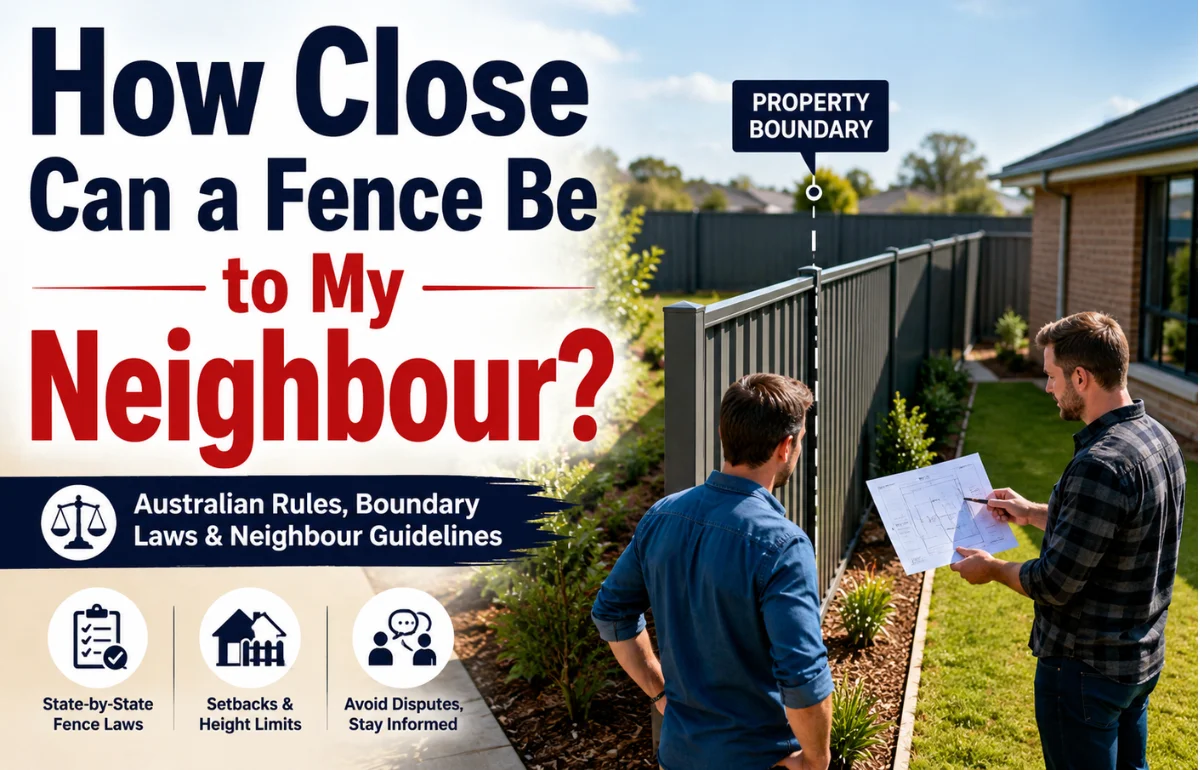
How close can a fence be to my neighbour? In Australia, there is no single national rule — the answer depends on your state or territory, your local council’s bylaws, and what’s stated in your property title documents.
As a general guide, most councils permit boundary fences to sit directly on the shared property line, but height restrictions, setback requirements for front yards, and specific land zones can all change what’s legally allowed.
If you’re planning to build or replace a fence, understanding these rules before you start will save you a painful dispute — and possibly a legal bill — down the track.
I’ve helped a number of homeowners in Australia work through boundary questions, and I can tell you from experience that most fence conflicts aren’t really about the fence itself. They’re about assumptions — one neighbour assumes the line is one place, the other assumes something different, and neither person checked the actual title documents.
This guide walks through what the rules genuinely say, where they differ across states, and how to handle the conversation with your neighbour before things get awkward.
Understanding Property Boundaries and How Close a Fence Can Be to Your Neighbour
Before anything else, you need to know where your boundary actually sits. Your property boundary is the legal line that separates your land from your neighbour’s. It’s recorded in your Certificate of Title, and in most states, you can access this through your state’s land titles office.
The boundary line is not the same as where an old fence happens to be. Fences drift over time — a post rots, someone replaces it two inches to the left, and decades later that small shift becomes a source of genuine confusion. If you’re in any doubt about where your boundary sits, commissioning a registered surveyor is the most reliable first step. It typically costs between $800 and $2,500 depending on your location and the complexity of the survey, but it’s almost always cheaper than a fence dispute that ends in VCAT or NCAT.
Once you know where your boundary is, you have a solid foundation for working out how close a fence can be to your neighbour — and for having that conversation with confidence.
How Close Can a Fence Be to My Neighbour’s Property Line?
Yes, in most Australian states, a fence can be built directly on the shared boundary line. This is actually the most common arrangement for residential properties. When a fence sits on the boundary, it’s considered a dividing fence — and that means both neighbours typically share the cost of installation and ongoing maintenance equally, as long as the fence meets the standard described in your state’s dividing fences legislation.
That said, there are situations where a fence cannot go right on the boundary, or where doing so requires additional approval:
- Front yard setbacks: Many councils restrict fence height in front yards — usually to 1.2 metres or less — and some prohibit solid fences close to the street altogether for sight-line safety reasons.
- Sloped land: On steep blocks, footings may need to extend into one property to support the fence structure, which requires the affected neighbour’s consent.
- Special zones: Properties in bushfire-prone areas, flood zones, or heritage overlays may have specific fence requirements that override standard council rules.
- Corner blocks: If your property sits on a corner, sight-line triangles near intersections usually restrict what you can build near the road boundary.
Understanding these exceptions is just as important as knowing the general rule, because they’re the situations most likely to create a dispute if overlooked.
How Close Can a Fence Be to My Neighbour? A State-by-State Breakdown
This is where things get genuinely complicated. How close a fence can be to your neighbour — and what height and style it can be — varies depending on which Australian state or territory you’re in. Here’s a plain-English breakdown of each jurisdiction.
How Close Can Fences Be to Neighbours in New South Wales?
NSW is governed by the Dividing Fences Act 1991. Neighbours share the cost of a sufficient dividing fence, and the fence can be built on the common boundary. Before building, you must serve a Fencing Notice on your neighbour, giving them at least 21 days to respond. If they don’t agree within that period, you can apply to the NSW Civil and Administrative Tribunal (NCAT) for a resolution.
Height limits vary by local council. In most residential zones, rear and side boundary fences are permitted up to 1.8 metres without development approval. Front fences typically face tighter limits — often around 1.2 metres.
How Close Can a Fence Be to a Neighbour’s Property in Victoria?
Victoria’s Fences Act 1968 (substantially amended in 2014) is one of the more detailed frameworks in the country. Neighbours must share the cost of a sufficient fence, and a Fencing Notice must be served before work begins. The notice must include a description of the proposed fence, the location of the boundary, and a quote from a fencing contractor.
In most of metropolitan Melbourne, a standard timber paling fence of 1.8 metres on a rear or side boundary is considered a “sufficient fence” and generally does not require a planning permit. Anything higher, or any fence in a heritage overlay, often requires council approval.
Queensland: Fence Proximity and Neighbour Rules
Queensland operates under the Neighbourhood Disputes (Dividing Fences and Trees) Act 2011. The Act requires neighbours to contribute equally to a sufficient fence and mandates that a Fencing Notice be served at least 30 days before construction. If a neighbour fails to respond or disputes the proposal, the matter goes to the Queensland Civil and Administrative Tribunal (QCAT).
Height limits vary by local government area, but the common residential standard is 1.8 metres for side and rear fences. Front fences are often restricted to around 1.2 metres, depending on whether your property is in a suburban or character zone.
South Australia
South Australia uses the Fences Act 1975, which similarly requires shared contributions and pre-work notice. Councils in SA apply their own Development Plan rules on top of the state legislation. In most residential areas, a 1.8-metre side or rear fence is compliant without additional permits. Front fences may be restricted further depending on whether your home is in a designated character area.
Western Australia
WA follows the Dividing Fences Act 1961, along with local government bylaws. Western Australia is notable for a relatively high level of variation between local councils — what’s allowed in the City of Perth may differ materially from a regional shire. Always check with your specific council before starting any fence work, particularly if you’re asking how close a fence can be to your neighbour on a narrow suburban block.
Tasmania, ACT, and Northern Territory
Each of these jurisdictions has its own dividing fences framework, and they broadly follow the same pattern: shared cost, pre-construction notice, and council-specific height rules. The ACT’s Tree Protection Act 2005 also intersects with fence placement when trees are involved near a shared boundary.
Comparison Table: How Close Can a Fence Be to a Neighbour Across Australia?
What If Your Neighbour Wants to Build Closer Than You’re Comfortable With?
This comes up more often than you’d expect. Knowing how close a fence can be to your neighbour in legal terms is one thing — but what if the proposed placement feels too close for practical or safety reasons?
Australian law generally permits a neighbour to build a fence on the boundary without your agreement on the style or materials, as long as it meets the legal standard for a “sufficient fence” in your area. That said, there are legitimate grounds on which you can object or negotiate:
Safety hazards. If the proposed fence position would block emergency access to a door or window, create a dangerous sight-line issue near a driveway, or interfere with fire safety access, these are valid grounds for raising a formal objection with your local council.
Encroachment. If your neighbour’s fence is actually being built on your side of the boundary — even by a small amount — that’s an encroachment. You have the right to require its removal or relocation. This is another reason a surveyor’s report is so valuable before any work starts.
Heritage and easement restrictions. If your property has an easement (for drainage, utilities, or access), a fence cannot be built in a way that blocks that easement. Check your title documents and contact your local council to confirm whether any easements apply.
Exceeding council height limits. If your neighbour wants to build a fence taller than what the local planning scheme allows, they need a planning permit — and you have the right to object to that application during the public comment period.
The Fencing Notice: A Step Most Homeowners Skip
I want to spend a moment on fencing notices because they’re frequently overlooked, and that oversight causes a lot of unnecessary problems. Across every Australian state, you are legally required to give your neighbour formal written notice before building, replacing, or significantly repairing a dividing fence. This isn’t just a courtesy — it’s a legal requirement, and fences built without proper notice can create complications if you later need to enforce cost-sharing or resolve a dispute.
A proper fencing notice should include:
- A description of the proposed fence (material, height, style)
- The location of the proposed boundary line
- A quote or cost estimate from a licensed fencing contractor
- A proposed construction timeline
Once served, your neighbour has a set period (21–30 days, depending on your state) to respond. If they agree, you can proceed and share the cost. If they object, the dispute goes to your state’s civil tribunal. If they simply don’t respond within the deadline, most states allow you to proceed with the fence and recover half the cost through the tribunal later.
If you’re keen to understand more about the process before engaging a professional, exploring quality DIY learning programs can help you build the foundational knowledge to have an informed conversation with both your neighbour and your fencing contractor.
Talking to Your Neighbour: The Step That Saves Everyone Time
No legislation replaces a decent conversation. In my experience, the homeowners who handle fence situations most smoothly are the ones who knock on the door and talk things through before any notices are served or contractors are engaged. It sets a collaborative tone and often surfaces concerns that can be addressed simply — a different fence style that suits both parties, a shared preference for a particular material, or an agreement about who manages the project.
When you have that conversation, go in with specific information. Know where the boundary sits, have an idea of what fence you’re proposing, and have a rough sense of cost. If you can show your neighbour a specific quote and a clear map of the boundary, it tends to move things along much faster than vague discussions about how close a fence can be to your neighbour’s side of the property.
When Disputes Go Further: Your Options
Despite best efforts, some fence disputes do escalate. Common triggers include:
- A neighbour who refuses to contribute to the cost of replacing an existing fence that’s fallen into disrepair
- Disagreement over what constitutes a “sufficient fence” in your area
- A new fence that one neighbour claims encroaches on their land
- Trees or roots from one property interfering with an existing fence
In these cases, your state’s civil tribunal is the appropriate venue. Applications are typically straightforward, filing fees are modest (usually $50–$100), and most hearings are resolved without legal representation. The tribunal can order one or both neighbours to contribute to fence costs, require a fence to be relocated, or direct repair works to be carried out.
If you’re planning significant changes to your property and want to understand how boundary and fencing questions fit into a broader upgrade strategy, our home upgrade services are a good starting point for mapping out what’s involved.
How Close Can Pool Fencing Be to a Neighbour’s Boundary?
If your fence is also a pool barrier — which is common for properties where the pool sits close to a boundary — the rules around how close a fence can be to your neighbour change significantly. Pool fencing in Australia is governed by the Building Code of Australia and state-specific pool safety legislation, which takes precedence over standard dividing fence rules.
Pool barriers must generally be at least 1.2 metres high, have no climbable elements within 900mm of the top, and meet strict requirements around gate latches and self-closing mechanisms. These requirements apply regardless of where the fence sits relative to the property boundary, and compliance is checked by a licensed pool safety inspector. A fence that satisfies your council’s standard fence rules may still fail a pool safety inspection if it doesn’t meet barrier-specific requirements — so it’s worth confirming both sets of rules before you build.
Conclusion
The answer to how close can a fence be to my neighbour is: right on the boundary line in most cases, but only if you’ve confirmed the boundary, followed the correct notice process, and checked your local council’s height and zone requirements. There’s no shortcut around those steps, and the homeowners who skip them are the ones who end up in tribunals or paying out of pocket for fences to be moved.
Start with your Certificate of Title and your council’s planning portal. Talk to your neighbour early and with good information in hand. Serve a proper fencing notice before anything is built. And if things stall, your state’s civil tribunal is a straightforward and affordable path to a resolution. Get the groundwork right, and the fence itself is the easy part.
Frequently Asked Questions
How close can a fence be to my neighbour’s house in Australia?
There is no fixed national minimum distance — in most states, a dividing fence can sit directly on the shared property boundary, though local council rules may impose setbacks in specific zones or for front fences facing a road.
Can my neighbour build a fence right on our shared boundary without asking me?
Your neighbour can build a fence on the boundary line, but they are legally required to serve you a formal Fencing Notice first and give you 21–30 days to respond, depending on your state.
What is the legal fence height between neighbours in Australia?
In most Australian states, a standard dividing fence on a rear or side boundary can be up to 1.8 metres without a planning permit, while front fences near roads are typically limited to around 1.2 metres — but this varies by local council.
Who is responsible for paying for a fence between neighbours?
Under Australian dividing fences legislation, neighbours share the cost equally for a sufficient dividing fence, unless one party has caused damage or a written agreement specifies a different arrangement.
Do I need council approval to build a fence next to my neighbour’s property?
In most residential situations, a standard 1.8-metre Colorbond or timber fence on a side or rear boundary does not require council approval, but fences in heritage zones, bushfire areas, or front yards facing roads often do — always check with your local council before starting work.
Other Resources
- Do I Need Approval for a Deck? Australia Rules Explained
- Can I Build a Granny Flat on My Property? Complete Guide
- Do I Need Approval for a Carport? Rules & Permits Guide

I’m Salman Khayam, the founder and editor of this blog, with 10 years of professional experience in Architecture, Interior Design, Home Improvement, and Real Estate. I provide expert advice and practical tips on a wide range of topics, including Solar Panel installation, Garage Solutions, Moving tips, as well as Cleaning and Pest Control, helping you create functional, stylish, and sustainable spaces that enhance your daily life.