
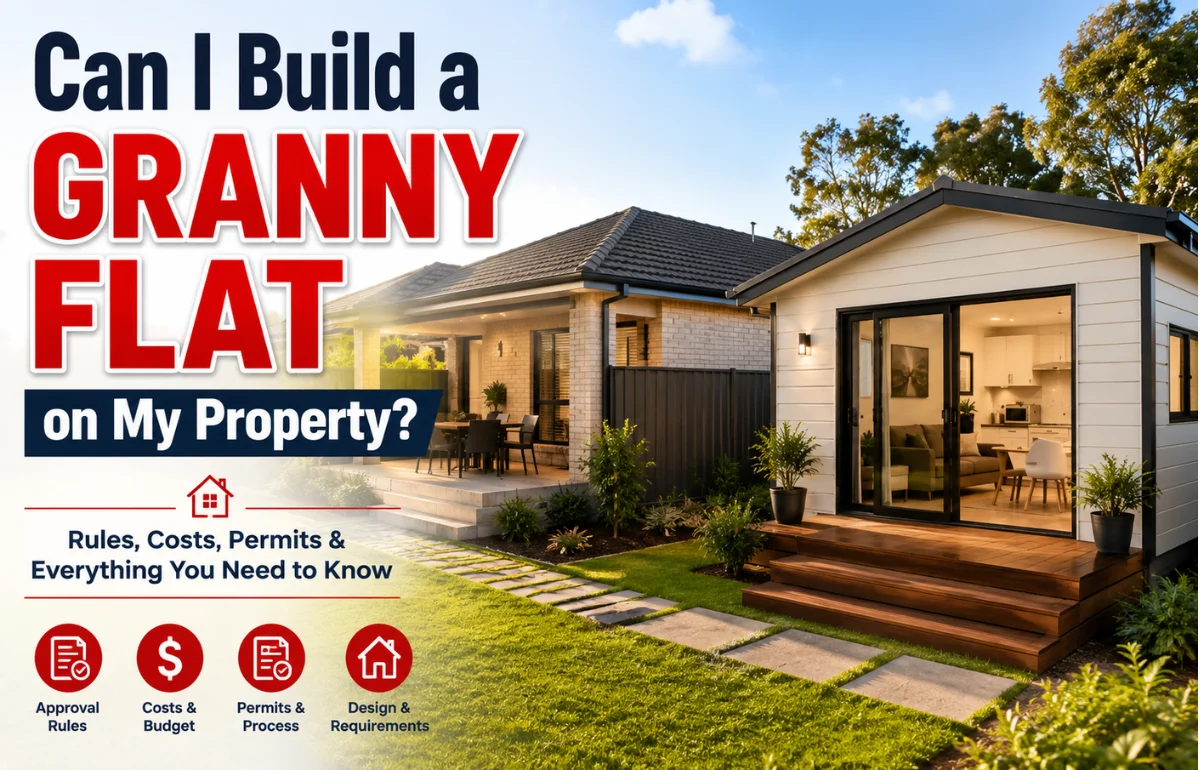
Yes — in most cases, you can build a granny flat on your property in Australia, but whether you’ll need council approval, how large it can be, and what rules apply depend heavily on which state or territory you’re in, your block size, and your local council’s specific planning controls.
A granny flat is a self-contained secondary dwelling on the same lot as your main home, complete with its own kitchen, bathroom, and living space. It’s separate from a studio or sleep-out, which typically lacks those self-contained features.
The question “can I build a granny flat on my property?” is one I hear from homeowners constantly — and the honest answer is: probably yes, but the path to getting there varies more than most people expect.
What Exactly Is a Granny Flat — and Can You Build One on Your Property?
Before you start sketching floor plans, it helps to understand what the term actually means in a legal and planning sense. One of the first things I tell people who ask, “Can I build a granny flat on my property?” is that the definition itself changes depending on which state you’re in — and that matters more than most homeowners realise.
In New South Wales, the State Environmental Planning Policy (Housing) 2021 defines a secondary dwelling (the official term) as a self-contained dwelling established in conjunction with another dwelling on the same lot. Victoria uses the term “dependent person’s unit” in some contexts, while Queensland refers to them as “auxiliary units.” South Australia calls them “ancillary accommodation.”
The terminology matters because it determines which planning pathway applies to your project and what exemptions — if any — you can access.
In practice, most Australians understand a granny flat as a compact, fully independent living unit of roughly 40–80 square metres, located either attached to or detached from the main home. It can house an elderly parent, an adult child, a tenant generating rental income, or even a short-stay guest through platforms like Airbnb.
State-by-State Rules: Where Can You Build a Granny Flat on Your Property?
This is where things get genuinely complicated, and where I’ve seen homeowners make the most expensive mistakes. Rather than assuming the rules are the same across the country, treat each state as its own planning environment.
New South Wales
NSW has arguably the most streamlined process in Australia for anyone looking to build a granny flat on their property. Under the Housing SEPP, you can build a granny flat of up to 60 square metres on a residential lot of at least 450 square metres without needing a full development application (DA), provided you meet a set of complying development criteria. You’ll still need a Complying Development Certificate (CDC) from a private certifier or council, but this is significantly faster than a DA — often approved within 20 days.
Key requirements in NSW include a minimum lot size of 450 m², a maximum internal floor area of 60 m², and specific setback rules from boundaries and the primary dwelling. Flood-prone land, heritage areas, and certain bushfire zones can disqualify a property from the complying development pathway, pushing it back into a full DA process.
Victoria
Victoria’s approach is more fragmented. There is no state-wide equivalent to NSW’s Housing SEPP that streamlines granny flat approvals. Instead, you’re largely subject to your local council’s planning scheme. Some councils are relatively progressive and allow secondary dwellings in residential zones fairly readily; others are restrictive.
Victoria also distinguishes between a “dependent person’s unit” (a temporary, relocatable structure for a dependent) and a permanent secondary dwelling. If you want something permanent and fully self-contained, you’ll almost certainly need a planning permit in most Victorian councils, and the process can take several months.
Queensland
Queensland underwent significant planning reforms in 2023 and 2024 to make secondary dwelling approvals easier. In many residential zones across Queensland, a secondary dwelling of up to 80 square metres can now be built as accepted development — meaning no development application is required — provided you meet the Queensland Development Code’s requirements around setbacks, building height, and lot coverage.
The 80 m² figure is notably more generous than NSW’s 60 m², giving Queensland homeowners a little more room to design something functional. You’ll still need building approval through a private certifier or council’s building department, but the planning hurdle is removed for compliant builds.
South Australia
In SA, ancillary accommodation is permitted in most residential zones, but it must be ancillary to the main dwelling — meaning it can’t be separately leased in most cases. This is a crucial distinction if your goal is to generate rental income. SA’s planning policies also require that the secondary dwelling be smaller than the primary home and that only one family occupies the combined lot.
Western Australia
WA allows “ancillary dwellings” up to 70 square metres on lots of 350 m² or more in residential zones, under the Residential Design Codes (R-Codes). This is one of the more permissive lot size thresholds in the country. However, the ancillary dwelling must be visually connected to the primary home through shared design elements, and there are restrictions on separately renting both dwellings simultaneously in some local government areas.
The Key Factors That Determine If You Can Build a Granny Flat on Your Property
Regardless of which state you’re in, the same core factors come up when any homeowner or planner assesses a secondary dwelling project.
Lot Size and Zone
Nearly every state has a minimum lot size below which a secondary dwelling simply won’t be approved. In NSW, that’s 450 m², in WA it’s 350 m², and in Queensland, it varies by zone. If your block is smaller than the threshold, your options are limited — though some councils have made exceptions for lots in urban infill areas.
Your zoning also matters. A property in a residential zone will typically be eligible; properties in rural residential, environmental protection, or heritage zones may face outright restrictions or complex overlays.
Setbacks and Site Coverage
Even if your lot is large enough, the actual buildable area may be constrained by setback requirements (how far the structure must sit from boundaries and the primary dwelling) and maximum site coverage rules (what percentage of the lot can be covered by structures). I’ve spoken to homeowners who had plenty of land in terms of total area but couldn’t fit a granny flat because the remaining open space requirements left no viable footprint.
Sewerage and Utilities
A self-contained granny flat requires connection to water and sewerage — either mains services or an approved on-site system. In urban areas, this is usually straightforward. In semi-rural locations, you may need an additional connection point, upgraded septic capacity, or even a new wastewater system, which can add high cost to the project.
Existing Structures on the Property
If there’s already an approved secondary dwelling, studio, or sleep-out on the property, adding another may not be permissible under your state’s planning rules. Most states allow only one secondary dwelling per lot in residential zones.
Approval Pathways for Building a Granny Flat on Your Property
Understanding the difference between building approval and planning approval is something a lot of homeowners get confused about — and conflating the two can lead to costly delays.
Planning approval (a DA or planning permit) addresses whether the proposed use and development is appropriate for the location under the planning scheme. Building approval (a CDC, building permit, or construction certificate) addresses whether the structure itself complies with the National Construction Code (NCC) and Australian Standards.
For complying development in NSW or accepted development in Queensland, you bypass the planning approval stage entirely and move straight to building approval. Everywhere else — particularly in Victoria and SA — you often need both.
Approval pathway comparison by state:
Note: Timeframes are estimates and depend on council workload and project complexity.
What Does It Actually Cost to Build a Granny Flat in Australia?
Cost is where expectations and reality often diverge significantly when you set out to build a granny flat on your property, and I want to give you a realistic picture rather than a marketing-friendly one.
A basic prefabricated or modular granny flat — the type that arrives partly assembled and is craned into position — typically starts around $80,000–$120,000 for a one-bedroom unit. A custom-built, architect-designed secondary dwelling can range from $180,000 to $350,000 or more, depending on size, finishes, and site conditions.
On top of the build cost, you should budget for:
- Architectural or draftsperson fees: $3,000–$15,000
- Certification and approval fees: $2,000–$8,000
- Site preparation and foundation work: $5,000–$30,000 (highly variable)
- Utility connection costs: $3,000–$15,000
- Landscaping and fencing to comply with setback or privacy requirements: $2,000–$10,000
A realistic total for a compliant, liveable one-bedroom granny flat in a metro area of Australia is $120,000–$200,000 all-in. Two-bedroom builds typically start closer to $180,000.
From a return-on-investment perspective, rental yields on secondary dwellings in Sydney, Melbourne, and Brisbane are strong. A one-bedroom granny flat in Western Sydney, for example, commonly rents for $380–$550 per week — meaning the build cost can be recovered in as little as five to eight years in a high-demand area.
Common Mistakes When You Build a Granny Flat on Your Property
Having guided many people through the question of whether they can build a granny flat on their property, a few patterns emerge again and again.
Assuming state rules apply uniformly within that state. Local councils can add layers of restriction on top of state planning policies. Just because secondary dwellings are generally permitted in your state doesn’t mean your specific council hasn’t added overlays that restrict them further.
Skipping the pre-application consultation. Most councils offer a pre-DA or pre-application meeting for a modest fee. This hour of time can save months of rework by flagging issues before you’ve paid for full architectural drawings.
Not checking the title for covenants or easements. Some property titles — particularly in older subdivisions or estates — carry restrictive covenants that limit what can be built. These are private legal agreements that sit outside the planning system and can prohibit secondary dwellings entirely.
Underestimating site works. Sloped sites, clay soils, flood overlays, and tree protection zones can dramatically inflate the cost of foundation and earthworks. Always get a geotechnical report and survey before finalising your budget.
Renting Out Your Granny Flat: What You Need to Know
If your goal is to generate rental income, a granny flat is one of the most practical ways to do it without subdividing your land. However, there are a few things to be clear about.
In NSW and QLD, granny flats can be rented to any tenant — they don’t need to be a family member. In SA, this is where the restrictions bite hardest: “ancillary accommodation” in SA is traditionally required to house a person with a dependency connection to the main household, though reforms have gradually relaxed this.
From a tax perspective, if you rent out your granny flat, that portion of your property is used for income-producing purposes. You can claim deductions on construction costs, interest, maintenance, and depreciation, but you’ll also face capital gains tax implications on that proportion of the property when you eventually sell. Getting advice from a tax professional familiar with property investment is worth the cost.
Short-term rental through Airbnb or Stayz is permissible in many areas but may require separate registration with your state government — NSW, for instance, introduced a statewide short-term rental accommodation framework that requires all listings to be registered.
Design Considerations Worth Thinking About Early
Once you’ve confirmed you can build a granny flat on your property and you’re moving into the design phase, a few decisions made early will save considerable time and money later.
Privacy between dwellings. Windows on the secondary dwelling should be positioned so they don’t look directly into the main home’s living areas or private outdoor spaces. Most planners will require this as part of the approval, but it’s worth thinking about from day one.
Separate entrance. Even if the granny flat is physically attached, having a clearly separate entrance gives the occupant genuine independence — which matters whether they’re a tenant or an elderly parent.
Universal design features. If the flat is intended for an older family member, designing it to be accessible from the outset — wider doorways, no step at the threshold, a roll-in shower — is far cheaper than retrofitting later.
Energy efficiency. Australia’s NCC now requires secondary dwellings to meet a minimum 7-star NatHERS energy rating in most states. Exceeding this baseline reduces ongoing running costs and adds appeal to future tenants.
For homeowners who want to understand these design decisions more deeply before committing to a builder, exploring home improvement courses can provide a practical foundation in what to look for and how to communicate effectively with designers and certifiers.
Should You Use a Builder, an Owner-Builder Permit, or a Modular Home?
There are three broad ways to deliver a granny flat project, and each has trade-offs.
A registered builder managing the full project gives you consumer protection under your state’s home warranty insurance scheme (in states that offer it), a clear contract, and a single point of accountability. It’s typically the most expensive option but also the most straightforward from a legal and insurance standpoint.
An owner-builder permit allows you to manage the construction yourself, which can reduce labour costs. However, in most states, owner-builder projects are excluded from residential warranty insurance, which affects your ability to sell the property for up to seven years after completion. The administrative burden is also real — you’re responsible for coordinating trades, managing compliance, and keeping records.
A modular or prefabricated granny flat sits somewhere in between. The structure is built in a factory and delivered to the site — often reducing construction time and on-site disruption considerably. Quality varies significantly between manufacturers, so due diligence on warranty, certifications, and past projects is essential.
If you’re not sure which path fits your situation, it’s worth getting proper guidance from professional home improvement services before committing to either a builder or a prefab supplier.
FAQs
Can I build a granny flat on my property without council approval?
In NSW and Queensland, you can build a complying secondary dwelling without a full DA, using a faster certification pathway — but you’ll still need a CDC or building approval. You can’t legally build without some form of approval.
Does a granny flat add value to my property?
Yes, in most cases. A well-designed, council-approved secondary dwelling can add significant market value and increase rental yield, with many valuers treating it as a significant income-producing asset.
Can I rent out my granny flat to anyone in Australia?
In NSW and Queensland, yes — granny flats can be rented to any tenant. In South Australia, restrictions traditionally require an occupant with a dependency connection to the main household, though this is changing.
How long does it take to get approval for a granny flat?
Approval timeframes range from two to six weeks in NSW under the CDC pathway, up to three to six months in Victoria, where a full planning permit is typically required.
Do I need to subdivide my land to build a granny flat?
No. A secondary dwelling is built on the same title as your primary home — no subdivision is necessary. If you subdivide, the secondary dwelling would become a separate property under a different title, and different planning rules would apply.
Where to Go From Here
If you’ve read through this and you’re thinking “yes, this is something I want to pursue,” the next practical step is a site-specific assessment — not a builder quote. Before you spend money on architectural drawings or talk to a modular home company, you need to understand what’s actually permissible on your specific lot under your council’s rules.
Start by contacting your local council’s duty planner for a quick preliminary check. Get a copy of your property’s zoning certificate (a Section 10.7 certificate in NSW, for example) and look at what overlays, covenants, or easements may affect your site. Then engage a certifier or town planner for a pre-application consultation.
Building a granny flat on your property is one of the most rewarding projects an Australian homeowner can undertake — it’s practical, financially sound, and adds genuine flexibility to how your household operates over time. But it rewards people who do their homework first.
Other Resources
- Do I Need Approval for a Carport? Rules & Permits Guide
- Can I Build a Shed Without Council Approval? Guide

I’m Salman Khayam, the founder and editor of this blog, with 10 years of professional experience in Architecture, Interior Design, Home Improvement, and Real Estate. I provide expert advice and practical tips on a wide range of topics, including Solar Panel installation, Garage Solutions, Moving tips, as well as Cleaning and Pest Control, helping you create functional, stylish, and sustainable spaces that enhance your daily life.