
The cost to build a shed in Australia typically ranges from $4,000 for a small kit garden shed to over $50,000 for a large custom-engineered farm or industrial shed, with most homeowners spending somewhere between $8,000 and $25,000 for a mid-sized garage or workshop shed installed on a concrete slab. The final figure depends on shed size, materials, site conditions, council permits, and whether you go with a basic kit or a fully managed custom build.
I’ve spent a fair bit of time pulling apart quotes from shed builders around the country, and the one thing I can tell you upfront is that the advertised “from” price you see on most websites is rarely the number you’ll actually pay once everything is accounted for.
I want to walk you through this properly, the way I wish someone had walked me through it the first time I priced out a shed for my own backyard. No fluff, no vague ranges pulled from nowhere, just a clear picture of where your money goes and why two sheds that look identical in a brochure photo can cost $10,000 apart.
Why Shed Pricing in Australia Is So Inconsistent
If you’ve spent any time searching for shed prices, you’ve probably noticed the numbers don’t line up. One site quotes garages from $7,530. Another says a mid-size workshop runs $9,000 to $14,000. A third tells you a basic shed costs as little as $500. None of these figures is wrong, exactly. They’re just answering different questions.
The $7,530 figure is usually a bare steel kit, no slab, no installation, no doors fitted, sometimes not even delivery. The $9,000 to $14,000 figure usually includes labour and a basic concrete base. The $500 figure is talking about a small plastic storage shed you’d buy flat-packed from a hardware store, not something you’d park a car in or use as a workshop.
This is the first thing I’d tell anyone starting this process: ask exactly what’s included before you compare two quotes side by side. A kit-only price and an installed price are not the same product, even if the steel itself is identical.
What Actually Determines the Cost to Build a Shed in Australia
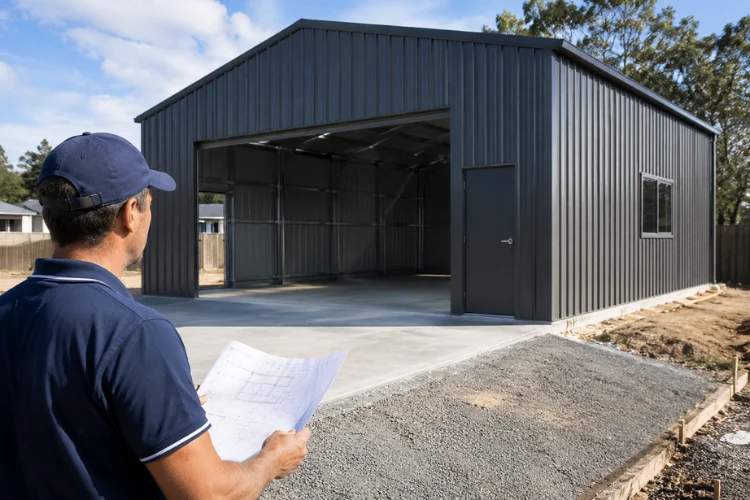
I’ve broken this down into the variables that move the price the most, based on patterns I’ve seen across quotes from both small backyard builders and the larger national shed companies.
Shed Size and Span
This is the obvious one, but it’s worth being specific about it. A small 3×3 metre garden shed sits at the bottom of the market, generally between $4,000 and $7,000 once installed with a basic slab. Step up to a 6×6 metre workshop or double garage, and you’re looking at roughly $9,000 to $14,000. Move into farm shed or large garage territory at 9×12 metres or beyond, and costs climb to $20,000 to $35,000, sometimes well past that once you add engineering for wider clear spans.
Width matters more than length in terms of cost per square metre. A shed that needs to span 12 metres without internal posts requires heavier portal frames and more steel than a narrower shed of the same floor area, so two sheds with identical square metreage can have noticeably different price tags depending on how that area is shaped.
Roof Type and Pitch
A simple gable roof is the cheapest option you’ll find, and it’s cheap for a good reason: it’s structurally straightforward and uses standard trusses. Skillion roofs (a single sloped roof) are also relatively affordable and popular for garages and lean-to style sheds. Once you start asking for custom rooflines, multiple gables, or steeper pitches for snow loads in places like the Victorian high country or Tasmania, you’re adding both material and labour cost.
Open vs Enclosed Walls
This is one of the biggest cost swings I’ve seen in shed pricing, and it’s not always obvious from a quick browse. A roof-only structure, like an open-sided hay shed or a carport, might cost from $150 per square metre. Fully enclose that same footprint with steel walls and doors, and you’re often looking at $250 per square metre or more. Add concrete block walls instead of steel sheeting, and pricing can jump again, sometimes past $550 per square metre for industrial or grain storage builds that need that extra rigidity.
Materials: Colorbond, Zincalume, and Beyond
Material choice affects both upfront cost and how much you’ll spend down the track. Here’s how the common options compare.
Colorbond costs more than Zincalume, but it gives you colour options and slightly better thermal performance, which matters if you’re planning to spend real time inside the shed rather than just storing the mower in it. Zincalume tends to be the value pick for purely functional farm and machinery sheds where nobody’s worried about the colour matching the house.
Site Preparation and the Concrete Slab
This is the cost that catches people out the most, in my experience. A shed kit price almost never includes the slab, and the slab is not cheap. Concrete slabs typically run $70 to $100 per square metre, and if your site needs cutting, levelling, or drainage work because it’s sloped or has poor soil, you can add several thousand dollars on top of that just to get a flat, compliant base ready.
If you’re building on flat, already-cleared land, you’ll pay considerably less than someone working with a sloped block that needs retaining or significant earthworks. I’d genuinely recommend getting a site assessment before you fall in love with a particular shed design, because the site often costs more to prepare than the shed costs to buy.
Labour and Installation
If you’ve got a slab already down and you’re just paying for assembly, labour for a standard shed installation generally sits between $1,200 and $2,500. If the installer also needs to handle the slab and footings as part of the job, that combined labour cost often climbs to $3,000 or more, on top of the concrete materials themselves.
DIY kits exist specifically to avoid this cost, and they can work well if you’re handy and have help for the heavier lifting. But I’d flag that most kit sheds assume a level of construction confidence that not everyone actually has, and a botched DIY install can end up costing more to fix than it would have cost to hire a professional in the first place.
Council Permits
This is the part of shed budgeting that gets skipped most often in online guides, and it shouldn’t be. In Victoria, for example, most sheds over 10 square metres, or those built close to a property boundary, need a building permit, and that permit typically costs between $500 and $2,000. If your block sits in a bushfire-prone area, a floodplain, or carries a heritage overlay, you can expect additional costs for engineering reports and consultant documentation, and the permit process itself takes longer.
Rules vary by state and by council, so the smartest move is checking your local council’s planning portal before you commit to a size or position for your shed. I’ve seen people design an entire shed around a particular footprint only to find out it triggers permit requirements they hadn’t budgeted for, which then changes the whole financial picture.
Add-Ons That Quietly Increase the Total
Roller doors, personal access doors, insulation, mezzanine flooring, internal walls, electrical wiring, skylights, and ventilation systems all sit outside the base shed price. None of these are essential, but most people end up wanting at least two or three of them once they start picturing how they’ll actually use the space. My advice is to list out everything you think you might want before you get a quote, even the things you’re only half-considering, because retrofitting insulation or wiring after the shed is up costs more than including it in the original build.
Kit Shed vs Custom Build: Which One Actually Saves You Money
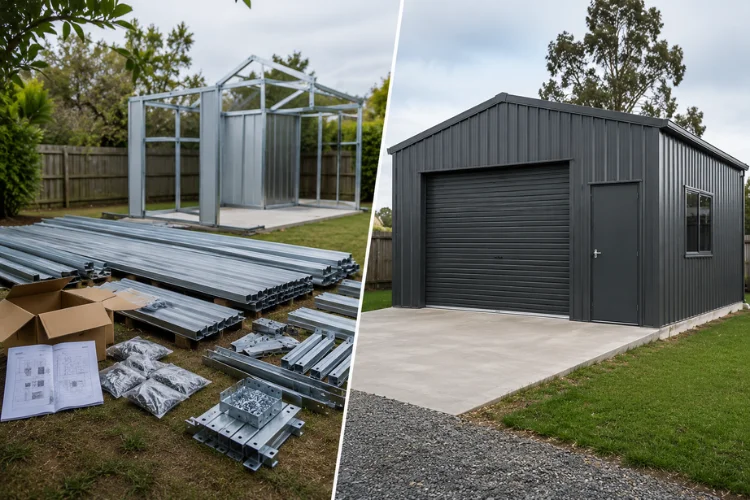
This is a genuine fork in the road, and the answer depends on your circumstances more than most articles let on.
A kit shed is cheaper on paper. You’re buying the steel components, sometimes with basic instructions, and you handle the slab, permits, and installation yourself or hire separate tradespeople for each piece. This suits confident DIYers, rural properties where labour is harder to source anyway, and anyone who genuinely enjoys managing a project themselves.
A custom or fully managed build costs more upfront because the price includes site visits, design, permit lodgement, materials, the slab, and installation as one package. What you’re paying for here is certainty. There’s no surprise bill for a permit you didn’t know you needed, no mismatch between the slab a separate concreter poured and the shed dimensions you ordered, and no gap in the schedule where you’re waiting on three different tradespeople to coordinate around each other.
In my experience watching people go through both paths, the kit option only ends up cheaper if you already have most of the skills and aren’t paying anyone for labour. The moment you start hiring out the concrete work, the permit paperwork, and the installation separately, the cost gap between “kit plus hired help” and “fully managed custom build” narrows a lot faster than people expect, and sometimes disappears altogether.
A Realistic Cost Breakdown by Shed Type
Pulling together everything above, here’s roughly what Australian homeowners and property owners are paying in 2026 for fully installed sheds, including a basic slab and standard installation.
These figures move depending on your state, your site conditions, and how heavily you customise the build, but they give you a defensible starting point for budgeting rather than a guess.
Hidden Costs People Forget to Budget For
A few things I’ve noticed get left out of people’s mental budget more often than they should be:
Site access matters more than most people think. If a crane or heavy delivery truck can’t get close to your build site, you may need to pay for additional handling or a longer installation process, particularly for larger farm sheds delivered as pre-fabricated frames.
Stormwater and drainage compliance can add cost in urban and semi-rural areas where councils require you to manage runoff from a new roof structure rather than letting it pool on a neighbouring property.
Electrical and plumbing fit-outs, if you’re planning to use the shed as a workspace, home gym, or studio, typically add $1,500 to $3,000, depending on how much wiring and how many outlets or fixtures you need.
Insurance adjustments are easy to overlook. A new structure on your property, especially one used for vehicles, tools, or business purposes, usually needs to be added to your home and contents policy, and it’s worth getting a quote for that before the shed goes up rather than after.
Should You Build or Buy a Pre-Fabricated Shed
Buying a pre-fabricated kit shed tends to be the more cost-effective route for smaller, simpler structures, largely because manufacturers buy steel and components in bulk and pass some of that saving on. Building from scratch with custom-sourced materials gives you more design freedom but usually costs more once you account for individual material purchases and the labour to assemble something non-standard.
For most homeowners, the practical answer sits in the middle: a kit shed with a custom slab and a few selected add-ons, installed by a professional. It gives you the cost efficiency of a manufactured kit with enough flexibility to suit your block and your actual needs.
If you’re weighing this decision for your own property, it’s worth getting a proper feel for what’s involved in coordinating trades, permits, and timing before you commit, and that’s exactly the kind of thing covered in good practical renovation education aimed at Australian homeowners managing their own building projects.
Getting Quotes That Actually Compare
The single most useful thing I can tell you, after looking through more of these quotes than I expected to, is to ask every shed company the exact same three questions: Does this price include the slab, does it include installation labour, and does it include standard doors and flashings, or are those extras? Once you strip quotes back to that level, you’ll find the real spread between companies is much narrower than the headline prices suggest, and you can compare like for like instead of guessing.
It’s also worth getting a site-specific quote rather than relying purely on a calculator or catalogue price, since soil conditions, wind ratings, and council zone can shift the final number meaningfully from the advertised base price. If you’re already planning other improvements to your property alongside the shed, it can be worth bundling that conversation with broader home upgrade services so you get a coordinated view of costs and timing across the whole project rather than tackling each piece in isolation.
Final Thoughts on Budgeting for Your Shed
The cost to build a shed in Australia isn’t a single number, and anyone who gives you one figure without asking about your size, materials, site, and permit situation is guessing. What I’d take away from all of this is to budget in layers: the shed kit itself, the slab and site prep, installation labour, council permits where they apply, and whatever add-ons actually matter to how you’ll use the space. Add those up properly, and you’ll land on a number that holds up once the actual quotes start coming in, rather than one that falls apart the moment a concreter looks at your block.
If you’re ready to move from research to action, the next sensible step is getting a few site-specific quotes so you can compare real numbers against the ranges in this guide, and start narrowing down what size, material, and layout actually fits your budget and your block.
Frequently Asked Questions
How much does it cost to build a basic shed in Australia?
A small basic shed, such as a 3×3 metre garden shed, generally costs between $4,000 and $7,000 fully installed, or as little as $500 to $3,000 for a small flat-packed plastic shed bought without professional installation.
Is it cheaper to buy a shed kit or build a custom shed?
Shed kits are usually cheaper upfront, but once you factor in hiring separate tradespeople for the slab, permits, and installation, the gap to a fully managed custom build often narrows significantly.
Do I need council approval to build a shed in Australia?
In most states, sheds over 10 square metres or built near a property boundary require a building permit, so it’s worth checking your local council’s rules before finalising your design.
What is the average cost per square metre for a shed in Australia?
Roof-only farm sheds start from around $150 per square metre, while fully enclosed sheds with steel walls typically start from $250 to $350 per square metre, depending on size and complexity.
Does the cost of a shed include the concrete slab?
No, most shed kits and catalogue prices cover the steel structure only. Concrete slabs are a separate cost, typically ranging from $70 to $100 per square metre, depending on site conditions.
More Shed Resources
- Barn Shed Homes Australia: 9 Essential Facts to Know
- 10m x 20m Shed Prices: 2026 Cost Breakdown Guide
- Shed Cost Australia: Complete 2026 Price Guide

I’m Salman Khayam, the founder and editor of this blog, with 10 years of professional experience in Architecture, Interior Design, Home Improvement, and Real Estate. I provide expert advice and practical tips on a wide range of topics, including Solar Panel installation, Garage Solutions, Moving tips, as well as Cleaning and Pest Control, helping you create functional, stylish, and sustainable spaces that enhance your daily life.