
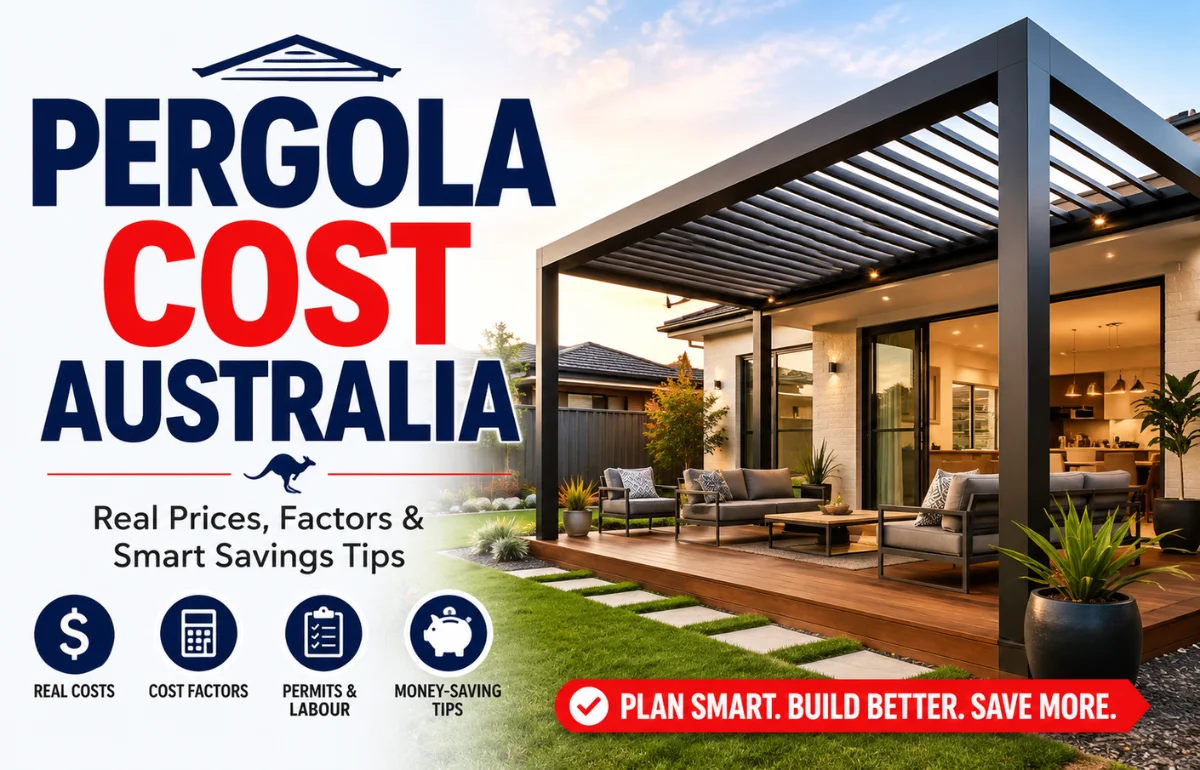
Pergola cost Australia typically ranges from $3,000 to $25,000, depending on the size, material, roof type, and whether you hire a licensed builder or go the DIY kit route. The national average for a professionally installed pergola sits around $8,000–$12,000 for a mid-sized structure. If you’re in a capital city like Sydney or Melbourne, expect labour alone to push you toward the higher end.
And if you’ve ever stood in your backyard imagining a shaded outdoor space where you can actually enjoy a weekend afternoon without squinting at the sun, you already know why more Australians are investing in pergolas than ever before.
I’ve spent time researching the real costs behind pergola projects across Australia, and what I consistently found is that most cost guides give you a number without explaining why that number exists. This article changes that.
Why Pergola Prices in Australia Vary So Much
If you’ve searched pergola cost Australia and seen figures ranging from $2,000 to $30,000 on the same page, you haven’t been misled — you’ve just seen the full spectrum. The variation is real, and it comes down to a handful of concrete factors that most homeowners don’t think about until they’re already talking to a builder.
Material Type Makes the Biggest Difference
The material you choose for your pergola isn’t just a style decision — it’s a financial one that affects the upfront cost, the ongoing maintenance bill, and how long the structure actually lasts.
Timber is the classic choice and remains popular in Australia for its natural warmth. Treated pine is the budget-friendly end of the timber spectrum, costing roughly $150–$250 per square metre to supply and install. Hardwood options like spotted gum or merbau will push that to $300–$450 per square metre. Timber requires periodic oiling or staining, which adds to the lifetime cost.
Aluminium has become the dominant material in the mid-range pergola market because it’s low-maintenance, lightweight, and resists rust and rot. Powder-coated aluminium pergola kits can be purchased for as little as $2,500–$5,000, while professionally installed custom aluminium structures typically run $8,000–$15,000.
Steel is typically reserved for larger, semi-commercial structures or high-wind regions. It’s the most durable option, but also the heaviest to work with. A steel pergola build usually comes in between $10,000 and $20,000+, depending on size and complexity.
Vinyl/PVC is increasingly appearing in the Australian market as a fully weatherproof and maintenance-free option. It’s mid-range in price — similar to or slightly above aluminium — and doesn’t warp or crack in harsh UV conditions.
Roof Type Changes Everything
A pergola without a roof is an open-beam structure. Add a roof, and you’ve changed both the function and the cost considerably.
- Open slatted/louvre roof (manual): $4,000–$10,000
- Motorised louvre roof: $8,000–$20,000+
- Polycarbonate sheeting: $3,500–$8,000
- Colorbond steel roofing: $4,000–$9,000
- Shade sail or retractable canopy: $1,500–$5,000
Motorised louvre roofs are the fastest-growing segment of the Australian pergola market right now, and for good reason — they let you open or close roof slats with a remote or smartphone app, meaning your outdoor space works year-round regardless of rain or sun. But that convenience comes at a meaningful price premium.
Size and Footprint
Standard pricing in the Australian market is quoted per square metre once you get beyond kit pergolas. Here’s a rough guide based on common sizes:
These ranges account for typical mid-quality materials and standard labour rates. A premium timber build with custom joinery will push well beyond the top of each range.
Labour Costs: Where Your Budget Really Goes
Labour is one of the biggest drivers of pergola cost Australia-wide, and in my experience, homeowners consistently underestimate it. Material costs are easier to estimate because you can price them online. Labour is trickier.
Across Australia, a licensed carpenter or builder charges between $80 and $150 per hour for pergola work. A standard 4m x 4m pergola typically takes two tradespeople two to three days — so you’re looking at 32–48 hours of labour, costing anywhere from $2,500 to $7,200 in wages alone.
Labour rates vary noticeably by state:
- Sydney and Melbourne: $100–$150/hr
- Brisbane and Perth: $90–$130/hr
- Adelaide and Hobart: $80–$120/hr
- Regional areas: $70–$110/hr (but add freight and travel costs for materials)
One thing worth knowing: some builders quote a fixed price for the whole job, while others quote labour-only and expect you to source materials separately. Always clarify this upfront. A “cheap” labour-only quote that requires you to coordinate materials can end up costing more than a full-service builder who handles everything.
Freestanding vs. Attached Pergolas: The Price Difference
This is one of the most commonly overlooked distinctions when budgeting for pergola cost in Australia, and it can make a $1,000–$3,000 difference on a mid-sized build.
A freestanding pergola stands independently, usually in the middle of a garden or at the edge of a lawn. It requires four corner posts set into footings, which means concrete work and post anchoring. This adds $500–$2,000 to the project depending on soil conditions and footing depth.
An attached (wall-mounted) pergola connects directly to your home’s exterior wall. It typically uses two posts at the front and mounts to the house at the back using a ledger board or bracket system. This saves on materials and installation time — often reducing the total cost by $1,000–$3,000 compared to a freestanding equivalent.
However, attached pergolas require flashing to prevent water ingress where the structure meets the wall. Poorly done waterproofing is the number one cause of moisture damage in attached pergola builds. Don’t cut corners here.
Council Permits and Building Approvals: The Hidden Cost
This is where Australian pergola projects frequently surprise homeowners — and where pergola cost Australia can quietly blow out by $1,000+ before a single post goes into the ground.
Most states and territories require a building permit or council approval for any pergola over a certain size, height, or proximity to a boundary. The rules differ state by state:
- NSW: Pergolas up to 20 sqm and under 3m high may be exempt as complying development, but only if they’re not in a heritage overlay or flood zone.
- Victoria: An open, unroofed pergola attached to a dwelling may not require a permit, but a roofed pergola (even a simple polycarbonate one) often triggers permit requirements.
- Queensland: Generally more permit-friendly, but Class 1 buildings still require compliance with the Queensland Development Code.
- WA and SA: Require permits for most pergola structures over a certain size; check with your local council before starting.
Permit costs themselves run between $200 and $800 on average, but engaging a building certifier or drafting engineer to draw up compliant plans can add $500–$2,000 on top of that. If your build doesn’t comply and a neighbour reports it, you may be forced to modify or demolish the structure at your own expense.
My strong advice: check with your local council before you sign any contract with a builder. The few phone calls it takes can save you thousands.
DIY Pergola Kits vs. Professional Installation
The DIY pergola kit market in Australia has grown significantly. You can now buy a fully engineered aluminium pergola kit online for $2,500–$6,000, delivered flat-packed to your door. For people who are reasonably handy, these can be a genuinely cost-effective option.
That said, the savings aren’t always as large as they appear. Consider:
- Footings: You’ll still need concrete footings, which often means hiring a concreter ($300–$800) or, at a minimum, renting equipment.
- Engineering certification: Many kit suppliers include engineer-stamped drawings, but some councils require additional certification for your specific site conditions.
- Time investment: A weekend project for two capable people can easily stretch to three or four weekends if complications arise.
- Warranty: Professional installations usually come with a workmanship warranty (typically 5–10 years). Self-installed kit builds typically carry only the product warranty from the manufacturer.
The honest answer is that a DIY kit makes sense if you’re experienced with structural outdoor projects, have two helpers, and aren’t in a heritage area with strict council rules. Otherwise, the money saved often doesn’t justify the risk.
There’s also an insurance consideration that rarely gets discussed. If a DIY-installed structure causes property damage or personal injury, your home and contents insurer may dispute the claim on the basis that the work wasn’t performed by a licensed tradesperson. For a structure sitting permanently in your backyard where kids and guests spend time, that’s not a small risk to absorb.
What Actually Adds Value — And What’s Just Expensive
Not every pergola upgrade is worth the cost. Here’s a practical breakdown based on what genuinely improves comfort, liveability, and resale value versus what’s nice-to-have marketing.
Worth the investment:
- Motorised louvre roofs — the year-round usability they provide justifies the cost for most households
- In-roof drainage systems — eliminates pooling and overflow issues with closed roofs
- Powder-coat colour matching — a pergola that matches your home’s exterior looks intentional and adds real visual appeal
- LED strip lighting built into the frame — professionally installed in-frame lighting is unobtrusive and significantly extends evening usability
Think carefully about:
- Glass walls and sliding door systems — beautiful, but adds $2,000–$8,000 and requires regular cleaning
- Outdoor heaters integrated into the pergola — useful in cooler southern states, less so in Brisbane or Darwin
- Custom laser-cut privacy screens — premium aesthetic, but only worthwhile if privacy is a genuine concern in your yard
Pergola Cost Australia: Getting Accurate Quotes

The single best thing you can do before committing to a pergola project is get at least three quotes from licensed builders. Not one quote, not two — three minimum. The variation between quotes on a $15,000 job can easily be $4,000–$5,000, and understanding why they differ will teach you more about the project than any article can.
When comparing quotes, make sure each one specifies:
- All materials (including grade and brand, where relevant)
- Labour rates or fixed labour component
- Whether footings and concrete are included
- Whether council approvals and certification are included
- The warranty period and what it covers
If you’re planning a larger outdoor renovation that extends beyond just a pergola, it’s worth exploring our home improvement services — we work with homeowners across Australia to scope, budget, and manage projects from initial planning to final sign-off.
Pergola Cost by City: Real-World Ranges
Because labour rates, material availability, and demand all vary geographically, here’s a city-by-city snapshot for a standard mid-range 4m x 4m pergola with an aluminium frame and polycarbonate or louvre roof:
Darwin and tropical north Queensland warrant a mention here — structures in cyclone-prone areas must meet higher wind ratings under Australian Standard AS/NZS 1170.2, which requires heavier-gauge materials and more robust anchor systems. Budget an additional 15–25% for cyclone-rated builds.
Maintenance Costs: The Number Nobody Budgets For
Here’s something most pergola cost Australia guides skip entirely: what does it cost to maintain the structure after it’s built?
A timber pergola needs re-oiling or re-staining every 2–3 years in most Australian climates. Materials cost $100–$300, labour if you hire out $400–$800. Over 10 years, that’s a meaningful maintenance overhead.
Aluminium requires minimal maintenance — typically an annual clean with mild detergent and water. No repainting, no sealing. Long-term cost is close to zero.
Steel pergolas need rust inspection and touch-up of any scratched or chipped powder coat annually, particularly in coastal areas. Budget $100–$300 per year, depending on proximity to saltwater.
Polycarbonate roofing panels need periodic cleaning and may yellow or become brittle in UV-intense environments. Replacement panels run $30–$70 per square metre. Most polycarbonate used in Australian pergola builds carries a 10-year UV warranty, but the actual lifespan is often 15–20 years if maintained.
If you want to go deeper on planning and costing outdoor projects, our renovation training resources cover budgeting frameworks, builder selection, and project scoping in practical detail.
Timing Your Build: Does Season Affect Pergola Cost Australia?

This is a question I don’t see answered anywhere, and it’s actually useful. Builder availability in Australia follows a predictable seasonal pattern. The busiest period for outdoor construction is September through February — spring and summer — when homeowners are motivated, and the weather is cooperative. During this window, good builders are often booked 6–12 weeks in advance, and some charge a small premium simply because demand outstrips supply.
If you can be flexible, planning your pergola build in the March–July window has a few genuine advantages. Builders tend to have more availability, they’re often more willing to negotiate on price, and the slightly cooler conditions actually make it easier to work with materials like timber that can warp in direct summer heat during installation.
That said, avoid locking in a build date right before Christmas if you can. Tradesperson availability collapses in mid-December, materials deliveries slow down, and council offices go on skeleton staff, meaning permit approvals can be delayed by weeks.
One more practical note: if your project involves significant concreting for footings, avoid scheduling during the height of summer in north Queensland or the NT. Extreme heat accelerates concrete curing in ways that affect final strength, and most experienced concreters will tell you the same thing.
Financing a Pergola: What Are Your Options?
For most Australians, a mid-to-large pergola project is a meaningful spend — and when you look at the full pergola cost Australia picture, including interest, the financing method you choose can add hundreds or thousands to the final total.
Cash or savings remains the most cost-effective approach because there’s no interest component. If you’re within six months of having the budget available, it’s almost always worth waiting.
- Home equity loan or redraw facility: If you have equity in your home, drawing on it to fund a renovation is typically the lowest-interest option available. The pergola, if it adds measurable value to your property, can partially justify this approach.
- Personal loan: Rates vary widely — from around 6% to 20%+, depending on the lender and your credit profile. For a $10,000 pergola over two years, the interest cost on a personal loan could add $800–$2,000 to the total project cost. Factor that in when comparing financing options.
- Buy Now Pay Later (BNPL): Some suppliers offer payment plans through third-party providers. These rarely cover professional installation labour, and the fine print around fees and defaults warrants careful reading.
- Builder payment terms: Most reputable builders accept a deposit (typically 10–20%) with the balance on completion, giving you time to confirm you’re satisfied before the final payment clears.
The Biggest Mistakes Australian Homeowners Make When Budgeting
Having looked at pergola cost Australia projects closely, these are the recurring mistakes that lead to budget blowouts:
Skipping the permit check. Starting a build without council approval is the most expensive mistake you can make. Rectification work is always costlier than doing it right the first time.
Choosing material based purely on upfront cost. Treated pine looks like a bargain at $150/sqm until you’re paying $600 every three years to re-oil it. Lifetime cost matters more than purchase price.
Not accounting for site preparation. If your yard slopes, has tree roots, or requires drainage modifications, site prep alone can add $1,000–$3,000 to the project. Ask your builder to inspect the site before quoting.
Assuming a quote includes everything. Lighting, electrical connections, concrete, and disposal of excavated soil are frequently excluded from initial quotes. Ask explicitly what’s not included.
Going with the cheapest quote. The lowest quote frequently reflects shortcuts — unlicensed labour, inferior materials, or missing approvals. Saving $2,000 on a quote is not worth an unsafe or non-compliant structure.
Frequently Asked Questions
How much does a basic pergola cost in Australia?
A basic freestanding timber or aluminium pergola with an open roof typically costs $3,500–$7,000 installed, depending on size and location.
Do I need council approval for a pergola in Australia?
In most states, yes — particularly for roofed pergolas or any structure above a certain size. Rules vary by state and local council, so check before you build.
Is it cheaper to build a pergola yourself or hire a builder?
A DIY kit can reduce costs by 30–50% on materials, but you’ll still need footings and possibly permits. Professional installation provides workmanship warranties and code compliance that DIY builds typically don’t.
What is the longest-lasting material for a pergola in Australia?
Powder-coated aluminium offers the best combination of longevity and low maintenance. Hardwood timber can last just as long but requires regular upkeep to achieve that lifespan.
Does a pergola add value to a home in Australia?
Yes, consistently. Real estate professionals across Australia note that a quality outdoor entertaining area — pergola included — increases the perceived and actual value of a property, particularly in family-oriented suburbs.
Where to Go From Here
Understanding pergola cost Australia is genuinely complex — there’s no single number that applies to every backyard, material, or council zone. What this article has tried to do is give you the full picture: not just a price range, but the reasoning behind it.
If you’re at the planning stage, the best first step is a site assessment by a licensed builder in your area. Get three quotes, confirm your council’s permit requirements, and be realistic about how the space will actually be used — a $6,000 aluminium kit serves a casual user just as well as a $20,000 custom build if the requirements are simple.
And if you need help thinking through the broader scope of an outdoor project, we’re here to help. Start with a clear budget, ask the right questions, and you’ll end up with a structure you’ll genuinely enjoy for the next twenty years.
Other Resources
- Do I Need Council Approval for a Pergola in Australia? Guide
- Do I Need Approval for a Retaining Wall? Guide
- How Close Can a Fence Be to My Neighbour? Australian Rules

I’m Salman Khayam, the founder and editor of this blog, with 10 years of professional experience in Architecture, Interior Design, Home Improvement, and Real Estate. I provide expert advice and practical tips on a wide range of topics, including Solar Panel installation, Garage Solutions, Moving tips, as well as Cleaning and Pest Control, helping you create functional, stylish, and sustainable spaces that enhance your daily life.