
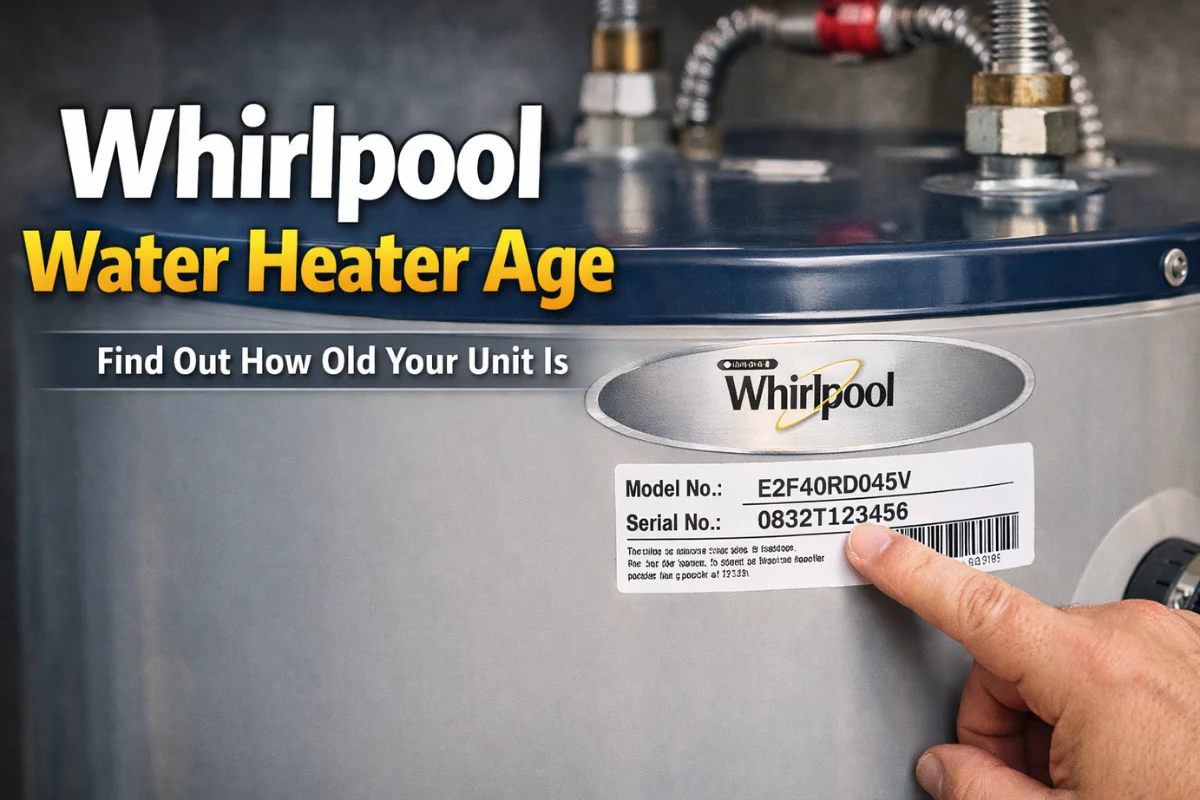
Every week, I walk through homes for inspections, and one of the first things I check in the utility room is the water heater. Most homeowners have no idea how old their unit is — and that gap in knowledge can lead to cold showers at best, a flooded basement at worst. Knowing your Whirlpool water heater age is one of those small details that quietly protects your home and your wallet.
The good news is that Whirlpool makes it relatively straightforward to decode the manufacture date right from the serial number on the unit. Once you know where to look and how to read it, the whole process takes under two minutes. This guide walks you through exactly that — plus what to do once you have the date in hand.
Why the Age of Your Water Heater Matters More Than You Think
A water heater is one of the hardest-working appliances in any home. It runs silently in the background — heating water for showers, dishes, laundry — day in and day out. Because it rarely demands attention, it also rarely gets it. That neglect is part of why water heater failures account for roughly $4,444 in average insurance claims per incident, according to data from the Insurance Institute for Business and Home Safety.
Most tank-style water heaters, including Whirlpool models, are designed to last 8 to 12 years. Some run reliably for 15 years or more with proper maintenance; others give out before the decade mark due to hard water conditions, heavy household demand, or deferred upkeep. The age alone does not tell the whole story, but it is the best single indicator of where your unit stands in its service life.
If a water heater is over ten years old and showing any signs of rust, sediment buildup, or inconsistent heating, it is already living on borrowed time.
Knowing the Whirlpool water heater age also matters when you are buying or selling a home. During a 4-point inspection — which many insurers require — the inspector will note the age and condition of major systems, including the water heater. An aging unit can flag as a liability and affect your coverage or negotiations.
Where to Find the Serial Number on a Whirlpool Water Heater
Before you can decode anything, you need to locate the serial number. Whirlpool places a data label — sometimes called a specification sticker or rating plate — directly on the side of the tank. On most models, it sits in the upper third of the unit, usually near the cold water inlet connection.
The sticker is white or silver with printed black text, and it contains a range of technical information about the unit. Here is what you will typically find on it:
- Model Number – identifies the specific product line
- Serial Number – the key field for determining age
- Tank Capacity (US Gallons) – commonly 30, 40, 50, or 75 gallons
- Voltage and Wattage – upper and lower element specs for electric models
- BTU Input – for gas models
- First Hour Rating (FHR) – how many gallons it can deliver in the first hour
- Manufacturer Location
If the sticker has faded or been painted over, check the back of the unit or look for a secondary label near the base. In older homes I have inspected, the sticker is sometimes partially obscured by insulation wrap — peel it back carefully and you should still find the rating plate underneath.
How to Read a Whirlpool Serial Number to Find the Manufacture Date
Whirlpool uses two serial number formats depending on the production era. Both encode the manufacture year and week in the first four digits — the difference is a single letter in the middle of the sequence that appears in one style and not the other.
Style 1 — Fully Numeric Serial Number
This format is the older of the two and contains only numbers. A typical example looks like this:
So 02481084563 tells me this unit was manufactured in the 48th week of 2002 — roughly late November or early December 2002. That would make it about 23 years old, well past its expected service life.
Style 2 — Serial Number with an Alpha Character
Newer Whirlpool models introduced a letter in the fifth position of the serial number. Everything else works the same way:
The letter in position five is a plant or production code and does not affect the date calculation. You read the manufacture date exactly the same way: first two digits for year, next two for week.
Quick tip: If the first two digits read “16,” the unit was made in 2016. Week 01 is the first week of January; week 52 is the last week of December. Use a week-to-date converter (many are free online) if you want the approximate calendar date of manufacture.
Decoding the Week Number: What Does It Actually Mean?
The ISO week numbering system divides the year into 52 or 53 weeks, starting with Week 1 as the week containing the first Thursday of January. So if your serial number shows week 12, the unit was made in mid-March of that year.
For most homeowners, the exact week is less critical than the year. But if you are trying to calculate a precise age for warranty purposes — Whirlpool’s limited warranties on residential water heaters typically range from 6 to 12 years, depending on the model — knowing the manufacturing week can matter when you are close to the warranty boundary.
Comparison: Whirlpool Water Heater Lifespan by Type and Usage
Not all Whirlpool water heaters age at the same rate. The tank type, energy source, and how hard the unit works all influence longevity. Here is a practical comparison based on industry standards and field experience:
| Water Heater Type | Typical Lifespan | Key Aging Factors | Recommended Action at Age |
|---|---|---|---|
| Standard Electric Tank | 10–15 years | Sediment buildup, anode rod depletion | Inspect at year 8; consider replacement at year 12 |
| Standard Gas Tank | 8–12 years | Flue corrosion, thermocouple wear, sediment | Inspect at year 7; plan replacement at year 10 |
| Power Vent Gas | 10–13 years | Blower motor wear, condensate buildup | Annual maintenance; replace motor if needed after year 8 |
| Heat Pump / Hybrid Electric | 13–15 years | Compressor life, refrigerant integrity | Inspect compressor at year 10; full replacement at year 14 |
| Tankless (On-Demand) | 15–20 years | Scale buildup on heat exchanger, flow sensor wear | Flush annually; component replacement as needed |
I have seen gas tank units fail as early as seven years in homes with heavily mineralized water and no water softener. Conversely, I have found electric tank heaters still functioning cleanly at 17 years in conditioned environments where the anode rod was replaced on schedule. The table above reflects averages, not guarantees.
Signs Your Whirlpool Water Heater Is Aging Out — Regardless of the Number
The manufacture date gives you a baseline, but your eyes and ears give you real-time data. Here are the warning signs I consistently document during home inspections on aging units:
Rusty or discolored hot water
If the hot water coming from your taps has a reddish-brown tint, internal corrosion is likely underway. This is most common once the sacrificial anode rod — a magnesium or aluminum rod designed to corrode in place of the tank — has been fully depleted. On a unit older than 8 years that has never had its anode replaced, this is almost expected.
Rumbling or popping sounds during heating
Sediment accumulates at the bottom of the tank over time, particularly in areas with hard water. When the heating element or burner fires, it forces hot water through that sediment layer, producing the characteristic rumbling sound. Beyond the noise, this sediment layer forces the heater to work harder, reducing efficiency and accelerating wear on the tank liner.
Pooling water or visible corrosion near the base
Any moisture around the base of the unit — even a small puddle — warrants immediate attention. This usually indicates a failing pressure relief valve, a loose connection, or early-stage tank failure. On a unit already past ten years, moisture at the base often signals the beginning of the end.
Inconsistent water temperature
Fluctuating hot water output — especially when demand is moderate — points to a failing thermostat or heating element. While these components can be replaced, a repair on a unit older than 10 years is often a short-term fix on a long-term problem.
What to Do Once You Know Your Whirlpool Water Heater Age
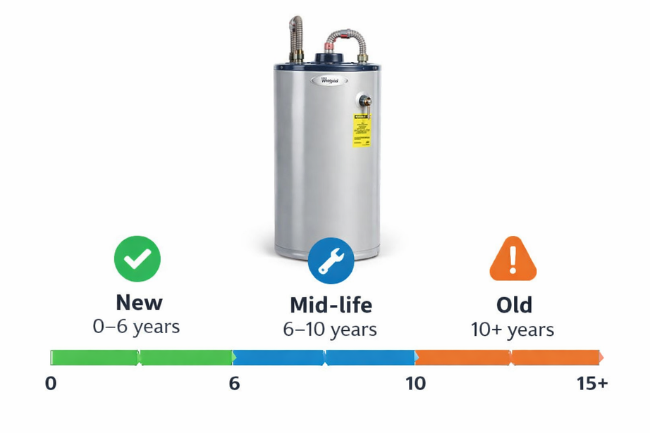
Armed with the manufacture date, you have three practical paths depending on where your unit falls on the timeline.
Under 6 Years Old
Your unit is likely within its warranty period. Register the product with Whirlpool if you have not already, and keep the serial number and model number on file. Schedule an annual flush to remove sediment, and check the anode rod every three years. You have time on your side — use it to build a maintenance habit rather than waiting for problems.
6 to 10 Years Old
This is the window where proactive owners pull ahead. I recommend a professional inspection at this stage to assess the anode rod, pressure relief valve, and overall tank condition. If the anode rod is nearly depleted, replacing it now can extend the tank’s life by several years. Start budgeting for eventual replacement — even if nothing is wrong today, a new unit is likely within a few years.
Over 10 Years Old
At this point, the question is not whether to replace the unit, but when. A water heater that fails unexpectedly — particularly one that leaks — can cause significant water damage to flooring, walls, and any stored belongings in the area. I always advise homeowners with a Whirlpool water heater age exceeding ten years to begin the replacement planning process actively, especially before winter, when demand is highest.
When replacing, consider upgrading to a higher-efficiency model. Heat pump water heaters, for example, can reduce water heating energy costs by up to 70% compared to standard electric resistance models, according to the U.S. Department of Energy.[1]
Maintenance Habits That Extend Your Whirlpool Water Heater’s Life
The best way to make the most of whatever age your unit is currently at is consistent, simple maintenance. These are the practices that genuinely make a difference:
- Annual tank flush: Draining a few gallons from the drain valve removes accumulated sediment before it hardens into a thick layer. This alone can add years to a tank’s life.
- Anode rod inspection every 3–5 years: The anode rod is your tank’s primary defense against internal corrosion. Once it is depleted to a thin wire, the tank itself begins to corrode.
- Pressure relief valve testing: The T&P valve should be tested annually by briefly lifting the lever. If it does not snap back cleanly or if it drips afterward, replace it.
- Insulating older units: On units older than 7 years, adding a water heater insulation blanket can improve efficiency by 25–45%, per the U.S. Department of Energy.[2]
- Setting temperature to 120°F: The default factory setting is often 140°F, which accelerates mineral scaling and increases the risk of scalding. Most households do well at 120°F.
Checking Whirlpool Water Heater Age During a Home Inspection
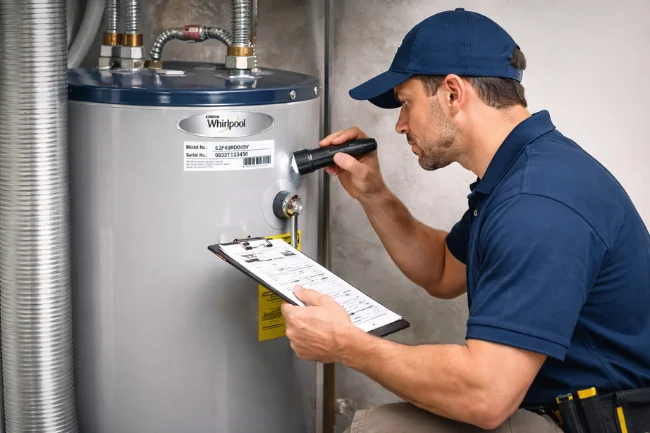
If you are buying a home, the water heater age is one of the items your inspector should flag. During a standard home inspection or 4-point inspection, I document the serial number, decode the manufacture date, and note any visible signs of wear or deferred maintenance.
A seller is not required to replace a functioning water heater simply because it is old. But knowing the Whirlpool water heater age puts you in a stronger negotiating position. If the unit is 11 years old with visible rust staining and a sediment rattle, you have legitimate grounds to request a price adjustment or a replacement credit.
From my own inspection log, roughly 30% of homes I examine have water heaters that are over ten years old, and less than half of those homeowners are aware of the age. It is not negligence; it is just that water heaters are easy to forget until they stop working.
FAQs
1. How do I find the serial number on my Whirlpool water heater?
Look for the white or silver data label on the upper portion of the tank, typically near the cold water inlet pipe. The serial number is printed directly on that sticker alongside the model number and capacity information.
2. What do the first four digits of a Whirlpool serial number mean?
The first two digits represent the year of manufacture, and the next two represent the week of that year. For example, “1506” means the unit was made in the 6th week (early February) of 2015.
3. How long does a Whirlpool water heater typically last?
Most Whirlpool tank-style water heaters last between 8 and 12 years, though units with regular maintenance and favorable water conditions can reach 15 years. Tankless models generally have a longer service life of 15–20 years.
4. Is it worth repairing a Whirlpool water heater that is over 10 years old?
For minor repairs like a thermostat or heating element on a unit in otherwise good condition, a repair can buy a couple more years. However, for major issues like tank corrosion or repeated failures on a unit over 10 years old, replacement is almost always the smarter investment.
5. Does the Whirlpool warranty cover water heaters older than 10 years?
Whirlpool’s residential water heater warranties typically range from 6 to 12 years, depending on the model tier; once the warranty period expires, repairs and replacements are the homeowner’s responsibility. Check your specific model’s warranty documentation using the serial number on the Whirlpool website.
The Bottom Line
Taking two minutes to find and decode your Whirlpool water heater age is one of the most useful things you can do as a homeowner. The serial number is right there on the tank — it just takes knowing where to look and how to read it. Whether your unit is brand new or pushing twelve years, that date gives you a clear framework for maintenance decisions, budget planning, and knowing when replacement should move to the top of your list.
If your water heater is showing any of the warning signs I described — rust, noise, moisture, inconsistent temperatures — do not wait for a failure. Schedule an inspection now, pull the serial number, and have an honest conversation with a licensed plumber about where your unit stands. A proactive replacement is always less expensive than an emergency one — and far less disruptive than a flooded utility room.

I’m Salman Khayam, the founder and editor of this blog, with 10 years of professional experience in Architecture, Interior Design, Home Improvement, and Real Estate. I provide expert advice and practical tips on a wide range of topics, including Solar Panel installation, Garage Solutions, Moving tips, as well as Cleaning and Pest Control, helping you create functional, stylish, and sustainable spaces that enhance your daily life.