
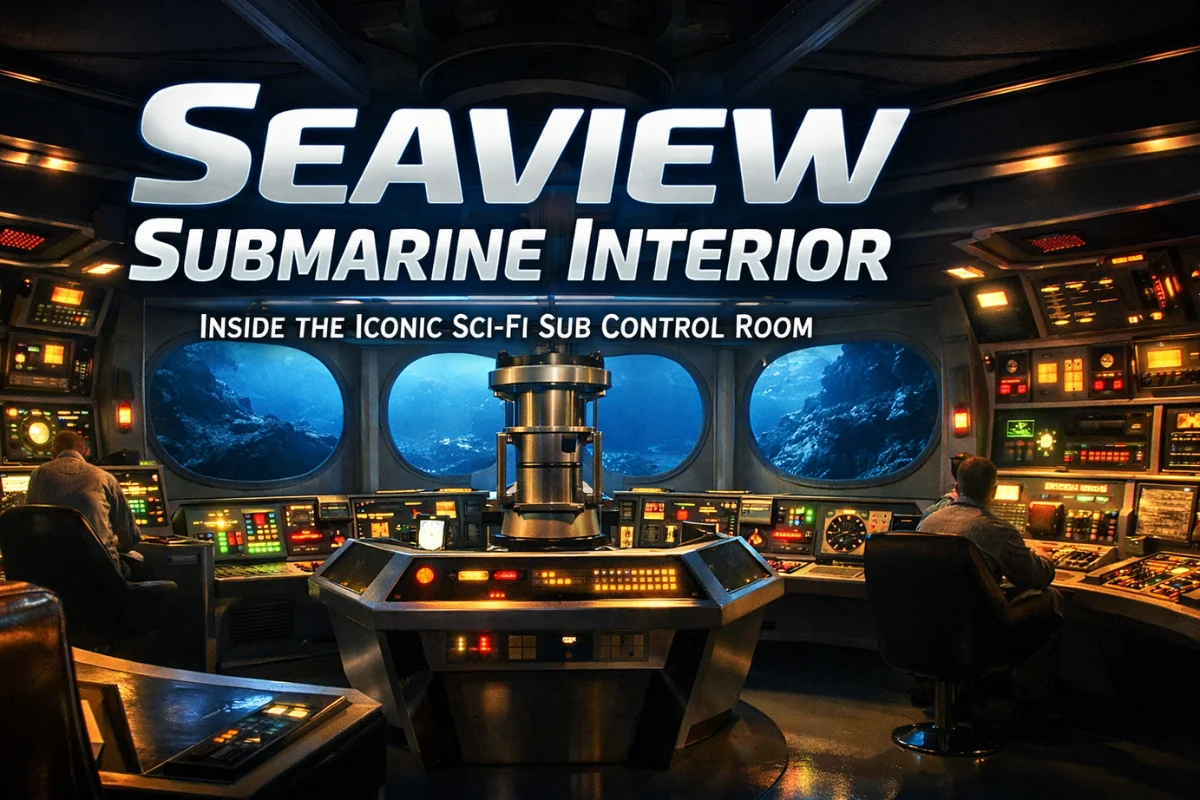
The Seaview submarine interior is, without question, one of the most beloved and meticulously imagined fictional vessel designs in television history. When Irwin Allen launched Voyage to the Bottom of the Sea on ABC in 1964, he didn’t just create a sci-fi adventure show — he built a world. A pressurized, riveted, blinking-light world that millions of viewers wanted to live in. I’ve spent a considerable amount of time studying the design history, the production documents, and the real-world naval influences behind this iconic submarine, and what I found is far richer than most fans realize.
Whether you’re a longtime fan of the show, a production designer researching retro-futurist aesthetics, or simply someone curious about how Hollywood turned a modest budget into a convincing 600-foot nuclear submarine, this breakdown covers everything worth knowing about the Seaview submarine’s interior spaces, design philosophy, and cultural legacy.
What Made the Seaview Submarine Interior So Distinctive?
Irwin Allen’s production team, led by art director William Creber and set decorator Walter M. Scott, faced an unusual challenge: design a submarine interior that felt simultaneously realistic and fantastical. Real submarines of the early 1960s were claustrophobic, utilitarian, and largely beige. The Seaview couldn’t be any of those things — not on television.
The solution was a kind of aspirational naval realism. The team studied declassified schematics from the USS Nautilus (SSN-571), the world’s first operational nuclear-powered submarine, and used those proportions as a loose framework. From there, they extrapolated into territory that no actual naval architect would sanction: cathedral-like corridors, an observation nose that jutted forward like a transparent arrowhead, and a flying sub bay that defied most reasonable explanations of structural integrity.
What makes the Seaview submarine interior so enduring is that it commits fully to its own logic. Every room connects to every other room in a way that feels navigable, even if the spatial geometry doesn’t quite hold up to scrutiny.
The Seaview Submarine Interior Control Room: Command, Chaos, and Character
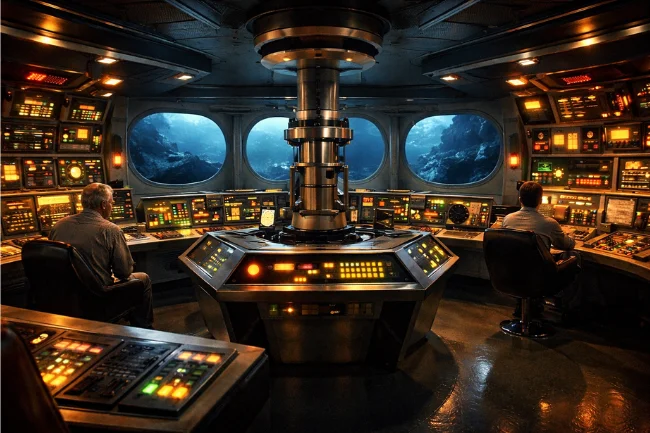
If you ask anyone to picture the Seaview submarine interior, they’ll picture the control room first. It’s where Admiral Nelson and Captain Crane spent most of their screen time, and it’s where the production budget was most visibly concentrated.
The control room featured a raised periscope island at its center, flanked by instrument consoles that ran the full length of both side walls. The consoles were dressed with an extraordinary mix of actual surplus military electronics, custom-built prop panels, and theatrical lighting rigs designed to suggest computational power without actually performing any. Many of the switches and dials were sourced from decommissioned aircraft and naval vessels — a common practice in mid-century science fiction production that gave props a tactile authenticity that modern CGI still struggles to replicate.
The forward bulkhead opened into the observation nose, creating a visual through-line that gave the control room an unusual sense of depth. Directors loved it. You could stage a conversation in the control room and have the vast, dark ocean visible through the nose windows in the same shot — a visual shorthand for the show’s central tension between human technology and the uncontrollable natural world.
The ceiling in the control room was lower than it appeared on screen. Forced perspective and careful camera placement made the space seem larger than it was, a technique the crew refined over four seasons of production.
The Observation Nose: The Seaview Submarine Interior’s Signature Space
No element of the Seaview submarine interior is more recognizable than the observation nose. That distinctive flying-saucer-shaped forward section, with its four large circular viewports arranged symmetrically around a central axis, became the visual signature of the entire show.
In practical terms, the nose set was built on a hydraulic gimbal rig that could tilt and roll to simulate underwater turbulence. The viewports were backlit with projected footage of actual underwater photography, combined with painted cel overlays and, in later seasons, early optical printing effects. The result was genuinely immersive for its era.
The nose served several narrative functions. It was a space for quiet contemplation — Admiral Nelson frequently retreated there to think through problems. It was a site of first contact with underwater civilizations and strange phenomena. And it was, perhaps most importantly, a space where the show’s visual language was most fully realized: a human being, sitting in a chair, surrounded by machinery, looking out at an alien world they barely understood.
The furniture in the nose was sparse — a small table, two or three chairs, occasionally a plotting board — which made the viewport windows the undisputed focal point. That restraint was intentional. More furniture would have crowded the frame and diminished the sense of oceanic vastness the set designers were working to create.
Crew Quarters, Corridors, and Secondary Spaces of the Seaview Submarine Interior
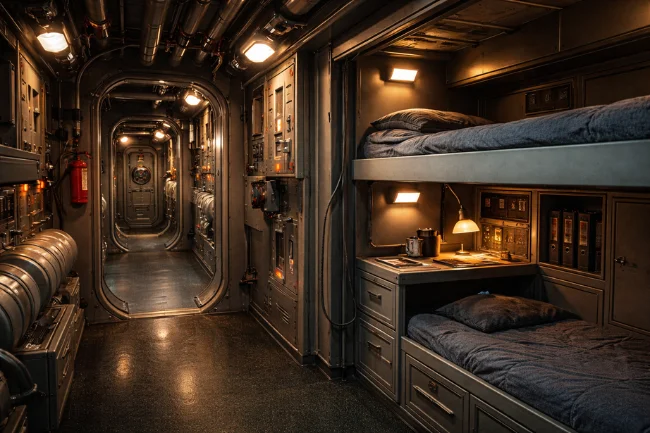
Beyond the control room and observation nose, the Seaview submarine interior comprised a network of secondary spaces that appeared with varying frequency depending on episode requirements and budget constraints.
Officers’ Quarters Inside the Seaview Submarine Interior
The officers’ quarters were functional but not spartan. Each cabin featured a fold-down bunk, a small desk, and wall-mounted equipment panels. The set was redressed and reconfigured between episodes to represent different cabins — Admiral Nelson’s quarters had slightly more elaborate furnishing than standard crew cabins, with a bookshelf and a framed painting that became a recurring visual motif across the show’s run.
The Missile Room
The missile room was a recurring action location and one of the larger standing sets. It featured a row of torpedo tubes on one wall, an overhead gantry for loading operations, and enough open floor space to accommodate the fight choreography that was a staple of the show’s second and third seasons. The set’s industrial aesthetic — bare metal, exposed piping, utilitarian lighting — contrasted sharply with the more polished look of the control room and nose.
The Laboratory
Admiral Nelson was, canonically, a scientist as much as a military commander, and the Seaview’s laboratory reflected that duality. The lab set was dressed with glassware, oscilloscopes, reel-to-reel data recorders, and a central examination table. It served as the primary location for episodes involving biological experiments, extraterrestrial specimens, and the various scientific crises that drove the show’s plots.
Corridors and Access Tunnels
The connecting corridors of the Seaview were built with a consistent visual grammar: curved overhead conduits, regularly spaced bulkhead doors with manual wheel-locks, and overhead fluorescent lighting that cast few shadows. This consistency gave the ship a coherent sense of spatial identity — you always felt like you were on the same vessel, even when you were technically on three different redressed sets.
Seaview Submarine Interior vs. Real Nuclear Submarine Interiors: A Comparison
One of the most fascinating exercises for any naval history enthusiast is to compare the Seaview submarine interior with the interiors of contemporary real-world submarines. The results reveal both how much research the production team did and how deliberately they departed from it.
| Feature | Seaview Submarine Interior (Fictional) | USS Nautilus / Skipjack-class (1960s) |
|---|---|---|
| Control Room Size | Large, open-plan, cinematic | Compact, high crew density |
| Observation Windows | Multiple large circular viewports | None (periscope only) |
| Corridor Width | Approximately 5–6 feet | 2–3 feet in most sections |
| Ceiling Height | 7–8 feet (staged) | 6 feet or less |
| Lighting | Bright, directional, dramatic | Utilitarian fluorescent |
| Color Palette | Grey-green with accent lighting | Institutional grey and off-white |
| Laboratory Space | Dedicated multi-room lab | Minimal; shared with other functions |
| Recreation Areas | Implied but rarely shown | Ward room, small crew mess |
| Flying Sub Bay | Full hangar with launch capability | No equivalent |
| Computer Systems | Wall-mounted blinking panels | Early analog fire-control systems |
The contrast is instructive. The Seaview submarine interior was designed to be read on screen — every space needed to communicate its function instantaneously to a television audience with no naval background. Real submarines are designed to be used, with ergonomics and damage-control requirements governing every spatial decision. These are fundamentally different design briefs, and it shows.
The Flying Sub Bay: The Seaview Submarine Interior’s Most Ambitious Set
No discussion of the Seaview submarine interior would be complete without addressing the flying submarine and its launch bay. Introduced in Season 2 as both a plot convenience and a merchandising opportunity, the Flying Sub (or FS-1) occupied a bay forward of the observation nose — a spatial impossibility given the nose’s established position, but one the show simply decided not to worry about.
The bay set was one of the largest constructed for the show, featuring a full-scale replica of the Flying Sub’s upper fuselage, launch rails, and equipment racks. It became a frequently used action location and a fan favorite. The matte paintings used to extend the set in wide shots are, by the standards of the era, exceptionally well-executed.
Production Legacy: How the Seaview Submarine Interior Shaped Sci-Fi Design
The design language developed for the Seaview submarine interior had a measurable influence on subsequent science fiction production design. The practice of using surplus military electronics as set dressing — which Irwin Allen’s team helped systematize — became standard in the industry through the 1970s and 1980s. The Star Trek original series, which premiered two years after Voyage to the Bottom of the Sea, shares several aesthetic DNA markers with the Seaview’s interior, including the color-coded instrument panels and the mixed use of practical and decorative lighting.
More directly, the Seaview’s observation nose concept — a forward-facing transparent space from which the crew could observe their environment — reappears in numerous subsequent productions, from the Seaquest DSV bridge to the bow observation lounge of the Enterprise-D in Star Trek: The Next Generation.
Production designer Ken Adam, who was designing the submarine interiors for the James Bond film The Spy Who Loved Me in the mid-1970s, has cited the Seaview’s aesthetic as part of his visual research. Whether consciously or not, the Seaview submarine interior left its fingerprints on a generation of imagined underwater architecture.
What Collectors and Enthusiasts Look for in Seaview Submarine Interior Memorabilia
For anyone approaching the Seaview submarine interior from a collector’s or researcher’s perspective, a few key resources are worth knowing.
The most detailed surviving documentation of the set designs comes from the Academy of Motion Picture Arts and Sciences’ Margaret Herrick Library, which holds production design materials from several Irwin Allen productions. Original blueprints for the primary Seaview sets are among the most sought-after items in science fiction production design collecting.
The Seaview herself — the physical model used for exterior shots — went through several revisions over the show’s four-season run, and correspondence between these model changes and interior set modifications is documented in the production records held by 20th Century Fox’s historical archive division.
For those interested in the electronics that dressed the sets, research from the Prop Store and It’s a Wrap auction houses has traced many of the original prop panels to surplus suppliers in the Los Angeles area who served the film and television industry throughout the 1960s. Several pieces from the Seaview sets have appeared at auction in recent years, typically fetching prices in the mid-four-figure range.
The Enduring Appeal of the Seaview Submarine Interior
What keeps people returning to analyze, recreate, and celebrate the Seaview submarine interior, more than six decades after the show’s premiere? I think it comes down to sincerity. The designers of this show genuinely believed in what they were building. They weren’t being ironic about the blinking lights or the hydraulic periscope or the observation windows that should have imploded under oceanic pressure. They built a world they wanted to exist, with the tools they had, and that conviction comes through in every frame.
The Seaview submarine interior represents a particular moment in American cultural history — a period when the deep ocean was as mysterious and exciting as outer space, when nuclear technology was still freighted with wonder rather than pure dread, and when television was just beginning to discover what it could do with ambitious production design. That moment is gone, but the Seaview preserves it in amber.
Conclusion
If you’re studying the Seaview submarine interior for any purpose — whether you’re a designer, a historian, a fan, or simply someone who caught a rerun and found yourself wanting to know more — the richest path forward is to go back to primary sources. Watch the show with the production design in focus, not just the story. Notice how spaces are established and revisited. Track how the set decorators used lighting and furniture to distinguish rooms that were, structurally, very similar.
The next step, if you want to go deeper, is to seek out the production records. The Margaret Herrick Library accepts research inquiries, and several dedicated fan communities — including the Voyage to the Bottom of the Sea fan database maintained by researcher Ed Charon — have compiled remarkable documentation from cast and crew interviews, call sheets, and surviving prop records. There’s always more to find.
FAQs
1. Was the Seaview submarine interior based on a real vessel?
The Seaview was loosely inspired by nuclear submarines of the early 1960s, particularly the USS Nautilus (SSN-571), but the interior design substantially departed from reality for dramatic and visual effect. The observation nose, wide corridors, and large laboratory spaces have no direct equivalent in actual submarine design.
2. How many sets were built for the Seaview submarine interior?
At peak production, the Seaview interior comprised approximately six to eight primary standing sets, including the control room, observation nose, laboratory, missile room, officers’ quarters, and flying sub bay, with additional corridor sections redressed as needed.
3. What happened to the original Seaview submarine interior set pieces after the show ended?
Most original set pieces were broken down or repurposed after the show’s cancellation in 1968. Some prop panels and electronics appeared in other Fox productions through the 1970s, and a small number of authenticated pieces have emerged at auction in recent decades, though documentation of provenance is often incomplete.
4. Did the Seaview submarine interior design influence Star Trek?
Both productions were running simultaneously at different studios in the mid-1960s and drew from the same aesthetic pool of surplus military electronics and retro-futurist design conventions. Direct influence is difficult to establish, but the parallel aesthetic choices reflect a shared moment in television science fiction history.
5. Where can I find accurate blueprints or schematics of the Seaview submarine interior?
The most reliable schematics available to the public come from fan research compilations published by enthusiast communities, cross-referenced against production stills and episode footage. The Margaret Herrick Library holds some original production materials, and several illustrated reference books on Irwin Allen productions include partial set plans.
For broader information, visit Wellbeing Makeover

I’m Salman Khayam, the founder and editor of this blog, with 10 years of professional experience in Architecture, Interior Design, Home Improvement, and Real Estate. I provide expert advice and practical tips on a wide range of topics, including Solar Panel installation, Garage Solutions, Moving tips, as well as Cleaning and Pest Control, helping you create functional, stylish, and sustainable spaces that enhance your daily life.