

If you’ve been following Rio de Janeiro real estate news lately, you already know the market has taken on a different energy than it had just a few years ago. I’ve spent considerable time tracking data from FipeZAP, Secovi Rio, and on-the-ground intelligence from local brokers, and what I’m seeing tells a nuanced story — not a simple bull run, not a crash warning, but a split market with real pockets of opportunity and real risks depending on where and how you play it.
Rio is no longer just an aspirational lifestyle destination. As of early 2026, it’s drawing serious capital from both domestic and international investors who see long-term value in a city that has been underpriced relative to its fundamentals for much of the past decade. This piece breaks down exactly what’s happening, neighborhood by neighborhood, segment by segment, so you can make decisions based on data rather than headlines.
The Big Picture: Where Rio de Janeiro Real Estate Stands Right Now
Rio de Janeiro Real Estate Price Growth: Steady, Not Spectacular
The most recent data from FipeZAP paints a picture of controlled momentum. The most recent 12-month price change in Rio de Janeiro is about +5.2%, which is in line with or slightly below the pre-pandemic long-run pace of 4 to 7% nominal growth — no sign of an abnormal acceleration.
That might sound modest, but context matters. Over the past decade, Rio de Janeiro experienced more dramatic swings than many comparable cities, including a significant run-up before the 2014–2016 economic crisis, followed by years of stagnation. A steady 5% growth, then, represents something that was sorely missing from this market for nearly a decade: stability.
Compared to one year ago in January 2025, Rio de Janeiro property prices rose about 5.6% in nominal terms, from R$10,330 to approximately R$10,910 per square meter. When you adjust for inflation, real gains are thinner, but positive — and that’s a meaningful shift from years of stagnation.
A Tale of Two Markets
What strikes me most about the current situation is how sharply segmented things are. Rio de Janeiro is best described as a split market: high interest rates give mortgage-dependent buyers more bargaining power in most areas, but prime Zona Sul neighborhoods with limited supply still lean toward sellers.
Brazil’s Selic rate has remained elevated through this period, squeezing affordability for buyers who rely on financing. But for cash buyers — especially foreign investors benefiting from a weak Brazilian real — the conditions are actually quite favorable. This is one of the clearest patterns I’ve observed in recent Rio de Janeiro real estate news: the market isn’t behaving uniformly, and your experience will depend entirely on which segment you’re entering.
Rio de Janeiro Real Estate by Neighborhood: Where the Action Is
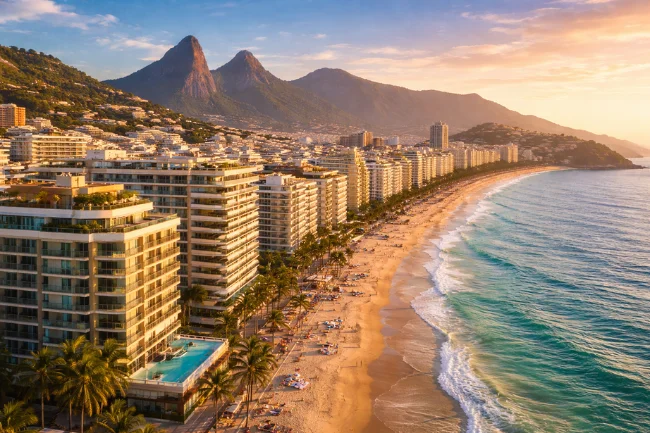
Leblon, Ipanema, and Lagoa — Still the Prestige Addresses
The three most expensive neighborhoods for residential property in Rio de Janeiro are Leblon at around R$25,000 per square meter, Ipanema at roughly R$24,000 per square meter, and Lagoa at approximately R$17,000 per square meter.
What keeps these neighborhoods commanding such premiums? Leblon commands its premium due to the extreme scarcity of available units combined with walkable beaches and top-tier restaurants. Ipanema’s draw is world-famous beach access, metro connectivity, and dense nightlife and retail options. Lagoa appeals for quiet lagoon views, proximity to Jardim Botânico park, and a family-friendly atmosphere.
If you’re looking at the top end of the market, expect to budget seriously. A typical luxury property in Rio de Janeiro in 2026 ranges from R$5,000,000 to R$20,000,000 (approximately US$900,000 to US$3,600,000), and this budget buys a renovated 3 to 4 bedroom apartment of 200 to 350 square meters in Leblon or Ipanema near the beach, on a higher floor with doorman service and parking.
Barra da Tijuca and Jacarepaguá — The Growth Leaders
For buyers looking at appreciation upside, the west zone is where the data points most clearly. The top three neighborhoods with the fastest rising property prices in Rio de Janeiro are Barra da Tijuca, Jacarepaguá, and Ipanema. Barra da Tijuca leads the pack with approximately 9.3% annual price growth, followed closely by Jacarepaguá at around 9.2%, while Ipanema comes in at roughly 7.7%.
The main demand driver behind these neighborhoods is a combination of family-oriented condo living with amenities in the West Zone and persistent scarcity combined with walkability in the South Zone.
Barra da Tijuca attracts families and remote workers seeking larger spaces at more moderate prices, with typical 3-bedroom apartments renting for R$4,000–R$7,000 monthly. This segment shows steady growth as work-from-home trends continue.
Rio de Janeiro Property News: Gentrifying Areas Worth Watching
I pay close attention to the emerging neighborhoods in any market because that’s often where the early-mover advantage lives. The Rio de Janeiro neighborhoods showing the strongest signs of gentrification and investor interest are Centro (particularly the revitalized Porto Maravilha area), Tijuca, Vila Isabel, and parts of the Recreio dos Bandeirantes corridor. These neighborhoods have experienced annual price appreciation of approximately 5% to 9% over the past year, outperforming the citywide average.
Infrastructure investment is a major catalyst here. The Rio de Janeiro areas with the most significant infrastructure projects planned are Recreio dos Bandeirantes (Linha 4 metro extension), Centro and Praça XV (Linha 2 extension from Estácio), and the corridor connecting Niterói to São Gonçalo via the new Linha 3. These projects include the R$9.8 billion Linha 4 extension to Recreio, the R$4.4 billion Estácio to Praça XV connection, and the R$14.6 billion Linha 3 intermunicipal metro, all announced in June 2025 with first operations projected for 2031.
Rio de Janeiro Real Estate News: The Rental Market Story
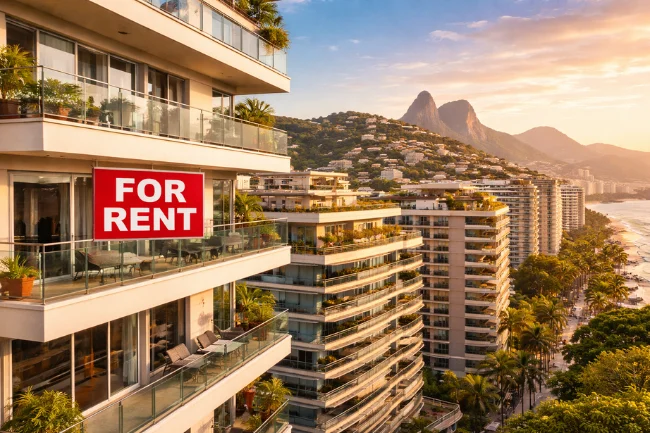
The rental side of recent Rio de Janeiro real estate news is where things get genuinely interesting — and where I’d argue the clearest opportunity lies right now.
Rental prices in Rio de Janeiro have surged 9.66% over the past 12 months through July 2025, significantly outpacing both inflation and national averages. When rent growth nearly doubles the pace of sale price appreciation, that’s a signal worth paying attention to.
Rio de Janeiro rents are growing around 10 to 11% per year, which is roughly double the pace of sale prices — and that kind of gap tells you housing is becoming more attractive as a yield play.
Rio de Janeiro Rental Yield Data by Strategy
The average gross rental yield for residential properties in Rio de Janeiro is approximately 5.9% per year, based on the FipeZAP rent-to-price ratio for December 2025. Most residential properties in Rio fall within a gross yield range of 4.5% to 7.5%, with significant variation depending on neighborhood and property type.
A realistic net rental yield for foreign owners in Rio in 2026 falls between 3.5% and 4.5% for long-term rentals after accounting for IPTU, condomínio, and management fees.
For short-term rental operators, the numbers tilt even more favorably. Short-term rental demand remains exceptionally strong, with successful Airbnb operations in prime locations generating monthly income equivalent to 3–4 months of traditional rent. That said, building-level condominium rules can restrict this strategy entirely — a fact I’d urge every buyer to verify before committing.
Foreign Investment in Rio de Janeiro Real Estate: An Increasingly Dominant Force
One of the most significant trends reshaping Rio de Janeiro real estate news is the surge in international buyer activity. Transaction volumes have increased substantially, with foreign buyers now representing 25–35% of luxury property purchases.
By focusing on lifestyle, convenience, and future rental potential, international buyers have transformed the dynamics of Rio’s real estate market. Their activity in 2025 continues to create attractive opportunities for both personal use and investment, setting the stage for projected trends in 2026 and beyond.
Luxury real estate sales grew nearly 300% in Rio from January to March 2025, with 219 units sold in the state capital during that period alone.
What’s driving this? The weak Brazilian real is a significant factor — it makes Rio-priced assets look attractively valued in dollar or euro terms. International buyer interest has reached all-time highs, driven by favorable exchange rates and Rio’s unique lifestyle appeal.
Revitalized districts, such as the Port Zone, are projected to become even more attractive as cultural, commercial, and residential hubs. Exchange rates, local infrastructure improvements, and global economic factors will play a crucial role in shaping investor behavior in 2026.
Rio de Janeiro Real Estate: Neighborhood Price Comparison Table
Understanding where value sits across Rio’s neighborhoods is essential for any buyer or investor. Here’s a breakdown of key areas based on current market data:
| Neighborhood | Price per sqm (R$) | 12-Month Appreciation | Avg. Gross Yield | Profile |
|---|---|---|---|---|
| Leblon | R$25,000–R$30,000 | ~7–8% | 4.0–4.5% | Ultra-premium, extreme scarcity |
| Ipanema | R$22,000–R$25,000 | ~7.7% | 4.5–5.0% | Iconic, beach-front, metro access |
| Lagoa | ~R$17,000 | ~5–6% | 5.0–5.5% | Family-friendly, quiet views |
| Barra da Tijuca | R$10,000–R$14,000 | ~9.3% | 5.5–6.5% | Growth leader, family & expat demand |
| Jacarepaguá | R$7,000–R$10,000 | ~9.2% | 6.0–7.0% | Emerging, high upside potential |
| Tijuca/Vila Isabel | R$7,000–R$9,000 | ~5–7% | 6.5–7.5% | Gentrifying, strong local rental demand |
| Campo Grande/Zona Norte | R$4,500–R$7,000 | ~3–5% | 7.0–7.5% | Entry-level, high yield, lower liquidity |
Sources: FipeZAP December 2025, Secovi Rio neighborhood panel, TheLatinvestor analysis (January 2026)
Rio de Janeiro Luxury Real Estate: Resilience and Record Activity
The high-end side of Rio de Janeiro real estate news deserves its own spotlight because it’s been operating by different rules. The luxury segment has shown remarkable resilience with a 70% jump in sales value in 2023 and continued strong performance through 2025.
For the short-term outlook covering 2025–2026, industry experts project annual price growth of 5–7% for luxury properties, outpacing the broader market by 2–3 percentage points. Leblon and Ipanema will maintain their premium status due to extremely limited new supply, while Barra da Tijuca will see the most new luxury development activity.
The buyer profile is also shifting. The medium-term forecast for 2025–2030 projects a cumulative price increase of 15% for the luxury segment, with international buyer participation expected to grow from the current 25% to 35% of total luxury transactions.
What are high-end buyers demanding from new developments? Market evolution trends identified by professionals include increasing demand for smart home technology and wellness amenities becoming standard features rather than premium add-ons. There’s growing interest in mixed-use luxury developments that combine residential, retail, and hospitality components. Sustainability features are transitioning from nice-to-have to must-have elements.
Rio de Janeiro Real Estate Risks That Deserve Honest Attention
No balanced assessment of Rio de Janeiro real estate news would be complete without looking at what could go wrong. I’d be doing readers a disservice to gloss over the real headwinds.
The three biggest risks for property prices in Rio de Janeiro are prolonged high interest rates that keep demand weak, a potential re-acceleration of inflation that squeezes household budgets, and localized issues like security perception or unexpected condo fee increases. The single risk with the highest probability of materializing is that interest rates stay elevated for longer than expected, which would extend the period of constrained buyer demand and slow price appreciation further.
Brazil’s Selic rate trajectory remains a wild card. If the Central Bank stays hawkish longer than markets anticipate, mortgage affordability will remain compressed for local buyers — which could weigh on mid-market transaction volumes even as luxury and cash-buyer segments hold firm.
Rio de Janeiro’s price-to-income ratio remains stretched compared to national averages, with typical apartments in Zona Sul requiring 15 to 20 years of average local household income — higher than many comparable cities. That dynamic limits who can actually participate in the market as a buyer, concentrating ownership further in affluent domestic and foreign hands.
Security perception, particularly in areas bordering favelas, remains a practical concern that affects both pricing and rental demand. This is a local knowledge issue — one where working with an experienced, on-the-ground broker is not optional.
Rio de Janeiro Housing Market Outlook: What the Next 12 Months Suggest
A plausible range for Rio de Janeiro property prices over the next year is roughly -5% on the downside (if credit tightens further and rates stay elevated longer than expected) to +7% on the upside (if rate cuts arrive sooner and buyer confidence returns), with something near +3% to +5% being the most likely outcome.
My read on the current Rio de Janeiro real estate news cycle: the base case is modest nominal appreciation with rental yields remaining elevated. For buyers entering with a long horizon — five years or more — and particularly for those not dependent on Brazilian mortgage financing, the setup is more attractive than the top-line macro numbers suggest. The infrastructure pipeline, growing foreign interest, and still-below-2014-peak real prices in most areas provide a reasonable floor.
Practical Considerations for Rio de Janeiro Real Estate Buyers
The estimated average home price in Rio de Janeiro is approximately R$ 1.05 million, which translates to around 210,000USDor€190,000EUR.The realistic price range covers roughly 80210,000 USD or €190,000 EUR. The realistic price range covering roughly 80% of property purchases falls between R 500,000 and R$ 2.5 million, or approximately $100,000 to $500,000 USD.
Buyers in Rio de Janeiro typically negotiate 7% off the listed price, though luxury properties in areas like Ipanema can see discounts of 8% to 12% due to longer time on market. Knowing this going in is one of the more actionable pieces of Rio de Janeiro real estate news you can carry into a negotiation.
Apartments dominate Rio de Janeiro’s residential market in 2026, making up about 75% of listings because the city’s dense urban layout and mountainous terrain favor vertical construction over single-family homes.
For foreign nationals, the legal framework is relatively accessible. Foreigners can legally own and rent out residential property in Rio de Janeiro without needing Brazilian residency, though you will need a CPF (tax ID) to sign contracts.
Conclusion: Is This the Right Moment?
The honest answer is: it depends on your objectives, risk tolerance, and capital structure. What I can say with confidence is that the Rio de Janeiro real estate news coming out of early 2026 is broadly more positive than the narrative from 2019 or 2020, and the fundamentals — rental demand, supply constraints in prime areas, infrastructure investment, and foreign buyer interest — are mostly pointing in the right direction.
If you’re a cash buyer targeting rental income in mid-market areas like Tijuca or Barra da Tijuca, the yield math works right now. If you’re a long-term investor interested in capital appreciation and are willing to hold through an uncertain interest rate environment, Zona Sul’s structural scarcity makes a compelling case. If you’re mortgage-dependent and need short-term capital gains, the current credit environment is your biggest obstacle.
The next step is straightforward: get specific. Map your budget to two or three neighborhoods, work with a locally licensed broker (ideally CRECI-registered), verify the condo rules on your target building, and run the actual yield numbers before committing. Rio has a way of rewarding buyers who do their homework and penalizing those who rely on assumptions.
FAQs
1. What is the average property price in Rio de Janeiro in 2026?
The citywide average sits at approximately R$10,910 per square meter, translating to a typical apartment purchase price of around R$1.05 million (roughly $210,000 USD), though prices vary dramatically by neighborhood.
2. Can foreigners buy property in Rio de Janeiro?
Yes — foreign nationals can legally purchase and rent out residential property in Rio without Brazilian residency. You will need a CPF (Brazilian tax identification number) to complete the transaction.
3. What rental yields can investors realistically expect in Rio?
Gross yields currently average around 5.9% citywide, with net yields for foreign owners falling between 3.5% and 4.5% after taxes, condo fees, and management costs.
4. Which Rio neighborhoods are seeing the fastest price growth right now?
Barra da Tijuca (approximately 9.3% annual growth) and Jacarepaguá (approximately 9.2%) are currently leading the city in price appreciation, with Ipanema not far behind at around 7.7%.
5. Is it a good time to buy property in Rio de Janeiro in 2026?
For cash buyers with a long investment horizon, the market conditions in early 2026 are broadly favorable — rents are outpacing sale prices, prime supply is constrained, and real prices remain below 2014 peak levels. Mortgage-dependent buyers face tighter conditions due to elevated Brazilian interest rates.

I’m Salman Khayam, the founder and editor of this blog, with 10 years of professional experience in Architecture, Interior Design, Home Improvement, and Real Estate. I provide expert advice and practical tips on a wide range of topics, including Solar Panel installation, Garage Solutions, Moving tips, as well as Cleaning and Pest Control, helping you create functional, stylish, and sustainable spaces that enhance your daily life.