
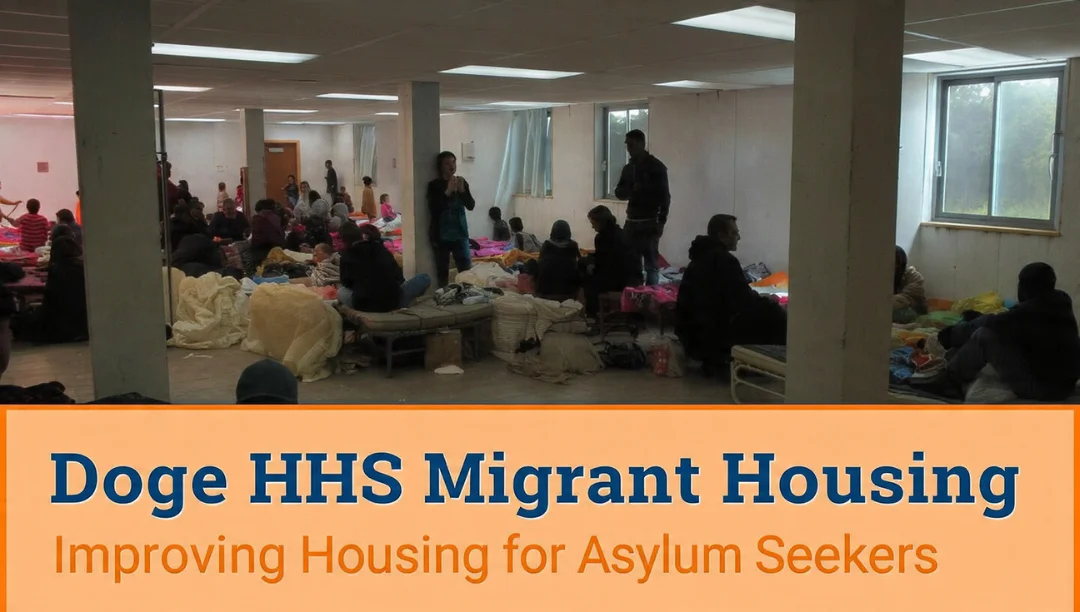
The Doge HHS migrant housing contract refers to a federal procurement agreement between the U.S. Department of Health and Human Services and a little-known private contractor awarded during a surge in unaccompanied minors at the southern border. Valued at reports nearing $530 million, the deal raised urgent questions about contractor vetting, emergency spending authority, and government accountability in the care of vulnerable children.
The Crisis That Created the Contract
To understand why this contract exists at all, you need to understand what was happening at the southern border in 2021. The number of unaccompanied minors—children crossing into the United States without a parent or legal guardian—surged dramatically. The Office of Refugee Resettlement (ORR), which operates within HHS, is legally responsible for sheltering and caring for these children once they’re taken into federal custody.
ORR typically manages a network of licensed shelters run by nonprofit organizations and state agencies. But when the system gets overwhelmed, the agency has to move fast—sometimes contracting with outside vendors to set up emergency intake sites. These are sometimes converted convention centers, military bases, or large-scale temporary facilities where hundreds or even thousands of children are housed while case workers process their placement options.
The pressure on the system was real. Children were sleeping in overcrowded Border Patrol facilities not designed for long-term care—places with inadequate sleeping space, limited medical access, and no meaningful programming for kids. HHS had legal and moral obligations to get children out of those conditions quickly. That urgency, while understandable, is also what opened the door to questions about whether proper contractor vetting was sacrificed for speed.
What Is the Doge HHS Migrant Housing Contract, Exactly?
The contract in question was awarded to a company referred to publicly as Doge—not the internet meme or the cryptocurrency, but an actual registered government contractor. The agreement was structured to have Doge provide temporary housing facilities for unaccompanied migrant children under HHS’s Office of Refugee Resettlement.
At its reported value of nearly $530 million, this would rank among the largest single contracts HHS issued during that period for emergency child migrant housing. The scope of work included:
- Facility setup and management: Identifying, preparing, and operating locations to house minors
- Staffing: Providing case managers, security personnel, and support staff
- Basic services: Meals, clothing, medical screening, and educational programming
- Case coordination: Supporting the process of connecting children with sponsors in the U.S.
On paper, these are legitimate functions that a qualified contractor could provide. The core problem, as investigators and journalists quickly found, was whether Doge was actually qualified—and whether HHS did the work to find out before signing.
Who Is the Company Behind the Contract?
This is where the story becomes murky. The company at the center of the Doge HHS migrant housing contract had an extremely limited public profile at the time the contract was awarded. No active website. No verifiable staff directory. No documented history of managing emergency shelters or working in child welfare.
For context, government contractors are typically required to register with the System for Award Management (SAM.gov), and many larger contracts also require companies to submit documentation of their past performance, financial capacity, and key personnel. For a $500+ million deal involving the direct care of children, you’d expect a contractor with a substantial, auditable track record.
What watchdog groups and journalists found was the opposite: a company with minimal public presence that seemingly had no prior experience managing facilities of this kind. That raised two serious questions:
- How did Doge get on the government’s radar as a potential contractor?
- What due diligence did HHS conduct before awarding the deal?
Neither question has been answered publicly with full transparency, which is a significant part of why this story has not faded away.
How Emergency Contracting Works—and Where It Can Break Down
To be fair to HHS, there’s an important legal and procedural context here. Federal acquisition rules allow agencies to bypass competitive bidding in genuine emergencies. This is called a “sole-source” or “limited competition” procurement, and it’s legal under the Federal Acquisition Regulation (FAR) when specific conditions are met—including when time constraints make normal procedures impractical, and lives may be at stake.
In theory, the ORR surge qualified as exactly that kind of emergency. Children were in inadequate conditions, the system was overwhelmed, and existing shelter capacity couldn’t keep up with the pace of arrivals. HHS has argued, broadly, that it needed to act fast.
But the emergency contracting authority is not unlimited. Agencies are still expected to:
- Verify that a contractor is capable of performing the work
- Confirm the contractor is in good standing and not debarred
- Document the emergency justification in writing
- Conduct at least cursory market research
- Establish clear deliverables and payment milestones
The concern with the Doge HHS migrant housing contract is that some or all of these steps may not have been adequately completed. Government Accountability Office (GAO) reporting and oversight committee inquiries have pointed to documentation gaps that suggest the normal safeguards were either rushed or bypassed.
A Comparison: Emergency Contracting Done Right vs. Done Wrong
This table illustrates not what HHS definitely did wrong, but the gap between what sound emergency contracting looks like and what the public record shows in this case.
What Did the Investigation Actually Uncover?
Congressional interest in the Doge HHS migrant housing contract intensified after initial media reporting flagged the contract’s unusual characteristics. House and Senate oversight committees sent inquiry letters to HHS leadership requesting documentation on how the contractor was selected and what performance metrics were in place.
Follow-up reporting from investigative journalists found several concerning data points:
- Facilities were incomplete or unaccounted for: Some housing sites expected to be operational under the contract were either delayed, not yet open, or not clearly traceable to Doge’s operations.
- Limited paper trail: Oversight investigators noted a sparse documentation record—problematic for any government contract, doubly so for one of this size.
- Questions about subcontracting: In large emergency housing contracts, it’s common for a prime contractor to rely heavily on subcontractors. Whether Doge had established those relationships before being awarded the deal—or was scrambling to build them after—was a subject of inquiry.
- Funding disbursement: One of the unresolved questions is how much of the contract value was actually paid out, to whom, and when. Federal contracting rules require disbursements to be tied to deliverables, but audits suggested this linkage may have been imprecise.
None of these findings has yet produced formal criminal charges. But they have kept the case active in the eyes of federal watchdog agencies and congressional investigators.
The Children at the Center of This Story
It’s easy for a story like this to become entirely about money and process—and miss the human stakes. These are real children. Many of them traveled thousands of miles through dangerous conditions. They arrived frightened, sometimes sick, often separated from everyone they knew.
The care they receive in federal custody matters enormously. Studies on childhood trauma show that the quality of early placements—whether children have consistent adult contact, educational engagement, access to mental health support, and a sense of physical safety—has lasting effects on their development and outcomes.
When a contractor responsible for providing those conditions is under-resourced, inexperienced, or simply not delivering, the children pay the price. That’s not hypothetical. Investigations into prior emergency shelter operations have documented cases where unqualified contractors failed to provide adequate staffing, resulting in children with limited access to case managers, delayed family reunifications, and inadequate mental health services.
The Doge HHS migrant housing contract, at its core, is a story about whether the government protected the children it was legally and morally responsible for protecting—or whether it prioritized speed and convenience over substance.
Political Context and the Broader Oversight Landscape
The contract became a flash point partly because it sat at the intersection of two politically charged topics: immigration and government spending. Members of Congress from both parties have raised concerns, though with different emphases.
Some legislators focused on the humanitarian angle—were children properly cared for? Others concentrated on fiscal accountability—was taxpayer money wasted or misused? And some raised structural questions about whether HHS’s emergency contracting process has sufficient guardrails regardless of which administration is in power.
It’s worth noting that emergency procurement controversies are not unique to any one administration or political era. Similar questions arose around COVID-19 PPE contracts, FEMA disaster response contracts after major hurricanes, and Department of Defense contingency contracting in overseas operations. The Doge HHS case fits into a pattern of emergency spending that outpaces oversight infrastructure—a systemic problem, not merely a political one.
What Reforms Could Prevent This in the Future?
Policy experts and government accountability organizations have pointed to several structural reforms that could reduce the likelihood of similar contracting failures:
- Pre-qualified vendor pools: HHS and ORR could maintain a pre-vetted roster of contractors with documented experience in child welfare and emergency housing. When surges happen, the agency could draw from this pool quickly without sacrificing due diligence.
- Mandatory performance bonding: Requiring contractors to post a performance bond—a financial guarantee that they’ll complete the work—creates a financial deterrent against awarding contracts to undercapitalized or unqualified companies.
- Real-time IG oversight: Rather than waiting for post-hoc audits, embedding Inspector General staff in the contracting process for large emergency awards would allow problems to be flagged before money flows out the door.
- Clearer subcontractor disclosure: If a prime contractor like Doge intends to fulfill most of the work through subcontractors, those subcontractors should be disclosed and vetted as part of the award process.
- Automatic GAO review triggers: For emergency contracts above a certain dollar threshold involving vulnerable populations, an automatic referral to the Government Accountability Office for expedited review could serve as an institutional check.
These aren’t radical ideas. Many of them already exist in some form in federal acquisition guidance. The challenge is consistent implementation under pressure, which is precisely when agencies are most likely to cut corners.
Where the Case Stands Today
As of the most recent available reporting and public records, the Doge HHS migrant housing contract remains under review. No criminal charges have been filed. HHS has not issued a comprehensive public accounting of what was delivered under the contract, what was paid, or what the outcomes were for the children housed in associated facilities.
Congressional oversight inquiries are ongoing. The HHS Office of Inspector General has reportedly reviewed aspects of the contract, though a full public report has not been released. Investigative journalists continue to file Freedom of Information Act (FOIA) requests for documentation.
The practical implication: this story is not closed. And given the dollar amount involved and the population affected, it shouldn’t be closed until there’s a clear, public answer to what the government got for its money—and whether the children in its care were genuinely protected.
FAQ
1. What is the Doge HHS migrant housing contract in simple terms?
It’s a large federal contract—worth up to roughly $530 million—awarded by the Department of Health and Human Services to a company called Doge to house unaccompanied migrant children during a border surge, later scrutinized because the company had little verifiable experience.
2. Has anyone been criminally charged in connection with this contract?
No criminal charges have been publicly filed as of the most recent available information, though federal oversight agencies and congressional investigators have called for continued review and auditing.
3. Why was the contract given without competitive bidding?
HHS used emergency contracting authority, which legally allows agencies to bypass normal competitive bidding when there’s an urgent need—in this case, a surge in unaccompanied children requiring immediate shelter solutions.
4. How much of the contract money was actually paid out?
The exact disbursement figure is not fully public. Oversight reviews have raised questions about whether payments were properly tied to demonstrated performance, but a complete accounting has not been released.
5. What happens to the children if a contractor fails to deliver?
Children may experience delays in case processing, inadequate staffing, limited access to mental health services, or extended stays in facilities not meeting ORR standards—outcomes that can compound trauma already experienced during migration.
Final Takeaway
The Doge HHS migrant housing contract is a case study in what happens when urgency collides with inadequate safeguards. The need to house unaccompanied children quickly was real. The failure—if that’s ultimately what investigators confirm—was not in acting fast, but in acting without the oversight structures that should accompany any large expenditure of public funds.
For taxpayers, it’s a reminder that emergency spending authority is a powerful tool that requires equally powerful accountability mechanisms. For policymakers, it’s an argument for investing in pre-positioned contracting infrastructure so that the next time a humanitarian crisis demands rapid response, the government doesn’t have to choose between speed and integrity.
And for the children who passed through these facilities—or didn’t reach them because contracted capacity never fully materialized—it’s a reminder that accountability in government contracting is never just an abstract policy matter. It has human consequences that can last a lifetime.
Learn about Mietmakler
For broader information, visit Wellbeing Makeover

I’m Salman Khayam, the founder and editor of this blog, with 10 years of professional experience in Architecture, Interior Design, Home Improvement, and Real Estate. I provide expert advice and practical tips on a wide range of topics, including Solar Panel installation, Garage Solutions, Moving tips, as well as Cleaning and Pest Control, helping you create functional, stylish, and sustainable spaces that enhance your daily life.