
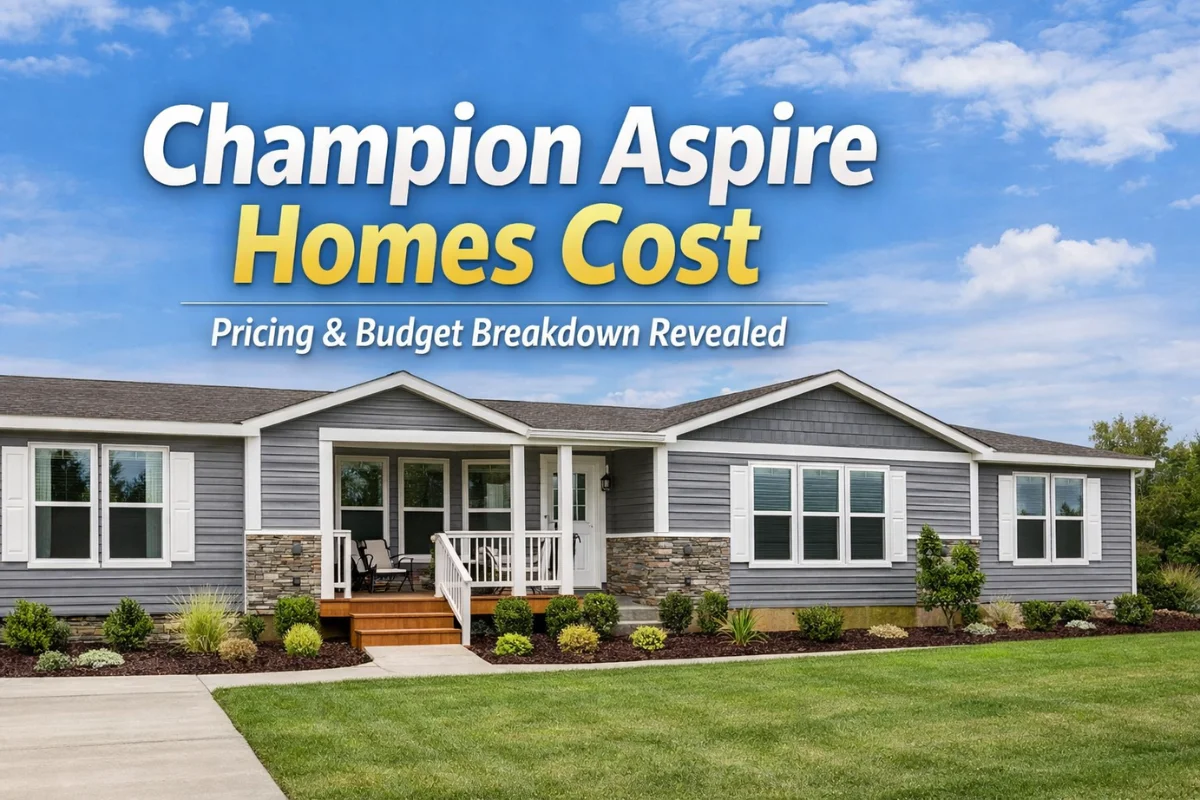
If you’ve been researching the champion aspire homes cost online, you’ve probably noticed that nobody seems to give you a straight number. Websites say “contact your local retailer,” and dealers quote ranges so wide they’re almost meaningless. I’ve been through this process myself and talked with buyers across different states, so in this post, I’m going to give you a real, grounded breakdown of what Champion Aspire homes cost — from the base unit price to the true all-in number you’ll see when the dust settles.
The short answer: a Champion Aspire home will typically run you anywhere from $80,000 to $175,000+, depending on configuration, location, and what you choose to add. But that number alone won’t help you budget accurately. The how behind that range matters just as much as the figure itself.
What Is the Champion Aspire Series — and Why Does the Cost Vary?
Before we get into dollars, it’s worth being clear about what the Aspire series actually is — because understanding the product is essential to understanding why Champion Aspire Homes cost what it does. Champion Homes — one of the largest factory-built home manufacturers in North America, with more than 50 years in the industry — offers the Aspire as part of their multi-section manufactured home lineup. It’s built under the federal HUD code for manufactured housing, which means it’s inspected and certified to meet national construction and safety standards.
The Aspire series is available through several of Champion’s regional brands, including Dutch Housing and Titan Homes, depending on your region. Models within the series span a meaningful range of sizes — from more compact double-wide configurations starting around 1,100 square feet, up to larger layouts like The Madison (2,040 sq. ft., 3 bed/2 bath) and The Winston (2,183 sq. ft., 3 bed/2 bath) that compete with site-built homes on livable space.
What consistently defines the Aspire line is an emphasis on open-concept floor plans, split-bedroom layouts for privacy, and a modern interior aesthetic. The kitchen, primary bath, and select finish packages are usually configurable — meaning you can personalize them within the options your dealer carries.
Champion Aspire Homes Cost: The Base Price Explained
Here’s where a lot of buyers get tripped up. When a dealer quotes you a “base price,” they’re typically quoting just the manufactured home unit itself — what rolls off the factory floor and gets transported to your site. That number does not include delivery, installation, site preparation, utility connections, or any required local upgrades.
According to Champion Homes’ own published guidance, pricing varies by home size, spec level, and personalization options, and the final price comes directly from an independent retailer in your area — not from Champion directly.
Based on current market data from dealers and manufactured housing platforms:
- Single-section (singlewide) Aspire models: Starting around $60,000–$80,000 for the base unit
- Double-wide multi-section Aspire models: Typically $85,000–$135,000 for the base unit
- Larger Aspire configurations (2,000+ sq. ft.): $120,000–$160,000 and up for the base unit
These are starting points. By the time you add delivery, installation, and site work, most buyers are looking at a final out-the-door cost that runs 20–40% higher than that base number.
The Full Champion Aspire Homes Cost Breakdown: What to Budget For
This is the section I wish someone had handed me before I started shopping. Champion’s own pricing blog confirms that the cost of a manufactured home goes well beyond the unit itself. Here’s a realistic cost breakdown for a mid-range Aspire double-wide:
1. Base Home Price
This is the home unit itself. For a 3-bedroom, 2-bathroom Aspire double-wide in the 1,500–1,800 sq. ft. range, expect this to land between $90,000 and $130,000, depending on your dealer and region.
2. Delivery and Transportation
Delivery costs depend on the distance from the factory and the complexity of your site access. Most buyers pay $3,000–$10,000 for delivery. Long-haul transport or difficult terrain can push this higher, especially if oversized load permits or escort vehicles are required.
3. Installation and Setup
This covers setting the home on its foundation, anchoring it, and connecting the two sections. Installation typically runs $7,000–$20,000, per data from manufactured home installation specialists. The type of foundation — pier and beam versus concrete slab — significantly affects this number.
4. Site Preparation
If your land needs grading, clearing, excavation, or drainage improvements, budget $5,000–$20,000 for site prep. Uneven terrain or rocky soil costs more. Accessible, flat lots cost significantly less.
5. Utility Connections
Connecting your home to water, sewer or septic, electricity, and natural gas or propane can range from $3,000 to $15,000+, depending on how far existing utilities are from your lot. Rural properties often face higher utility extension costs.
6. Foundation
A basic pier system is the most affordable option, while a full concrete slab or perimeter foundation costs more but may be required by local codes or desired for financing purposes. Budget $4,000–$15,000 for foundation work.
7. Permits and Local Requirements
Building permits, inspections, and any region-specific code compliance — such as energy efficiency upgrades for northern climates or wind zone ratings for coastal areas — add $1,500–$5,000 or more in some markets.
8. Optional Add-Ons
Garages, covered porches, decks, upgraded appliances, and premium flooring are popular additions that can add $5,000–$30,000, depending on scope.
Champion Aspire Homes Cost by Model: Comparison Table
The following table gives an overview of select Aspire-series configurations and their estimated total all-in cost ranges. Note that these are market estimates based on publicly available data and buyer reports — your actual costs will vary by location and dealer.
| Model / Configuration | Sq. Ft. | Beds/Baths | Est. Base Price | Est. All-In Cost |
|---|---|---|---|---|
| Aspire Singlewide (entry) | ~789 | 2 bed / 1 bath | $60,000–$75,000 | $80,000–$105,000 |
| Aspire Double-wide (standard) | ~1,400–1,600 | 3 bed / 2 bath | $85,000–$115,000 | $115,000–$155,000 |
| The Madison (Aspire line) | ~2,040 | 3 bed / 2 bath | $110,000–$135,000 | $145,000–$180,000 |
| The Winston (Aspire line) | ~2,183 | 3 bed / 2 bath | $120,000–$145,000 | $155,000–$195,000 |
| Large Aspire Multi-Section | 2,000+ | 4 bed / 2 bath | $130,000–$160,000 | $170,000–$215,000+ |
Estimates based on dealer listings, ManufacturedHomes.com data, and published Champion Homes pricing guidance. Contact a local retailer for precise quotes in your area.
What Affects Champion Aspire Home Cost the Most?
There are several variables that can shift the champion aspire homes cost by tens of thousands of dollars. I want to walk through the biggest ones so you can assess your own situation accurately.
Geographic Region and Champion Aspire Homes Cost
A buyer in rural Indiana is going to pay differently than one in southern California or coastal Florida. Regional labor costs, local code requirements, and delivery distances all factor in. California’s strict Title 24 energy standards, for example, typically require upgrades that aren’t needed in other states. Florida’s hurricane wind zone ratings add to both the home spec and installation requirements.
Lot Conditions
This one catches people off guard more than almost anything else. If you own land that’s flat, cleared, and close to utilities, your setup costs stay manageable. If your land is wooded, sloped, or far from utility connections, those costs climb fast. Site preparation is one of the least predictable line items in the whole process.
Upgrade Selections
Champion’s Aspire series lets you configure the kitchen, primary bath, and certain finish packages. Adding upgraded cabinetry, flooring, countertops, or energy-efficient appliances can add meaningful cost. The upside is that upgrades like better insulation, high-efficiency HVAC, and EnergyStar-rated windows often pay back through lower utility bills over time — a point reinforced by both HUD’s manufactured housing guidelines and EnergyStar.gov data.
Foundation Type
If you’re placing your home on private land and intend to finance with a conventional mortgage rather than a chattel (personal property) loan, many lenders require a permanent foundation. That shifts your foundation cost upward but can also expand your financing options and improve long-term resale value.
Dealer Markup and Local Competition
Champion sells through independent retailers, and each dealer sets their own margins and fee structures. In markets with more dealer competition, you may have more negotiating room. In areas with fewer options, pricing tends to be firmer. It’s worth contacting more than one dealer if there are multiple in your area.
Champion Aspire Homes vs. Site-Built Homes: How Do the Costs Compare?
One of the most common questions I hear is whether the Champion Aspire homes cost is truly lower than building a traditional stick-built home. The honest answer: usually yes on upfront cost, but the gap is narrower than many people assume.
According to data from the National Association of Home Builders (NAHB), the median cost to build a new single-family site-built home in the U.S. runs well over $300,000 in most markets when land and all site work are factored in. A fully installed Champion Aspire double-wide on your own land can come in at $120,000–$175,000 in many regions — a substantial difference.
However, there are important nuances. Site-built homes in most markets tend to appreciate at higher rates. Manufactured homes on leased land (in a community or park) may not appreciate at all or may even depreciate. Manufactured homes on owned land with a permanent foundation tend to hold value better. Financing terms also differ — interest rates for manufactured home loans are often higher than for conventional mortgages, which affects your total cost of ownership over time.
Financing a Champion Aspire Home: How Your Loan Choice Affects Total Cost
Understanding how you’ll finance your home is part of understanding its true cost. There are several routes buyers typically take:
- Chattel loans are the most common for manufactured homes and treat the home as personal property. They tend to have higher interest rates and shorter terms (15–20 years) than conventional mortgages, which increases monthly payments and total interest paid.
- FHA Title I and Title II loans are government-backed options that can offer more favorable terms. Title II loans, in particular, apply when the home is on a permanent foundation on land you own and is classified as real property.
- Conventional mortgages through Fannie Mae’s MH Advantage program are available for certain manufactured homes that meet specific construction and design standards, which some Aspire models qualify for. These come with terms more closely resembling a traditional 30-year mortgage.
The financing route you take will affect your total cost of homeownership more than almost any single upgrade decision you make on the home itself.
How to Get an Accurate Champion Aspire Homes Cost Quote
Given how much variation exists in champion aspire homes cost, the most important thing you can do is approach the quoting process strategically.
Request an itemized breakdown — not just a single number. Ask the dealer to separate the home cost, delivery, installation, site prep, foundation, utility hookups, and any required local code upgrades. That transparency lets you compare quotes from multiple dealers apples to apples.
Visit more than one dealer if possible. Champion’s independent retailer network is large, and pricing can vary. A drive to a neighboring dealer could save you several thousand dollars.
Get your land assessed before finalizing your budget. A site visit from a contractor or installer can reveal grading, utility, or access issues that aren’t obvious from a property listing.fv
Ask about what upgrades are already included in the model. Some dealer listings include appliances, skirting, or steps in their price; others don’t. Clarifying this upfront prevents sticker shock later.
Don’t overlook the EcoWise energy-efficient options available through Titan Homes (one of Champion’s brands that builds the Aspire in the northeast). These homes are built to higher energy standards and can meaningfully reduce your monthly utility costs — worth factoring into the long-term cost math.
Is the Champion Aspire Homes Cost Justified? An Honest Assessment
From everything I’ve seen and researched, the Champion Aspire series offers genuine value for the price point — particularly for buyers who own their land and can take advantage of favorable financing. The build quality, open floor plans, and customization options make it competitive with other manufactured home lines in its price range, and the larger Aspire models give you real, livable space that would cost significantly more to build on-site.
That said, the value equation only works if you go in with a full-cost mindset. Buyers who focus only on the base unit price and get surprised by delivery, site work, and installation costs end up feeling like they overpaid — even when they didn’t. Buyers who plan for the complete picture and shop their dealer options thoughtfully tend to come out with a home they’re genuinely happy with.
FAQs
1. What Is the Champion Aspire Homes Cost for a Base Model?
Base prices for Champion Aspire single-wide models typically start around $60,000–$75,000, while multi-section double-wide models begin closer to $85,000–$115,000 — before delivery, installation, or site work.
2. Does the quoted price include delivery and setup?
In most cases, no. Champion homes are priced through independent retailers, and delivery, installation, foundation work, and utility hookups are usually quoted separately. Always ask for a fully itemized estimate.
3. How long does it take to get a Champion Aspire home delivered after ordering?
Build and delivery timelines vary by region and dealer backlog, but most buyers should plan for 3 to 6 months from order to move-in, accounting for factory production, transport scheduling, site prep, and inspections.
4. Can I get a conventional mortgage on a Champion Aspire home?
Yes, in some cases. If the Aspire model meets Fannie Mae’s MH Advantage criteria and is placed on a permanent foundation on land you own, conventional mortgage financing may be available — often with better rates than standard chattel loans.
5. How does the Champion Aspire compare to other Champion series in terms of cost?
The Aspire series generally falls in the mid-to-upper range of Champion’s lineup, offering more space and higher-end finish options than entry-level series but priced below some of their most premium modular lines. It’s positioned as a quality-focused step up from basic manufactured housing.
Your Next Step
If you’re seriously considering a Champion Aspire home, the most useful thing you can do right now is contact two or three local Champion-authorized retailers and ask for itemized all-in quotes on the specific model you’re interested in. The champion aspire homes cost you see on any website is always a starting point — the real number comes from your dealer, your land, and your local code requirements. Use the cost categories outlined in this post as a checklist to make sure nothing is missing from what they give you.
You can locate authorized Champion dealers through the retailer finder at championhomes.com. From there, your retailer will walk you through current floor plan availability, regional pricing, and any local code requirements that affect your build. Going in informed makes every conversation more productive — and keeps you from leaving money on the table.

I’m Salman Khayam, the founder and editor of this blog, with 10 years of professional experience in Architecture, Interior Design, Home Improvement, and Real Estate. I provide expert advice and practical tips on a wide range of topics, including Solar Panel installation, Garage Solutions, Moving tips, as well as Cleaning and Pest Control, helping you create functional, stylish, and sustainable spaces that enhance your daily life.