
If you own a pool in the Whitney area, you already know that keeping it in peak condition isn’t exactly a passive hobby. Pool maintenance Whitney Nevada comes with its own set of challenges — intense desert heat, hard water, dust storms, and the kind of UV exposure that can bleach a vinyl liner in a single summer. I’ve spent years working with pool systems in this region, and the care routine here looks quite different from what you’d follow in, say, a mild Pacific Northwest climate. This guide covers everything from chemistry basics to seasonal shutdown, tailored specifically to what Whitney’s environment actually demands.
Why Whitney’s Climate Makes Pool Maintenance Whitney Nevada Uniquely Demanding
Whitney sits in the Las Vegas Valley, which means it inherits the full force of the Mojave Desert. Summer temperatures regularly push past 110°F, and the area sees an average of 294 sunny days per year, according to the National Oceanic and Atmospheric Administration (NOAA). That matters enormously for pool owners because heat and UV light are two of the fastest ways to burn through chlorine and destabilize your water chemistry.
When the sun beats down on an outdoor pool for 10–12 hours a day, free chlorine degrades rapidly. Without a stabilizer like cyanuric acid, you can lose most of your chlorine within a few hours of application. Add to that the fact that Clark County’s tap water is notoriously hard — averaging around 278 parts per million (ppm) of calcium hardness, well above the ideal range of 200–400 ppm — and you’ve got a recipe for scale buildup on tile lines, equipment, and pool surfaces if you’re not proactive about it.
This isn’t meant to be alarming. It just means that pool maintenance in Whitney, Nevada, requires a tighter schedule and more attention than many pool guides assume.
Pool Maintenance Whitney Nevada: Getting Your Water Chemistry Right
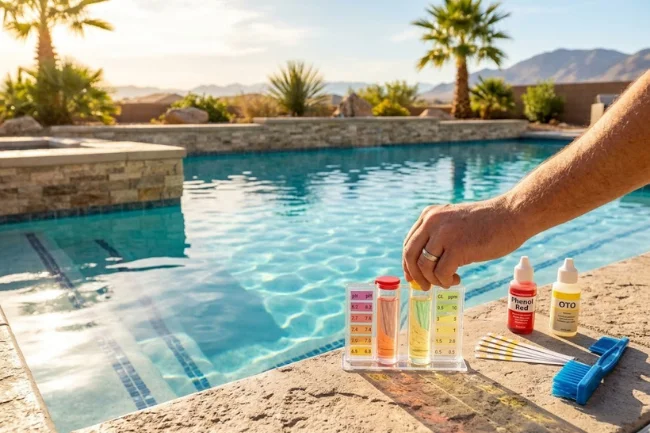
Getting your water chemistry right is the foundation of everything else. Imbalanced water doesn’t just look uninviting — it damages pool surfaces, corrodes equipment, and can make swimming uncomfortable or unsafe.
pH Levels
pH should stay between 7.2 and 7.6. In Whitney’s hard water environment, pH tends to drift upward on its own, especially when the water heats up. High pH makes chlorine significantly less effective and encourages calcium carbonate to come out of solution and form scale. I check pH at least twice a week during the summer months and use muriatic acid or sodium bisulfate to bring it down when needed.
Free Chlorine and Stabilizer
Free chlorine should sit between 1 and 3 ppm for a residential pool. Because of Whitney’s intense sun exposure, I strongly recommend keeping cyanuric acid (CYA) levels between 30 and 50 ppm. CYA acts as a sunscreen for your chlorine, shielding it from UV degradation. Without it, you’ll be dumping chlorine into the pool constantly. That said, don’t let CYA climb above 80 ppm — at high concentrations, it actually starts to suppress chlorine’s sanitizing power, a phenomenon sometimes called “chlorine lock.”
Total Alkalinity
Total alkalinity (TA) buffers the pH and keeps it from swinging wildly. A healthy range is 80–120 ppm. In desert pools, TA tends to creep up, especially if you’re adding a lot of fill water to replace evaporation. Use muriatic acid to lower it when necessary.
Calcium Hardness
This one is especially important in Whitney. Since the tap water is already hard, calcium hardness in your pool can climb past 400 ppm fairly quickly, particularly as evaporation concentrates the minerals left behind. High calcium hardness causes white, crusty deposits on the waterline, steps, and inside the pump housing. Aim to keep it between 200 and 400 ppm. Partial draining and refilling — sometimes called a dilution drain — is the most practical way to reset calcium levels when they get too high.
Evaporation: A Bigger Problem Than Most People Expect
In Whitney during peak summer, a pool can lose 1.5 to 2 inches of water per week to evaporation alone. That’s roughly 1,000 to 1,500 gallons monthly for an average 15,000-gallon residential pool. This matters for two reasons.
First, a dropping water level can starve the pump of water, causing it to run dry and overheat — a quick way to need an expensive pump replacement. Keep the water level at least halfway up the skimmer opening at all times.
Second, every time you add fill water, you’re also adding more minerals and throwing off your chemistry balance. This is why pool maintenance in Whitney, Nevada demands more frequent water testing than what pool owners in cooler or more humid climates ever need to bother with.
A quality pool cover can cut evaporation by 50–70%, according to the U.S. Department of Energy. I know most people don’t want to hassle with covering a pool every night in summer, but even using one during the hottest part of the day or when the pool isn’t in use can make a measurable difference.
Whitney Nevada Pool Maintenance: Filtration and Circulation in Desert Conditions
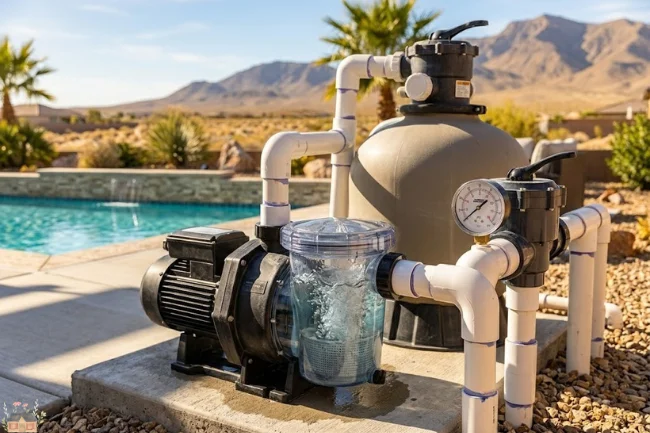
Your filter and pump are the heart of any pool system, and in Whitney’s environment, they work harder than average.
Running Time
During summer, I recommend running your pool pump a minimum of 8 hours per day, and many local pool professionals suggest 10–12 hours if the pool sees heavy use. The goal is to turn over the entire volume of water at least once — ideally twice — per day. This prevents dead zones where algae can get a foothold and ensures your sanitizer is reaching every corner of the pool.
Running the pump during off-peak electricity hours (typically 9 PM to midnight and 6 AM to 9 AM in Nevada) can also meaningfully reduce your energy bill, since NV Energy uses time-of-use pricing for many residential customers.
Filter Maintenance for Whitney Nevada Pool Owners
Whether you have a sand filter, a cartridge filter, or a diatomaceous earth (DE) filter, desert dust and windblown debris will clog it faster here than in most other regions. Whitney sits close to open desert terrain, so filter maintenance windows are shorter than the manufacturer’s general guidance.
For sand filters, backwash when the pressure gauge reads 8–10 psi above the clean baseline — don’t wait for the full 10+ psi climb that’s often cited in generic guides. For cartridge filters, rinse the cartridges every 4–6 weeks during summer and do a full chemical soak every 3–4 months. DE filters require backwashing and recharging with fresh DE powder regularly; follow your filter’s specific capacity rating.
Algae Prevention: One of the Biggest Pool Maintenance Challenges in Whitney Nevada
Algae isn’t just a cosmetic problem — it consumes chlorine rapidly, fouls filtration, and can make pool surfaces dangerously slippery. In the heat of a Whitney summer, green algae can appear and spread within 24–48 hours if chlorine drops too low.
The best prevention strategy combines consistent sanitizer levels, proper circulation, and weekly algaecide treatments as a backup. Phosphate removers are also worth considering; algae feed on phosphates that enter the pool from leaves, dust, fertilizers, and even tap water. Keeping phosphate levels below 200 ppb (parts per billion) cuts off a significant food source.
If you do get an algae bloom, shock the pool with a large chlorine dose — typically 10 ppm or more — brush every surface thoroughly, and run the filter continuously until the water clears. Then backwash or clean the filter, test, and rebalance.
Comparison: DIY Pool Maintenance vs. Professional Pool Service in Whitney, NV
This is a question I get asked constantly by anyone new to pool maintenance in Whitney, Nevada. Here’s an honest side-by-side:
For most Whitney homeowners with demanding work schedules or those who travel frequently in summer, a professional pool service pays for itself in equipment longevity and prevented repairs. For someone who enjoys the hands-on aspect and can commit to a consistent routine, DIY is entirely viable — provided you invest in a reliable test kit (not just test strips) and stay disciplined about the schedule.
Pool Maintenance Whitney Nevada: A Seasonal Calendar
Spring (March – May)
This is prep season. Start by testing the full water chemistry panel after the mild winter. Clean and inspect the filter, check pump seals and O-rings for cracks, and scrub the waterline tile to remove any scale or calcium deposits that built up. Prime the pool with a phosphate remover and a preventive algaecide dose before temperatures climb.
Summer (June – September)
This is the most demanding period. Test chemistry two to three times per week. Shock the pool weekly or after heavy rain or high bather loads. Clean skimmer baskets every few days. Keep a close eye on the water level due to rapid evaporation. Inspect tile and coping for scale buildup monthly.
Fall (October – November)
As temperatures drop, you can reduce filtration run time to 6–8 hours daily. Continue testing chemistry weekly. Trim back any trees or shrubs that drop leaves into the pool. This is also a good time to have a professional inspect the heater if you plan to extend the swimming season or use the pool year-round.
Winter (December – February)
Whitney’s winters are mild enough that most pools don’t need to be winterized the way pools in colder states do. You can keep the pool fully operational year-round with reduced maintenance. Run the pump at least 4–6 hours daily to prevent stagnation, and test chemistry every two weeks. If you do choose to close the pool, use a proper winter cover, balance the chemistry before shutdown, and lower the water level slightly below the skimmer.
Whitney Nevada Pool Maintenance: Equipment That Wears Down Fastest
Desert conditions are hard on equipment in predictable ways. The parts that tend to fail first for Whitney pool owners:
- Pump seals and O-rings degrade faster than average due to temperature swings between night and day. Inspect them at the start of each season.
- Plumbing and fittings exposed to direct sunlight become brittle over time. UV-resistant insulation or pipe wrap can extend their lifespan significantly.
- Automatic pool cleaners — both suction-side and robotic — collect debris heavily after windstorms and can clog or overheat in extreme temperatures. Clean the filter bag or canister after every use during dusty periods.
- Salt chlorine generators (if you have a saltwater pool) are popular in the area for their low-maintenance chlorine production, but the salt cell’s plates accumulate calcium scale quickly in hard water. Clean the cell with a diluted muriatic acid solution every 3 months or per the manufacturer’s recommendation.
When Pool Maintenance in Whitney Nevada Calls for a Professional
Some situations warrant a call to a local pool service rather than a DIY fix:
- Persistent algae that doesn’t respond to shock treatment within 72 hours
- Cloudy water that remains despite balanced chemistry and good filtration
- Any grinding, loud, or unusual noise from the pump motor
- Visible cracks in the pool shell, coping, or decking
- Significant unexplained water loss (beyond evaporation) — this often points to a leak
- A pool heater that won’t ignite or produces inconsistent temperatures
For leak detection specifically, the Clark County area has several licensed pool service contractors who use electronic equipment to pinpoint leaks without unnecessary excavation.
Frequently Asked Questions
1. How often should I test my pool water in Whitney, Nevada?
During summer, test at least twice a week — pH and chlorine every time, with a full panel (alkalinity, calcium, CYA) once weekly. In winter, once a week is usually sufficient.
2. Is a saltwater pool easier to maintain in the desert heat?
A saltwater pool still requires chemistry management, but the salt cell automates chlorine production, which helps keep levels more consistent between visits. The tradeoff is more frequent cell cleaning due to hard water scale buildup.
3. What’s the best way to deal with calcium buildup on my pool tile?
A pumice stone works for light deposits; a diluted muriatic acid solution or professional bead blasting handles heavier scale. The best long-term solution is keeping pH below 7.6 and calcium hardness below 400 ppm.
4. How much water does my Whitney pool lose each week?
During peak summer, expect 1.5 to 2 inches of evaporation per week — more if you have a spa or water features running. A solar or safety cover can reduce that by roughly half.
5. Do I need to winterize my pool in Whitney, Nevada?
Rarely. Whitney’s winters don’t typically produce sustained freezing temperatures, so most pools stay operational year-round with a reduced maintenance schedule rather than a true winterization.
A Final Word on Getting It Right
Pool maintenance Whitney Nevada isn’t complicated, but it is consistent work — especially during the long, hot summer months when your pool is under the most stress. The owners I’ve seen get into trouble are usually the ones who check their chemistry once a month, skip filter cleanings, or wait until a problem is visible before they act. By that point, what could have been a $20 bottle of algaecide has turned into a $300 service call.
If you’re new to pool ownership in the Whitney area, I’d suggest starting with a professional water analysis from a local pool supply store — they can test for calcium hardness, CYA, phosphates, and metals that basic home test kits miss. Use that as your baseline, and build your routine from there.
And if you’d rather hand off the whole thing to someone who knows Whitney’s specific water conditions and climate quirks, a reputable local pool service is genuinely worth the investment. Either way, the key is consistency. A well-maintained pool in this climate lasts decades and stays beautiful. A neglected one becomes expensive fast.
Read Also: Calcium Nodules in Pool

I’m Salman Khayam, the founder and editor of this blog, with 10 years of professional experience in Architecture, Interior Design, Home Improvement, and Real Estate. I provide expert advice and practical tips on a wide range of topics, including Solar Panel installation, Garage Solutions, Moving tips, as well as Cleaning and Pest Control, helping you create functional, stylish, and sustainable spaces that enhance your daily life.