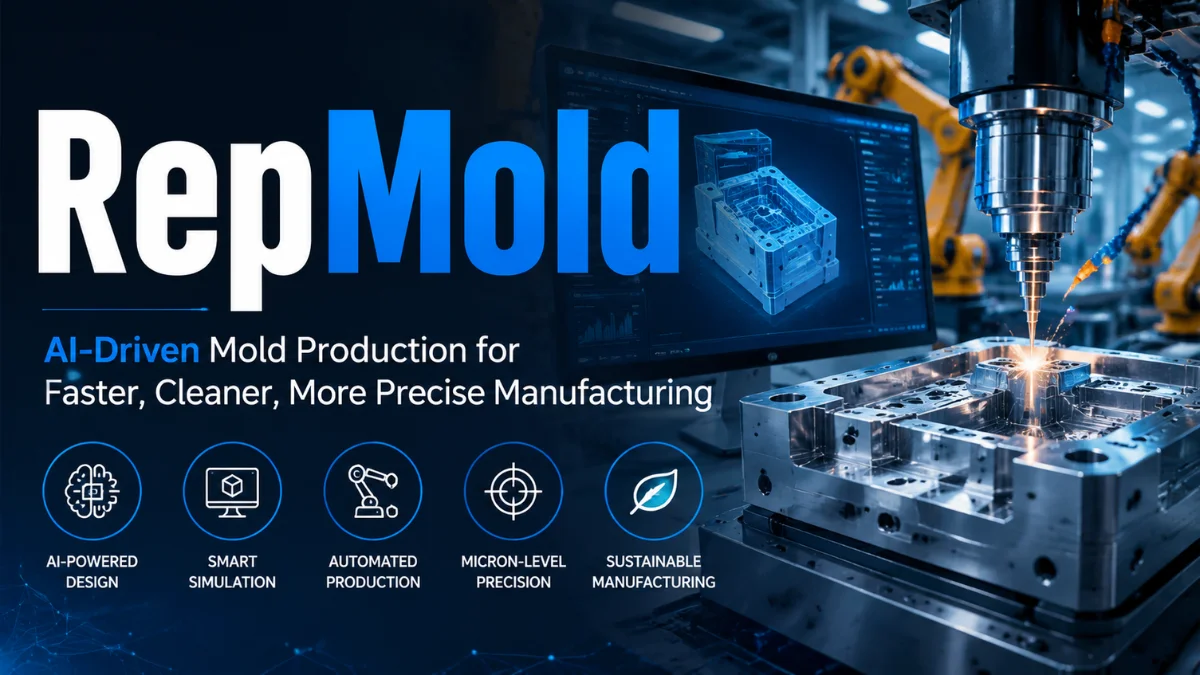
I see RepMold as a strong example of where modern manufacturing is heading: faster design, cleaner production, sharper precision, and less waste across the mold-making lifecycle. Instead of treating mold production as a slow, manual, trial-heavy process, RepMold brings artificial intelligence, digital simulation, automation, and precision engineering into one smarter manufacturing workflow.
What RepMold Means in Modern Manufacturing
RepMold refers to an AI-driven approach to mold production that uses digital design, intelligent analysis, automated validation, and precise fabrication to improve how molds are created and repeated. The main idea is simple: manufacturers should not wait until physical production begins to discover design flaws, material waste, or performance issues.
Traditional mold-making often depends on repeated manual adjustments. A design is created, a prototype is made, testing happens, problems appear, and then the cycle starts again. That process can work, but it is slow, expensive, and often wasteful.
RepMold changes that rhythm by moving more decisions into the digital stage. Before the mold is produced, AI can review geometry, detect weak points, simulate performance, and suggest improvements. This supports better accuracy and reduces avoidable mistakes.
AI is already being used in molding and manufacturing to optimize mold design, monitor production, support predictive maintenance, and reduce waste. RepMold fits into that wider shift toward smart manufacturing.
Why RepMold Matters Now
Manufacturers are under pressure from every direction. Customers want faster delivery. Industries need tighter tolerances. Material costs are rising. Sustainability targets are becoming harder to ignore. At the same time, product designs are becoming more complex.
This is exactly why RepMold matters.
A company that still relies only on old mold-making methods may struggle with long lead times, repeated defects, and inconsistent output. That is not a small problem. In industries like medical devices, automotive parts, electronics, and aerospace, a small production error can become a costly failure.
RepMold gives manufacturers a better way to manage speed and precision together. Instead of rushing and risking quality, the system uses data to make production decisions more reliable.
How RepMold Uses Artificial Intelligence
The strongest part of RepMold is its use of artificial intelligence during the design and validation process. AI can process design data faster than a human team can manually review every detail. It can compare patterns, check geometry, identify stress areas, and support better production planning.
This does not mean AI replaces engineers. That is a lazy way to think about it. In real manufacturing, experience still matters. What RepMold does is give engineers a sharper tool. It helps them see risks earlier and make better decisions before money is spent on physical tooling.
Research into AI and generative design for manufacturing shows that manufacturability must be built into the design process, especially for methods like injection molding and die casting. That is where systems like RepMold become useful.
AI-Driven Design Intelligence
In a RepMold workflow, design intelligence begins before fabrication. The system can analyze the structure of a mold, review wall thickness, check difficult curves, and detect areas where production may fail.
This matters because many design problems do not look serious on a screen. A part may appear correct in CAD, but once it reaches molding, issues such as warping, uneven flow, weak edges, or cooling problems can appear.
RepMold helps reduce that risk by giving manufacturers a stronger digital review stage. Instead of discovering errors late, teams can fix them early.
Smarter Simulation Before Production
Simulation is one of the biggest advantages of RepMold. It allows manufacturers to test how a mold may perform before actual production begins.
I would not treat this as a bonus feature. It is one of the most practical parts of the whole system.
Smart simulation can help answer questions such as:
- Will the mold hold tolerance?
- Where could stress appear?
- Will material flow evenly?
- Could cooling create distortion?
- Can the design be simplified without hurting performance?
This kind of testing reduces trial-and-error. It also saves time because fewer physical revisions are needed.
Precision Manufacturing with RepMold
Precision is not just about making something look accurate. In mold production, precision affects durability, product quality, assembly fit, safety, and repeatability.
RepMold supports precision by connecting digital design data with high-accuracy manufacturing processes. Once the digital mold profile is optimized, the same data can guide fabrication more consistently.
This is especially valuable when a company needs repeat production. A single accurate mold is useful, but the real advantage comes when that accuracy can be repeated across multiple runs.
Cleaner Production and Less Waste
One weak point in traditional manufacturing is waste. Extra material, rejected parts, repeated testing, unnecessary rework, and poor planning all increase cost.
RepMold supports cleaner production by improving decisions before production starts. If the design is better, fewer mistakes happen. If the simulation is stronger, fewer test cycles are needed. If material use is optimized, less scrap is produced.
AI systems in molding are already linked with waste reduction because they can help identify production problems earlier and improve material efficiency. RepMold builds on the same logic.
This is not only about environmental responsibility. Waste is also a business problem. Every rejected part is lost time, lost material, and lost margin.
Automation Without Losing Control
Many manufacturers hesitate when they hear the word automation. The fear is understandable. Poor automation can make a process more complex, not less.
RepMold should not be viewed as automation for the sake of automation. Its value comes from controlled automation. It connects design, testing, validation, and production in a more organized workflow.
The goal is not to remove human judgment. The goal is to reduce repetitive manual work, avoid preventable errors, and help skilled teams focus on higher-value decisions.
That distinction matters. A factory that automates a bad process only creates bad results faster. RepMold works best when automation is paired with good engineering discipline.
Faster Time-to-Market
Speed is one of the biggest reasons companies look at RepMold. Product development cycles are shorter now. Brands cannot afford months of delay because a mold design needs repeated correction.
RepMold can shorten time-to-market by helping teams move from concept to validated design faster. AI-supported design review, simulation, and automated production planning reduce delays between stages.
This does not mean every project becomes instant. Complex manufacturing still requires testing, quality checks, and skilled oversight. But RepMold can remove many delays caused by avoidable design mistakes and inefficient workflows.
RepMold for Prototyping
RepMold is useful for rapid prototyping because early-stage product ideas need flexibility. Designers often need to test different forms, adjust dimensions, and compare performance options.
Traditional tooling changes can be expensive. Digital mold optimization makes iteration easier. A team can test ideas virtually, refine the mold profile, and move toward a physical prototype with more confidence.
This is especially useful for startups, product development teams, and engineering departments working under tight deadlines.
RepMold for Mass Production
A system is not truly valuable if it only works for small experiments. RepMold’s bigger potential appears when it supports mass production.
In large-scale manufacturing, consistency matters as much as speed. A mold must produce the same quality again and again. Small variations can create major problems when thousands or millions of parts are involved.
RepMold helps by creating a reliable digital mold profile that can be replicated and controlled more accurately. That supports stable production quality across larger runs.
Automotive Applications of RepMold
The automotive industry depends heavily on precision parts, repeatable quality, and efficient production timelines. RepMold can support the development of interior components, lightweight structural parts, plastic assemblies, trim pieces, and specialized molded parts.
Automotive manufacturers also face pressure to reduce weight, improve fuel efficiency, support electric vehicle production, and keep costs under control. Better mold design can help by reducing material waste and improving part consistency.
In this sector, RepMold is not just about faster production. It is about reducing risk across complex supply chains.
Medical Manufacturing Applications
Medical manufacturing demands accuracy, cleanliness, repeatability, and strict quality control. A poorly made mold can create defects that are unacceptable in healthcare products.
RepMold can support medical device manufacturing by improving design validation and reducing production inconsistencies. It can be useful for molded components used in diagnostic devices, surgical tools, laboratory products, and healthcare packaging.
Medical manufacturing does not reward guesswork. RepMold’s simulation and precision-focused workflow make sense in an industry where small errors can carry serious consequences.
Electronics and Consumer Product Manufacturing
Electronics move fast. Product designs change often, parts are small, and tolerances can be tight. RepMold can help manufacturers produce casings, connectors, device parts, and small plastic components with greater consistency.
For consumer products, the benefit is also commercial. Faster mold development means brands can launch new designs sooner. Better material planning means lower waste. More precise production means fewer returns and fewer quality complaints.
RepMold works well in these markets because they reward speed, flexibility, and consistent finish quality.
Aerospace and High-Precision Industries
Aerospace manufacturing requires strict tolerances and dependable material performance. While not every aerospace part is suitable for the same mold process, the design discipline behind RepMold is highly relevant.
AI-supported design review, simulation, and defect prevention can help reduce uncertainty in demanding production environments. For high-precision industries, the value of RepMold is not only faster production. It is confidence.
When a part must perform under stress, heat, vibration, or repeated use, the mold behind that part must be engineered correctly from the beginning.
RepMold and Industry 4.0
RepMold fits naturally into Industry 4.0 because it depends on data, automation, digital workflows, and smarter production systems. Industry 4.0 is not just a buzzword. It describes the move toward connected factories where machines, software, sensors, and people work through shared data.
AI-driven manufacturing systems are becoming more common because they help companies optimize quality, cycle time, maintenance, and cost. Research into injection molding has also shown that deep reinforcement learning can support real-time process optimization and faster decision-making in production environments.
RepMold belongs in that conversation because it connects mold design with intelligent production planning.
Predictive Maintenance and Production Stability
One overlooked benefit of RepMold is its potential role in predictive maintenance. Molds and machines wear down over time. If maintenance is handled only after something breaks, production suffers.
AI can help identify patterns that suggest future failure. It can track performance data, detect unusual behavior, and help teams plan maintenance before downtime becomes expensive.
This is where RepMold can support long-term production stability. A smarter mold workflow is not only about making the first part correctly. It is about keeping the whole production system reliable.
Better Cost Control
RepMold can improve cost control in several ways. It can reduce design errors, shorten development cycles, lower scrap rates, support faster quoting, and improve production planning.
That said, I would not pretend RepMold is automatically cheap. Any advanced manufacturing system requires investment. Companies may need better software, trained staff, cleaner data, and updated workflows.
The real question is not whether RepMold costs money. It does. The real question is whether the current process is already costing more through delays, waste, errors, and lost production capacity.
For many manufacturers, the hidden cost of inefficient mold production is bigger than they admit.
Material Efficiency and Sustainability
Sustainability in manufacturing often gets discussed in vague language. RepMold makes the topic more practical because it connects sustainability with measurable production improvements.
- Less rework means less wasted energy.
- Better geometry means better material use.
- Fewer failed prototypes mean fewer discarded parts.
- More stable production means fewer defective batches.
Cleaner production is not only a public image issue. It can improve margins. Manufacturers that reduce waste often reduce costs at the same time.
The Human Side of RepMold
A common mistake is thinking technology alone fixes manufacturing problems. It does not.
- RepMold works best when people understand the process behind it. Engineers still need to review outputs. Production teams still need to manage machines. Quality teams still need to verify results. Decision-makers still need to set realistic goals.
- AI can support better manufacturing, but it cannot rescue a company that ignores training, data quality, or process discipline.
- The companies that gain the most from RepMold will be the ones that combine skilled people with intelligent systems.
Challenges Before Adopting RepMold
RepMold has strong potential, but adoption is not automatic. Manufacturers need to think carefully before implementing it.
The first challenge is data quality. AI depends on useful information. If a company has poor production records, inconsistent design data, or disconnected systems, the results will be limited.
The second challenge is training. Teams need to understand how to use AI-supported tools without blindly trusting every output.
The third challenge is integration. RepMold must fit into existing CAD, simulation, production, and quality workflows.
The fourth challenge is cost. Smaller manufacturers may need a phased approach rather than a full upgrade at once.
Ignoring these issues would be careless. RepMold can improve manufacturing, but only when implementation is handled seriously.
How Manufacturers Can Start with RepMold
A smart starting point is not to overhaul everything at once. I would begin with one high-value production area where delays, waste, or quality issues are already visible.
For example, a manufacturer could test RepMold on a mold family with frequent revisions. Another option is to use it for a product line where precision failures are expensive. The goal should be measurable improvement, not vague digital transformation.
Useful metrics may include:
- Lead time reduction
- Scrap rate reduction
- Fewer design revisions
- Improved part consistency
- Lower rework cost
- Better production repeatability
This makes adoption practical and easier to justify.
What Makes RepMold Different from Traditional Mold-Making
Traditional mold-making relies heavily on physical testing, manual correction, and experience-based decision-making. RepMold adds intelligence before production begins.
The biggest difference is timing. Traditional processes often discover issues after physical work has started. RepMold tries to catch those issues earlier through AI analysis and simulation.
That shift matters. Early mistakes are cheaper to fix. Late mistakes are expensive.
RepMold also improves repeatability. Once a digital mold profile is validated, it can support more consistent production across future runs.
Why RepMold Gives Manufacturers a Competitive Advantage
Manufacturing competition is no longer only about who can produce the cheapest part. Buyers also care about speed, quality, sustainability, and reliability.
RepMold helps manufacturers compete on all four.
A company that can produce precise molds faster has an advantage. A company that wastes less material has an advantage. A company that can scale from prototype to production with fewer errors has an advantage.
This is why RepMold should not be seen as a small technical upgrade. It can become part of a broader manufacturing strategy.
The Future of RepMold
The future of RepMold will likely be shaped by stronger AI models, better simulation tools, connected production systems, and more advanced automation. Manufacturing is moving toward systems that can learn from past production and improve future decisions.
Research into AI-led manufacturing already points toward more autonomous production environments, where design, planning, fabrication, and logistics become increasingly connected. RepMold is part of that larger movement.
Still, the future will not belong to companies that chase technology without a plan. It will belong to manufacturers that know which problems they are solving.
Final Thoughts on RepMold
RepMold offers a smarter path for mold production by combining AI-driven design, digital simulation, automation, precision engineering, material efficiency, and scalable manufacturing. For automotive, medical, electronics, aerospace, and Industry 4.0 environments, it can help reduce delays, improve quality, and support cleaner production.
My honest view is simple: manufacturers that still depend only on slow, manual, trial-heavy mold development are leaving money on the table. RepMold is not magic, but it gives serious manufacturers a better way to compete. The next step is to review your current mold production process, identify where delays and waste happen most often, and decide whether an AI-supported workflow can remove those bottlenecks.
FAQs
1. What is RepMold?
RepMold is an AI-driven mold production approach that improves design, simulation, precision manufacturing, automation, and material efficiency.
2. How does RepMold improve manufacturing speed?
RepMold reduces slow trial-and-error cycles by using AI analysis and simulation before physical production begins.
3. Is RepMold useful for small manufacturers?
Yes, RepMold can support small-scale prototyping as well as larger production runs, depending on budget and workflow needs.
4. Which industries can use RepMold?
RepMold is useful in automotive, medical devices, electronics, consumer products, aerospace, and other precision manufacturing sectors.
5. Does RepMold support sustainable manufacturing?
Yes, RepMold can reduce waste, rework, material misuse, and energy loss by improving design accuracy and production planning.

Julian Vane is a versatile writer at Wellbeing Makeover covering tech, health, and global culture. With years of experience across various industries, Julian brings a well-rounded perspective to lifestyle and business, helping readers stay informed and inspired in an ever-changing world.