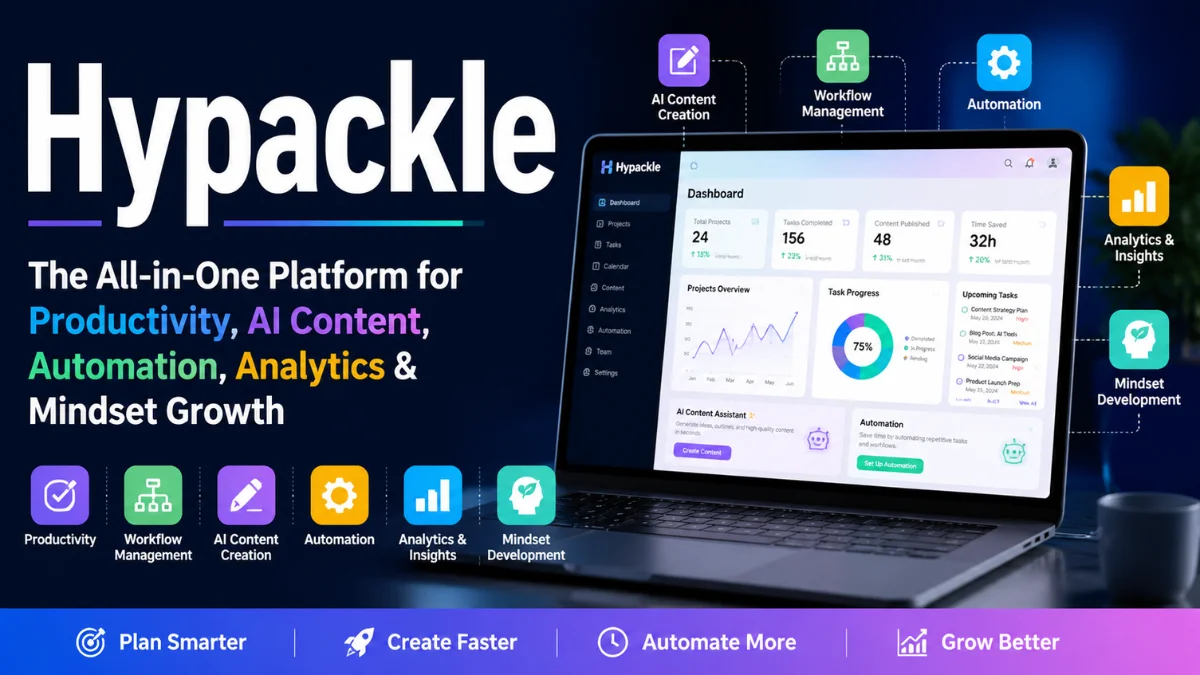
Hypackle is becoming an interesting name in the digital productivity space because it brings together several things people usually manage in separate tools: workflow planning, AI content creation, automation, analytics, and mindset development. I see its appeal clearly. Most people are not struggling because they lack tools. They are struggling because they have too many tools, too many tabs, too many half-finished ideas, and too little mental clarity.
That is where the idea of Hypackle starts to make sense. It is not only about working faster. Speed alone does not fix messy thinking. A person can write faster, schedule faster, and track faster, yet still feel scattered. A useful digital platform should help someone organise work, create better content, reduce repetitive tasks, understand performance, and stay mentally focused.
For creators, professionals, startups, and growing businesses, that combination matters. A creator needs ideas, structure, publishing support, and feedback. A business needs planning, team alignment, reporting, and consistency. A startup needs speed without losing direction. Hypackle is presented as a platform that tries to bring those needs into one connected digital environment.
What Is Hypackle?
Hypackle can be described as a digital platform built around modern work. It combines productivity support, workflow management, content creation, automation, analytics, and personal development into one broader system.
I would not reduce it to a simple task manager. That would miss the point. A basic task manager helps you remember what to do. A broader platform helps you understand what matters, how work moves, where time is wasted, and how content or projects can be improved.
The strongest idea behind Hypackle is connection. Instead of jumping between one app for planning, another for writing, another for scheduling, another for analytics, and another for team updates, users want a cleaner workspace. They want fewer disconnected systems and more practical clarity.
This is why Hypackle fits the current digital moment. Work has become fragmented. Creators manage blogs, videos, newsletters, social media, and brand partnerships. Businesses manage campaigns, teams, customers, reporting, and internal tasks. Professionals handle meetings, deadlines, documents, and constant communication. Without a central structure, everything becomes noise.
Hypackle is positioned as a way to reduce that noise.
Why Hypackle Matters in Modern Digital Work
The biggest problem in modern work is not laziness. It is an overload. People are surrounded by apps that promise efficiency, yet many of those apps create another layer of management. One tool stores ideas. One tracks tasks. One writes drafts. One schedules posts. One collects analytics. One manages team notes. After a while, the system built to save time becomes the thing consuming time.
I have seen this happen often. A person starts with good intentions. They create a content calendar, open a project board, add an automation tool, track analytics, and save ideas in a note-taking app. Within weeks, the workflow becomes too heavy to maintain. The result is not better productivity. It is digital clutter.
Hypackle matters because it responds to that exact frustration. The promise is not just “do more.” The better promise is “work with more clarity.” That is a stronger angle because serious creators and businesses do not only need output. They need direction.
A platform like Hypackle also matters because content and productivity are now deeply connected. Years ago, content creation was a separate marketing activity. Today, it touches almost every business function. Founders write LinkedIn posts. Agencies publish blogs. Coaches create newsletters. SaaS teams publish tutorials. Local businesses need SEO pages. Even personal brands need regular content to stay visible.
When content becomes part of daily work, the tools behind it must become smarter.
Hypackle as a Productivity Platform
Productivity is not about filling every hour with tasks. That is a common mistake. Real productivity is about choosing the right work, doing it in the right order, and finishing it without burning out.
Hypackle’s productivity angle appears to focus on helping users organise priorities, manage workflows, and track progress. That sounds simple, but it is valuable when done well. A clean productivity system should answer three questions quickly: What needs to be done? Who is responsible? What is blocking progress?
For solo creators, this can mean planning content ideas, setting deadlines, preparing drafts, and tracking publishing dates. For professionals, it can mean managing client work, internal tasks, reminders, and follow-ups. For startups, it can mean keeping small teams aligned without drowning in meetings.
The real benefit is visibility. When work is visible, people make better decisions. They stop guessing. They can see which task is urgent, which one can wait, and which one is not worth doing at all.
That last part matters. A strong productivity system should not only help users complete tasks. It should help them remove unnecessary tasks.
Workflow Management and Project Control
Workflow management is where many digital platforms either become useful or become annoying. A workflow should make work easier to move, not harder to understand.
Hypackle is positioned as a platform that supports workflow control. That means users can organise tasks, set priorities, manage project stages, and monitor progress. In practical terms, this could help teams move from scattered communication to a clearer process.
For example, a content team may start with topic research, then move into outlining, writing, editing, design, approval, publishing, and performance review. Without a workflow, people chase each other through messages. With a workflow, everyone can see where the content stands.
The same logic applies to business operations. A startup could use workflow planning to manage product updates, customer support tasks, marketing campaigns, or onboarding processes. A freelancer could use it to manage client projects from proposal to delivery.
The real value is reduced confusion. Confusion costs time. It also creates frustration. When people do not know what is happening, they either delay action or duplicate work. A tool that reduces that confusion can improve output without forcing people to work longer hours.
AI Content Creation Inside Hypackle
Content creation has become one of the biggest pressure points for modern professionals. Everyone needs content, but not everyone has time to write, plan, edit, and publish consistently.
Hypackle’s AI content creation angle is useful because it can support the early and middle stages of content work. That includes idea generation, outlines, draft structure, social post planning, blog development, and content repurposing.
Still, I would be careful here. AI content is not automatically good content. Lazy AI writing is easy to spot. It repeats ideas, uses generic phrases, and sounds like it was written for nobody in particular. If Hypackle is used properly, its value should be in supporting the human creator, not replacing judgment.
A serious content workflow still needs human experience. It needs examples, opinions, research, editing, and voice. AI can speed up the process, but the user must decide what is useful, what is weak, and what needs rewriting.
This is where Hypackle could be valuable for creators and marketers. It can help reduce the blank-page problem. It can help organise ideas faster. It can help turn rough notes into structured drafts. But the final quality still depends on the person using it.
Hypackle for SEO-Friendly Content Planning
SEO content is not just about putting keywords into an article. That approach is outdated and weak. Good SEO content needs search intent, structure, topical depth, readability, internal linking, useful headings, and clear answers.
Hypackle is positioned as useful for SEO-friendly content planning because it connects content creation with organisation and analytics. That matters because SEO is not a one-time writing task. It is a system.
A strong SEO workflow usually includes keyword research, competitor analysis, content briefing, writing, optimisation, publishing, internal linking, indexing checks, and performance review. If these stages are scattered across different tools, mistakes happen. Articles get published without a proper structure. Keywords are used badly. Internal links are forgotten. Performance is not reviewed.
A platform like Hypackle can help by keeping the content process more organised. Writers can plan topics. Marketers can track publishing schedules. Teams can review performance insights. Businesses can see which content supports growth.
For creators, this means fewer random posts and more intentional publishing. For businesses, it means content can become part of a wider digital marketing workflow rather than a disconnected activity.
Automation for Repetitive Work
Automation is one of the clearest reasons people look for smarter digital platforms. Repetitive tasks drain focus. They may be small, but they add up.
Scheduling reminders, updating task statuses, sending follow-ups, assigning recurring work, moving items between project stages, and collecting reports can all consume time. None of these tasks usually requires deep thinking, yet they interrupt the work that does.
Hypackle’s automation angle is useful because it can help users protect their attention. When routine tasks are automated, people can spend more time on strategy, creative thinking, client work, or problem-solving.
But automation should be used carefully. Bad automation creates more problems. If every small action triggers notifications, updates, and reminders, the system becomes noisy. Useful automation should remove friction, not create another layer of digital interruption.
The best use of automation is simple: automate what is repetitive, predictable, and low-value. Keep human attention for decisions that require judgment.
Analytics and Performance Insights
Analytics are where work becomes measurable. Without analytics, people rely on feelings. Sometimes feelings are useful, but they are not enough for content, marketing, or business decisions.
Hypackle is presented as including analytics and performance insights. That can help users understand what is working and what needs adjustment. For content creators, this might involve engagement, publishing consistency, audience response, or campaign performance. For businesses, it may support decision-making across marketing and operations.
The key benefit is feedback. A creator may think a certain topic is strong, but analytics may show that another topic brings better engagement. A business may believe a campaign is effective, but performance data may show weak results. Without measurement, improvement becomes guesswork.
Analytics also help with focus. When users know which activities produce results, they can stop wasting energy on low-impact work. That is especially important for small teams and startups because they cannot afford to spread themselves too thin.
However, analytics should not become an obsession. Not every valuable activity shows immediate numbers. Brand trust, authority, audience loyalty, and creative quality often take time. Good analytics should guide decisions, not control every move blindly.
Mindset Development and Mental Clarity
The mindset side of Hypackle is what makes it different from a standard productivity platform. Most tools focus on tasks. Hypackle is also associated with focus, clarity, creativity, and mental performance.
That matters because productivity problems are often mindset problems in disguise. A person may not be blocked because they lack a checklist. They may be blocked because they are overwhelmed, distracted, uncertain, or mentally tired.
Digital work demands constant decision-making. What should I write? What should I publish? Which task matters first? Is this campaign working? Should I reply now or later? Should I build, sell, edit, analyse, or plan? This constant decision load weakens focus.
A platform that supports mindset development can help users approach work more intentionally. It can encourage better planning, clearer priorities, and calmer execution. That is not soft or decorative. It is practical.
Mental clarity improves output. A focused creator writes better. A calm founder makes better decisions. A clear team communicates better. When people think better, they usually work better.
Hypackle for Creators
Creators are under pressure to produce more than ever. A single creator may need to plan videos, write captions, publish blogs, create newsletters, manage collaborations, respond to comments, track analytics, and stay consistent across platforms.
That is a lot of work for one person.
Hypackle can appeal to creators because it combines planning, content support, automation, and performance review. Instead of treating creativity as random inspiration, it can help creators build a repeatable system.
This does not mean creativity should become mechanical. The best creative work still needs personality, taste, timing, and originality. But structure helps. A creator who has organised ideas, scheduled tasks, drafted support, and analytics is less likely to disappear for weeks because the process has become too heavy.
For bloggers, Hypackle may help with topic planning, article outlines, SEO content workflows, and publishing consistency. For video creators, it may support scripting, content calendars, and repurposing ideas into posts. For social media creators, it may help organise campaigns and track engagement.
The biggest win is consistency. Most creators do not fail because they have no talent. They fail because they cannot maintain a sustainable content system.
Hypackle for Professionals and Teams
Professionals need clarity. Teams need alignment. Without both, work slows down.
Hypackle can support professionals by giving them a more organised way to manage tasks, deadlines, documents, content, and communication. This can be useful for marketers, developers, consultants, writers, designers, project managers, and business owners.
For teams, the value becomes even stronger. Team productivity depends on shared visibility. People need to know what is assigned, what is pending, what is approved, and what needs attention. If that information is hidden in messages or private notes, the team wastes time.
A connected platform can reduce unnecessary meetings. It can also reduce repeated questions. When the workflow is visible, people do not need to ask for updates every few hours.
For remote and hybrid teams, this is especially useful. Digital teams need systems that replace physical office visibility. Hypackle’s workflow and analytics positioning make it relevant for that kind of work environment.
Hypackle for Startups and Businesses
Startups move fast, but speed without structure becomes chaos. A startup may be building a product, managing customers, publishing content, testing campaigns, hiring people, and tracking growth at the same time.
Hypackle can appeal to startups because it promises a more unified way to manage work. Small teams often cannot afford complex enterprise systems. They need tools that are flexible, simple, and useful across different functions.
For businesses, Hypackle’s value may sit between productivity and marketing. A business does not only need internal organisation. It also needs visibility. That means content, SEO, social media, campaign tracking, customer communication, and reporting.
When these activities are connected, businesses can make better decisions. They can see how content supports marketing. They can track which workflows slow down delivery. They can automate routine tasks and free up time for higher-value work.
The main advantage is operational clarity. Businesses do not grow well when everything depends on memory, scattered spreadsheets, and random messages. They grow better when work has structure.
The Real Problem Hypackle Tries to Solve
The real problem Hypackle addresses is not simply productivity. It is fragmentation.
Fragmentation happens when ideas are in one place, tasks in another, drafts somewhere else, analytics in another dashboard, and team communication spread across several channels. The user spends more time connecting the work than doing the work.
That is the hidden cost of modern digital life. People think they are using efficient tools, but the tools often do not speak to each other in a meaningful way. The result is broken attention.
Hypackle’s all-in-one positioning is appealing because it tries to bring the pieces closer together. Planning, creating, automating, measuring, and improving should not feel like five separate battles.
The strongest platforms in the coming years will not be the ones with the longest feature lists. They will be the ones that reduce mental load. That is the standard Hypackle needs to meet if it wants to be taken seriously.
How to Think About Hypackle Before Using It
I would not recommend using any digital platform just because it sounds modern. That is how people end up paying for tools they barely use.
Before using Hypackle, I would ask a few practical questions. What problem am I actually trying to solve? Do I need better task management, better content creation, better automation, better analytics, or better focus? Am I looking for one platform because my current workflow is broken, or am I just chasing another tool?
That distinction matters. A platform cannot fix unclear goals. If a business has no content strategy, Hypackle may help organise the work, but it cannot magically create a strong strategy without human direction. If a creator has no publishing discipline, automation may help, but it will not replace commitment.
The smart way to approach Hypackle is to start with one clear use case. For example, use it first for content planning. Or use it for workflow management. Or use it for automation. Once the foundation works, expand from there.
Trying to use every feature at once is usually a mistake.
Benefits of Hypackle
The main benefit of Hypackle is simplicity through integration. When productivity, content creation, automation, analytics, and mindset support sit in one environment, users can reduce tool-switching and work with more focus.
Another benefit is better content consistency. For creators and businesses, consistency is often the difference between growth and invisibility. A platform that helps plan, draft, schedule, and review content can support long-term publishing habits.
Hypackle may also improve decision-making. Analytics can show users what works. Workflow visibility can show where projects slow down. Automation can reveal which repetitive tasks should no longer be handled manually.
The mindset element adds another layer. If users become more intentional about how they work, they may avoid burnout and scattered execution. That is valuable because many productivity systems fail when they ignore the human side of work.
Possible Limitations of Hypackle
No platform is perfect, and pretending otherwise would be poor writing. Hypackle’s biggest challenge is proving that its all-in-one promise actually works in practice.
Many platforms claim to combine everything. The danger is that they become wide but shallow. A tool may offer content creation, task management, automation, and analytics, but if each feature is weaker than dedicated alternatives, serious users may leave.
Another possible limitation is the learning curve. The more features a platform includes, the more carefully it must be designed. If the interface is confusing, users may feel overwhelmed instead of supported.
There is also the issue of content quality. AI content features can help, but they can also produce generic writing if users depend on them too heavily. Hypackle should be used as a support system, not as a replacement for expertise.
The final limitation is trust. For businesses, analytics, content, workflows, and automation may involve sensitive information. Any platform in this category must take privacy, reliability, and data protection seriously.
The Future of Platforms Like Hypackle
The future of work will not belong to people who simply use more tools. It will belong to people who build better systems.
Platforms like Hypackle represent a shift toward connected workspaces. Users want tools that understand the full cycle of digital work: plan, create, automate, publish, measure, and improve. That cycle is now central to creators, professionals, startups, and businesses.
The demand is clear. People want fewer scattered tools. They want better visibility. They want AI support without losing human control. They want analytics without drowning in dashboards. They want productivity without burnout.
If Hypackle can deliver on that balance, it has a strong place in the conversation around modern digital productivity.
Final Thoughts on Hypackle
Hypackle stands out because it is not presented as just another productivity tool. It is positioned as a broader digital platform for people who want to work with more clarity, create content more consistently, automate routine tasks, understand performance, and protect mental focus.
That combination is relevant because modern work is messy. Creators, professionals, startups, and businesses are dealing with more content, more platforms, more data, and more pressure than ever before. A tool that brings structure to that chaos can be useful.
My honest view is simple: Hypackle sounds valuable if it helps users reduce complexity. If it becomes another complicated dashboard, it misses the point. The real test is whether it helps people think clearly, act consistently, and improve their work without adding more noise.
If you are exploring Hypackle, start with one practical goal. Use it to organise your content workflow, manage a project, automate a repeated task, or review performance. The best next step is not to use every feature. The best next step is to use the right feature well.
FAQs
1. What is Hypackle?
Hypackle is presented as a digital platform that combines productivity, workflow management, AI content creation, automation, analytics, and mindset support.
2. Who should use Hypackle?
Hypackle is suitable for creators, professionals, startups, marketers, and businesses that want fewer scattered tools and clearer digital workflows.
3. Can Hypackle help with SEO content?
Yes, Hypackle can support SEO content planning by helping users organise topics, drafts, publishing workflows, and performance review.
4. Is Hypackle only a productivity tool?
No. Hypackle is positioned as more than a task manager because it also includes content creation, automation, analytics, and mindset development.
5. How should beginners start with Hypackle?
Beginners should start with one clear use case, such as content planning or workflow management, before using more advanced features.
Learn about Gmhiw

Julian Vane is a versatile writer at Wellbeing Makeover covering tech, health, and global culture. With years of experience across various industries, Julian brings a well-rounded perspective to lifestyle and business, helping readers stay informed and inspired in an ever-changing world.