
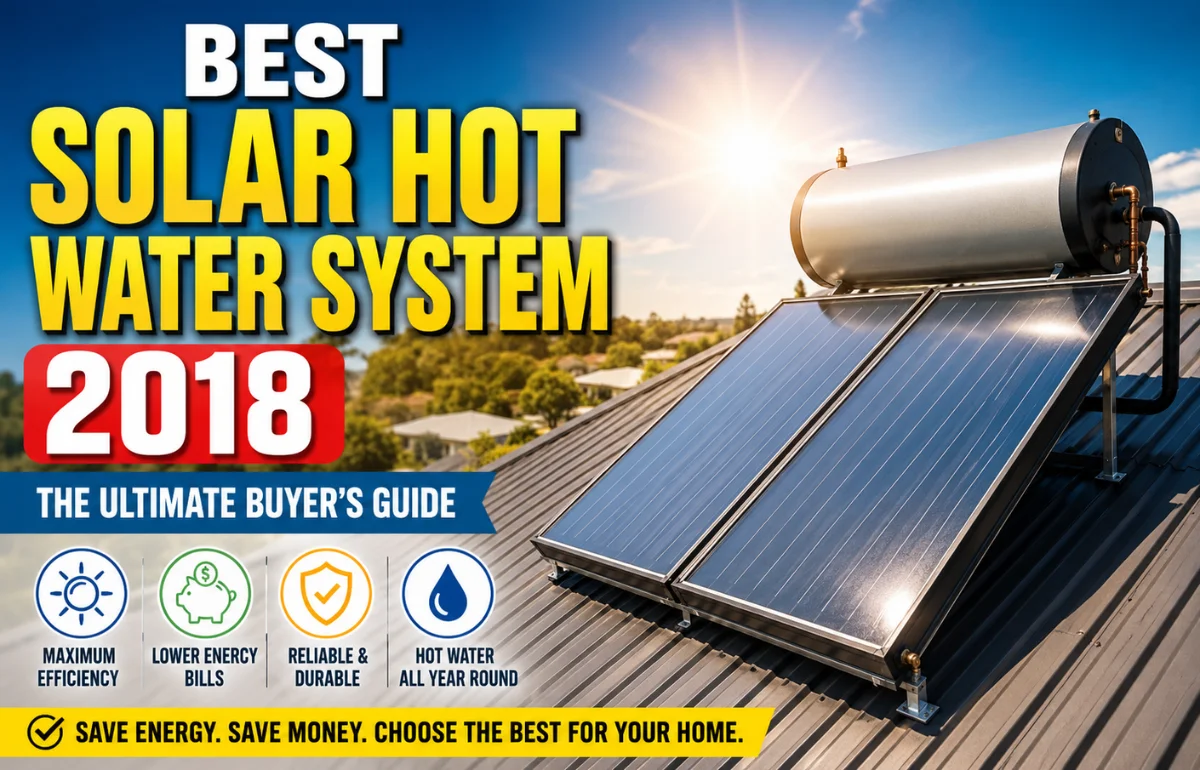
When someone asks me about the best solar hot water system 2018, I always tell them that it’s a fantastic question, but the answer isn’t a single product you can just buy off the shelf. The truth is, the best solar hot water system 2018 for your neighbor’s large family in a chilly climate might be completely different from the best solar hot water system 2018 for your small household in a sun-drenched part of the country.
After researching this topic extensively and helping dozens of homeowners navigate their options, I’ve learned that the market offers two clear frontrunners: flat plate collectors and evacuated tube systems. Your job is to figure out which technology makes the best solar hot water system 2018 for your unique situation.
Understanding which system delivers the best value and performance for your circumstances requires looking beyond marketing claims. It demands a deep dive into the technical differences, the installation requirements, and the long-term costs.
I’ve spent considerable time evaluating both technologies and speaking with installation professionals, and I’ve seen firsthand how making the right choice dramatically affects your satisfaction and savings. So, let’s break down exactly what you need to know to find the best solar hot water system 2018 for your home.
How Solar Hot Water Systems Work
Before we can determine the best solar hot water system 2018, it helps to understand the basic components and operation of a solar hot water system. All solar thermal systems share two major parts: the solar collector that captures heat from the sun, and the storage tank that holds the heated water.
The collector absorbs solar radiation and converts it to heat, transferring that heat to water or a heat-transfer fluid circulating through the system. In a typical installation, cold water from your mains supply enters the storage tank, where it’s heated by the collector before being distributed to your taps and appliances.
For most Australian homes, water heating accounts for a staggering 25% of total energy usage, making it the single largest contributor to your power bills. This is exactly why finding the best solar hot water system 2018 for your household is so critical—it directly tackles your biggest energy expense.
Solar hot water systems fall into two broad categories: passive and active systems. Passive systems rely on natural convection (thermosyphon) to circulate water, while active systems use pumps to move water or heat-transfer fluid between the collector and storage tank. Most modern Australian installations use active systems with a pump and controller, as these offer greater flexibility in collector and tank placement.
The storage tank is heavily insulated to minimize heat loss, and virtually all systems incorporate a booster element to ensure hot water availability during periods of low solar radiation. This booster might be electric or gas, and it typically activates automatically when the water temperature in the tank drops below a set threshold. When I was helping a friend in Melbourne choose her system, the booster was a key factor in her decision to select what she considered the best solar hot water system 2018 for her variable climate.
Flat Plate Solar Collectors: The Tried and True Choice

Flat plate collectors represent the traditional approach to solar water heating and remain a common contender for the title of the best solar hot water system 2018, especially for budget-conscious homeowners. These collectors consist of a flat, dark-colored absorber plate made of copper or aluminum, positioned beneath a glass cover. Copper tubes run across or through the plate, carrying water or heat-transfer fluid that absorbs the collected heat.
The glass cover creates a greenhouse effect, allowing sunlight to enter while trapping heat inside. This design has been refined over decades and offers reliable performance in most Australian climates. I’ve seen flat plate systems installed on homes across Sydney and Brisbane that have operated effectively for 20 years or more with minimal maintenance. Their longevity and proven track record make them a strong candidate for the best solar hot water system 2018 if you prioritize simplicity and durability.
The efficiency of a flat plate collector is highest when sunlight strikes it at a perpendicular angle. Since the collector surface is flat, this optimal condition occurs only around midday. Throughout the morning and afternoon, as the sun’s angle shifts, efficiency gradually decreases.
One of the most significant advantages of flat plate systems is their affordability. They typically cost 20 to 40 percent less than evacuated tube systems of similar capacity, making them attractive if your main goal is to find the best solar hot water system 2018 on a tighter budget. This lower upfront cost can substantially reduce the payback period and make solar hot water accessible to more households.
Flat plate systems also handle high water pressure well and are generally straightforward to install and maintain. Their robust construction withstands harsh weather conditions, and replacement parts are widely available through most plumbing suppliers.
However, flat plate collectors have notable limitations. They perform poorly in cold weather, as heat loss from the collector surface increases in low ambient temperatures. On overcast or cloudy days, their ability to capture diffused sunlight diminishes significantly compared to evacuated tube systems.
In frost-prone areas, they require careful freeze protection measures to prevent damage to the collector and piping. For a homeowner in Tasmania, a flat plate system might not be the best solar hot water system 2018 due to these cold-weather performance issues.
Evacuated Tube Solar Collectors: The Modern Efficiency Leader

Evacuated tube collectors employ more recent technology that has rapidly gained popularity in Australia and worldwide. Many experts consider this the best solar hot water system 2018 in terms of pure performance, particularly in less-than-ideal climates. These systems consist of parallel glass tubes mounted on a manifold, with each tube containing an inner absorber tube. The air between the inner and outer tubes is evacuated, creating a vacuum that acts as a highly effective insulator.
Inside each tube, a copper heat pipe contains a small quantity of fluid that vaporizes when heated. This vapor rises to the top of the tube, where it transfers heat to a manifold before condensing and returning to the bottom of the tube to repeat the cycle. Water circulates through the manifold, absorbing this heat before flowing to the storage tank. A friend of mine in Canberra, who experiences freezing winters, swears by his evacuated tube system as the best solar hot water system 2018 because it keeps working even when there’s frost on the roof.
The round shape of evacuated tubes allows them to capture sunlight from multiple angles throughout the day. As the sun moves across the sky, at least some tubes maintain a near-perpendicular orientation to the sun’s rays, resulting in more consistent heat collection from early morning to late afternoon. This means you get hot water earlier in the morning and later into the evening, a key advantage that makes it the best solar hot water system 2018 for households with unpredictable hot water usage patterns.
Where evacuated tube systems truly shine is their performance in less-than-ideal conditions. The vacuum insulation virtually eliminates heat loss from the absorber tubes, making these systems remarkably effective in cold, cloudy, or windy weather. In European studies, evacuated tube collectors have demonstrated efficiency gains of up to 104 percent over flat plate collectors in winter conditions. This superior performance in challenging weather is often the deciding factor for homeowners when choosing the best solar hot water system 2018.
The modular design of evacuated tube systems offers practical benefits as well. Individual tubes can be replaced separately if damaged, reducing repair costs compared to flat plate systems where damage often requires replacing the entire panel. Installation typically requires less labor, as a single person can handle the lightweight tubes, whereas flat plate collectors often require two or three installers due to their weight and bulk.
The primary downside of evacuated tube systems is their higher purchase price, typically 20 to 40 percent more than comparable flat plate systems. Some homeowners also find the appearance of the tubes less aesthetically pleasing than the clean lines of flat plate collectors, though this is increasingly subjective as evacuated tube designs have become more polished.
Flat Plate vs Evacuated Tube: Head-to-Head Comparison
To help you determine the best solar hot water system 2018 for your home, I’ve put together a comparison table of the key differences:
The research evidence is clear: evacuated tube collectors outperform flat plate systems in cold and overcast conditions, while flat plate systems offer better value in consistently warm climates with abundant sunshine. A recent study found evacuated tube collectors were 104% more effective than flat plate collectors during winter months. This is why, for many homeowners in southern states, an evacuated tube system is the best solar hot water system 2018, while those in northern Queensland often find a flat plate system provides the best solar hot water system 2018 value for their climate.
Split Systems vs Close-Coupled Systems

Beyond collector type, your solar hot water system configuration matters. Split systems place the collector on the roof while the storage tank sits at ground level, connected by insulated pipes. Close-coupled (thermosyphon) systems mount the storage tank directly above the collector on the roof.
Split systems offer greater flexibility in tank placement, which can be advantageous if your roof structure cannot support the weight of a full storage tank. The tank can be located in a garage or utility room, protecting it from extreme weather and simplifying maintenance access. These systems require a pump and controller to circulate water or heat-transfer fluid between collector and tank.
Close-coupled systems eliminate the need for a pump and controller, as they rely on natural convection to circulate water. As water heats in the collector, it rises to the tank, while cooler water from the tank flows down to replace it. This simplicity reduces initial cost and eliminates potential pump failures. However, the combined weight of the tank and collector on the roof requires careful structural assessment.
Thermosyphon systems are more susceptible to heat loss, as the tank is exposed to ambient conditions. Research has indicated that these systems can be the most cost-effective option when properly designed, though a reliable draindown technique for freeze protection remains a challenge in colder regions.
System Sizing: Getting It Right
Choosing the correct system size is essential for both performance and cost-effectiveness. An undersized system will rely too heavily on boosters, negating savings, while an oversized system wastes money on unnecessary capacity. Both scenarios mean you haven’t found the best solar hot water system 2018 for your needs.
Australian households typically use approximately 80 liters of hot water per person per day, though this varies significantly based on usage habits. A household of four might require a 200-300 liter tank, while a household of two could be comfortable with 100-150 liters.
Larger families with high hot water demand benefit from larger storage tanks, allowing them to collect and store more solar energy during sunny periods. Conversely, households that use most hot water in the evening might size their system to store sufficient hot water for the entire day’s use.
When I advise homeowners, I always recommend discussing their specific usage patterns with a qualified installer. Factors like the number of bathrooms, the presence of appliances like dishwashers and washing machines, and typical shower timing all affect optimal sizing. A good installer will perform a thorough assessment to help you find the best solar hot water system 2018 for your household.
Installation Considerations
Proper installation dramatically affects system performance. A well-designed and correctly installed system will outperform a technically superior system that has been poorly implemented. Even the best solar hot water system 2018 will fail to deliver savings if it’s not installed correctly.
Orientation and tilt are critical. In Australia, collectors should face north to capture the most sunlight throughout the day. The optimal tilt angle depends on your latitude, but installers typically adjust the mounting frame to achieve the best annual performance.
Shading is a significant performance killer. Even partial shading of the collector for part of the day can reduce annual output substantially. Trees, neighboring buildings, and even chimney stacks can create shading issues that should be evaluated before installation.
All pipes connecting the collector to the storage tank must be properly insulated to minimize heat loss and prevent freeze damage in colder regions. Pipe insulation also improves overall system efficiency by reducing the temperature drop as water travels from collector to tank.
Frost protection is essential in areas where temperatures drop below freezing. Without adequate protection, water expanding as it freezes can rupture pipes and destroy the collector, requiring expensive repairs or complete replacement. If you live in a frost-prone area, make sure any system you’re considering, which you believe to be the best solar hot water system 2018, has robust freeze protection built in.
Financial Considerations and Incentives
The financial case for solar hot water has strengthened significantly over the past decade. Government incentives and rising energy costs combine to make solar systems increasingly attractive investments.
In Australia, the Small-scale Renewable Energy Scheme provides small-scale technology certificates that can significantly reduce upfront costs. The number of certificates depends on the system’s location, size, and expected performance. Many installers offer upfront discounts in exchange for the right to claim these certificates.
State governments often provide additional rebates. In New South Wales, homeowners can receive up to $900 for replacing an electric water heater with a solar system, while gas-to-solar upgrades may qualify for $550.
Savings are substantial. The average household can reduce hot water energy costs by 50 to 80 percent with a properly sized and installed solar system. This translates to annual savings of $190 to $700 on energy bills. Over the system’s 20-year lifespan, the cumulative savings can reach $10,000 or more.
The break-even point for solar hot water typically occurs within 3 to 5 years, depending on local energy prices and available incentives. After that, the system essentially provides free hot water. When you factor in the rebates and long-term savings, the best solar hot water system 2018 often pays for itself much faster than you might think.
Heat Pump Systems: An Alternative Approach
While not a traditional solar thermal system, heat pumps deserve consideration as an energy-efficient hot water solution. Heat pumps extract heat from the surrounding air, much like a reverse-cycle air conditioner, and transfer it to water.
Heat pumps use approximately 75 percent less electricity than conventional electric resistance heaters, providing substantial energy savings. They operate effectively even when it’s cold outside, as there’s always some heat present in the air.
The Australian government officially categorizes heat pumps as solar water heaters for incentive purposes, as they utilize solar energy stored in the atmosphere. If you have rooftop solar panels, a heat pump can be programmed to operate during peak solar generation hours, further reducing costs.
Heat pumps cost less than traditional solar thermal systems and require no roof-mounted collectors. However, they produce a small amount of noise and have moving parts that may require maintenance or replacement. For some homeowners, a heat pump represents a more practical option than the best solar hot water system 2018 in the solar thermal category.
Common Mistakes to Avoid
Through my experience helping homeowners select solar hot water systems, I’ve identified several common pitfalls that prevent people from finding the best solar hot water system 2018 for their home:
Focusing solely on upfront cost: While budget matters, choosing the cheapest system often leads to higher operating costs and reduced performance. The best solar hot water system 2018 for you might cost a bit more upfront but save you more over the long term.
Ignoring climate considerations: A system designed for Queensland may be completely unsuitable for Melbourne or Hobart. Climate dramatically affects the performance of different collector types. The best solar hot water system 2018 in one location is not necessarily the best in another.
- Choosing the wrong size: An undersized system will disappoint; an oversized system will waste money. Work with an installer who performs detailed sizing calculations to ensure you get the best solar hot water system 2018 for your household size.
- Neglecting installation quality: The best system installed poorly will perform worse than a mid-range system installed well. Choose an experienced, licensed installer. A poor installation can ruin what should have been the best solar hot water system 2018 for your home.
- Forgetting about booster integration: The backup booster is essential for consistent hot water. Ensure your installer optimizes the booster for your specific situation, potentially integrating with solar PV if available.
?
Frequently Asked Questions
Q
Which is the best solar hot water system 2018 for cold climates?
Evacuated tube collectors are generally the best solar hot water system 2018 for cold climates because their vacuum insulation prevents heat loss and they continue performing efficiently on cold, overcast days.
Q
Are flat plate solar hot water systems cheaper to install?
Yes, flat plate systems typically cost 20-40% less than evacuated tube systems, making them the more affordable upfront option for homeowners looking for the best solar hot water system 2018 on a budget.
Q
How long do solar hot water systems last?
With proper maintenance, solar hot water systems typically last 20 years or more, making them a long-term investment regardless of which model you consider the best solar hot water system 2018.
Q
Can I install a solar hot water system on my own?
No, licensed plumbers and electricians must install solar hot water systems due to safety requirements, regulations, and the need for specialist knowledge. This applies regardless of which system you choose as the best solar hot water system 2018.
Q
What government rebates are available for solar hot water?
Australian homeowners can access Small-scale Technology Certificates through the Small-scale Renewable Energy Scheme, plus additional state-based rebates, which can reduce upfront costs by several thousand dollars on what you consider the best solar hot water system 2018.
Conclusion
The best solar hot water system 2018 depends entirely on your specific circumstances. Evacuated tube systems excel in cold, cloudy, or windy conditions and offer easier repairs, but cost significantly more. Flat plate systems provide excellent performance in warm climates at a much lower upfront price. The “best” system is the one that matches your climate, your household’s hot water usage patterns, and your budget.
Evaluate your local climate, household hot water demand, available roof space, and budget. Research available incentives and rebates in your area, as these can dramatically affect the value proposition. Obtain quotes from multiple licensed installers who specialize in solar hot water and can provide specific recommendations for your property.
The investment is significant, but the long-term savings and environmental benefits make it one of the most rewarding upgrades you can make to your home. To ensure you have the right support for your entire renovation journey—from selecting the perfect system to integrating it into your home’s design—it’s wise to speak with a renovation specialist who can offer guidance on the full scope of your project.
They can connect you with quality installers and help you navigate the decision process. For more detailed, customized support, consider our expert renovation assistance, which can help you plan your entire home efficiency upgrade. Finding the best solar hot water system 2018 is a fantastic first step toward a more comfortable, sustainable, and affordable home.
Other Solar Panel Resources
- Solar Power Hot Water System Price: Cost Guide 2026
- Solar Panel Hot Water System: Benefits, Costs & Guide
- Solar Hot Water System Price Guide: Costs & Savings

I’m Salman Khayam, the founder and editor of this blog, with 10 years of professional experience in Architecture, Interior Design, Home Improvement, and Real Estate. I provide expert advice and practical tips on a wide range of topics, including Solar Panel installation, Garage Solutions, Moving tips, as well as Cleaning and Pest Control, helping you create functional, stylish, and sustainable spaces that enhance your daily life.