
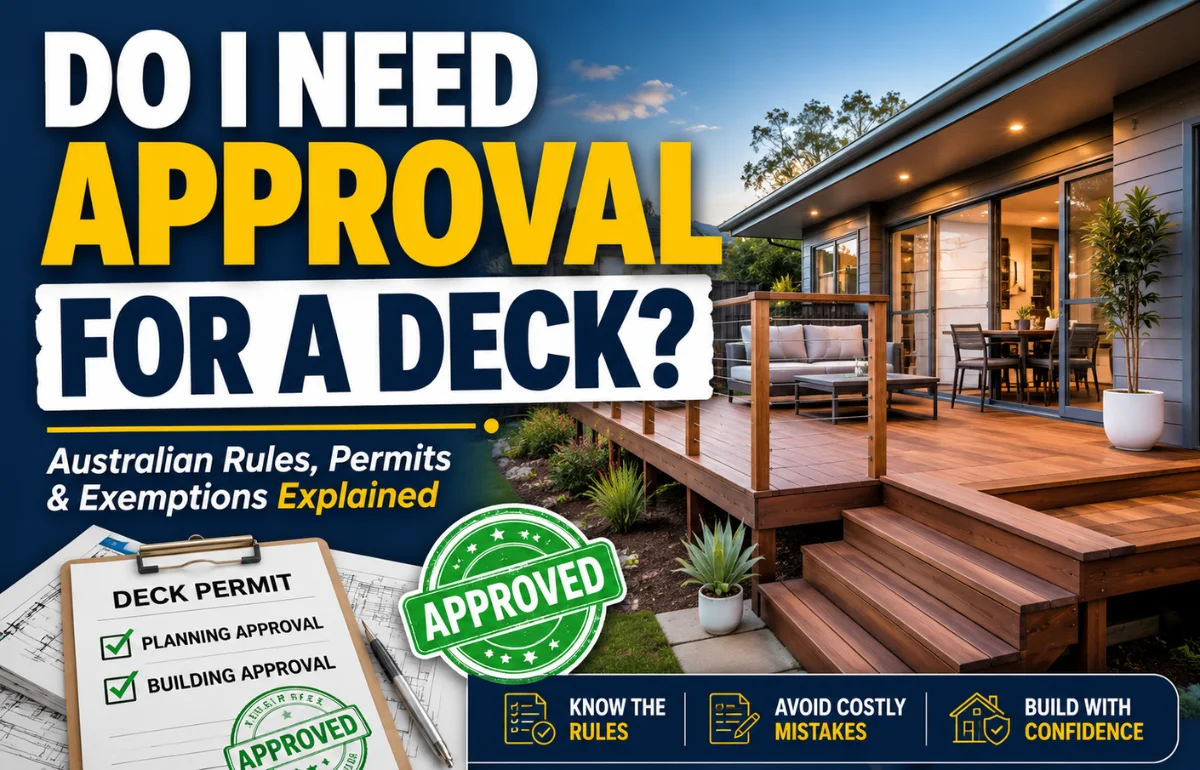
If you’ve been asking yourself, “Do I need approval for a deck?”, the short answer is: it depends — but more often than not, yes. In Australia, deck approval requirements are governed by a combination of state planning laws, local council rules, and the National Construction Code. Whether you need building approval, planning approval, or both comes down to your deck’s size, height, location, and what overlays apply to your property. This guide cuts through the confusion and gives you the practical, state-specific information you actually need before you break ground.
Why You Need Deck Approval — and Why It Matters More Than You Think
I’ve spoken with homeowners who skipped the approval process and genuinely believed their deck was too small to matter. A couple of them ended up with council orders to demolish structures they’d spent thousands building. That’s not a scare tactic — it’s what actually happens when you build without proper authorisation.
Deck approval isn’t bureaucratic box-ticking. It exists because an elevated, improperly braced deck can collapse. A deck built too close to a boundary can cause drainage issues for your neighbour. A deck constructed in a bushfire-prone area using the wrong materials can become a serious liability. The approvals process is designed to catch these problems before they become expensive disasters.
When you ask, “Do I need approval for a deck?” you’re really asking three separate questions:
- Do I need planning approval?
- Do I need building approval?
- Does my property have any overlays or constraints that change the answer?
In most Australian states, these are assessed independently, and the answer to one doesn’t automatically determine the answer to the other.
Planning Approval vs Building Approval: What’s the Difference?
This is where a lot of homeowners get tripped up, and it’s worth slowing down here.
What Is Planning Approval for a Deck?
Planning approval — sometimes called development approval or a planning permit — relates to land use and how a structure fits within its surrounding environment. It considers things like your property’s zoning, heritage status, character overlays, neighbourhood plans, and proximity to sensitive areas. Planning approval is administered by your local council or, in some states, a state planning authority.
You’re more likely to need planning approval for a deck if:
- Your property sits within a heritage or character overlay
- You’re in a bushfire management overlay or flood-prone zone
- The deck significantly changes the appearance or footprint of the property
- Your lot is in a neighbourhood plan area with specific development controls
What Is Building Approval for a Deck?
Building approval — also called a building permit — focuses on the structural and safety aspects of the deck itself. It confirms the design complies with the National Construction Code (NCC) and relevant Australian Standards. Building approval is typically issued by a licensed building certifier, not the council directly (though in some states, councils still play a role).
You’ll generally need building approval for any deck that:
- Exceeds certain size or height thresholds
- Is structurally connected to your home
- Is located in a cyclone or high-wind zone
- Has stairs, balustrades, or other safety-critical components that must be certified
Do I Need Approval for a Deck in My State? A Full Breakdown
Australia doesn’t have a single national answer to “Do I need approval for a deck?” Each state and territory sets its own thresholds. Here’s what the rules actually say where you live.
Do You Need Deck Approval in Queensland?
Queensland separates planning and building approvals, and Brisbane City Council has its own specific rules that differ slightly from those of regional councils.
For building approval in Brisbane specifically, you don’t need it if your deck:
- Has a plan area of no more than 10 square metres
- Sits no higher than 1 metre above natural ground level
- Is not roofed
- Has no side longer than 5 metres
- Does not affect the structural integrity of any existing buildings, retaining walls, or pool enclosures
If your deck doesn’t tick every one of those boxes, building approval is required. Regional Queensland councils may apply slightly different thresholds, so always check with your specific local authority.
Planning approval in Queensland kicks in if your property has a relevant overlay — such as the Traditional Building Character Overlay, a neighbourhood plan area, or if the deck involves more than minor building work.
Bushfire- and cyclone-affected properties in Queensland face additional requirements regardless of deck size or height.
Do You Need Deck Approval in New South Wales?
In NSW, a deck may qualify as exempt development — meaning no deck approval is needed — if it meets all of the following criteria under the State Environmental Planning Policy (Exempt and Complying Development Codes):
- Located behind the building line of any road frontage
- Set back at least 900mm from any boundary (or 5 metres in rural zones RU1–RU6)
- Area no greater than 25 square metres
- Enclosing walls no higher than 1.4 metres
- Floor no more than 1 metre above the existing ground level
- Maximum height of 3 metres at its highest point
If the deck is in a bushfire-prone area and any wall falls within 5 metres of a dwelling, the wall must be non-combustible. Fall outside any one of these conditions, and you’ll need a complying development certification or a full development application.
Do You Need Deck Approval in Victoria?
Victoria takes a different approach. The Victorian Building Authority (VBA) states that a building permit is required for any deck or verandah attached to a building, regardless of size. That’s a firm rule, not a guideline.
Detached decks that form part of the amenity of a building (essentially, any standalone deck that’s functionally connected to the home) also generally require a permit.
On top of that, if your property sits in an Environmental Significance Overlay, Significant Landscape Overlay, Erosion Management Overlay, or Salinity Management Overlay, a planning permit may be needed before any building permit can be issued.
Victoria’s takeaway: assume you need deck approval and confirm otherwise with your council.
Do You Need Deck Approval in Western Australia?
WA’s framework is shaped by the Residential Design Codes (R-Codes), which apply across all residential development in the state. Local governments can also apply their own policies that modify what’s deemed compliant.
As a rough benchmark used by some WA councils, low-level decks that stay under 500mm above ground and don’t exceed 20 square metres may be treated as not requiring development approval — but this is not a statewide standard. The R-Codes must be satisfied, and your local council’s policies take precedence.
Always verify with your local government before proceeding in WA.
Do You Need Deck Approval in South Australia?
In SA, whether you need approval for a deck is property-specific, determined by the Planning and Design Code. The PlanSA property lookup tool (sappa.plan.sa.gov.au) lets you check what applies to your specific address, including any overlays. Some decks may not require approval, but height, size, location, and zoning all factor in. There is no universal exemption threshold.
ACT, Tasmania, and Northern Territory
Each of these jurisdictions has its own exempt or low-risk development frameworks. They set individual thresholds based on size, height, siting conditions, and site-specific constraints. If those thresholds aren’t met, planning and/or building approval applies. Always check with your relevant territory or local authority before starting any deck project.
The Factors That Almost Always Trigger the Need for Deck Approval
Regardless of which state you’re in, certain conditions almost always mean you’ll need some form of approval. This is the part that catches people out because the deck itself might seem small or simple, but the site conditions override everything.
What Happens If You Build a Deck Without Approval?
Building an unapproved deck in Australia carries real consequences, and they’re worth understanding before you decide to “just get on with it.”
Councils have investigation powers and can require unapproved structures to be removed or rebuilt to a compliant standard. In NSW, illegal works can result in infringement notices and, in serious cases, significant financial penalties. Some matters end up in the Land and Environment Court.
From a real estate perspective, unapproved works must generally be disclosed when selling. Under Australian Consumer Law, knowingly concealing a material defect — including a deck built without approval — can expose a vendor to legal risk.
Insurance is another issue that doesn’t get enough attention. If your unapproved deck collapses, your home and contents insurer may deny the claim or significantly limit it on the basis that the structure was never properly certified.
The cost of doing it right upfront is always less than the cost of undoing it later. I’ve seen renovation projects stall at sale time because of unapproved decks, and the stress and expense of retrospective approval — if it’s even achievable — is genuinely painful.
What Most Deck Approval Guides Get Wrong
Most online resources tell you the thresholds — 10m², 1 metre height, and so on — but they don’t tell you something critical: the thresholds must all be satisfied simultaneously. Ticking four out of five conditions isn’t enough. Miss one, and the exemption doesn’t apply, and you do need approval for the deck.
They also rarely mention that overlays can override every other consideration. A deck that would normally be exempt in NSW can still require a development application if the property is heritage-listed or sits in a flood planning area. The property’s specific planning controls always take precedence over the general exemption criteria.
Another gap: the question of whether your deck is “attached” is interpreted more broadly than most people expect. A deck structurally connected to the home via a ledger board — even a small one — is generally considered attached and brings with it a different set of rules. In Victoria, that means a building permit is required automatically.
If you’re planning a renovation involving structural changes and want clarity before committing to a design, exploring expert renovation assistance can save you significant time and money before lodging anything with a council.
How to Get Approval for a Deck: The Process Explained
Once you’ve determined that deck approval is required, here’s how the process generally works.
Check Your Property’s Planning Controls First
Use your state’s online planning portal — City Plan online in Brisbane, NSW Planning Portal in New South Wales, PlanSA in South Australia — to identify your zoning, any overlays, and the specific development controls that apply. This step takes 15 minutes and can save months of backtracking.
Engage a Licensed Professional for Your Deck Approval
If your deck needs building approval, you’ll need a licensed building certifier (or in some states, a registered building surveyor). If it also requires planning approval, you may need a draftsperson, designer, or architect to prepare compliant drawings. Engaging these professionals before your design is finalised means you avoid designing something that needs to be redrawn from scratch.
Prepare Your Documentation
Building approval applications typically require site plans (showing the deck’s location on the lot), construction drawings (including footing layouts, framing plans, and cross-sections), and sometimes a structural engineer’s report for elevated or complex decks. Planning applications require a development application form, site plan, and supporting documentation relevant to any overlays.
Lodge Your Application and Wait
Timeframes vary. Simple deck approval applications in areas with low council workload can be turned around in a few weeks. Complex sites involving heritage overlays, flood zones, or referral to other agencies can take months. If a Request for Further Information (RFI) is issued during assessment, the clock pauses until you respond.
Build to the Approved Plans
Once approval is granted, the construction must match the approved drawings. Inspections are typically required at key stages — usually footing/substructure before the floor is laid, and a final inspection before the deck is used. Do not cover or progress past inspection hold points without sign-off.
Does Deck Material Affect Whether You Need Approval?
The question of whether you need approval for a deck is almost entirely about size, height, setbacks, and site constraints — not the decking material itself. Timber and composite boards are treated the same way from an approval perspective.
The exception is bushfire-prone areas. In BAL-rated zones, material selection directly affects compliance. Composite boards with appropriate BAL ratings can be used in certain bushfire conditions where untreated timber cannot. If your property has a BAL rating, material selection becomes part of the deck approval conversation, not just an aesthetic one.
For homeowners who want to understand how design choices interact with planning requirements before speaking to a certifier, renovation training resources offer a good starting point for building a solid baseline of knowledge.
Deck Approval Requirements by State: Comparison Table
Conclusion
The answer to “do I need approval for a deck?” in Australia is almost always “check before you build,” because the consequences of getting it wrong range from financial penalties to forced demolition. The approval framework isn’t designed to block homeowners from improving their properties — it’s designed to ensure those improvements are safe, structurally sound, and appropriate for their location.
Knowing your state’s thresholds is a starting point, but it’s your property’s specific planning controls — particularly overlays — that will determine whether an exemption applies or an application is required. Always confirm with your local council or a licensed certifier before purchasing materials or starting work.
If you’re at the early planning stage and want guidance on how to approach your project compliantly, speaking with a qualified professional early is always the right move.
Frequently Asked Questions
Do I need council approval for a small deck in my backyard?
Not always — in QLD, decks under 10m² at ground level may not need building approval, but planning approval could still apply depending on your property’s overlays.
Can I build a deck without a permit in Australia?
In limited circumstances, yes — some small, low-level decks qualify as exempt development, but every condition of the exemption must be satisfied simultaneously, and some states like Victoria require permits for all attached decks regardless of size.
What happens if I build a deck without approval in Queensland?
Council can require you to remove or rebuild the structure at your expense, issue infringement notices, and in serious cases, pursue court proceedings — plus unapproved works must typically be disclosed when you sell the property.
How long does deck approval take in Australia?
Simple applications in low-demand areas can take a few weeks, while complex sites involving overlays, heritage constraints, or referral requirements can take several months — delays most often occur when documentation is incomplete at lodgement.
Do I need a structural engineer for a deck?
Not always, but for elevated decks, large spans, sloped sites, or any deck in a high-wind or cyclone zone, a structural engineer’s report is typically required as part of the building approval documentation.
Other Resources
- Can I Build a Granny Flat on My Property? Complete Guide
- Do I Need Approval for a Carport? Rules & Permits Guide
- Can I Build a Shed Without Council Approval? Guide

I’m Salman Khayam, the founder and editor of this blog, with 10 years of professional experience in Architecture, Interior Design, Home Improvement, and Real Estate. I provide expert advice and practical tips on a wide range of topics, including Solar Panel installation, Garage Solutions, Moving tips, as well as Cleaning and Pest Control, helping you create functional, stylish, and sustainable spaces that enhance your daily life.