
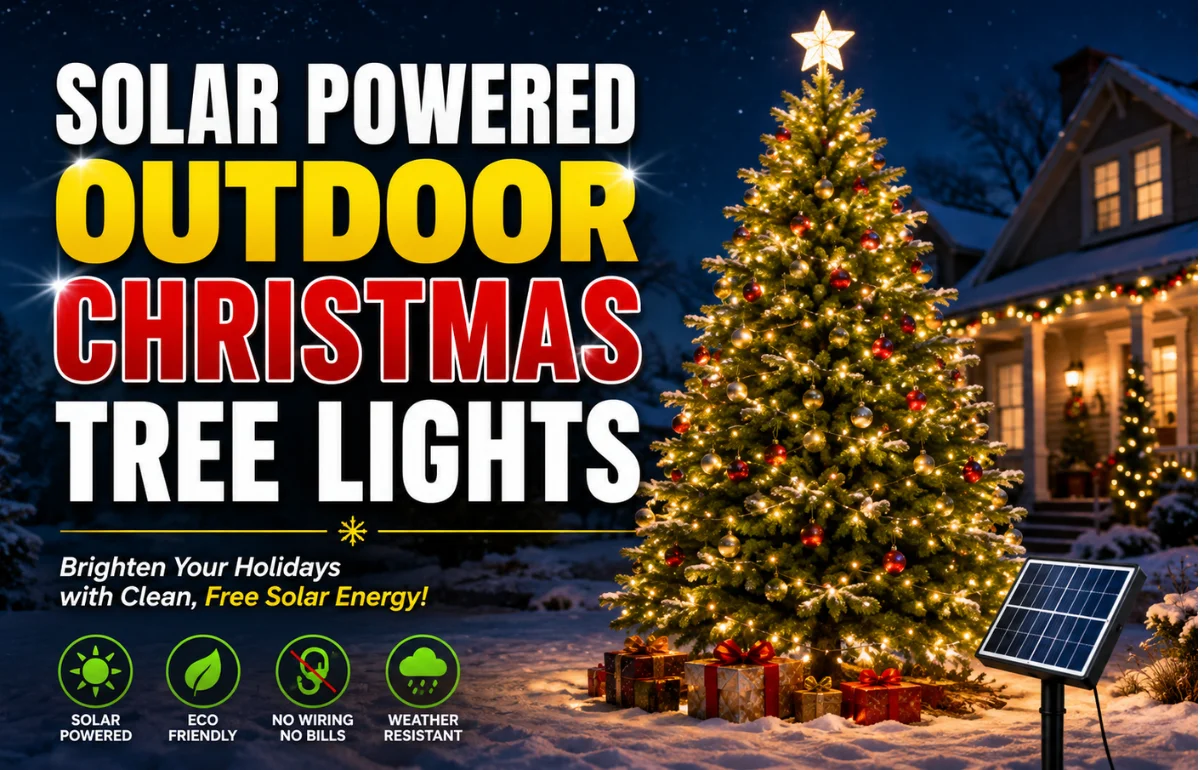
Solar powered outdoor christmas tree lights are string lights or decorative lighting sets that draw energy from a small photovoltaic (solar) panel, store it in a rechargeable battery during daylight hours, and automatically illuminate your outdoor Christmas tree after dark — all without a single electricity bill or extension cord. They come in a wide range of styles, from classic warm white fairy strings to multicoloured LED nets, icicle drapes, and even shaped motif lights. Because they run entirely off the sun, they offer a clean, cost-effective, and genuinely convenient way to decorate outdoor trees, gardens, fences, and porches during the festive season.
I’ve been decorating my outdoor space with solar Christmas lights for the past six years, and the difference they’ve made — both in how my garden looks on a December evening and how much I’m spending on electricity — is honestly remarkable.
Why Solar Powered Outdoor Christmas Tree Lights Have Taken Over Front Gardens
Walk down most residential streets in December, and you’ll notice something: a growing number of outdoor Christmas trees are glowing without a single power cable visible. That’s not magic — it’s solar. The shift has been gradual but consistent, driven by better battery technology, cheaper LED components, and a collective awareness that traditional plug-in lights quietly cost more than most people realise.
A standard set of 200 plug-in incandescent lights running for eight hours a night across a 30-day festive season can add a noticeable amount to your energy bill. Solar string lights eliminate that cost entirely. Once you’ve bought them, the sun does the rest.
But beyond cost, there’s the sheer freedom. No extension cords trailing across wet grass. No worrying about outdoor socket safety in the rain. No scheduling lights on a timer and forgetting to adjust it when sunset shifts. Modern solar Christmas lights handle all of that automatically.
How Solar Powered Outdoor Christmas Tree Lights Actually Work

Understanding the mechanics helps you choose the right product and set it up correctly, which a lot of buyers skip — and then wonder why their lights aren’t performing.
The Solar Panel: Powering Your Outdoor Christmas Tree Lights
The panel is the heart of the system. It converts sunlight into electrical energy through a photovoltaic process. Most solar Christmas light panels are small — typically between 1.5W and 3W — which is sufficient for powering a string of 100–400 LEDs for six to ten hours. The panel needs to be placed where it receives direct or near-direct sunlight for at least six to eight hours during the day.
One mistake I made early on: I placed the panel under the overhang of a garden canopy because it looked tidier. The lights barely lasted three hours each night. Moving the panel to an open, south-facing patch of garden completely changed the performance.
The Rechargeable Battery in Solar Christmas Tree Lights
Most sets use AA or AAA NiMH (nickel-metal hydride) batteries built into or connected to the control box. These batteries degrade over time — typically lasting two to four seasons before capacity drops noticeably. The good news is that most manufacturers design their control boxes to accept standard replaceable batteries, so you don’t need to buy a whole new set.
The Light-Sensing Switch
Nearly all solar Christmas lights have a built-in dusk-to-dawn sensor. When light levels drop below a threshold, the switch activates and the lights turn on automatically. This is why your lights will also flicker on inside a dark shed or if the panel is covered — it’s just the sensor responding.
Choosing the Right Solar Powered Outdoor Christmas Tree Lights

This is where most buyers get overwhelmed. The market is flooded with options at every price point, and the specs can look meaninglessly similar. Here’s what actually matters.
LED Count and Coverage for Outdoor Christmas Tree Lights
For a typical 6-foot outdoor artificial Christmas tree, you’ll want at least 200 LEDs to achieve a full, lush look. For a 7–8 foot tree, aim for 300–400. For a large garden feature tree or hedge, 500+ or multiple linked strands work better.
Most manufacturers express coverage in metres rather than LED count. A 10-metre string with 100 LEDs will look noticeably sparser than a 10-metre string with 200 LEDs.
Battery Capacity (mAh)
This is the single most overlooked spec. A panel might receive eight hours of good winter sun but if the battery is only 600mAh, your lights will dim or cut out well before midnight. Look for at least 1200mAh for a basic set, and 2000mAh+ for longer run times or if you live somewhere with short, overcast winter days.
IP Rating
For outdoor use, you need a minimum of IP44 (protected against splashing water from any direction). IP65 is better — it’s rated for low-pressure water jets, which effectively means heavy rain won’t cause problems. Some bargain sets sold as “outdoor” carry no IP rating at all, which is a red flag.
Lighting Modes
Almost every solar Christmas light set now comes with multiple modes — steady on, slow fade, twinkle, flash, wave, and combinations thereof. For a Christmas tree, I personally prefer either steady warm white or a gentle slow-fade. The rapid-flash modes can be visually irritating and may not be suitable for households with photosensitive individuals.
Comparison Table: Solar vs Plug-In Outdoor Christmas Tree Lights
Solar Powered Outdoor Christmas Tree Lights: Real-World Performance

Most reviews of solar powered outdoor christmas tree lights focus on ideal conditions. I want to be more useful than that.
Winter Sun Is Weak: What That Means for Solar Christmas Tree Lights
In December, the sun sits low on the horizon and daylight hours are short. Even on a clear day, a solar panel at a low angle receives significantly less energy than in summer. This means that in northern latitudes especially, your battery may not reach full charge during a cloudy week. Keeping the panel tilted at roughly 45–60 degrees and pointed south (in the northern hemisphere) maximises the limited winter sun available.
Some premium solar Christmas light sets now include a USB backup charging port on the control box. This is a feature worth paying extra for — it means you can top up the battery via a USB adapter on days when the sun simply doesn’t cooperate.
The First Night Is Always the Best
When you unbox a new solar light set, the batteries are typically pre-charged from factory testing. Your first night will often be the best performance you see until you’ve had a full sunny day of recharging. Don’t judge the product by that first night.
Cold Weather and Solar Powered Christmas Tree Lights: Battery Facts
NiMH batteries lose capacity in cold temperatures. A battery rated at 1800mAh in a warm environment may effectively behave like a 1200mAh battery at 0°C. This is physics, not a product defect. If you’re decorating in a region that regularly sees sub-zero December nights, buying a set with a higher battery capacity than you think you need is the right approach.
How to Install Solar Powered Outdoor Christmas Tree Lights

Installation is refreshingly straightforward compared to mains-powered sets, but there are a few things worth doing properly when setting up solar powered outdoor christmas tree lights.
Start by identifying where the sun hits most directly in your garden during the day — typically an open, unshaded area facing south (or north if you’re in the southern hemisphere). The solar panel cable on most sets is 3–5 metres long, giving you reasonable flexibility in positioning.
Wrap your lights around the tree from the trunk outward, working in a spiral from bottom to top. Keep the spacing even and avoid bunching — solar LED sets are fixed arrays, not adjustable incandescent strings, so bunching wastes coverage.
Fix the solar panel in the ground with the included stake, pointing it at your best sun angle. Don’t point it at a wall or fence, even a white one. Some homeowners use a small adjustable panel bracket available at hardware stores, which lets you fine-tune the angle seasonally.
If you’re undertaking a broader garden or outdoor property refresh to frame your festive display, exploring professional property improvement solutions can help you get the structural and landscaping elements right before you add the lighting layer.
Maintenance Tips to Keep Your Solar Christmas Tree Lights Lasting Longer
A well-maintained solar Christmas light set can last four to six seasons. Here’s what actually extends the life:
Clean the Panel Regularly
Dust, bird droppings, and debris significantly reduce panel efficiency. Wipe the panel gently with a damp cloth once a week during the festive season and whenever you notice performance dropping.
Store Correctly Off-Season
When the season ends, remove the batteries from the control box before storage. NiMH batteries stored at partial or full charge in a cool, dry place retain capacity much better than batteries left in a device for months. Store the lights loosely coiled — wrapping them tightly around a spool stresses the wire insulation over time.
Replace Batteries Proactively
Don’t wait until your lights are only lasting two hours before replacing the batteries. If you notice a 20–30% reduction in run time compared to when the set was new, it’s time. Fresh batteries are typically a few pounds and immediately restore full performance.
The Environmental Case for Solar Powered Christmas Tree Lights
The environmental case for solar powered outdoor christmas tree lights is more nuanced than marketing copy suggests.
LEDs themselves are dramatically more efficient than incandescent bulbs — typically using 80–90% less energy for the same light output. Solar eliminates operational carbon entirely during use. The manufacturing footprint of the solar panel and battery does carry an environmental cost upfront, but this is offset across multiple seasons of use.
One aspect I’ve not seen discussed widely: at end of life, NiMH batteries should be recycled through a designated collection point rather than landfilled. Most large supermarkets and electronics retailers operate battery recycling bins. The solar panel itself can typically be recycled through local authority WEEE (Waste Electrical and Electronic Equipment) schemes.
If you’re interested in going further with sustainable property improvements beyond seasonal lighting, there’s excellent property improvement training available that covers energy efficiency and sustainable outdoor design in more depth.
Other Ways to Use Solar Powered Outdoor Christmas Tree Lights in Your Garden

Solar powered outdoor christmas tree lights are versatile beyond a single tree. From my own garden and from what I’ve seen work well for others:
- Garden archways and pergolas take on a genuinely magical quality with solar fairy lights woven through them. Because there’s no cable to route, you can run lights all the way around without creating a hazard.
- Hedges and topiary look spectacular with solar net lights draped over them — the uniform grid of LEDs gives an even glow that string lights struggle to replicate on rounded shapes.
- Fence lines with solar icicle lights give a dramatic border effect that looks particularly striking when there’s frost or snow on the ground.
- Outdoor planters and urns near doorways can be wrapped with solar micro-LED strings — the thin wire versions — for a subtle, elegant entry-level display without any power cable visible.
Frequently Asked Questions
How long do solar Christmas lights stay on at night?
Most quality solar Christmas light sets run for six to ten hours on a full charge. Performance depends on battery capacity, the number of LEDs, and the chosen lighting mode — steady modes use more power than twinkling or flashing modes.
Can solar Christmas lights charge on cloudy days?
Yes, but with reduced efficiency. Photovoltaic panels generate electricity from daylight, not direct sunshine, so they do charge on overcast days — just more slowly. After several consecutive cloudy days, run time may be noticeably shorter.
Do solar Christmas lights work in cold weather?
They do, though battery performance decreases in cold temperatures. NiMH batteries lose some effective capacity below freezing, so lights may not run as long on very cold nights. Choose sets with higher battery capacity if you live in a cold region.
Can I leave solar Christmas lights out in the rain?
Provided the lights carry a minimum IP44 rating, yes — they’re designed for outdoor use in all typical weather conditions. Avoid submerging the control box or panel, and check that any connections are properly sealed.
Why are my solar Christmas lights not turning on?
The most common causes are: the panel not receiving enough sunlight during the day, the on/off switch being in the off position, depleted or failing batteries, or the sensor being triggered prematurely by a nearby light source. Check each of these in order before assuming the product is faulty.
Making the Switch to Solar Powered Outdoor Christmas Tree Lights This Season
Solar powered outdoor christmas tree lights have genuinely matured as a product category. The early reputation for dim, short-lived performance was earned — but it no longer applies to well-specified modern sets. Choose based on battery capacity, IP rating, and LED density rather than price alone, position your panel where the winter sun actually reaches, and you’ll have a display that runs reliably and looks beautiful from dusk to well past midnight.
If you’re decorating a proper outdoor tree or planning a broader garden display this Christmas, the investment in a quality solar set pays itself back in the first season and keeps giving for years. And if you’re thinking bigger — about creating an outdoor space worth decorating in the first place — that’s the right place to start.
More Solar Panel Interesting Resources
- Solar Powered Christmas Lights for Outside Guide
- Best Solar Hot Water System 2018 Guide
- Solar Power Hot Water System Price: Cost Guide 2026

I’m Salman Khayam, the founder and editor of this blog, with 10 years of professional experience in Architecture, Interior Design, Home Improvement, and Real Estate. I provide expert advice and practical tips on a wide range of topics, including Solar Panel installation, Garage Solutions, Moving tips, as well as Cleaning and Pest Control, helping you create functional, stylish, and sustainable spaces that enhance your daily life.