
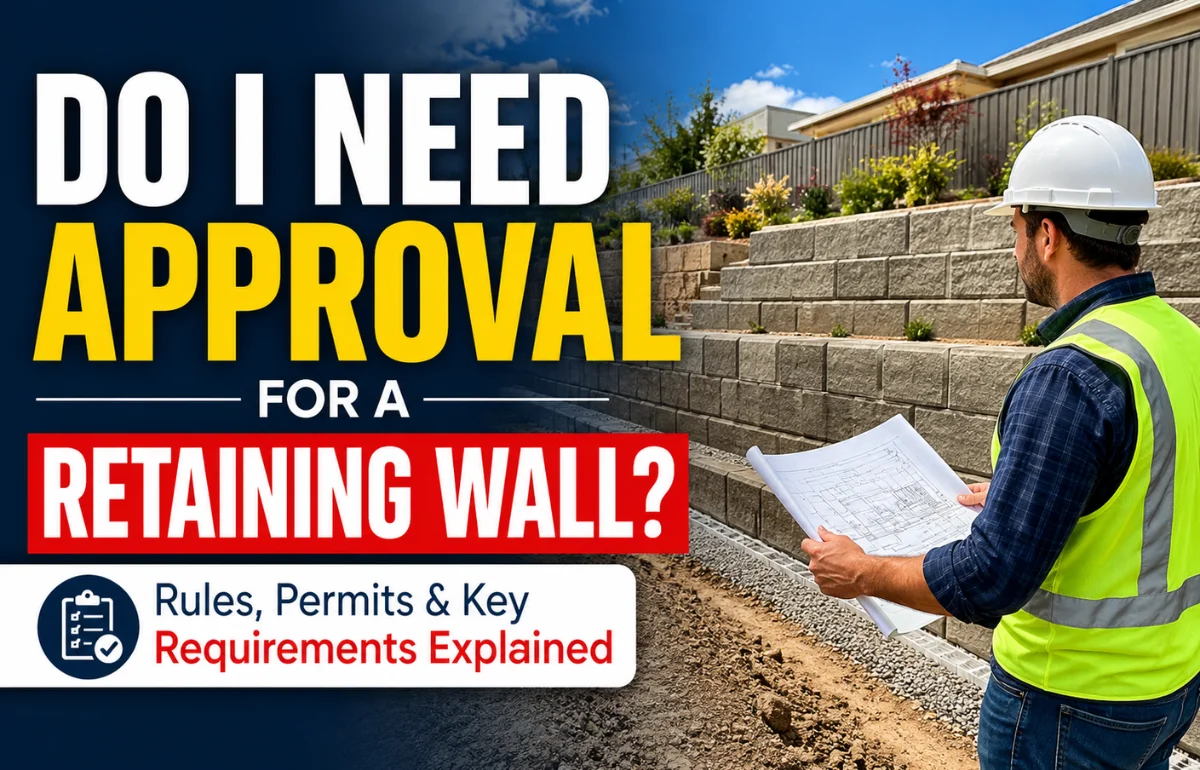
If you’re asking “Do I need approval for a retaining wall?”, here’s the short answer: it depends on the height, location, and what your wall is supporting. In Australia, retaining walls under one metre high that meet specific setback and load requirements are generally exempt from both planning and building approval.
Anything above that threshold — or near a boundary, an easement, or a structure — typically requires formal approval from your local council or a licensed building certifier.
The rules vary slightly from state to state and even between local government areas, so getting the specifics right before you break ground is not just good practice — it’s the difference between a compliant build and a costly rebuild.
What Is a Retaining Wall, and Why Does It Need Approval at All?

A retaining wall is any structure built to hold back soil that wouldn’t otherwise remain stable on its own. On sloping blocks — which are extraordinarily common across Queensland, New South Wales, and Victoria — retaining walls are practically a rite of passage for homeowners. They carve out flat usable space, prevent soil erosion, protect neighbouring properties, and can genuinely transform a yard that felt unusable.
The reason approval exists at all isn’t bureaucratic box-ticking. Retaining walls, when they fail, don’t just look bad — they can collapse onto neighbouring properties, damage buried services, redirect stormwater in dangerous ways, and create significant legal liability for homeowners. I’ve spoken to builders who’ve dealt with retaining walls built without any engineering input, and the stories aren’t pretty. A wall that looks solid and well-built can be carrying hidden structural stresses that only emerge under heavy rain or soil saturation.
So the approval process is really a safety net — for you, for your neighbours, and for the integrity of your land.
The One-Metre Rule: What It Means and Why It’s Not That Simple
The most widely quoted rule in Australian retaining wall regulation is the one-metre threshold. Walls under one metre in total height generally don’t require building approval, provided they meet a set of additional conditions. But I want to be honest with you here: many homeowners read “one metre” and assume their project is automatically in the clear. That’s where things can unravel.
In Queensland, for example, the Building Regulation 2021 specifies that a retaining wall doesn’t need building approval only if it meets all of the following conditions simultaneously:
- The total wall height — including the fill or cut being retained — is no more than one metre above the natural ground level
- There is no “surcharge loading” over the “zone of influence” (meaning no driveway, fence, building, or other structure is sitting above or near the retained soil)
- The wall is at least 1.5 metres away from any existing building or another retaining wall
- The wall does not form part of the boundary fencing for a swimming pool
That’s quite a specific set of requirements, and in practice, a lot of residential retaining wall projects fail at least one of them. If you’ve got a driveway running along the top of where your wall will sit, or if your fence will be mounted directly on the wall, you’re almost certainly in building approval territory — regardless of height.
The same logic applies in New South Wales, where the Exempt Development Code under the State Environmental Planning Policy (Exempt and Complying Development Codes) 2008 sets similar height and setback conditions. In Victoria, the relevant residential code likewise draws the line at one metre, with comparable caveats around boundaries and loads.
Planning Approval vs. Building Approval: Understanding the Difference

This is a distinction that catches a lot of homeowners off guard — and one that a surprising number of online articles gloss over entirely. There are actually two types of approval that may apply to your retaining wall, and they’re separate processes.
Planning approval relates to how your wall interacts with land use, zoning, and environmental overlays. You typically don’t need planning approval for a standard residential retaining wall under one metre. However, if your property sits within a heritage overlay, a flood-prone area, a bushfire risk zone, a waterway corridor, a wetlands overlay, or a biodiversity-sensitive area, planning approval may be required regardless of height. In Brisbane, for instance, the City Plan 2014 identifies a range of overlays that can trigger a development application even for relatively modest earthworks.
Building approval is about structural compliance and safety. This is handled by a licensed private building certifier or your local council’s building department, and it focuses on whether the physical structure of your wall meets the relevant building codes and standards, including the National Construction Code and the Queensland Development Code NMP 1.7 (for Queensland projects).
If your project needs building approval, you’ll need to supply scaled and detailed plans prepared by a draftsperson or architect, and in many cases, structural engineering documentation. Your certifier will conduct periodic inspections during construction, not just review the paperwork at the start.
The practical upshot: always check both streams of approval, not just one.
When You Definitely Need Approval: A Clear Breakdown
Rather than leaving this as a vague checklist, I want to lay out the specific circumstances where approval is unambiguously required — because the grey areas are where mistakes happen.
Height Above One Metre
Any retaining wall that exceeds one metre in total retained height needs building approval. That measurement includes the depth of cut or fill being managed, not just the visible face of the wall above ground.
Walls Supporting a Structure or Load
If your retaining wall is bearing any kind of load above it — a driveway, a fence, a deck, a shed, or a building — it is classified as a structural element, and building approval is required. This applies even if the wall itself is under one metre.
Proximity to a Property Boundary
Most councils have specific setback requirements for retaining walls near side and rear boundaries. In many Gold Coast and Brisbane local government areas, a minimum 600mm clearance from a side boundary is required. Walls built on or very close to a boundary almost always trigger a referral to the neighbouring property owner and may require formal approval.
Proximity to Sewer Lines, Stormwater Drains, or Easements
Building within one metre of a sewer main, water main, or registered easement is typically prohibited without formal approval and, in many cases, a referral to the relevant utility authority. Getting this wrong doesn’t just mean a fine — it can mean excavating and rebuilding at your own expense.
Walls Near Water Bodies
In Queensland, a retaining wall must generally sit at least 50 metres from a natural body of water unless appropriate approvals are in place. Walls that could redirect stormwater or alter drainage patterns toward a waterway are particularly scrutinised.
Terraced or Tiered Walls
This is one of the most commonly misunderstood situations in residential landscaping. Many homeowners build a series of smaller walls — each under one metre — in a tiered formation, reasoning that since no individual wall exceeds the threshold, no approval is needed. However, in most Australian jurisdictions, tiered walls that collectively retain more than one metre of fill are assessed as a single structure. The combined height is what matters.
Comparing Retaining Wall Approval Requirements by State
Note: These represent general rules. Always confirm specific requirements with your local council before commencing work.
What the Approval Process Actually Looks Like
If your project does require approval, the process is straightforward when you understand what’s involved. Here’s how it typically unfolds for a residential retaining wall in Queensland:
Site Assessment and Design
This is where you engage a structural engineer or a specialist retaining wall contractor to assess the site — soil type, slope angle, drainage patterns, proximity to structures and boundaries. The outcome is a set of engineering plans that will form the backbone of your approval application.
Engineering Certification
In Queensland, a qualified structural engineer must prepare a Form 15 (Design), which certifies that the wall design meets all relevant standards. This document is submitted as part of the building approval application.
Building Approval Submission
Your plans and Form 15 go to a licensed private building certifier. They assess compliance against the Building Act 1975, the Building Regulation 2021, and the National Construction Code. For more complex projects — particularly those near waterways or in overlay zones — a referral to the local council may also be required.
Construction and Final Inspection
Once approval is granted, construction can begin according to the certified plans. On completion, your certifier returns to conduct a final inspection and issues a Form 16, which records that the wall was built as specified. This document is essential if you ever sell the property.
What Happens If You Build Without Approval?
This is worth being direct about. Building a retaining wall without the required approvals is a building offence in every Australian state. The consequences can range from a formal compliance notice requiring you to obtain retrospective approval, to a demolition order if the wall can’t be brought into compliance. Retrospective approvals are generally available — at TSC Group and similar certification bodies, for example — but they typically cost more than getting it right the first time, and they’re not guaranteed.
Beyond the regulatory risk, there are practical financial consequences. When you go to sell your property, a conveyancer or solicitor will look at the building records. An unapproved retaining wall can stall a sale, reduce your sale price, or become a point of negotiation that works against you. It can also affect your home insurance coverage if a wall-related incident occurs.
If you’re planning a broader property improvement project — including landscaping, drainage upgrades, or structural changes — it’s worth exploring your full range of property improvement solutions before committing to a single component in isolation.
Drainage: The Detail That Determines Whether Your Wall Lasts
One aspect that gets surprisingly little attention in approval discussions — but that matters enormously in practice — is drainage. A structurally sound, fully approved retaining wall will still fail prematurely if water has nowhere to go behind it.
Hydrostatic pressure is the force water exerts against the back of a retaining wall when it has no exit. After prolonged rainfall, saturated soil becomes significantly heavier and exerts dramatically more force than dry soil. Without adequate drainage — typically in the form of agricultural drainage pipes, weep holes through the wall face, or a gravel backfill layer — that pressure builds until something gives.
I’ve seen beautifully constructed walls with good engineering certificates crack and lean within a few years simply because the drainage solution was inadequate. In most council guidelines, and certainly in Queensland’s approval conditions, stormwater must be captured and directed either to the kerb or to an approved stormwater system. It absolutely cannot be concentrated and discharged onto a neighbouring property. This isn’t just a compliance requirement — it’s fundamental to the wall doing its job long-term.
When you’re assessing quotes from contractors, ask specifically how they plan to manage water behind the wall. A contractor who can’t give you a clear answer about drainage is one worth being cautious about.
Practical Tips Before You Start Any Retaining Wall Project

From experience, a few practical steps save a lot of headaches:
Pull your property’s overlay maps before doing anything else. In Brisbane, the City Plan’s online tool lets you check zoning, overlays, and any recorded easements on your property in a matter of minutes. NSW and Victoria have equivalent tools through their state planning portals. Knowing this before you call a contractor means you arrive at that first conversation with genuinely useful information.
Don’t measure the wall face and assume that’s the height. Height is measured from the lowest natural ground level to the top of the retained fill. If you’re cutting into a slope and filling behind the wall, both the cut and fill dimensions contribute to the regulated height. I’ve encountered homeowners who measured 900mm at the front of the wall and assumed they were under the threshold — only to find the total retained height from the cut side was closer to 1.4 metres.
Talk to your neighbours early. Walls near shared boundaries have a way of becoming disputes if the neighbour is surprised. A simple conversation upfront — and ensuring stormwater isn’t being redirected onto their land — prevents most of the friction and occasionally surfaces useful information, like where shared service lines are buried.
Get a licensed professional for anything over 600mm. Even for walls that technically fall below the approval threshold, having a qualified builder or engineer cast an eye over your design is cheap insurance. The cost of an hour’s consultation is nothing against the cost of rebuilding a failed wall.
Understand your soil type before you finalise the design. Reactive clay soils — common across large parts of Queensland and Victoria — expand significantly when wet and contract in dry conditions. This movement exerts additional lateral pressure on retaining walls and influences both the design specifications and the drainage strategy. A soil test is inexpensive and eliminates a major unknown from the equation.
If you’re someone who enjoys understanding the technical and regulatory side of home projects more deeply, some well-structured home makeover courses can genuinely sharpen your knowledge of what’s involved in compliant residential construction before you commit to a contractor.
Frequently Asked Questions
How high can a retaining wall be without council approval in Australia?
In most Australian states, retaining walls under one metre high are generally exempt from building approval, provided they also meet setback, load, and location conditions. Always verify the specific rules with your local council, as requirements differ between jurisdictions.
Do I need an engineer for a retaining wall under 1 metre?
Not legally in most cases, but it’s still strongly advisable for any wall above 600mm — especially on reactive soils or sloping sites. An engineer’s input significantly reduces the risk of drainage problems and structural failure down the track.
Can I build a retaining wall on a boundary?
Building directly on a boundary is generally not permitted without prior approval and, in many cases, written agreement from the neighbouring property owner. Most councils require a minimum setback of between 600mm and 900mm from a side or rear boundary.
What is a Form 15 for a retaining wall in Queensland?
A Form 15 is an engineering design certificate issued by a licensed structural engineer confirming that your retaining wall design meets all relevant building standards. It is a mandatory document as part of the building approval process for walls that exceed the exempt threshold in Queensland.
What happens if I build a retaining wall without approval?
You may be issued a compliance notice, required to obtain retrospective approval at additional cost, or in serious cases ordered to demolish the wall. Non-compliant walls can also complicate property sales, void building warranties, and affect your home insurance coverage.
Where to Go From Here
Retaining walls sit at the intersection of practical landscaping, structural engineering, and regulatory compliance — and that combination trips up more homeowners than it should. The rules aren’t designed to be obstructive; they exist because retaining walls carry genuine risks when built without proper consideration of soil, drainage, loads, and proximity to structures.
If your wall is straightforward — under a metre, well away from boundaries and services, carrying no additional load — you may well be in the clear without formal approval. But if any of those variables are in play, the cost of getting professional advice upfront is trivial compared to the cost of remediation or a failed property sale down the track.
The best next step is to have your site assessed by a licensed building certifier or a qualified retaining wall contractor before you finalise your design. Bring your property’s overlay information and a rough sketch of what you have in mind, and let them tell you exactly where you stand.
Other Resources
- Sleepers as a Retaining Wall: Build It Right
- How Close Can a Fence Be to My Neighbour? Australian Rules
- Do I Need Approval for a Deck? Australia Rules Explained
- Can I Build a Granny Flat on My Property? Complete Guide

I’m Salman Khayam, the founder and editor of this blog, with 10 years of professional experience in Architecture, Interior Design, Home Improvement, and Real Estate. I provide expert advice and practical tips on a wide range of topics, including Solar Panel installation, Garage Solutions, Moving tips, as well as Cleaning and Pest Control, helping you create functional, stylish, and sustainable spaces that enhance your daily life.