
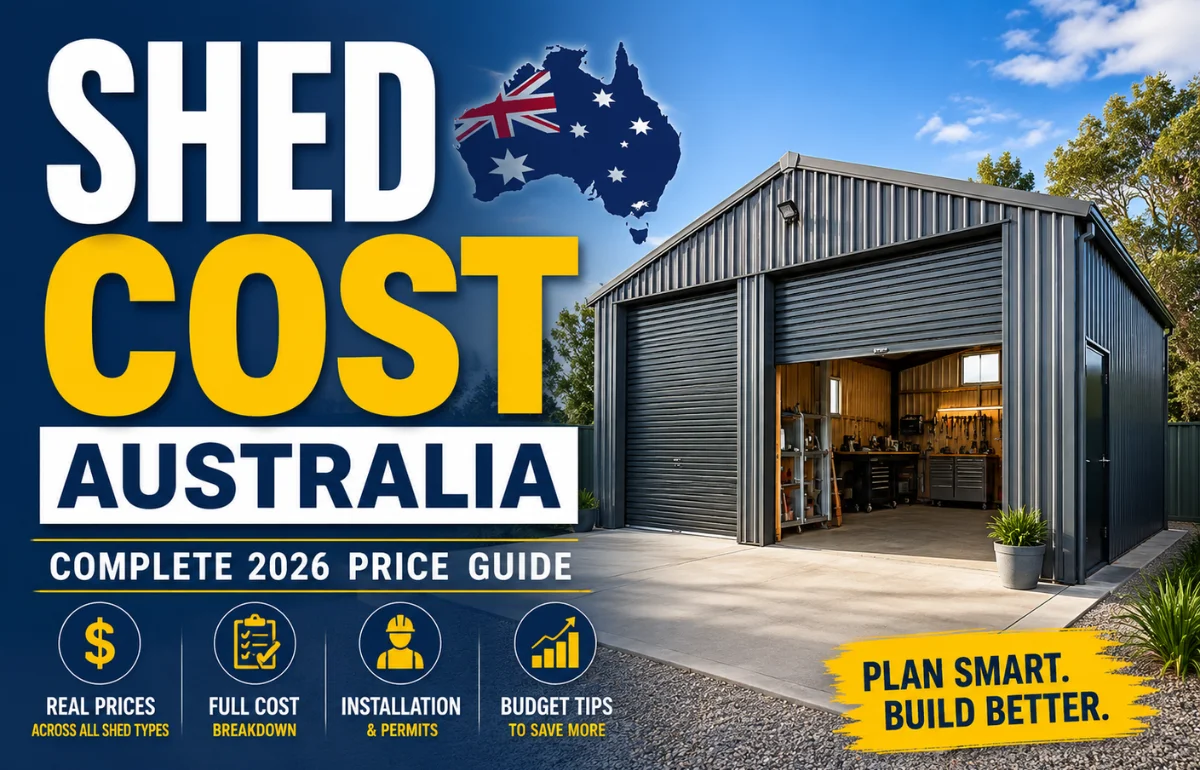
If you’re trying to figure out the shed cost in Australia, here’s the short answer: you’re looking at anywhere from $500 for a basic flat-pack garden shed to well over $80,000 for a large industrial or liveable structure. The average homeowner building a mid-size backyard shed or garage typically spends between $8,000 and $25,000 fully installed. But shed cost in Australia varies enormously depending on size, material, location, whether you DIY or hire a builder, and a handful of factors most price guides gloss over. This article breaks all of it down — including the things most suppliers don’t advertise upfront.
Why Shed Costs in Australia Are So Hard to Pin Down
I’ve spoken with dozens of Australian homeowners over the years who’ve gone into the shed-buying process with a budget in mind and come out the other side having spent 30–50% more. Not because they were scammed — but because the headline price rarely reflects the true cost.
A shed quote might look affordable on paper. But that figure often excludes the concrete slab, council permits, delivery to a remote area, site preparation, installation labour, roller doors, insulation, and electrical fit-out. Strip all that away, and you’re sometimes just buying a flat-pack kit of steel panels.
Understanding the full picture of shed cost in Australia means knowing what’s genuinely included, what’s not, and where your money actually goes.
Shed Cost Australia by Type: A Realistic Price Overview

Different shed categories carry very different price brackets. Here’s a breakdown of what you can realistically expect to pay for shed cost in Australia across the main shed types in 2026, fully installed unless otherwise noted.
Small Garden and Storage Sheds
These are the compact sheds you’d find at Bunnings or Stratco — typically between 1.5m x 1.5m and 3m x 3m. They’re used for garden tools, bikes, and general overflow storage. At this size, shed cost in Australia is at its most accessible — and in many cases, no building permit is required.
- Flat-pack plastic shed (DIY): $500–$1,500
- Small metal or Zincalume shed (DIY): $900–$2,500
- Small Colorbond shed (installed): $3,500–$6,500
These entry-level sheds rarely require a building permit if they’re under 10m² and set back appropriately from boundaries — though this varies by local council.
Backyard Workshops and Single Garages
This is where most Australian homeowners land. A 6m x 6m workshop or a single garage is a common build, and it’s arguably the sweet spot of the residential shed cost range in Australia — substantial enough to be genuinely useful, but not so large that it requires complex engineering or council scrutiny. Expect to pay:
- Kit shed supply only (no slab or labour): $3,000–$7,000
- Fully installed with slab and single roller door: $9,000–$16,000
- Premium Colorbond with insulation, PA door, and permit handling: $14,000–$22,000
Double Garages
A standard double garage (6m x 9m or 7.5m x 9m) is one of the most commonly built residential structures in Australia. It’s also where many people first notice how fast shed cost in Australia climbs once roller doors, a slab, and insulation are all factored in.
- Supply only (kit): $6,500–$12,000
- Fully installed with slab and two roller doors: $18,000–$30,000
- High-spec with insulation, windows, and permit: $25,000–$38,000
Farm and Rural Sheds
Machinery sheds, hay sheds, and open-front farm sheds are sized differently — often 12m x 18m or larger. Labour and logistics in regional and remote areas add significantly to costs. Farm sheds also frequently require site-specific engineering certificates, which adds to both the timeline and the budget.
- Open-front machinery shed (supply only): $13,000–$25,000
- Enclosed farm shed with roller door (installed): $22,000–$50,000
- Large multi-bay farm shed (18m x 30m+): $45,000–$120,000+
One thing worth knowing about farm sheds that rarely appears in cost guides: hot-dip galvanised steel frames carry a premium over standard primed steel, but they last significantly longer in agricultural environments where fertilisers, animal waste, and moisture cause corrosion faster than in suburban settings. When comparing the true shed cost in Australia for rural builds, that durability premium often pays for itself within a decade.
Industrial and Commercial Sheds
Warehouses, factories, and commercial workshops represent the highest tier of shed cost in Australia — starting around $50,000 for a modest structure and climbing well into six figures for anything with serious span, clearance, or engineering requirements. Fire rating compliance, stormwater management, accessibility provisions, and council development approval processes all contribute to both cost and complexity in the commercial space.
Australian Shed Cost Comparison: The Full Breakdown Nobody Gives You
Most cost guides compare shed types in theory. This one compares what you actually pay at each stage of the project so you can plan your budget for Australian shed costs properly.
Note: All figures are indicative estimates for 2026. Prices vary significantly by state, site conditions, and chosen supplier.
What Drives Up the Cost of a Shed in Australia
1. Site Conditions and Access
This one catches people off guard more than almost anything else. If your block is sloped, has poor drainage, requires a retaining wall, or sits on clay soil that needs extra slab engineering, your costs increase — sometimes dramatically. A site that needs a 600mm cut and fill before the slab can even be poured might add $5,000–$15,000 to your project.
Remote or rural properties carry additional costs, too. Delivery surcharges, longer travel times for installers, and logistics for crane or forklift access can all push the final shed cost in Australia well beyond what an equivalent city build would run.
2. Material Choice and How It Affects Australian Shed Costs
Colorbond is the most popular choice in Australia for good reason — it’s durable, thermally efficient, comes in a wide range of colours, and resists corrosion well. But it costs more than Zincalume, which is the raw, unpainted alternative. Zincalume sheds are often 10–20% cheaper upfront, and while they’re excellent for farm and industrial use, many homeowners prefer the finished look of Colorbond for a domestic setting.
Timber sheds occupy a different space entirely. They’re aesthetically warm, easy to customise internally, and well-suited to home offices or studio sheds. But they carry maintenance costs over time — painting, staining, pest treatment — that steel doesn’t.
3. Engineering Requirements and Wind Ratings
Something most budget estimates don’t mention: every shed in Australia must be engineered to the wind and terrain category of its specific location. A shed in coastal Queensland or the Northern Territory cyclone zone must meet far stricter engineering requirements than the same shed built in suburban Adelaide. This directly affects shed cost across Australia — the structural members and steel specifications required in a high-wind zone are meaningfully more expensive than standard residential grade.
If your site sits in a bushfire-prone area (Bushfire Attack Level or BAL-rated zone), additional requirements apply to materials and gaps in construction, further lifting costs.
4. Council Permits: An Often-Overlooked Shed Cost in Australia
Permit fees alone can range from a few hundred dollars to over $3,000, depending on your council and what overlays apply to your land. Heritage overlays, flood zones, and vegetation overlays can all trigger planning permits on top of the standard building permit — and those planning applications take time and often require professional drawings or reports.
In Victoria, sheds over 10m² typically require a building permit. In Queensland and NSW, the thresholds vary, and exemptions exist for some structures below certain heights and setbacks. In South Australia, a Class 10a shed under 15m² may be exempt, but anything larger typically requires consent. Permit fees are one of the most frequently underestimated components of shed cost in Australia — always check with your local council before buying.
I’ve seen homeowners who purchased a shed kit, had it delivered, and then discovered they couldn’t legally erect it in their intended position without a planning permit that would take months and $2,000+ to process. Check first. This is one of the most avoidable costs in any shed project, and it’s entirely a function of doing your homework early.
5. The Hidden Cost of “Supply Only” Quotes
Many online shed retailers advertise shed prices that cover only the steel kit — no slab, no delivery, no installation, no doors. When you’re comparing shed cost in Australia across different suppliers, this apples-to-oranges problem is one of the biggest sources of confusion.
A shed advertised at $4,990 might require another $7,000–$12,000 in slab and labour costs to actually be habitable. When you’re budgeting, always ask: What exactly is included in this price?
DIY vs. Professionally Built: How Each Option Affects Shed Cost in Australia

For experienced builders or handy tradies, erecting a shed kit yourself is genuinely achievable and can save $2,000–$8,000 in labour costs. Most shed kits from reputable Australian manufacturers come with detailed instructions and pre-drilled components. The steel arrives on a pallet, numbered and sorted, and the process is closer to a large-scale assembly project than traditional construction.
That said, DIY shed building isn’t without risk. Mistakes in footing placement, frame alignment, or roof sheet fastening can compromise the structural integrity of the building, and some council permits require a licensed builder to sign off on the completed structure regardless. Getting your footings wrong by even 20–30mm can mean the frame won’t plumb up correctly, leading to a costly remedy.
The concrete slab is often the trickiest part for first-timers. Getting a level, square slab with correctly positioned hold-down bolts is genuinely skilled work. Some DIY builders choose to hire a concretor for the slab and then self-erect the frame above it — a reasonable middle ground that keeps costs down without sacrificing the most technically demanding phase of the build.
If you’re keen on building your own shed but want to approach it with real knowledge rather than guesswork, structured DIY learning programs can equip you with the skills to tackle the project confidently and safely — and help you avoid the kinds of errors that turn a weekend project into a multi-week headache.
For more complex builds — anything requiring site cuts, council permits, engineering certificates, or a large concrete slab — professional installation almost always pays for itself in reduced errors, permit navigation, and warranty protection. At that level, the shed cost in Australia rises, but so does peace of mind.
How Your State Affects Shed Cost in Australia
Location is one of the most underestimated variables in shed cost across Australia. Here’s a general pattern of how the price of a shed in Australia shifts by state:
- New South Wales and Victoria: Labour costs are higher in Sydney and Melbourne metro areas. Urban shed installation tends to run 10–20% above the national average due to demand and cost-of-living pressures on tradies. Permit processes in these states are also well-structured but can be slow.
- Queensland: Cyclone-rated structures in northern Queensland carry engineering premiums. South East Queensland is generally competitive on pricing. Remote QLD can add substantially to delivery and labour costs.
- Western Australia: Perth metro pricing is broadly comparable to Melbourne. Remote WA sites — including mining regions — can see massive delivery surcharges, sometimes $2,000–$8,000 for remote site delivery alone.
- South Australia and Tasmania: Generally among the more affordable states for residential shed installation, though material delivery to Tasmania carries freight premiums.
- Northern Territory: Cyclone engineering requirements make NT among the more expensive locations per square metre for shed construction, particularly in Darwin and surrounding regions.
Liveable Sheds and Studio Spaces: How Shed Costs in Australia Climb Higher
There’s a growing trend across Australia of people converting or building sheds as liveable spaces — granny flats, studios, home offices, or even primary dwellings in rural areas. These are sometimes called “shedominiums” or liveable sheds, and they represent the upper end of shed cost in Australia for residential projects.
The regulatory picture here is more complex. A liveable structure must meet the National Construction Code (NCC) requirements for residential buildings, which means insulation, weatherproofing, ventilation, plumbing, and electrical all come into scope. A liveable shed of 6m x 9m might cost $40,000–$90,000+ to complete to a habitable standard — significantly more than a comparable storage or workshop shed.
There’s also the question of land zoning and dwelling entitlements. In many rural zones, a second dwelling on a lot requires a development application and may not be approved at all, depending on your local planning scheme. Conversely, some rural councils have relaxed their rules to support affordable housing — meaning what’s permissible on one side of a council boundary may be completely different on the other.
What makes liveable sheds genuinely cost-effective when done right is their efficiency as a structure: steel-framed buildings are fast to erect and relatively cheap per square metre of enclosed floor area compared to a conventional brick veneer home. The challenge is in the fit-out — plumbing, electrical, wall lining, flooring, kitchen, and bathroom — which rapidly erodes the structural cost advantage.
If you’re considering a project like this, it’s worth seeking professional guidance for your project early in the planning stage, before you’ve committed to a design or supplier. The planning pathway for liveable sheds differs significantly from state to state, and getting it wrong at the start costs far more than getting the right advice upfront.
How to Get an Accurate Shed Cost Estimate in Australia
The best way to avoid budget blowouts when researching shed cost in Australia is to approach quoting with a clear brief. Before contacting any supplier or builder, know the following:
- Exact site dimensions and location — including slope and soil type if known
- Intended use — storage, workshop, liveable, farm, commercial
- Whether you need the slab — and if so, what thickness
- Door requirements — roller doors, pedestrian access doors, sliding doors
- Insulation and lining requirements
- Whether you’ll need electrical connections
- Any bushfire, cyclone, or flood zone requirements for your property
Get at least three quotes from suppliers who provide fully itemised breakdowns. Any quote that doesn’t show the slab, delivery, labour, and permit costs separately should prompt further questions.
FAQs About Shed Cost in Australia
How much does a basic shed cost in Australia?
A basic garden or storage shed in Australia starts from around $500–$900 for a small DIY flat-pack, and $3,500–$6,500 for a professionally installed small Colorbond shed.
Do I need a building permit for a shed in Australia, and does it affect cost?
In most Australian states, sheds over 10m² require a building permit — fees typically range from $500 to $2,000+, so factor this into your total shed cost budget from the start.
How much does a concrete slab for a shed cost in Australia?
A concrete slab for a mid-size shed (6m x 6m) typically costs $2,500–$5,000 depending on thickness, soil conditions, and your location.
Does shed cost in Australia differ between a kit and a custom build?
A supply-only shed kit is cheaper upfront, but once you factor in slab, labour, and permits, the gap narrows considerably — and custom-built options often include permit handling and warranty support that kits don’t.
How long does it take to build a shed in Australia, and does timing affect price?
A standard residential shed installation takes one to three days once permits are approved; from quote to completion, expect four to twelve weeks — and note that peak-season demand can push both timelines and shed costs in Australia higher.
Where to Go From Here
Shed cost in Australia is never a single number — it’s a combination of what you’re building, where you’re building it, what’s included in your quote, and how much of the project you’re managing yourself. The most expensive mistakes in shed projects come from incomplete quotes, skipped permits, and poor site preparation — none of which need to happen if you go in with the right information.
Whether you’re planning a backyard workshop, a farm machinery shed, or something more ambitious, get your brief together before you get your quotes. Know what you’re comparing. And if the scope of the project feels bigger than a weekend job, bring in the right people early rather than correcting mistakes later.
Other Resources
- Pergola Cost Australia: Complete Pricing Guide 2026
- Can I Build a Shed Without Council Approval? Guide
- Greenhouse and Garden Shed Combination: Perfect for Your Garden

I’m Salman Khayam, the founder and editor of this blog, with 10 years of professional experience in Architecture, Interior Design, Home Improvement, and Real Estate. I provide expert advice and practical tips on a wide range of topics, including Solar Panel installation, Garage Solutions, Moving tips, as well as Cleaning and Pest Control, helping you create functional, stylish, and sustainable spaces that enhance your daily life.