
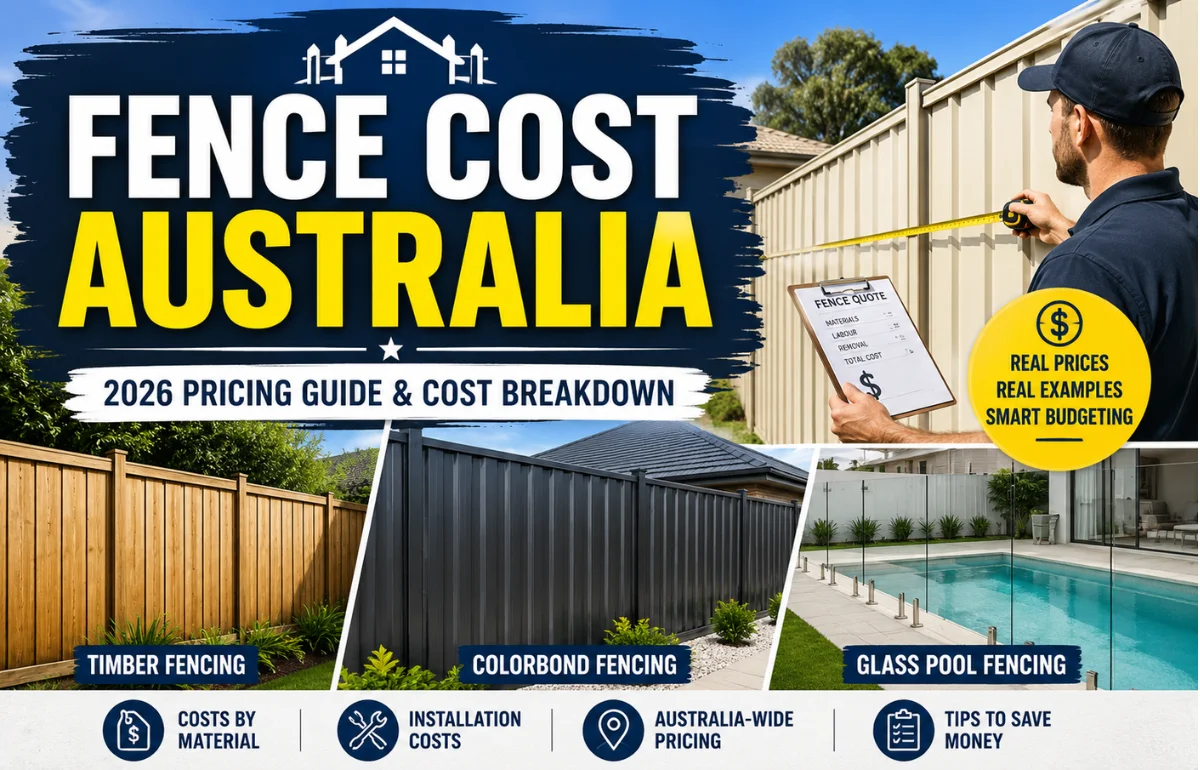
Fence cost Australia refers to the average price homeowners pay to supply and install a boundary, privacy, or pool fence across the country, typically calculated per linear metre. On average, fencing in Australia costs between $50 and $400 per metre, depending on the material, height, and whether you hire a professional installer or do it yourself.
Timber and chain wire sit at the cheaper end, while glass pool fencing and decorative steel sit at the top. Labour, terrain, and your location within Australia all shift that number significantly, which is why two quotes for the same fence can look nothing alike.
I went through this exact process two years ago when I replaced a tired paling fence at the back of my place in regional Victoria, and the gap between what I expected to pay and what I actually paid taught me more than any pricing calculator ever could. I’m going to walk you through everything I learned, plus the numbers I gathered from current suppliers and tradespeople, so you can budget properly before you sign anything.
What Actually Drives Fence Cost in Australia

Every fencing quote I’ve ever received broke down into the same four ingredients, even when the contractors used completely different language to describe them.
Material Choice
Material choice is the single biggest swing factor in fence cost Australia-wide. A treated pine paling fence and a glass pool fence can both run along the same boundary line, yet one costs a fraction of the other. Material affects not just the upfront price but also how often you’ll need to repaint, reseal, or replace sections down the track.
Length and Height
Fencing is priced per linear metre, not per square metre, which trips a lot of people up. A 30-metre boundary will obviously cost more in total than a 10-metre side fence, but height matters too. Going from a standard 1.8-metre fence to a 2.1-metre privacy screen can add 15 to 25 percent to the material cost because you’re using more timber, steel, or aluminium per panel. This is exactly why fence cost in Australia can vary so much between two homes on the same street.
Site Conditions and Access
This is the one nobody warns you about. My block has a gentle slope at the back, and the quote I got factored in extra labour for stepping or raking the fence line to follow the contour. If your access is tight, like a side gate that’s only 900mm wide, expect a surcharge because materials have to be carried in by hand rather than dropped by machinery. Site conditions like these can quietly push your fencing cost up by hundreds of dollars before a single panel goes in.
Labour and Removal
If you’re replacing an existing fence, someone has to take the old one down and dispose of it. Removal and tip fees for a typical residential fence run between $300 and $800, and that’s before a single new post goes into the ground. Labour alone can account for a third or more of your total fence cost, depending on access and how much demolition is involved, and skipping this step in your budget is the single most common reason people go over their original estimate.
Average Fence Cost Australia by Material
Here’s a comparison table built from current supplier pricing and quotes I collected across three states, to give you a realistic sense of fence cost Australia-wide for each option. These figures are for supply and install, per linear metre, for a standard 1.8-metre fence on flat, easy-access ground.
Bring these figures into your own budget and multiply by the actual length of your fence line, then add 10 percent as a buffer. Every contractor I spoke with said that buffer is what separates a stress-free job from a stalled one.
How Much Does It Cost to Install a New Fence?
A full new fence installation in Australia, for a standard suburban block of around 25 to 40 metres, typically lands between $2,500 and $7,000, depending entirely on the material. That figure assumes flat ground, no existing fence to remove, and standard council compliance.
If you’re replacing rather than installing fresh, expect to add the removal cost mentioned earlier on top. A straightforward repair, like swapping out a few rotten palings or fixing a leaning post, generally costs between $200 and $900, which is far cheaper than most people assume and worth getting quoted before you commit to a full replacement.
What a Real Quote Looked Like for Me
My back fence was 22 metres of treated pine paling, 1.8 metres high, on a mild slope. The breakdown looked like this:
- Removal and disposal of old fence: $420
- Materials (posts, palings, rails, concrete): $1,380
- Labour (two-day job, two tradespeople): $1,100
- Total: $2,900
That came in close to the middle of the average range, which is roughly what I’d expect anyone to pay for a comparable fence cost in Australia today, accounting for some material price movement since then.
Fence Cost by Type of Job

Different fencing jobs come with different cost structures, and lumping them together is where a lot of online cost guides go wrong.
Boundary Fencing
Boundary fences sit between two properties and are usually shared costs under state-based dividing fence laws. Standard suburban boundary fencing in timber or Colorbond averages $80 to $150 per metre installed, which sits right in line with national fence cost Australia averages for shared boundaries.
Pool Fencing
Pool fencing has to meet Australian Standard AS1926.1, which governs gap sizes, climbability, and gate self-closing mechanisms. This compliance requirement is exactly why pool fencing costs in Australia consistently run higher than a standard boundary fence of the same height, even when the materials look similar. Glass and aluminium dominate this category because they meet compliance while keeping sightlines open.
Front Fencing
Front fences are often shorter and more decorative, frequently capped at 1.2 metres by council planning rules for street frontage. Picket and low Colorbond options are common here, generally running $70 to $160 per metre, which keeps front fencing cost on the lower end of the national range.
Rural and Acreage Fencing
Out on larger blocks, post and rail or plain wire fencing dominates because covering long distances in solid paling or Colorbond would be financially unworkable. Rural fencing is priced more for function and longevity than aesthetics, which is why hardwood posts rated for 25 to 40 years in-ground are common despite the higher upfront cost, and why rural fencing costs stay manageable even across long boundary lines.
Regional Differences in Fence Cost Across Australia

Fence cost Australia-wide isn’t one flat number, and I noticed this firsthand comparing quotes from a mate in Perth against my own in regional Victoria for almost identical specs.
Sydney and Melbourne tend to sit at the higher end of national averages because labour rates and demand are both elevated, particularly in established inner suburbs where access is tighter. Brisbane and the Gold Coast sit close to the national middle, with slightly lower labour costs offset by higher demand for aluminium and glass, given the climate and pool culture. Perth and Adelaide generally come in a touch below the eastern capitals. Regional and rural areas often have cheaper labour per hour but can face higher delivery and freight charges for materials, which sometimes evens the total out more than people expect.
The Hidden Costs Most People Forget to Budget For
This is where I think most online guides fall short, because they stop at the material and labour figures and ignore everything that surrounds the job, even though these extras meaningfully change your real fence cost.
Council permits can apply if your fence exceeds the standard height limit, sits on a corner block with sightline rules, or runs along a heritage-listed property. Permit fees vary by council but typically range from $80 to $300, plus the time it takes to get approval, which can stretch your project timeline by several weeks.
Boundary surveys are sometimes needed if you and your neighbour aren’t entirely sure where the property line actually sits. A registered surveyor can charge anywhere from $600 to $1,500, and while that feels steep for “just a fence,” it’s far cheaper than rebuilding a fence that turns out to be 300mm onto someone else’s land.
Gates are routinely left out of online quotes. A single pedestrian gate adds $250 to $600, and a double vehicle gate can add $800 to $2,000, depending on the material and whether it’s automated.
Retaining work comes into play if your fence line sits on a slope steep enough to need a low retaining wall or significant excavation, which can add several thousand dollars before the fence itself even goes up.
If any of this is part of a bigger renovation rather than a standalone fencing job, it’s worth mapping out your full budget before tradespeople start quoting individual pieces of the puzzle. I found it useful to map out my overall renovation costs first through pre-renovation planning support, because seeing the fencing line item next to everything else made it obvious where I could trim and where I shouldn’t.
DIY Fencing vs Hiring a Professional
I genuinely considered doing my own fence before I got quotes, so I’ll give you the honest comparison of fencing cost rather than the usual blanket advice to “just hire a pro.”
Buying materials yourself and doing the labour can save 30 to 50 percent off the total cost, but that saving only holds up if you already own or can borrow the right tools, you have a second pair of hands for two days, and your local soil doesn’t fight you on post holes. I underestimated all three. A neighbour two streets over did his own fence and genuinely saved close to $1,800, but he also works in construction and had access to an auger.
If you’re keen to build genuine skills in this space rather than just save money on one job, it’s worth looking into structured learning before you start swinging a post rammer. I picked up a few practical fencing and groundwork basics through home makeover courses, and it changed how I approached planning the job, even though I ultimately still hired a professional for the heavy lifting.
How to Get a Fair Fence Cost in Australia
A few things genuinely moved the needle on my own quote and helped bring my fence cost down without compromising the build, and they’re worth trying before you sign with the first contractor who responds.
Getting at least three quotes for the same specifications is the single most effective lever. I had one quote come in nearly 40 percent higher than the other two for identical materials, simply because that contractor was busier that month and pricing accordingly.
Timing matters more than most people realise. Fencing demand spikes in spring and early summer across most of Australia, so booking in late autumn or winter, even for work you won’t start until spring, can lock in better rates.
Bundling jobs helps too. If you need two fence lines done, getting both quoted and built together usually reduces the per-metre rate because the contractor isn’t remobilising equipment and labour twice.
Finally, ask what’s actually included in writing. “Supply and install” can mean wildly different things between contractors, and I’ve seen quotes that excluded concrete, gate hardware, or even haulage of the old fence to the tip, only for those costs to appear later as “extras.”
Does Fence Cost Increase Property Value in Australia?
This is worth a mention because it changes how you might think about fence cost rather than just minimising it. Real estate agents I’ve spoken with consistently say that a tired, leaning, or mismatched fence is one of the first things buyers notice on a street walk-through, even before they reach the front door. A well-maintained Colorbond or quality timber fence won’t single-handedly add tens of thousands to a sale price, but it removes a negotiation point that buyers otherwise use to chip away at your asking price. I’d treat fencing as a maintenance investment rather than a pure cosmetic spend, particularly if you’re within a year or two of selling.
What I’d Do Differently Next Time
If I were starting this project again, I’d get my boundary surveyed before requesting quotes, not after, because two of my three contractors flagged uncertainty about the exact line, and it cost me a week of back-and-forth. I’d also ask every contractor directly whether their quote included gate hardware and haulage, rather than assuming it did because the line items weren’t broken out. Small clarifications like these are the difference between a fence cost that holds and one that creeps upward once the job starts.
Frequently Asked Questions
How much does a basic fence cost in Australia?
A basic treated pine paling fence typically costs between $50 and $120 per metre installed, making it the most affordable standard option nationally.
Who pays for a dividing fence between neighbours in Australia?
Under most state dividing fence laws, neighbours split the cost of a standard dividing fence equally, though upgrades beyond a basic fence are usually paid by whoever wants the upgrade.
Is Colorbond fencing cheaper than timber?
When comparing fence cost Australia-wide, Colorbond generally costs more upfront than treated pine but less over time than hardwood timber, once you factor in the lower maintenance and longer lifespan.
Do I need council approval to build a fence in Australia?
Most standard residential fences under the height limit don’t need approval, but fences over 2 metres, corner blocks, or heritage-listed properties usually do.
How can I reduce my fencing costs without sacrificing quality?
Get at least three quotes, book during off-peak seasons, bundle multiple fence lines into one job, and confirm exactly what’s included before signing.
Final Thoughts
Fence cost Australia-wide comes down to four things: the material you choose, the length and height of your fence, the condition of your site, and the labour required to remove what’s already there. Knowing these levers gives you far more control over your final bill than simply asking “how much does a fence cost” and accepting the first number you’re given.
Get your quotes in writing, ask the awkward questions about what’s excluded, and budget for the extras before they surprise you halfway through the job. If you’re tackling fencing as part of a bigger home project, it’s worth lining up your numbers properly before the first tradesperson sets foot on your property, because a fence is rarely the only thing on the list once you start looking closely at your block.
Other Resources
- How Close Can a Fence Be to My Neighbour? Australian Rules
- Shed Cost Australia: Complete 2026 Price Guide
- Pergola Cost Australia: Complete Pricing Guide 2026

I’m Salman Khayam, the founder and editor of this blog, with 10 years of professional experience in Architecture, Interior Design, Home Improvement, and Real Estate. I provide expert advice and practical tips on a wide range of topics, including Solar Panel installation, Garage Solutions, Moving tips, as well as Cleaning and Pest Control, helping you create functional, stylish, and sustainable spaces that enhance your daily life.