
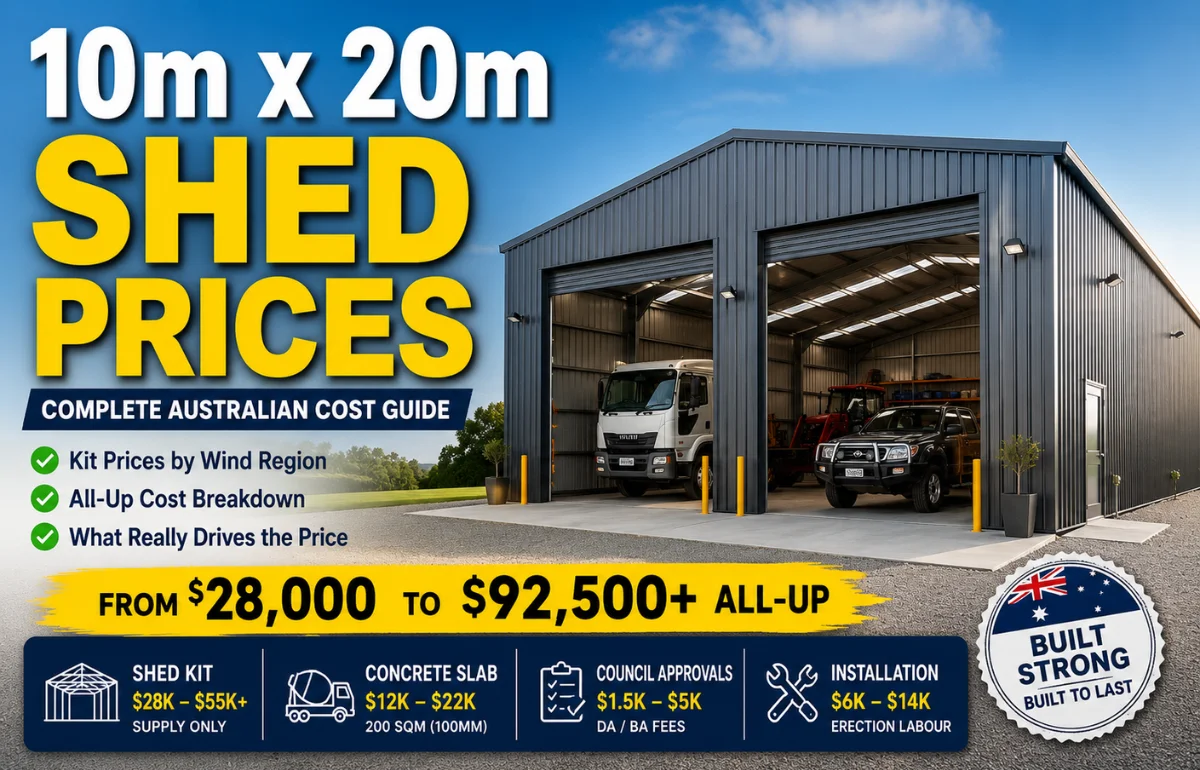
If you’ve been searching for 10m x 20m shed prices, here’s the short answer: in Australia, a 10m x 20m shed typically costs between $28,000 and $55,000+ for the kit supply alone, depending on your wind region, wall height, cladding profile, and the inclusions you choose.
That 200 square metres of floor space puts this well into the commercial and industrial tier — and the pricing reflects it. Add site preparation, concrete slab, council approvals, and installation, and the all-up cost can land anywhere from $45,000 to well over $85,000.
The range is wide because no two builds are identical, but this article breaks down exactly what drives the price so you can budget with confidence before you even call a supplier.
Why a 10m x 20m Shed Is a Different Category Altogether
I’ve spoken to a lot of people who start their shed research thinking the jump from a standard double garage to a 10×20 is just a matter of scale. It isn’t. At 200 square metres, you’re building something that most local councils classify alongside commercial structures, which means different engineering requirements, different approval pathways, and a noticeably different price bracket.
The 10×20 footprint is genuinely one of the most requested sizes in the industrial-residential crossover space. It’s large enough to house three or four vehicles, run a full trade workshop, store a couple of hay rolls with a machinery bay to spare, or serve as a light industrial workspace.
I’ve seen them converted into equestrian shelters, artist studios with mezzanines, and even shedominiums — shed homes that are architecturally interesting, affordable to build, and surprisingly liveable.
That versatility is part of why the pricing question is so nuanced. The same 10×20 footprint can be specced at a bare-bones kit level or built out with insulation, skylights, internal partitions, mezzanine floors, sliding glass doors, and site-specific engineering. Both are technically a 10m x 20m shed. The price difference between them can be $30,000 or more.
What’s Included in a 10m x 20m Shed Kit Price
When suppliers quote a kit price — the type of number you’ll often see advertised — they’re generally referring to supply only. That means the steel frame, cladding, gutters, downpipes, roller doors, and a personal access door, plus engineering documentation. What it does not usually include is the concrete slab, site preparation, transportation beyond a standard zone, or the labour to erect the shed.
Here’s what a standard kit at this size typically covers:
- Galvanised steel portal frame (C-section columns and rafters)
- COLORBOND® wall and roof sheeting (usually 0.42 BMT as standard)
- Barge caps, fascia flashings, gutters, and downpipes
- One industrial roller door (commonly 4.0m high × 4.0m wide at this size)
- One lockable personal access door
- Certified engineering documentation, including footing and concrete designs
- Connection plates and structural brackets
Everything beyond that list is either an optional extra or a separate trade you need to price independently. Some suppliers include the slab design in their documentation, which saves you paying a structural engineer separately — but the concrete pour itself is always additional.
10m x 20m Shed Prices by Wind Region
One of the biggest drivers of price variation that most buying guides don’t explain clearly enough is the wind classification system. Australia is divided into wind regions under the Australian Standard AS 4055, and the structural engineering required for your shed changes significantly depending on where your property sits.
These figures are kit-only, supply-only estimates based on current Australian market pricing. Region C and D sheds cost significantly more because the steel frame weight increases, connection systems become more complex, and components like roller doors must be upgraded to cyclonic-rated variants with wind locks.
When I was comparing quotes for a project in coastal Queensland, the difference between a Region A and Region C spec for the same shed footprint was almost $12,000 on the kit alone — before a single litre of concrete was poured. That’s not padding from the supplier; it’s genuinely the cost of building something that won’t fail in a Category 2 storm.
The Real All-Up Cost: Kit vs Fully Erected
This is the number most people actually need, and it’s rarely advertised upfront. Here’s a realistic breakdown of total costs for a 10m x 20m shed in a typical Region A location:
The slab cost alone varies enormously depending on soil class, site access, and your region. An M-class soil with good access and a flat site will be dramatically cheaper than an H or P class reactive site requiring deeper piers and a thicker pad. Most suppliers will provide a certified footing design that your concretor can work from, which is worth having in your hands before you get slab quotes.
What Drives Shed Price Up: The Extras That Add Up Fast
The base kit gives you a weatherproof shell. But most people building at this scale have more specific requirements, and the add-ons are where budgets can stretch quickly.
Wall Height
Standard eave height at this footprint is typically 4.0 metres. Increasing to 5.0 or 6.0 metres adds to the frame weight, cladding area, and engineering complexity. Expect an uplift of $3,000 – $8,000 for a height increase, depending on your wind region.
Additional Roller Doors
A second industrial roller door on the opposite end — to allow drive-through access for trucks or farm equipment — is a popular addition. Roller doors at this size range from $2,500 to $6,000 per opening, depending on size, type, and whether you want automatic openers.
Insulation
In a workshop or liveable space, insulation is close to non-negotiable for comfort. Bulk insulation batts for roof and walls in a 200 sqm shed run roughly $4,000 – $9,000 installed, depending on the R-rating you choose. Reflective foil insulation on the roof alone is a more affordable option that reduces radiant heat significantly.
Mezzanine Floor
A structural mezzanine — useful for office space, parts storage, or a break room — adds $8,000 to $18,000, depending on the area and load capacity required. This is one of the most valuable additions for trade businesses.
Lean-To or Side Skillion
Adding a lean-to along one long wall extends your covered area without a full structural bay. A 3m lean-to running the 20m length adds roughly $6,000 – $14,000 to the project.
Cladding Profiles
Different cladding options — corrugated, Monoclad, K-Panel, Longspan, or architectural profiles like SharpLine — vary in price and aesthetics. Premium architectural wall cladding can add $3,000 – $7,000 compared to standard corrugated.
Comparing Shed Suppliers in Australia: What You Get for the Money
Not all 200 sqm shed quotes are built the same. Understanding what each supplier’s business model means for your price and experience is genuinely useful.
Kit Supply Only Suppliers (like Modern Steel Buildings) quote a clear upfront price, ship the kit, and leave installation to you or your chosen builder. This suits experienced owner-builders or those with a trusted local contractor. The advertised price is real, and you can purchase directly.
Full-Service National Chains (like Wide Span Sheds and Fair Dinkum Builds) offer free design services, site-specific engineering, and a nationwide network of agents and installers. They don’t advertise a fixed price because your quote depends on your site, soil class, and spec. The trade-off is that you’re getting a more tailored product, but the final number won’t come until after a design consultation.
Regional Specialists (like Stockman Sheds in South East Queensland) operate on a smaller, more personal scale — handling design, council approvals, slab, and construction under one roof with their own licensed crew. For many customers, particularly those who aren’t experienced project managers, this model is worth a price premium because it removes the coordination headache entirely.
When comparing quotes, make sure you’re comparing apples to apples. A $31,000 kit quote and a $58,000 fully erected quote can be for nearly the same end result — the difference is who manages all the pieces in between.
Council Approvals and What People Often Forget
In Australia, virtually every 10m x 20m shed will require council approval. At 200 square metres, you’re well above the threshold where a complying development certificate applies in most states.
The approval process varies by council and state, but you’ll generally need:
- A site plan showing setbacks and the shed position on your property
- Engineering drawings and certified structural documentation
- A building permit or development application
- Sometimes, a soil report, particularly for reactive soil sites
Most suppliers provide the engineering drawings as part of their kit package, which is a significant cost saving. However, lodging the application, paying council fees, and managing the process is usually your responsibility — or something you engage a private certifier to handle.
In my experience, people consistently underestimate both the time and cost of approvals. Budget $1,500 – $5,000 for this process and allow 6 – 12 weeks for approval before construction can start.
DIY vs Professional Installation
The question of whether to self-build a 10m x 20m shed is one worth thinking through carefully. At this scale, the structural complexity increases — portal frames require correct alignment, plumb columns, and precise connection torquing. A shed kit at this size is achievable for a competent owner-builder with the right help, but it’s not a weekend project.
If you’re drawn to the idea of building it yourself, there are genuine resources available. Good DIY learning programs can take you through shed construction fundamentals, including reading engineering drawings, understanding footing requirements, and safely handling structural steel — before you get to the site.
If you’d rather leave it to professionals, quality erectors typically charge $6,000 – $14,000 for a shed at this size, which includes unloading, assembly, and fixing to the slab. That cost buys you speed, warranty coverage on the installation, and peace of mind that the structure has been assembled correctly.
For a shed that’s going to house expensive equipment, vehicles, or serve as a workspace for years, that investment is usually well justified. Many homeowners and business owners also find that coordinating across trades is where projects stall — in which case, engaging professional home improvement services from the outset can save more money than the service costs.
Is a 10m x 20m Shed Good Value in 2026?
Pound for pound, steel shed construction in Australia remains one of the most cost-effective ways to add usable covered space to a property. At $45,000 – $90,000 all-up, a 200 sqm permanent structure compares extremely favourably to the cost of a commercial tenancy or traditional construction at the same floor area.
Steel sheds built with Australian BlueScope steel and COLORBOND® cladding are also low-maintenance. With a 20 – 30 year manufacturer’s warranty on materials and engineered structures designed for your local conditions, you’re not looking at high ongoing costs. The concrete slab will outlast the building above it.
From a property perspective, a well-positioned and council-approved outbuilding of this size adds genuine value to rural and semi-rural blocks — particularly in regional Queensland, New South Wales, and Victoria, where farm sheds and rural workshops are considered standard inclusions.
Frequently Asked Questions
How much does a 10m x 20m shed cost in Australia?
A 10m x 20m shed kit in Australia typically costs $28,000 – $55,000, depending on wind region and inclusions; the all-up price, including slab, approval, and installation, usually falls between $52,000 and $92,000.
What is included in a 10×20 shed kit price?
Most kit prices include the steel portal frame, COLORBOND® cladding, gutters, one roller door, a personal access door, and certified engineering documentation — but not the concrete slab, site prep, or installation labour.
Do I need council approval for a 10m x 20m shed?
Yes, in almost every Australian state and council area, you will need a building permit or development approval for a structure at this size. Your shed supplier should provide the engineering drawings you need to submit.
How long does it take to build a 10m x 20m shed?
Allow 6 – 12 weeks for council approval, then 2 – 5 days for professional erection once the slab is cured. From the first quote to the completed shed, most projects take 3 – 6 months in total.
What size roller door do I need for a 10m x 20m shed?
For this footprint, a 4.0m high × 4.0m wide roller door is the industry standard for single access. If you need truck or large machinery access, consider a 5.0m or 6.0m high opening, which may require a custom roller door or tilt panel alternative.
Final Thoughts
A 10m x 20m shed is a serious investment, and the price range in Australia is genuinely wide — not because suppliers are being vague, but because a lot of legitimate variables affect the number. Wind region, wall height, soil class, cladding choice, extras, and whether you’re buying a kit or a fully erected turnkey build all pull the total in different directions.
The most useful thing you can do before calling anyone is get clear on three things: what you’ll actually use the shed for, what your site conditions are, and whether you’re managing the project yourself or handing it off. Once you know those answers, the quotes you receive will make a lot more sense — and you’ll be in a much stronger position to compare them properly.
If you’re ready to take the next step, start by getting at least two site-specific quotes from accredited suppliers in your region, and make sure each one specifies whether the price includes slab, installation, and council documentation. The difference between a supply-only and fully erected quote can be $25,000 or more — and knowing which one you’re looking at is the most important piece of information on any quote you receive.
Other Resources
- Garage Door Track Repair Henderson NV | Expert Help
- Insulated Door for Garage: Benefits, Types & Costs
- Garage Floor Coating Paint: Types, Benefits & How to Choose the Right One

I’m Salman Khayam, the founder and editor of this blog, with 10 years of professional experience in Architecture, Interior Design, Home Improvement, and Real Estate. I provide expert advice and practical tips on a wide range of topics, including Solar Panel installation, Garage Solutions, Moving tips, as well as Cleaning and Pest Control, helping you create functional, stylish, and sustainable spaces that enhance your daily life.