
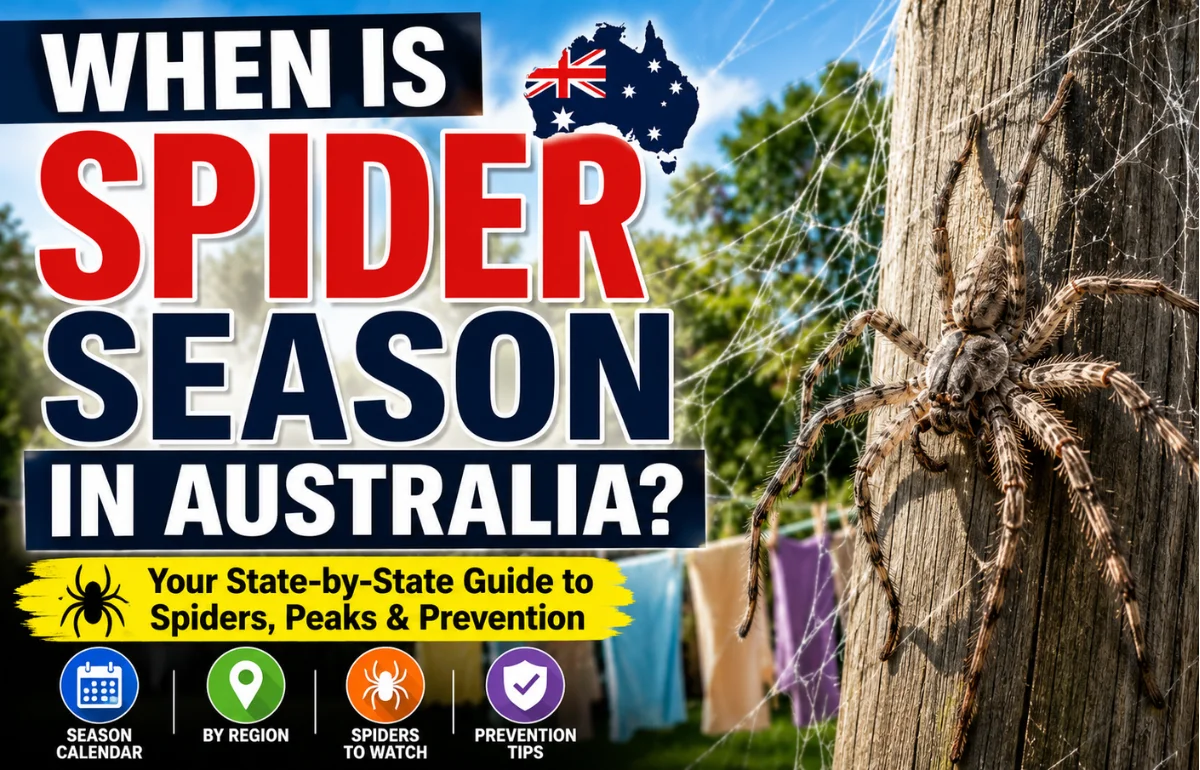
Spider season in Australia runs from roughly September through to April, with the real peak sitting between November and March. That’s when warming temperatures, longer daylight hours, and the insect boom that comes with spring and summer rain push spiders out of hiding to feed, mate, and build webs in greater numbers.
It’s not that Australia suddenly grows more spiders overnight — it’s that the ones already living in your garden, roof void, or woodpile become far more visible and active once the weather turns. I’ve spent enough spring mornings flicking webs off the clothesline to know exactly when this shift happens, and it’s almost always the same week the jacarandas start flowering.
If you’ve ever wondered why your evening walk past the garden suddenly involves dodging webs that weren’t there last month, or why your letterbox seems to host a new tenant every October, this is the season doing exactly what it does every single year.
When Does Spider Season in Australia Actually Start?
Here’s something most articles on this topic skip over: spider season doesn’t arrive on the same date across the country, because Australia doesn’t really have one climate. It has several.
Southern Australia (NSW, Victoria, South Australia, Tasmania)
In Sydney, Melbourne, Adelaide and Hobart, the shift is fairly easy to track because it follows the standard seasonal calendar. Spiders start stirring in September as soil and air temperatures climb, become genuinely active by October and November, and stay busy right through summer into early autumn. By April, cooler nights start sending most species back undercover. This is the pattern I notice most years living on the East Coast — a sudden uptick around the second or third week of October, almost like someone flipped a switch.
Northern Australia (Queensland, Northern Territory, northern WA)
Up north, the picture is messier and, honestly, more interesting. Because the tropics stay warm year-round, there isn’t a sharp “off season” the way there is in Hobart or Melbourne. What drives spider numbers in Queensland and the Top End is the wet season, roughly November through April. Heavy monsoonal rain floods burrows and undergrowth, forcing ground-dwelling spiders into the open and sometimes straight into homes. So while southern states talk about a spring start, northern Australia is really talking about a wet-season surge.
This regional split matters more than most pest control content gives it credit for. If you live in Cairns, asking “when is spider season in Australia” gets you a very different practical answer than if you live in Hobart.
Why Spiders Get Busier in Warmer Months
A few things stack on top of each other to create this seasonal spike, and once you understand them, the whole pattern stops feeling random.
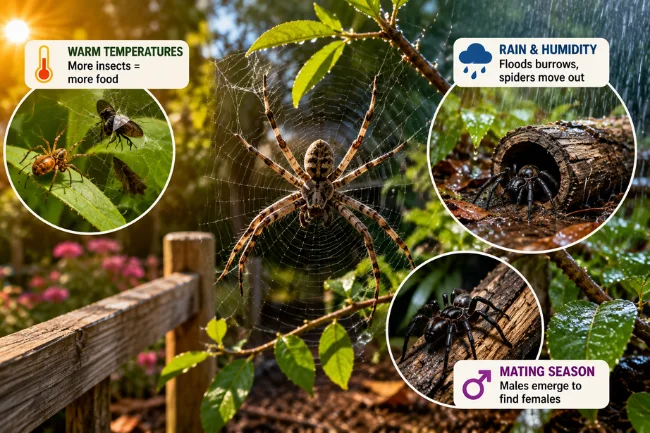
Spiders are cold-blooded, so their metabolism is directly tied to temperature. Warmer weather means faster growth, quicker digestion, and more energy for hunting and reproducing. At the same time, the insects spiders eat — flies, moths, mosquitoes, beetles — go through their own population boom in spring and summer, so there’s simply more food on offer, which keeps spiders out and hunting for longer stretches.
Rain plays a bigger role than people expect. A burst of humidity after a dry spell often triggers a short-term jump in sightings, because moisture-loving species come out to take advantage of softer ground and more prey. Heavy or sustained rain does the opposite in a dramatic way: it floods burrows and leaf litter, pushing ground spiders like wolf spiders and sheet-web weavers up onto fences, grass, and tree branches in search of dry ground.
This is actually how those eerie “ghost web” photos you sometimes see after East Coast flooding happen — spiders aren’t multiplying overnight, they’re relocating en masse and using silk threads caught on the wind, a behaviour called ballooning, to disperse quickly.
Mating season adds another layer, specifically for male spiders. Species like the Sydney funnel-web and the mouse spider have males that spend most of the year tucked away in burrows, only emerging to wander — often at night, often after rain — once they’re ready to find a female. That’s why funnel-web sightings tend to cluster heavily through summer and into autumn rather than tapering off as soon as the weather cools.
Spider Season Calendar by Region
I haven’t seen this laid out clearly anywhere else, so here’s a rough comparison of how spider season actually plays out depending on where you are in Australia.
These are general patterns, not guarantees — a freak heatwave in August or an unusually wet winter can shift things earlier or later in any given year.
The Spiders You’re Actually Most Likely to Run Into
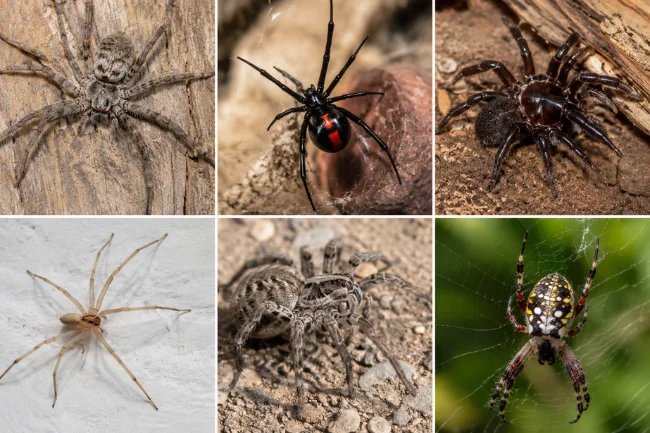
Knowing when spider season in Australia hits is only half the picture. Knowing what you’re looking at matters just as much, mostly so you don’t panic over a harmless huntsman or, worse, dismiss something genuinely dangerous.
Sydney Funnel-Web Spider
Found mainly across NSW, particularly the Sydney basin and surrounding bushland, this is the species that gets the most attention for good reason. Males wander at night during summer and autumn, especially after rain, searching for mates, and they’re far more likely to end up in a backyard, pool, or shoe left outside than females, who tend to stay in their burrows. A bite needs immediate medical attention, but it’s worth knowing that effective antivenom has existed since 1980, and there hasn’t been a confirmed death from a funnel-web bite since that antivenom became available.
Redback Spider
Recognisable by the bright red or orange stripe on a glossy black body, redbacks favour dry, sheltered spots — under outdoor furniture, in garden sheds, inside disused pots, along fence lines. Only females deliver a medically significant bite, and males are rarely seen at all. Around 2,000 redback bites are reported across Australia each year, which sounds alarming until you realise antivenom has been available since 1956 and serious complications are uncommon with prompt treatment.
Huntsman Spider
Big, fast, and genuinely startling if one drops onto your windscreen, huntsmen are almost entirely harmless to humans despite the reaction they provoke. They’re actually useful tenants, since they hunt cockroaches, moths, and other household pests. I’ve made peace with the ones that live behind my pantry door for exactly this reason.
White-Tailed Spider
Slim, dark, with a pale tip on the abdomen, these are common indoor visitors, particularly in cooler, dark corners like under furniture or inside folded towels. Bites can cause localised pain and swelling, but aren’t considered medically dangerous, despite an old (and now debunked) reputation for causing flesh necrosis.
Mouse Spider
Often mistaken for a funnel-web because of similar size, colour, and burrowing habits, mouse spiders also have wandering males that show up more often in late summer. Treat any large, dark, burrow-dwelling spider with the same caution you’d give a funnel-web rather than trying to tell them apart yourself.
Black House Spider and Daddy Long Legs
Less dramatic but far more common indoors, these two turn up in window frames, garage corners, and ceiling edges practically year-round, with numbers ticking up through spider season alongside everything else.
What Actually Triggers a Sudden Spider Surge
The calendar gives you the general window, but three specific events tend to cause the sharp, noticeable spikes that people actually message their pest control company about.
A heatwave following a cooler stretch often brings a short burst of activity as spiders make the most of the sudden warmth. Heavy rain after a dry period does something similar by softening the ground and triggering insect hatches that spiders follow. And actual flooding causes the most visible response of all — mass relocation, ballooning, and those unsettling web-covered fields and fence lines that occasionally make the news in flood-affected regions of NSW and Victoria.
None of these events means your property suddenly has more spiders than it did the week before. It usually means the spiders that were already there have become impossible to ignore.
How I Get My Home Ready Before the Season Hits
I treat the first cool change in late winter as my cue to do a proper walk around the house, rather than waiting until I’ve already found a web across the back door. A few things have made a genuine difference over the years.
Sealing gaps around windows, doors, and where pipes or cables enter the house cuts off the easiest entry points before spiders go looking for shelter. Clearing clutter from garages, sheds, and under outdoor furniture removes the exact hiding spots redbacks favour. Keeping outdoor lighting pointed away from entry points helps too, since bright lights near doors attract the insects that spiders are there to eat in the first place.
Honestly, most of this overlaps with general seasonal home maintenance rather than being a separate spider-specific job. I’ve started folding it into the same pre-summer checklist I use for gutter clearing and screen repairs, and if you’re looking at your place with the same broader maintenance mindset, it’s worth getting proper professional home improvement services involved for the sealing, screening, and structural gaps that are genuinely hard to fix properly on a Saturday afternoon with a caulking gun.
Is Spider Season Changing With the Climate?
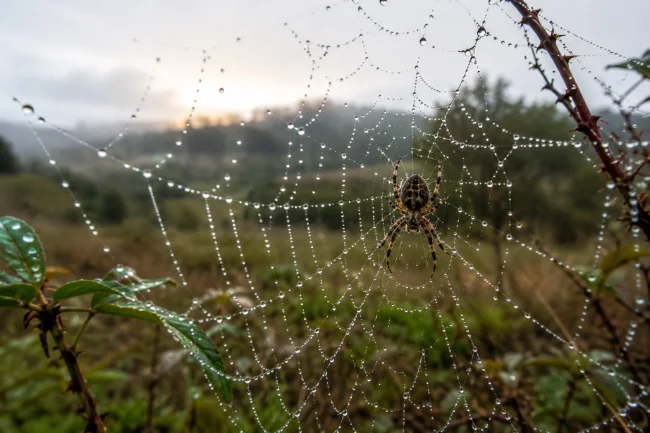
This part doesn’t get discussed much, but it’s worth raising. Warmer average temperatures and shifting rainfall patterns have a flow-on effect on insect and spider activity windows. Several pest control operators and entomologists have noted activity starting slightly earlier in spring and stretching slightly later into autumn in some regions compared to a couple of decades ago, particularly in Queensland and northern NSW. It’s not dramatic year to year, and it varies by location, but it’s a reasonable explanation if you’ve noticed spider season feeling like it starts earlier than it used to.
When Should You Actually Call Pest Control?
The best time to book a treatment is just before your region’s peak window, not after you’ve already got an infestation on your hands. For most of southern Australia, that means late winter or very early spring. For Queensland and the Top End, late winter still works well, ahead of the wet season surge. Treating proactively targets nesting spiders and unhatched egg sacs before numbers climb, which makes a noticeably bigger difference than reacting once webs are already showing up daily.
What months are spider season in Australia?
Spider season generally runs from September through April, with peak activity between November and March across most of the country.
Is spider season worse in some Australian states than others?
Queensland and northern NSW tend to see the longest, most intense seasons due to warmer temperatures and wet-season rainfall.
Do spiders die off in winter?
Most don’t die — they slow down, hide in sheltered spots like roof voids and sheds, and become far less visible until temperatures rise again.
Are funnel-web spiders more dangerous during spider season?
Sightings increase because males wander more in summer and autumn searching for mates, but the venom itself isn’t seasonally stronger or weaker.
How do I know if I have a spider infestation?
Frequent webs rebuilding within a day, multiple egg sacs in sheds or eaves, and repeated indoor sightings in the same spots are the clearest signs.
Final Thought
Spider season in Australia isn’t something you can avoid entirely, but it’s predictable enough that you can stay a step ahead of it. Knowing your region’s timing, recognising which species actually matter, and doing a proper walk-around before the warm weather hits will save you most of the surprises. If your place needs more than a caulking gun and an afternoon to get genuinely sealed up before the season turns, it’s worth getting it looked at properly rather than waiting for the first web across the back door to remind you.
Other Resources
- Crazy Ants Pest Control: Complete Removal Guide
- Pest Control for Wolf Spiders: Complete Guide
- Are Tenants Responsible for Pest Control? Guide

I’m Salman Khayam, the founder and editor of this blog, with 10 years of professional experience in Architecture, Interior Design, Home Improvement, and Real Estate. I provide expert advice and practical tips on a wide range of topics, including Solar Panel installation, Garage Solutions, Moving tips, as well as Cleaning and Pest Control, helping you create functional, stylish, and sustainable spaces that enhance your daily life.