
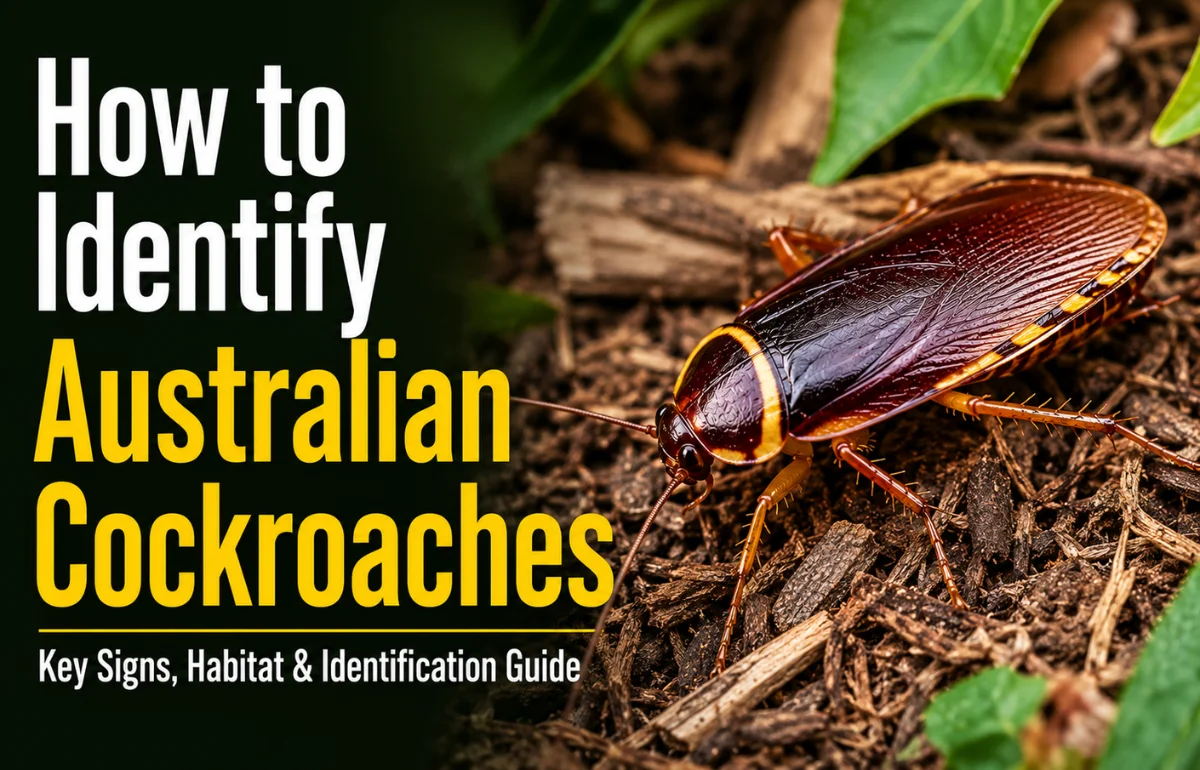
To identify Australian cockroaches, look for a medium-to-large, reddish-brown insect roughly 25 to 35 millimetres long, with a pale yellow band across the back of its head and matching yellow streaks running along the leading edge of its wings.
Unlike many household roach species, the Australian cockroach (Periplaneta australasiae) is just as happy living in your garden as it is sneaking indoors, which is exactly why it turns up in mulch beds, compost bins, and roof cavities long before anyone spots one in the kitchen.
Learning how to identify Australian cockroaches properly is the first real step toward dealing with them, because confusing them with American or German cockroaches almost always means reaching for the wrong treatment.
I grew up in a weatherboard house in Brisbane with a banana tree out the back, and if there’s one insect I learned to recognise by torchlight before I could even spell its name, it’s this one. Years later, after fielding more questions than I can count from readers and homeowners about “is this an Australian cockroach or something worse,” I still find the same handful of details trip people up every time. So let’s go through what actually separates this species from the rest, without the guesswork.
Why Getting the Identification Right Actually Matters
Cockroaches aren’t a single problem with a single fix. German cockroaches respond well to gel baits placed in kitchen cracks. Oriental cockroaches need moisture control near drains. Australian cockroaches, on the other hand, often need outdoor perimeter treatment because that’s where the colony actually lives, with the indoor sightings being more like scouting trips than the main event.
I’ve seen homeowners spend months spraying their pantry shelves for a roach that was never living indoors to begin with, because they assumed every cockroach in the house was a German one. Getting the species right tells you where to focus, what bait or treatment will actually work, and roughly how serious the problem is likely to become if it’s left alone. In other words, knowing how to identify Australian cockroaches correctly is what decides whether your next move actually works or just wastes a weekend.
Key Physical Features That Set the Australian Cockroach Apart
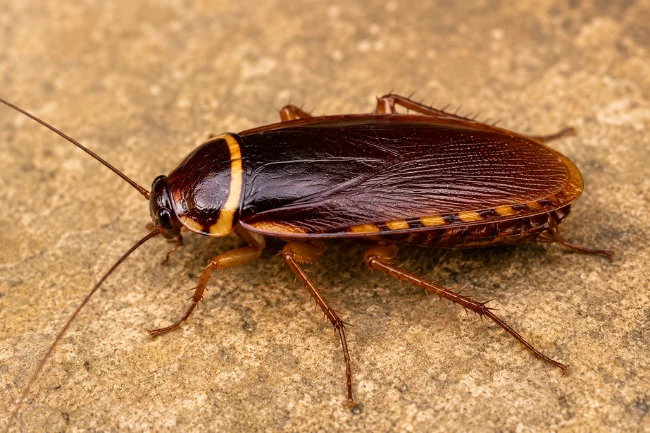
These are the exact details I check first whenever someone asks me how to identify Australian cockroaches in their own backyard, since they hold up even when you’ve only got a couple of seconds before the roach disappears.
Size and Body Shape
Adults typically measure between 25 and 35 millimetres, which puts them in the same ballpark as a five-cent coin laid end to end about twice over. They’re flatter and more elongated than a beetle, with long, spindly legs and antennae that are roughly as long as the body itself.
Colour and the Yellow Collar Marking
This is the detail I tell people to check first. Australian cockroaches are a warm reddish-brown, almost mahogany in good light, but the giveaway is a pale yellow line running across the pronotum, which is the shield-like plate just behind the head. You’ll also notice thin yellow streaks near the base of the wings, close to where they meet the body. American cockroaches have a similar head marking, but it’s usually more of a solid ring rather than a simple stripe, and American cockroaches run noticeably bigger overall.
Wings, Flight, and Movement
Both sexes have full wings that cover the entire length of the abdomen, and unlike Oriental cockroaches, which are essentially flightless, Australian cockroaches can and do fly, particularly on warm, humid evenings. I’ve had one glide straight past my head while I was stacking firewood, which is a fairly memorable way to confirm a species ID.
Where Australian Cockroaches Like to Hide
This species genuinely prefers the outdoors, which makes it different from most of the roaches people picture when they think “infestation.” Knowing where to look matters just as much as knowing what to look for if you want to identify Australian cockroaches before they ever make it inside. Common hiding spots include:
- Mulch and garden beds, especially around the base of trees and shrubs
- Compost bins and piles of damp leaf litter
- Roof voids and subfloor spaces, particularly in older homes
- Stacked firewood, timber offcuts, and garden sheds
- The leaf bases of palms and similar plants, where moisture collects
Indoors, they tend to favour roof cavities, wall cavities near plumbing, and laundry areas rather than kitchen cupboards, which is one of the clearer behavioural differences between this species and the German cockroach.
Australian Cockroach vs American Cockroach vs German Cockroach
People mix these three up constantly, so here’s how they actually compare side by side, which makes it far easier to identify Australian cockroaches at a glance instead of guessing.
Life Cycle Clues That Help With Identification
One detail that rarely gets mentioned is how much slower this species develops compared to the German cockroach most people are used to hearing about. A German cockroach can go from egg to breeding adult in around 50 to 60 days. Australian cockroach nymphs, by contrast, often take six months to a year to fully mature, depending on temperature and food availability.
The egg case, called an ootheca, is dark brown and roughly the size of a grain of rice. Females typically drop it in a sheltered, moist spot rather than carrying it around, which is another point of difference worth knowing if you’ve found one of these capsules in the garden and aren’t sure what laid it.
Nymphs are wingless and noticeably darker than adults, with a more uniform black-brown colouring that can make them harder to identify on sight until that yellow collar starts to develop. This is one of the few growth stages where size and colour alone won’t help you identify Australian cockroaches reliably, so habitat and the egg case become your best clues instead.
Behavioural Signs You’re Dealing With This Species, Not Another
Beyond appearance, behaviour gives away a lot. Australian cockroaches become far more active during the warmer months, particularly after rain, when humidity rises and outdoor food sources become more abundant. They’re drawn to light at night, which is why you’ll often see them around porch lights or near windows on a balmy evening.
They’re also genuine plant eaters, nibbling on seedlings, leaf matter, and even some ornamental plants, which sets them apart from American and German cockroaches that lean more toward decaying organic matter and food scraps. If something has been chewing at your seedlings overnight and you’ve spotted a reddish-brown roach nearby, that plant damage alone can help you identify Australian cockroaches before you’ve even had a close look at the markings.
Common Identification Mistakes Homeowners Make
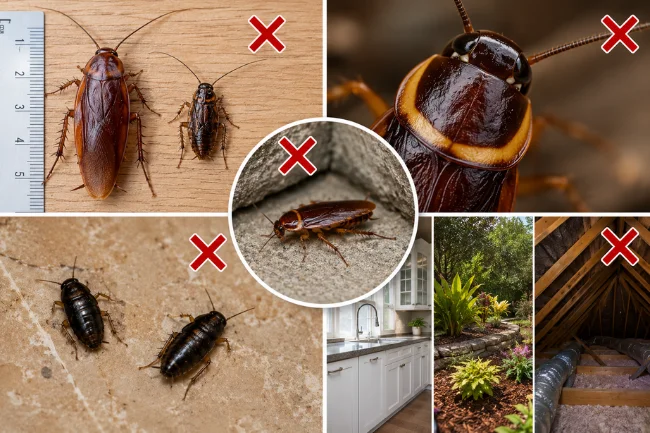
A few errors come up again and again, even among people who already know roughly how to identify Australian cockroaches:
- Assuming size alone is enough, when juvenile American cockroaches and adult Australian cockroaches can look deceptively similar at a glance
- Overlooking the yellow markings entirely because the roach was seen briefly, in poor lighting, or already retreating into a crack
- Believing that because a roach was found outside, it isn’t a “real” infestation risk, when this species moves indoors readily once the weather turns cooler
- Mistaking dark, wingless nymphs for an entirely different species rather than a juvenile stage of the same one
- Treating every sighting as a kitchen problem and ignoring garden beds, roof voids, and subfloor areas where the actual colony may be established
When DIY Identification Isn’t Enough
A torch, a tape measure, and a bit of patience will get most homeowners reasonably close to a correct identification. But once you’re dealing with repeated sightings, a colony near the roofline, or a mix of species in the same property, professional inspection genuinely earns its cost. Pest technicians aren’t just confirming a species, they’re also tracing the colony back to its source, which is something that’s far harder to do from the inside of a house alone. Even confident DIY efforts have their limits, and that’s usually when getting help to identify Australian cockroaches properly pays for itself.
A lot of the homeowners I’ve spoken with only start thinking seriously about pest prevention once they’re already organising other improvements around the property, and honestly, that’s a sensible time to act. Folding pest control into your broader home upgrade services plan, rather than treating it as a separate emergency call later on, tends to save both time and money down the track.
Quick Field Checklist for Identifying Australian Cockroaches
When you spot one and want a fast answer, run through this in your head:
- Is it roughly 25 to 35 millimetres long, about the length of a five-cent coin doubled?
- Does it have a yellow stripe across the back of the head, rather than a full solid ring?
- Are there faint yellow streaks near the base of the wings?
- Was it found outdoors, in mulch, compost, or near a roof void, rather than inside a kitchen cupboard?
- Did it fly, or at least glide a short distance, when disturbed?
If most of those line up, you’re very likely looking at an Australian cockroach rather than its American or German relatives.
Final Thoughts
Telling cockroach species apart isn’t about memorising entomology textbooks, it’s about knowing the two or three details that actually matter, the size, the yellow markings, and where you found it. Once you’ve nailed down how to identify Australian cockroaches correctly, the rest of the decision-making, whether that’s garden treatment, sealing roof gaps, or calling in a professional, becomes a lot more straightforward. If you’ve spotted one of these in or around your home and want a second opinion before deciding how to handle it, getting a proper inspection booked is usually the quickest way to put the question to rest.
Frequently Asked Questions
Are Australian cockroaches dangerous?
They’re not venomous, but like most cockroaches they can spread bacteria and trigger allergies or asthma symptoms in sensitive people, so they’re worth controlling rather than ignoring.
Do Australian cockroaches fly?
Yes, both males and females have full wings and are capable fliers, especially on warm, humid nights, which is another easy way to identify Australian cockroaches once they’re airborne.
What’s the difference between Australian and American cockroaches?
Australian cockroaches are smaller, with a yellow stripe rather than a full ring around the head, and prefer gardens over drains and basements.
Why are Australian cockroaches in my garden?
They’re naturally an outdoor species drawn to mulch, compost, and damp organic matter, so a garden with plenty of moisture and plant debris is exactly where they want to be.
How do I get rid of Australian cockroaches if I find one inside?
Start by checking nearby garden beds and roof voids for the source colony, since indoor sightings are often just stragglers from an outdoor population that needs treating at its root. This is really the whole point of learning how to identify Australian cockroaches in the first place, it tells you where to actually start.

I’m Salman Khayam, the founder and editor of this blog, with 10 years of professional experience in Architecture, Interior Design, Home Improvement, and Real Estate. I provide expert advice and practical tips on a wide range of topics, including Solar Panel installation, Garage Solutions, Moving tips, as well as Cleaning and Pest Control, helping you create functional, stylish, and sustainable spaces that enhance your daily life.