
If you’ve ever dipped a test strip into your pool and watched the color shift into the danger zone, you know that sinking feeling. High pH, high alkalinity — and suddenly you’re Googling what to do before your next swim day goes sideways. That’s exactly where a sodium bisulfate pool treatment comes in, and once you understand how it works, it becomes one of the most reliable tools in your pool maintenance routine.
I’ve been managing residential and above-ground pools for years, and if there’s one chemical that gets overlooked in favor of its harsher alternatives, it’s sodium bisulfate. Most people default to muriatic acid out of habit, not knowledge. By the end of this post, you’ll understand why dry acid deserves a permanent spot in your pool chemical arsenal — and how to use it safely and effectively.
What Is Sodium Bisulfate, Exactly?
Sodium bisulfate goes by more names than almost any other pool chemical. You’ll see it labeled as dry acid, acid salt, bisulfate of soda, or sometimes safety acid on store shelves. Less commonly, it appears under the industrial names nitercake or nitre cake. No matter the label, the chemical formula is the same: HNaO₄S.
In its physical form, sodium bisulfate is a white, granular crystalline solid. It’s produced through the neutralization of sulfuric acid with a sodium compound, which results in a highly acidic substance with a pH hovering around 1. That might sound alarming, but in diluted pool concentrations, that extreme acidity is exactly what makes it effective.
What sodium bisulfate does in your pool is straightforward: it donates hydrogen ions into the water, which lowers the pH. It also reacts with carbonates in the water, reducing total alkalinity. Both functions are critical for keeping your pool water balanced, comfortable, and safe for swimmers.
Why Choose Sodium Bisulfate Over Muriatic Acid?
This is the question I get most often from pool owners who’ve been using liquid muriatic acid (hydrochloric acid) for years. The honest answer is that muriatic acid works — but at a cost that sodium bisulfate simply doesn’t carry.
Here’s a direct comparison:
| Feature | Sodium Bisulfate (Dry Acid) | Muriatic Acid (Hydrochloric Acid) |
|---|---|---|
| Form | Granular solid | Liquid |
| Fumes | Minimal to none | Strong, corrosive fumes |
| Storage | Easy — sealed container | Requires ventilation, careful storage |
| Handling Risk | Low — no splashing hazard | High — can cause chemical burns |
| Shipping | Easy to ship/transport | Restricted in many areas |
| Effectiveness | Slightly slower acting | Fast acting |
| Impact on TDS | Adds sodium to water | Adds chlorides |
| Best For | Regular maintenance, beginners | Large-volume rapid corrections |
| Cost | Moderate | Generally lower per dose |
Muriatic acid does lower pH faster, but the trade-off is significant. Splashes can damage pool surfaces, nearby plants, clothing, and skin. The fumes alone are enough to cause respiratory irritation if you’re working in an enclosed pool area. Sodium bisulfate, on the other hand, is granular — meaning there’s no liquid to splash and no fumes to inhale during application.
For regular pool maintenance, most professionals and seasoned pool owners have shifted toward dry acid precisely because the safety profile is so much better. The slight difference in speed is not worth the added hazard for most homeowners.
Understanding Pool pH and Why It Drifts High
Before you reach for any chemical, it helps to understand why pool pH keeps creeping upward. In my experience, this surprises a lot of people — they assume pH is stable unless they add something to change it.
The truth is, several natural factors push pH higher over time:
- Swimmer activity: Sweat, body oils, and urine are slightly alkaline and raise pH with use.
- Carbon dioxide off-gassing: CO₂ naturally dissolves in water and helps buffer pH downward. Aeration — from waterfalls, fountains, or heavy splashing — releases CO₂ and causes pH to rise.
- Chlorine compounds: Certain sanitizers, like cal-hypo and liquid chlorine, have a high pH and will raise pool water pH after each addition.
- Fill water: Tap water in many regions is slightly alkaline (pH 7.5–8.0) to protect municipal pipes from corrosion.
- High alkalinity: When total alkalinity is too high, it acts as a buffer that resists pH changes downward — even if you add acid.
This is why pH management is an ongoing task rather than a one-time fix. Using a sodium bisulfate pool treatment regularly — not just in crisis moments — keeps you ahead of these natural drift factors.
The Ideal pH Range and What Happens Outside It
The target pH range for swimming pools is 7.2 to 7.6, with 7.4 often cited as the sweet spot. This range mirrors the natural pH of human eyes and mucous membranes, which is why swimming in a properly balanced pool feels comfortable.
When pH climbs above 7.8:
- Chlorine becomes less effective: At pH 8.0, chlorine is only about 20% active. That means your sanitizer isn’t doing its job even if your chlorine levels read fine on the test strip.
- Scale formation increases: Calcium carbonate deposits build up on pool walls, tiles, and equipment — including your heater and pump.
- Cloudy water: High pH leads to cloudiness as calcium precipitates out of solution.
- Skin and eye irritation: Ironically, both very low and very high pH cause irritation. High pH water can feel “slippery” and cause eye discomfort.
When pH drops below 7.2, you face a different set of problems — corrosion of equipment, plaster etching, and sharp eye irritation. This is why the application method and dosage of sodium bisulfate matter so much.
Testing Your Pool Water Correctly
Before adding any chemical to your pool, testing accurately is non-negotiable. I always recommend a multi-parameter liquid reagent test kit over basic test strips for pool owners who want precision. Strips are convenient but can be inconsistent depending on how long they’ve been open, sun exposure during storage, and user technique.
What to test for:
- pH (target: 7.2–7.6)
- Total Alkalinity (target: 80–120 ppm)
- Free Chlorine (target: 1–3 ppm)
Take your water sample from elbow depth, away from return jets or skimmers, and test it promptly — pool water changes once it’s exposed to air. The Taylor K-2006 test kit is widely regarded as one of the most reliable options for residential pools, and it’s what I personally use. (Taylor Technologies, Inc. — a trusted name in water testing since 1930.)
If both your pH and total alkalinity are elevated, address alkalinity first. Reducing alkalinity will naturally lower pH, too, and it prevents you from overshooting in either direction.
How to Calculate the Right Sodium Bisulfate Dosage
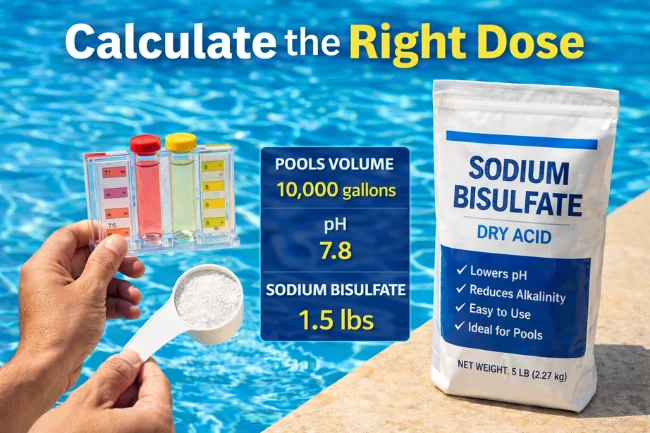
Most sodium bisulfate products come with a dosage chart on the label, and these are calculated based on:
- Your pool’s water volume (in gallons)
- How far your current pH is above the target
- Your current total alkalinity level
As a general rule of thumb, roughly 1.5 lbs of sodium bisulfate per 10,000 gallons of water will lower pH by approximately 0.2 units. However, this varies by brand concentration and your pool’s current alkalinity buffering capacity.
My rule: Start with 75% of the calculated dose, retest after 6 hours, and add more if needed. This is not excessive caution — it’s practical pool chemistry. Overshooting pH downward means you’ll need to add a pH increaser (sodium carbonate) to bring it back up, which wastes both time and money.
If your alkalinity is over 120 ppm, the alkalinity needs to come down first. To lower alkalinity specifically, the same sodium bisulfate is used, but you apply it differently — adding it in a concentrated stream to one area of the pool (rather than broadcasting it) targets the alkalinity more directly. This is a nuance that many beginner guides skip over entirely.
How to Add Sodium Bisulfate to Your Pool
Proper application makes a real difference in how evenly the chemical disperses. Here’s how I approach it:
Step 1: Timing Matters
Add sodium bisulfate in the early evening or on a cloudy day. Direct sunlight degrades pool chemicals faster, and you want the acid to have time to work before swimmers are back in the water.
Step 2: Run the Pump First
Make sure your circulation pump is running before you add anything. This ensures the chemical distributes evenly rather than settling in one spot and causing localized pH drops.
Step 3: Pre-Dissolve (Optional But Recommended)
For above-ground pools or pools with vinyl liners, I recommend pre-dissolving sodium bisulfate in a bucket of pool water before adding it. This prevents any undissolved granules from sitting on the liner surface, which can cause bleaching or damage over time.
Step 4: Add Near Return Jets
For in-ground pools with return jets, sprinkle the dry acid granules directly in front of the jets. The water flow immediately disperses the chemical throughout the pool. If your pool has no jets, walk the perimeter and broadcast the granules evenly along the water’s edge.
Step 5: Never Add to the Skimmer
A common mistake I see: adding sodium bisulfate (or any acid) directly into the skimmer basket. The concentrated chemical can damage your pump, filter, and plumbing if it passes through undiluted.
Step 6: Keep Swimmers Out for 6 Hours
After adding the chemical, wait at least 6 hours with the pump running before anyone swims. Retest pH before allowing use. If it’s still above 7.6, a second partial dose may be needed.
Handling and Storage Safety
Even though sodium bisulfate is significantly safer than muriatic acid, it’s still a strong acid and deserves respect.
- Always wear gloves and safety glasses when handling dry acid.
- Never mix sodium bisulfate with chlorine or any other pool chemicals — even in the bucket you use to pre-dissolve it. Mix with water only.
- Store in a cool, dry place, away from direct sunlight and moisture. Once the bag is opened, reseal it tightly. Sodium bisulfate is hygroscopic — it absorbs moisture from the air and can clump if left unsealed.
- Keep away from children and pets.
- In case of skin contact, flush immediately with large amounts of water. If ingested or if fumes cause significant eye irritation, contact Poison Control (1-800-222-1222 in the US).
Common Sodium Bisulfate Pool Mistakes to Avoid
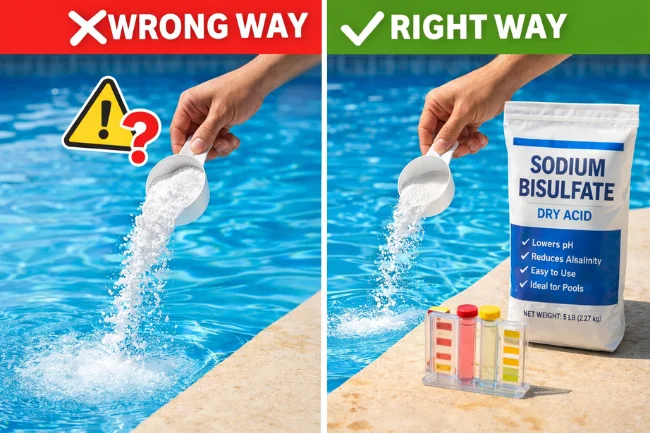
Over the years, I’ve seen pool owners make the same errors repeatedly. Here are the ones worth calling out:
- Adding the full dose at once. This is the most common mistake. pH can overshoot past 7.0, making the water corrosive and damaging your equipment. Always dose in increments.
- Not accounting for alkalinity. High alkalinity resists pH changes. If you’re adding dry acid and the pH isn’t moving, the culprit is almost certainly high total alkalinity. Address it first.
- Testing too soon. Some pool owners test 30 minutes after adding sodium bisulfate and panic when the pH hasn’t changed much. Give the chemical a full circulation cycle (minimum 4–6 hours) before drawing conclusions.
- Using it in cold water. Below 60°F (15°C), chemical reactions slow considerably. Your results will be less predictable. This mainly applies to those treating pools in early spring or late fall.
- Skipping the retest. pH can continue to drift after your initial correction, especially if you didn’t address alkalinity at the same time. Retest 24 hours later to confirm stability.
Sodium Bisulfate for Spas and Hot Tubs
Everything covered here applies to spas and hot tubs, too, but the scale is dramatically different. Most spas hold 300–500 gallons, so dosages are tiny — often just a tablespoon or two. The same 75% rule applies, and retesting is even more important because small volumes are more sensitive to chemical shifts.
Hot water also accelerates off-gassing, which is why spa pH tends to rise faster than pool pH. Weekly testing is recommended for active spa users.
When Sodium Bisulfate Alone Isn’t Enough
There are situations where dry acid isn’t the best primary tool:
- Very large drops needed quickly (e.g., pH above 8.5 in a commercial pool): Muriatic acid may be more practical due to the volume required.
- Persistently high alkalinity: Sometimes the root cause is your fill water. If your tap water consistently has very high alkalinity (above 200 ppm), you may need a pre-treatment filter or a water softener to prevent constant chemical corrections.
- Calcium hardness issues: If your water is also very hard (high calcium), you may need a sequestrant in addition to pH management.
Conclusion
Managing your pool’s pH doesn’t have to be complicated or hazardous. A sodium bisulfate pool treatment gives you precise, safe control over pH and alkalinity without the fumes, splash risk, or storage headaches that come with muriatic acid. Test regularly, dose conservatively, and always let the chemical circulate fully before retesting.
The real investment here isn’t money — it’s consistency. A pool that’s tested and adjusted weekly stays balanced with minimal effort. A pool that’s neglected for a month requires far more intervention and, often, more expense.
If you’re new to pool chemistry, start by picking up a quality liquid test kit and a bag of sodium bisulfate from your local pool supply store. Run a test today. You might be surprised how far off balance your water already is — and how simple it is to fix.
FAQs
1. How much sodium bisulfate do I need to lower my pool’s pH by 0.2?
As a general estimate, approximately 1.5 lbs per 10,000 gallons will lower pH by roughly 0.2 units, but always check the product label and start with 75% of the recommended dose.
2. Can I add sodium bisulfate directly to my pool without dissolving it first?
Yes, for in-ground pools with return jets, you can add granules directly to the water near the jets. For vinyl-lined or above-ground pools, pre-dissolving in a bucket of water first is safer to prevent liner contact.
3. How long after adding sodium bisulfate can we swim?
Wait at least 6 hours with the pump running, then retest pH before allowing swimmers back in. If pH is still above 7.6, an additional partial dose may be needed.
4. Is sodium bisulfate the same as baking soda?
No — they’re chemical opposites. Baking soda (sodium bicarbonate) raises alkalinity and pH, while sodium bisulfate lowers them. Never confuse the two.
5. Can sodium bisulfate damage pool equipment or surfaces?
When used correctly and at proper dosages, no. However, adding too much at once or letting undissolved granules sit on vinyl liners or plaster can cause localized damage. Always do it carefully and keep the pump running during treatment.

I’m Salman Khayam, the founder and editor of this blog, with 10 years of professional experience in Architecture, Interior Design, Home Improvement, and Real Estate. I provide expert advice and practical tips on a wide range of topics, including Solar Panel installation, Garage Solutions, Moving tips, as well as Cleaning and Pest Control, helping you create functional, stylish, and sustainable spaces that enhance your daily life.