
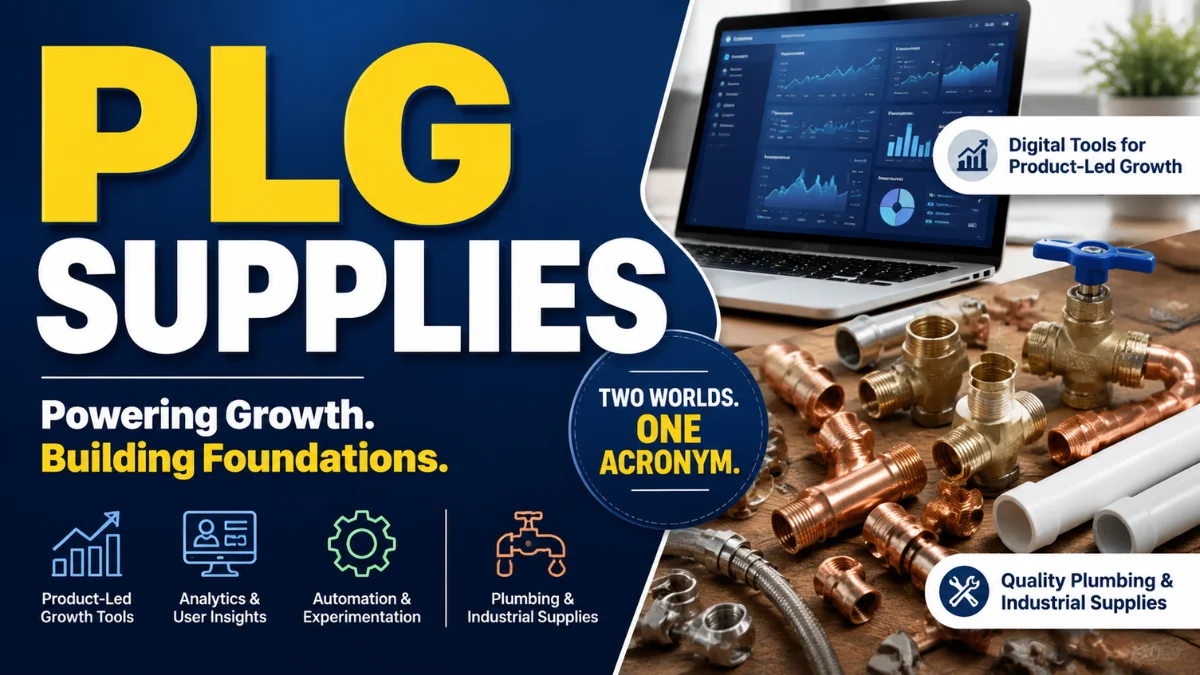
I remember sitting in a strategy meeting a few years back when a colleague from operations threw me a curveball. She said, “We need to audit our PLG supplies before the next quarter.” My mind, being deep in the world of SaaS and growth metrics, immediately jumped to analytics dashboards and user onboarding flows. I started talking about free-trial conversion rates. She looked at me like I had three heads. She was talking about pipes, valves, and copper fittings.
That awkward silence taught me a valuable lesson. The term PLG supplies is a classic case of industry jargon colliding. Depending on who you are talking to, it means two radically different things. In the tech and software world, PLG stands for Product-Led Growth. In the construction, plumbing, and industrial world, PLG stands for Plumbing.
Getting this wrong isn’t just embarrassing—it can derail a project. Ordering a shipment of user analytics software for a job site doesn’t fix a leaky pipe, and sending a box of gaskets to your product team won’t help your retention metrics.
In this post, I want to walk you through both definitions of PLG supplies. I will show you why context is king, how to tell which one you need, and why both interpretations are essential for keeping the modern world running smoothly.
What Exactly Are PLG Supplies? (The Big Picture)
Before I break down the two sides, let me define the umbrella term. PLG supplies are the resources, tools, or materials that a business relies on to either grow through its product experience (Tech) or maintain its physical infrastructure (Industrial).
Here is the critical distinction I have learned over the years. If you work in a digital environment, you likely think of software assets. If you work with your hands, you think of hardware materials. Neither group is wrong. They are just speaking different dialects of the same abbreviated language.
The confusion happens because the acronym “PLG” has become incredibly popular in the last five years, thanks to the rise of companies like Slack, Dropbox, and Calendly. Meanwhile, the plumbing industry has used “Plg” as shorthand on inventory sheets and supply orders for decades.
The Digital Definition: PLG as Product-Led Growth Supplies
Let me start with the definition that most of my colleagues in the tech industry are familiar with. When I hear PLG supplies in a boardroom or on a growth team Slack channel, I know we are talking about the toolkit required to execute a Product-Led Growth strategy.
In simple terms, Product-Led Growth is a business methodology where the product itself does the heavy lifting for customer acquisition, activation, and retention. You don’t need a pushy salesperson. You let the user try the product, fall in love with the value, and then upgrade.
The Core Components of Digital PLG Supplies
So, what specific items fall under this category? I have broken it down into four essential buckets that I consider non-negotiable for any serious SaaS operation.
1. User Analytics Platforms
You cannot improve what you do not measure. Digital PLG supplies always start with a robust analytics tool. I am talking about platforms like Mixpanel, Amplitude, or PostHog. These tools track every click, scroll, and feature interaction. They tell me where users get stuck and where they find that “aha” moment.
2. In-App Messaging & Onboarding Tools
Once you know what users are doing, you need to guide them. Tools like Appcues, Pendo, or Userpilot are essential PLG supplies for the modern SaaS company. They let you build walkthroughs, tooltips, and checklists directly inside your software. Instead of scheduling a demo call, a user gets a helpful pop-up that explains a complex feature right when they need it.
3. Self-Service Infrastructure
If a user has to talk to a salesperson to start a trial, you are not truly PLG. Self-service signup, payment processing (Stripe, Chargebee), and automated email sequences (Customer.io) are critical supplies here. They form the plumbing of the digital business—ironically, the analogy holds up well here.
4. Feature Flag & Experimentation Tools
Finally, I rely on tools like LaunchDarkly or Statsig. These allow me to roll out new features to only 10% of my user base first. If the feature breaks, only a few people see it. That is a core PLG supply because it protects the user experience while the team iterates.
Why SaaS Teams Rely on Product-Led Growth Resources
I have seen firsthand how a proper PLG toolkit changes a business. Traditional sales models are linear and expensive. You pay a sales rep, they find leads, they close deals. It works, but it does not scale cheaply.
When you have the right PLG supplies in place, you shift to a product-led motion. A user finds you via Google. They sign up for a free tier. They use your analytics dashboard (or whatever you sell) and see value. They invite their team. Then, when they hit a limit, they upgrade automatically via a credit card.
The supply chain here is not trucks and warehouses. It is API keys and database queries. But the goal is the same: efficiency. Without these digital supplies, a SaaS company would have to hire hundreds of salespeople to replicate the same growth. That is why understanding PLG supplies in the digital sense is a strategic advantage.
*Source: According to a 2023 report by OpenView, 61% of public SaaS companies had adopted a product-led growth model, up from 19% in 2018. (OpenView PLG Report)*
The Industrial Definition: PLG as Plumbing & General Supplies
Now, let me take off my tech hat and put on a hard hat. When my father, who runs a construction crew, talks about PLG supplies, he is not thinking about conversion funnels. He is thinking about the physical materials that keep water flowing and buildings standing.
In the industrial world, “Plg” is simply a shorthand for Plumbing and General supplies. This includes everything from a simple PVC elbow joint to complex pressure-reducing valves. If it involves moving liquid or gas through a pipe, it falls under this category.
The Physical Inventory of Industrial PLG Supplies
I have walked through enough supply warehouses to know that this side of the definition is vast. Here is what a typical order of industrial PLG supplies looks like:
-
Pipe and Tubing: Copper, PVC, PEX, galvanized steel, and cast iron.
-
Fittings and Valves: Elbows, tees, couplings, gate valves, ball valves, and check valves.
-
Fixtures and Hardware: Faucets, shower valves, flange gaskets, nuts, bolts, and hangers.
-
Tools and Safety Gear: Pipe wrenches, thread sealant (Teflon tape), cutters, torches, safety glasses, and gloves.
If a technician is repairing a commercial kitchen sink or installing a bathroom in a new high-rise, they cannot do the job without a steady supply of these items. Unlike software, these PLG supplies are physical. They rust. They break. They run out.
The Logistics of Keeping Industrial PLG Supplies in Stock
Managing industrial PLG supplies is a brutal logistics puzzle. I have seen project delays cost thousands of dollars a day simply because a specific 4-inch valve was on backorder.
The stakes are higher here than in software. If my analytics dashboard goes down for an hour, users get annoyed. If a plumbing system in a hospital fails because of a lack of replacement fittings, patients could be at risk. Reliable access to PLG supplies in the industrial sense is a matter of safety and operational continuity.
Contractors rely on a network of local distributors, big-box retailers (like Ferguson or Home Depot), and specialized manufacturers to keep their inventory flowing. They often use just-in-time delivery to avoid storing massive amounts of pipe on a cramped job site.
A Quick Comparison: Digital vs. Industrial PLG Supplies
To really cement the difference, I put together a comparison table. This helps me explain to new team members why we need to clarify which “PLG supplies” we are discussing in a given conversation.
| Feature | Digital PLG Supplies (Tech/SaaS) | Industrial PLG Supplies (Construction/Plumbing) |
|---|---|---|
| What “PLG” Stands For | Product-Led Growth | Plumbing & General |
| Core Items | Analytics dashboards, onboarding software, API keys | Pipes, valves, fittings, sealants, wrenches |
| Lifecycle | Infinite (digital copies) or subscription-based | Finite (consumable, rusts, breaks, gets used up) |
| Delivery Method | API integration, download link, cloud sync | Delivery truck, forklift, warehouse pickup |
| Main Challenge | User adoption, feature creep, data privacy | Supply chain delays, material costs, physical damage |
| Failure Consequence | Churned users, lost MRR (Monthly Recurring Revenue) | Flooding, property damage, safety hazards |
As you can see, they share almost nothing in common except the abbreviation. That is why I am so insistent on context when I hear the term PLG supplies in a professional setting.
How Context Determines the Meaning of PLG Supplies
I learned to stop assuming and start listening. If you hear the term PLG supplies in a conversation, you need to look for clues. I use a simple mental checklist to decode the meaning in under ten seconds.
Clue 1: The Vocabulary Used
If the speaker mentions words like funnel, activation, trial, retention, MRR, churn, A/B test, or API, they are talking about Product-Led Growth. These are software metrics. You do not ask a plumber about your “churn rate.”
If the speaker mentions words like PSI, pipe diameter, torque, soldering, flux, backflow, or gasket, they are talking about plumbing supplies. You do not ask a growth manager to check the PSI on a marketing campaign (well, mostly).
Clue 2: The Job Title of the Speaker
This is the easiest shortcut. If the person is a Product Manager, Growth Hacker, CTO, or SaaS Founder, they mean digital PLG supplies. If the person is a Site Supervisor, Master Plumber, Facilities Manager, or General Contractor, they mean physical plumbing supplies.
Clue 3: The Environment
If you are standing in an office with laptops and whiteboards, or you are on a Zoom call with a green screen background, assume digital. If you are standing on a concrete slab with rebar sticking out, or you smell PVC glue, assume industrial.
The Benefits of Getting Your PLG Supplies Right
I cannot overstate how much time and money you save by clarifying which PLG supplies you need before you place an order.
For the Digital Strategist
When you have the correct digital PLG supplies (like a proper onboarding tool and analytics suite), you achieve:
-
Lower Customer Acquisition Cost (CAC): Users convert without a sales call.
-
Higher Retention: In-app guides reduce frustration.
-
Faster Iteration: Feature flags let you test without crashing the whole product.
I have seen companies double their trial-to-paid conversion rates just by installing a simple tooltip sequence. That is the power of the right supply.
For the Industrial Contractor
When you have the correct physical PLG supplies on the truck:
-
Less Downtime: The crew is not standing around waiting for a part.
-
Code Compliance: Using the right valve or pipe ensures the inspection passes.
-
Safety: Proper fittings prevent catastrophic failures.
I once watched a job site lose two full days because they ran out of 3-inch copper couplings. Two days of payroll for four guys, wasted. That mistake cost over $3,000. All because someone misread the “PLG supplies” inventory sheet.
The Challenges Unique to Each Interpretation
No supply chain is perfect. I have faced headaches on both sides of this definition.
Digital Challenges (The SaaS Headache)
The problem with digital PLG supplies is integration sprawl. I have seen startups using six different tools that all do the same thing. They end up with data silos and a monthly bill that rivals a mortgage payment. Another challenge is the learning curve. Just because you buy a $50,000 analytics platform does not mean your team knows how to interpret the data.
Citation: Gartner found that the average enterprise uses over 1,000 different applications, leading to significant integration complexity. (Gartner, 2024)
Industrial Challenges (The Physical Headache)
The industrial side deals with raw material costs. Copper and steel prices fluctuate wildly based on global markets. A shipment of PLG supplies that cost 5,000lastmonthmightcost7,500 this month. Then there is the issue of physical damage. A forklift running into a pallet of PVC pipes can ruin an entire week’s worth of inventory.
The Future of PLG Supplies in Both Worlds
I find it fascinating to look ahead. Will the term PLG supplies ever resolve into one single meaning? I doubt it. But both fields are evolving.
In the tech world, generative AI is becoming a core PLG supply. Imagine AI co-pilots that onboard users instantly, answering questions before the user even asks. The toolkit for product-led growth is getting smarter, not just bigger.
In the industrial world, smart plumbing supplies are emerging. I am talking about leak-detecting valves and IoT-connected pressure sensors. These physical PLG supplies are starting to generate digital data. They are crossing over into the tech realm. A pipe that texts you when it is about to burst is technically a plumbing supply, but it feels very product-led.
The convergence is subtle. A construction manager might soon use a dashboard (digital PLG) to track his pipe inventory (industrial PLG). When that happens, the dual meaning of PLG supplies will become a feature, not a bug.
Frequently Asked Questions
1. What does PLG stand for in PLG supplies?
In the tech and SaaS industry, PLG stands for Product-Led Growth. In the construction and plumbing industry, PLG stands for Plumbing and General Supplies.
2. Can a single business need both types of PLG supplies?
Yes, absolutely. A modern smart-home device company needs digital PLG tools to sell their software subscription and physical PLG supplies to manufacture the hardware.
3. How do I avoid ordering the wrong PLG supplies?
Always check the context of the conversation. Look for keywords like “analytics” (digital) or “valves” (industrial), and confirm the job title of the person requesting the supplies.
4. Are there any universal PLG supply vendors that serve both markets?
Rarely. Digital supplies come from SaaS companies like Salesforce or HubSpot. Industrial supplies come from distributors like Grainger or Ferguson. They rarely overlap.
5. Is Product-Led Growth still relevant in 2026?
Yes, more than ever. As software budgets tighten, businesses demand to see value before paying. Having the right digital PLG supplies is critical for surviving economic downturns.
Final Thoughts and Your Next Move
Language is messy. Acronyms are convenient until they are not. I have seen brilliant professionals get tripped up by the dual meaning of PLG supplies, and I have done it myself more times than I care to admit. The key is to stop assuming everyone speaks your industry’s dialect.
If you are a tech founder, take a hard look at your current toolkit. Are your PLG supplies up to date? Do you have the right analytics and onboarding tools to support a product-led motion? If not, start auditing your stack today.
If you are a contractor or facilities manager, take a hard look at your inventory room. Are your PLG supplies organized? Do you have a reliable vendor for emergency valves and fittings? A little organization today prevents a flood tomorrow.
Take a moment right now to clarify which definition matters to your work. Send an email to your team defining the term. Write it down in your internal wiki. A simple clarification will save you hours of confusion and thousands of dollars in mistaken orders. That is a return on investment anyone can appreciate.

I’m Salman Khayam, the founder and editor of this blog, with 10 years of professional experience in Architecture, Interior Design, Home Improvement, and Real Estate. I provide expert advice and practical tips on a wide range of topics, including Solar Panel installation, Garage Solutions, Moving tips, as well as Cleaning and Pest Control, helping you create functional, stylish, and sustainable spaces that enhance your daily life.