I have spent a good chunk of my career watching businesses drown in data while starving for insight. EO Pis changed how I think about that problem. You know the scene. The marketing team has their dashboard glowing with click-through rates, sales is pumping fistfuls of CRM stats, operations is buried in supply chain spreadsheets, and finance is off in a corner with their own sacred numbers.
Everyone is measuring something, but no one is measuring the right thing together. That is exactly why EO Pis—the Enterprise Operations Performance Information System—has become my go-to framework for fixing broken executive visibility.
That frustration is exactly why I want to talk about EO Pis today. A few years ago, this term was mostly whispered in strategy consulting rooms. But heading into 2026, I see EO Pis popping up in board meetings, operational reviews, and even job descriptions for chief operating officers. The reason is simple: traditional reporting just broke under the weight of modern complexity.
When I first encountered the idea behind EO Pis, which stands for Enterprise Operations Performance Information System, I realized it was not just another piece of software or a prettier dashboard. It is a completely different way of thinking about how executives interact with their own company’s reality. Instead of looking at lagging indicators and fragmented reports, EO Pis offers a unified, real-time intelligence layer that sits above all the noise.
I am writing this post because I believe every leader deserves clarity. Not more data. Clarity. And that is exactly what EO Pis delivers when you understand how to use it.
What EO Pis Actually Means (Beyond the Acronym)
Let me clear up the definition right away because I have seen some confusion out there. EO Pis is not a single product you can buy off a shelf. It is a strategic executive-level framework. The full expansion is Enterprise Operations Performance Information System, but that mouthful tends to scare people off. So I will stick with EO Pis for the rest of this post.
The core idea is deceptively simple. Most organizations track performance in silos. Your manufacturing plant might measure units per hour. Your customer service team measures resolution time. Your finance team measures cost per transaction. Each of these is a perfectly valid metric on its own. But none of them tell you how the business is actually performing as a whole.
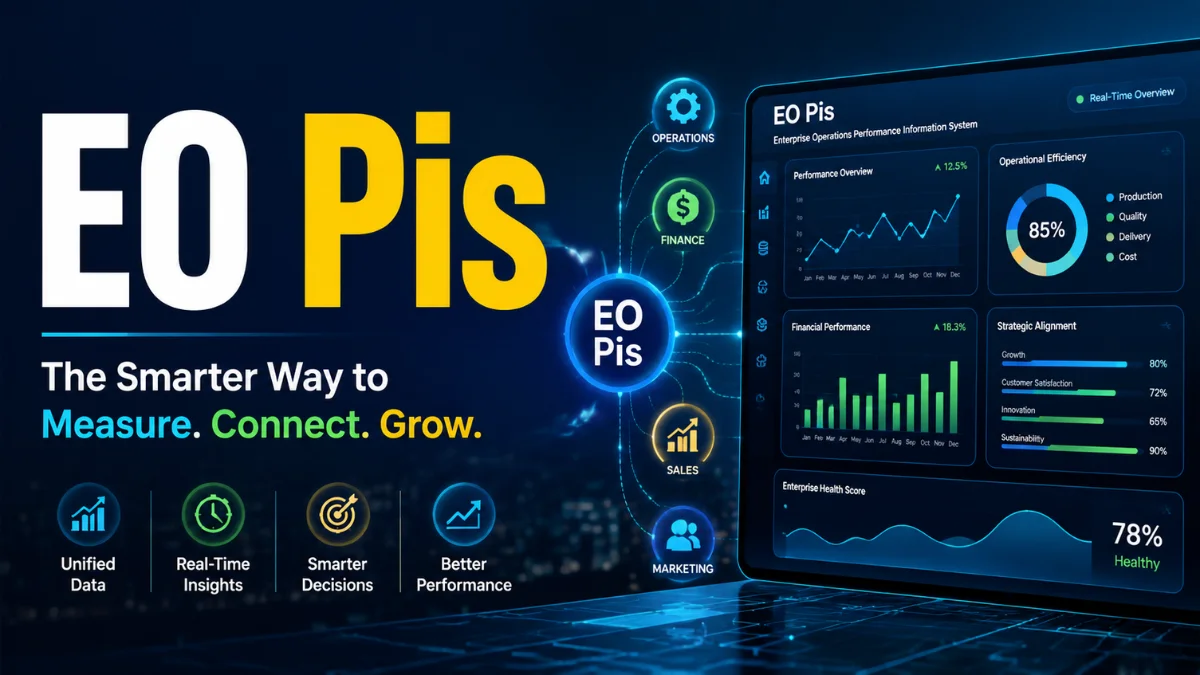
EO Pis solves that by consolidating operational, financial, marketing, and sales data into a single cohesive layer. I like to think of it as the central nervous system for executive decision-making. It does not replace your existing systems, like your ERP or CRM. Instead, it sits on top of them, pulling in the signals that matter and filtering out the noise.
The first time I saw a real EO Pis implementation in action, I was stunned by how quiet the executive dashboard was. No blinking red lights everywhere. No endless rows of micro-metrics. Just a handful of interconnected indicators that showed exactly where the business was aligned and where it was drifting apart. That quiet confidence is the whole point.
Why Traditional KPIs Are Not Enough Anymore
I need to be honest about something that might ruffle some feathers. Key performance indicators have become a bit of a crutch. Do not get me wrong. I love a good KPI as much as the next operations nerd. But the way most companies use KPIs is fundamentally backward. They pick a bunch of department-level numbers, throw them on a spreadsheet, and call it performance management.
Here is the problem. KPIs measure individual outcomes in isolation. Your sales team might be crushing their quota while your operations team is bleeding money fulfilling those rushed orders. Under a traditional system, both groups might even get bonuses because each hit their separate targets. But the enterprise as a whole lost money on every single sale.
EO Pis differs from traditional KPIs because it refuses to let those silos stand. Instead of celebrating department-level wins, EO Pis connects every metric to the long-term corporate strategy. It asks one simple question before tracking anything: does this measurement help us execute our strategic goals? If the answer is no, that metric does not belong in the executive view.
I have seen companies cut their executive reporting by over seventy percent after adopting EO Pis principles. They were drowning in vanity metrics that felt productive but actually obscured the real health of the business. When you strip away everything that does not serve the strategy, what remains is surprisingly simple. And that simplicity is what gives executives the mental space to think strategically instead of firefighting.
Moving from Retrospective to Predictive Intelligence
The shift that excites me most about EO Pis is the move away from retrospective analysis. Most traditional reporting is like driving a car by staring at the rearview mirror. You get a beautiful, detailed history of everything you’ve already passed. But by the time you see the pothole, you have already hit it.
EO Pis flips that model on its head. Because it consolidates data in real time from across the enterprise, it enables what I call forward-looking intelligence. You are not just asking what happened last quarter. You are asking what is happening right now and what is likely to happen next if current trends continue.
I worked with a mid-sized manufacturing client last year that had been using standard KPIs for a decade. Their monthly executive reviews were painful. Two hours of explaining why numbers were red or green, followed by another hour of assigning blame. When we introduced an EO Pis framework, the whole dynamic changed. Suddenly, they could see how a delay in raw materials from one supplier would impact marketing campaigns scheduled for next month. They could simulate different responses before the problem ever hit customers.
That is predictive intelligence in action. Not crystal ball nonsense. Just better data integration that reveals cause and effect across functions. EO Pis gives you the ability to see around corners, not because it is magic, but because it connects dots that were previously invisible.
The Executive Dashboard That Actually Gets Used
I have consulted for dozens of companies that spent millions on executive dashboards that nobody used after the first month. The pattern is always the same. Some software vendors sell a beautiful, colorful interface. The C-suite oohs and aahs at the demo. Then reality hits. The data is wrong. The refresh takes too long. The metrics do not mean anything strategic. Within ninety days, everyone is back to asking their assistants for manual reports.
EO Pis avoids this trap because it is not primarily a technology problem. It is a framework problem first. Before you ever connect a data source, you have to define what enterprise performance actually means for your specific organization. That strategic work is what makes the dashboard valuable.
When EO Pis functions as a master strategic dashboard for the C-suite, it has three characteristics that set it apart. First, it provides a high-level view of enterprise health without getting lost in granular details. Second, it allows drilling down into underlying data when an executive spots an anomaly. Third, it updates in real time or near real time, not monthly.
I remember a CEO telling me that his old dashboard felt like reading last week’s newspaper. His new EO Pis dashboard felt like flying a plane with live instruments. That metaphor stuck with me because it captures the urgency of modern business. Markets move too fast for monthly reports. If you cannot see operational bottlenecks, revenue trends, and workforce productivity as they happen, you are flying blind.
How Metric Consolidation Creates Enterprise Intelligence
Let me get practical about how EO Pis actually works under the hood. The magic is in the metric consolidation. Most companies have what I call reporting chaos. Marketing tracks cost per lead and conversion rates. Sales tracks pipeline velocity and win rates. Operations tracks throughput and defect rates. Finance tracks gross margin and operating expenses.
Each of these teams is doing good work. But their metrics are not designed to talk to each other. EO Pis breaks down these silos by aggregating cross-functional data into a single enterprise intelligence system. That sounds technical, but the outcome is simple. You can finally see how decisions in one part of the business ripple through the rest.
I will give you a concrete example. A retail client of mine could never figure out why their customer retention was sliding. Their marketing team was spending more on acquisition. Their sales team was closing deals faster. Their operations team was shipping on time. By every traditional measure, things looked fine. But when we built an EO Pis view, the problem jumped out immediately. The faster sales closings were pushing orders into a shipping cycle that required expedited freight, which ate into margin so badly that the company had to cut product quality. Customers noticed the quality drop and left.
Under standard KPIs, each department would have celebrated their individual numbers. Under EO Pis, the executive team saw the hidden dependency and changed the sales incentive structure within a week. That is enterprise intelligence. Not more data. Better connections.
Organizational Alignment from the Boardroom to the Frontline
The phrase organizational alignment gets thrown around so much that it has almost lost meaning. But I want to reclaim it because EO Pis makes alignment concrete instead of abstract. In most companies, strategic goals are well-defined at the executive level. The board approves a three-year plan. The CEO gives a rousing speech about priorities. Then everyone goes back to their daily work, and somehow the strategy evaporates.
Why does that happen? Because there is no connective tissue between the strategy and daily execution. A warehouse worker cannot see how their putaway speed connects to a corporate objective about customer satisfaction. A marketing coordinator cannot feel how their ad copy influences a five-year growth target.
EO Pis bridges this gap by ensuring that every metric tracked in the system is directly tied to corporate objectives. When you build the framework correctly, an employee at any level can trace their daily activities up through their department metrics to the enterprise goals. That transparency is incredibly motivating. I have seen frontline teams change their behavior without being ordered to, simply because they finally understood why their work mattered.
One healthcare client used EO Pis to align their nursing staff with patient outcome goals. Sounds obvious, right? But before EO Pis, the nurses were measured on task completion. How many beds were cleaned? How many forms were filled out? After the framework, they were measured on factors that actually connected to patient recovery and hospital readmission rates. The nurses did not need extra training. They just needed the right visibility into what the organization truly valued.
Industry Applications That Might Surprise You
A question I get asked constantly is whether EO Pis only works for massive tech companies or manufacturing giants. The answer is no. I have seen EO Pis adapted successfully across industries that could not be more different. In fact, the framework is so flexible that I would argue any organization with more than one department and a strategic plan can benefit.
In technology companies, EO Pis typically supports product performance tracking and innovation velocity. An executive can see how engineering resources, customer support tickets, and sales cycles interact. If a product update creates more support calls, that impacts sales capacity. That connection is invisible without integration.
In manufacturing, EO Pis enhances supply chain visibility and production efficiency. I worked with an auto parts supplier that used the framework to balance inventory levels against order fulfillment speed. They discovered that holding slightly more safety stock on certain components actually reduced total system cost because it prevented expensive expedited shipping on the backend. That insight came directly from consolidated data.
In healthcare, the stakes are even higher. Executives need to balance patient outcomes with operational sustainability. A hospital system I advised used EO Pis to connect nurse scheduling, patient readmission rates, and insurance reimbursement cycles. They found that investing in better discharge planning reduced readmissions enough to pay for itself within four months. Before EO Pis, nobody had ever looked at those three data sets together.
Financial services, retail, logistics, hospitality. The pattern holds everywhere. EO Pis adapts to your organizational structure and strategic goals. You are not forced into a vendor’s predefined categories. You define what performance means for your unique context, and the framework flexes around that definition.
The Structural Components You Need to Know
If you are thinking about implementing EO Pis in your own organization, you probably want to know what the actual system looks like. I will walk you through the structural components, so you have a realistic picture. Do not expect to buy an off-the-shelf product labeled EO Pis. That does not exist. Instead, you will assemble existing systems into a strategic layer.
First, EO Pis systems typically integrate data from several source systems. Enterprise resource planning platforms provide financial and operational data. Customer relationship management tools contribute to sales and marketing interactions. Human capital systems feed workforce metrics. External market data sources add competitive context. The integration layer is often the hardest part, but it is also where most of the value lives.
Second, modern EO Pis implementations increasingly include artificial intelligence and machine learning. I have seen predictive models that forecast cash flow issues two months in advance by correlating sales pipeline changes with supplier payment terms. I have seen anomaly detection algorithms that flag operational deviations before they become quality escapes. The AI is not the point. The intelligence it enables is the point.
Third, and most importantly, structurally, EO Pis operates as a strategic layer rather than a replacement. You do not rip out your transaction systems. You do not force everyone onto one platform. You simply add an aggregation and interpretation layer on top. This layered approach ensures scalability. As your business grows or changes, the framework adapts without requiring a multi-year technology migration.
I have seen too many performance management initiatives fail because leaders thought they needed to buy a single system to rule them all. That is a trap. EO Pis succeeds when it respects the systems you already have while adding executive-level synthesis on top.
Governance and Compliance with ISPE Frameworks
In regulated industries, the conversation around EO Pis often involves ISPE frameworks as well. For those who do not know, ISPE refers to the International Society for Pharmaceutical Engineering, but their framework principles apply more broadly to standardized performance evaluation and governance.
When I work with clients in pharmaceuticals, medical devices, or aerospace, they frequently ask about EO Pis ISPE combinations. The value here is that EO Pis provides operational intelligence while ISPE frameworks provide governance and compliance structure. Together, they ensure that your performance measurement meets both strategic and regulatory requirements.
For example, a medical device company needs to track manufacturing quality metrics for FDA compliance. But they also need to understand how those quality metrics influence market share and customer satisfaction. EO Pis ISPE integration gives them a single view that satisfies regulators while also serving executive decision-making. That is not a small benefit. It can save months of manual reporting and reduce compliance risk significantly.
The governance principles embedded in these frameworks also enhance trust and transparency. When your EO Pis system includes audit trails, data lineage, and role-based access controls, your board and your regulators can have confidence in what they are seeing. I have sat through enough compliance audits to know that defensible data is worth its weight in gold.
Clarifying Alternative Meanings and Related Concepts
Before I move on, I want to address some potential confusion because I have seen people get tripped up by search results. In Brazil, PIS refers to the Social Integration Program, a government benefit funded through payroll taxes. That meaning has absolutely nothing to do with enterprise operations or performance management. If you are searching in Portuguese, you will find very different content.
In academic and research settings, EO sometimes means Executive Orders, and PI often means Principal Investigator. A principal investigator running a research lab might talk about EO Pis in a completely different context. Again, unrelated to the enterprise performance framework I have been describing.
I mention these alternative meanings for one reason. If you are researching EO Pis online and stumble across government benefit programs or academic research administration, do not get confused. The enterprise operations framework is distinct. It is focused exclusively on executive-level performance intelligence across operational, financial, marketing, and sales functions.
Why 2026 Demands a Different Approach
I have been dropping the year 2026 throughout this post for a reason. The timing is not arbitrary. The business environment heading into 2026 is fundamentally different from what we saw even three or four years ago. Complexity has accelerated. Digital transformation is no longer optional. Market volatility has become the baseline rather than the exception.
In this environment, executives need more than static reports. I can say that with confidence because I talk to leaders every week who are exhausted by the old way of working. They spend seventy percent of their time just trying to figure out what is happening in their own company. That leaves only thirty percent for actually leading.
EO Pis matters in 2026 because it enables faster response times. When a supply chain disruption hits, you cannot wait for the month-end close to understand the impact. You need to know today which customers will be affected and what alternatives exist. EO Pis provides that visibility.
It also enables more accurate forecasting. Traditional forecasting looks at historical trends and assumes the future looks similar. That assumption is dangerous in a volatile world. By consolidating real-time data across functions, EO Pis supports scenario modeling and continuous reforecasting. You are not locked into an annual plan that becomes fiction by February.
Most importantly, EO Pis enables stronger alignment between strategy and execution. When I ask executive teams to write down their top three strategic priorities, I rarely get consensus. Even when the words match, the interpretation differs wildly. EO Pis forces clarity because every metric must trace back to a stated objective. That discipline alone transforms how organizations operate.
The Future of Performance Intelligence
I do not claim to have a crystal ball, but I have watched enough trends to see where performance intelligence is heading. The vendors will eventually catch up to the framework. In the next few years, I expect to see more software platforms explicitly marketing EO Pis capabilities. That will be helpful for buyers, but I also worry it will create confusion between the framework and the tools.
My advice is to remember that EO Pis is not a product. It is a way of thinking. The tools you use to implement it will change over time. The cloud platforms will get better. The AI will get smarter. The data integrations will get faster. But the fundamental discipline of consolidating cross-functional data into a strategic executive layer will remain valuable regardless of technology trends.
I also expect to see more mid-sized companies adopting EO Pis principles. Historically, only large enterprises had the resources for this level of integration. But cloud-based integration tools and affordable data warehouses have lowered the barriers dramatically. A company with fifty million in revenue can now build an EO Pis framework that would have cost millions just a decade ago.
If you are a leader at a growing company, do not assume this is out of reach. Start small. Connect your financial system and your operational system. Add marketing and sales data once that works. Build incrementally. The full EO Pis vision is a destination, but you can start capturing value on day one.
FAQs
1. What is EO Pis in simple terms?
EO Pis is an executive-level framework that pulls together operational, financial, marketing, and sales data into one real-time view so leaders can make better decisions faster.
2. How is EO Pis different from traditional KPIs?
KPIs measure isolated department outcomes, while EO Pis connects those outcomes into a unified view aligned with your long-term corporate strategy.
3. Does EO Pis require replacing my existing business systems?
No, EO Pis works alongside your current ERP, CRM, and other systems by aggregating and interpreting data without replacing anything.
4. Can a mid-sized company use EO Pis, or is it only for large enterprises?
Mid-sized companies can absolutely use EO Pis principles, especially now that cloud tools have made cross-functional data integration affordable and scalable.
5. What kind of results can I expect from implementing EO Pis?
Expect faster response times, better forecast accuracy, and stronger alignment between daily execution and strategic goals across your entire organization.
Putting EO Pis to Work in Your Organization
I have walked you through the definition, the differences from KPIs, the predictive capabilities, the structural components, and the industry applications. Now I want to leave you with something practical. If you are intrigued by EO Pis and want to bring it into your organization, do not start with software. Start with strategy.
Gather your executive team and answer three questions on a whiteboard. First, what are our top three strategic priorities for the next twelve months? Second, what would we need to measure to know we are making progress on those priorities? Third, which of those measurements can we already access, and which require new data integration?
Those three questions will reveal eighty percent of what you need to know about your EO Pis readiness. You might discover that you already have the data, but never consolidated it. You might discover that you are measuring the wrong things entirely. Either discovery is valuable because it points toward action.
I have seen too many performance initiatives die because leaders overcomplicated the first step. Do not fall into that trap. Pick one cross-functional connection that is currently invisible to your executive team. Build a small EO Pis view that reveals that connection. Show the value. Then expand.
The companies that thrive in 2026 and beyond will not be the ones with the most data. They will be the ones with the clearest view of how their entire operation works together. EO Pis gives you that view. The only question is whether you will start building it today or wait until your competitors force your hand. I know which choice I recommend.
You May Also Read: Attrities Explained: Joint & Workforce Insights

Julian Vane is a versatile writer at Wellbeing Makeover covering tech, health, and global culture. With years of experience across various industries, Julian brings a well-rounded perspective to lifestyle and business, helping readers stay informed and inspired in an ever-changing world.